CGI said on 21 October 2026 that the Ministry of Defence’s National Armaments Director Group has selected it to provide client-side support for PICASSO, the UK’s national geospatial intelligence programme. The contract was won in competition under the MOD’s Digital and IT Professional Services (DIPS) framework.
The announcement left out three things investors usually look for first: the contract’s value, its term and its start date.
CGI has supported PICASSO since 2011, so this is a continuation rather than a new client. The real question is what a renewal of an existing role is worth, and how secure that role is from one procurement to the next.
This piece separates what the award confirms from what it leaves open, and shows which signals matter more for CGI’s UK defence business.
What CGI actually won, and what the announcement leaves out
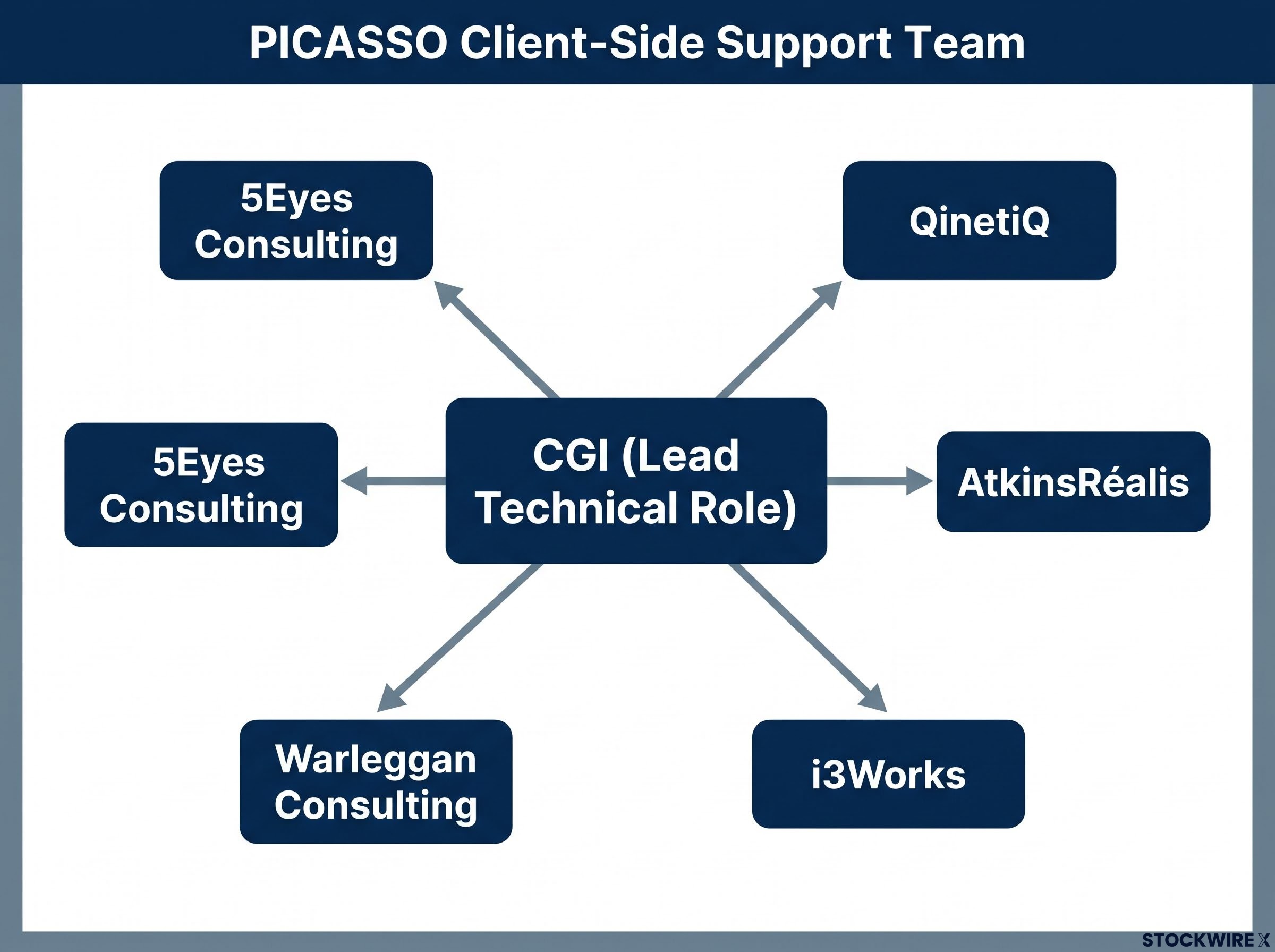
The contracting entity is CGI IT UK Ltd. Its continuing role is to lead on the technical side for the MOD and supply specialist project expertise at a number of locations. Client-side support means working for the MOD as its expert adviser and overseer, rather than building the systems directly. The work uses a flexible delivery model that lets the MOD draw on specialist skills as its needs change.
PICASSO builds and maintains the UK’s national geospatial intelligence (GEOINT) capability. GEOINT is intelligence drawn from imagery and mapping data about physical locations. The programme supports the National Centre for Geospatial Intelligence and serves national, tactical, NATO and Five Eyes users.
According to CGI, the aims include keeping GEOINT, imagery, meteorological and operational services running without interruption. The company also cites support in data, cyber security, AI, architecture, Agile delivery and service management.
Then the numbers stop. Without a value, investors have only earlier call-offs to gauge scale. A call-off is an individual contract awarded under a wider framework agreement.
| Call-off (indicative only, not this award) | Value | Period |
|---|---|---|
| 2025 call-off | £742,331.40 | 1 May-30 June 2025 |
| Contracts Finder PS618 | £3,706,904.21 | 2 months from 1 December 2025 |
| Early 2026 call-off | £2,388,667.19 | From 1 February 2026 |
| Awarded 26 August 2026, published 25 September 2026 | £3,461,183.64 | 7 months to 31 March 2027 |
Recent call-offs covered assured GEOINT production, exploitation and dissemination across about 70 systems and services. Sources differ on which call-off is the latest, but the September 2026 award is the more recent.
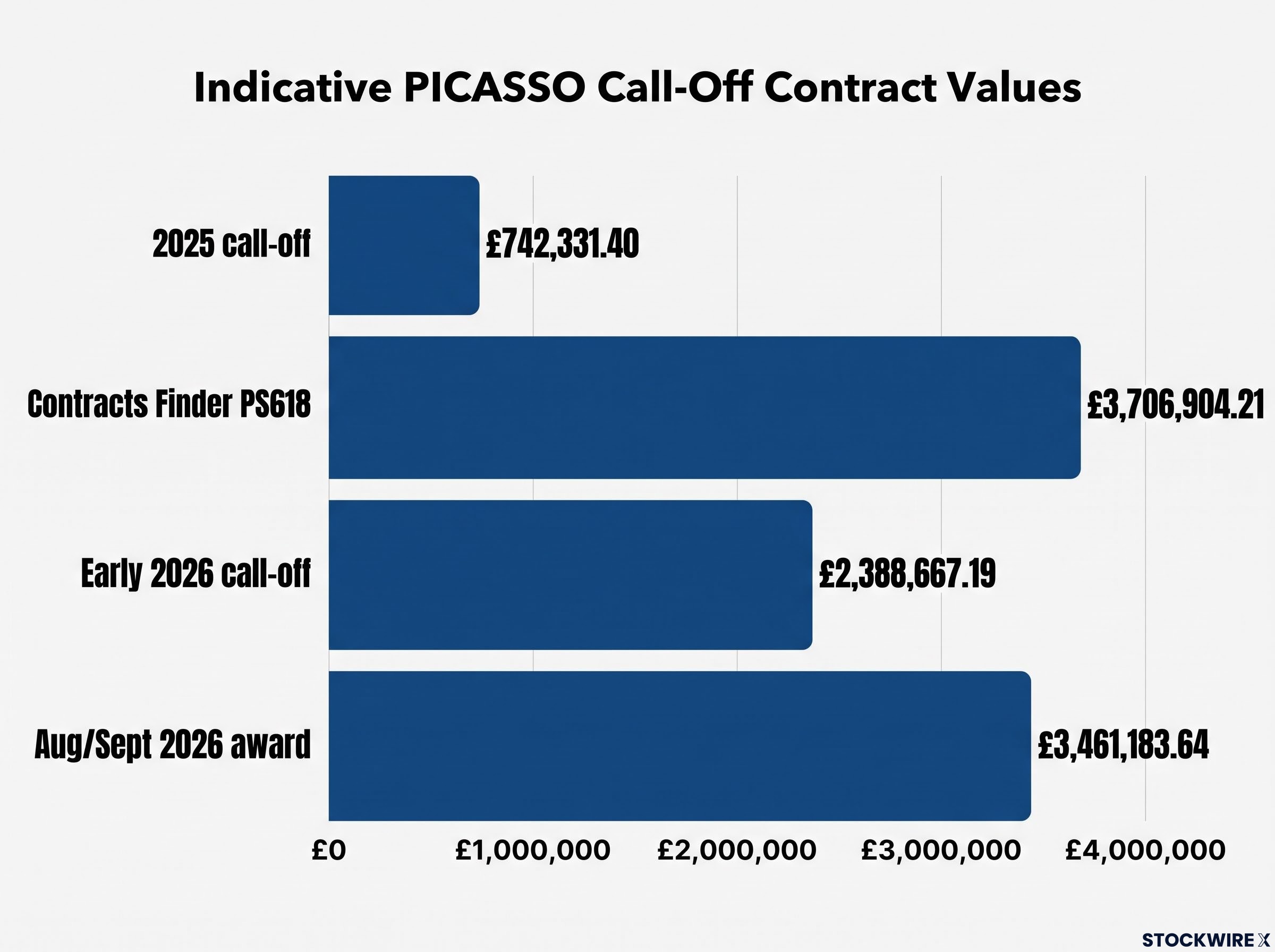
The pattern is the point. This work has been bought in slices of months, not years, so you should not annualise any single figure into a revenue run rate.
Who is on the team
CGI is delivering with five partners:
- QinetiQ
- AtkinsRéalis
- i3Works
- Warleggan Consulting
- 5Eyes Consulting
Together they cover enterprise architecture, cyber security, systems engineering, Agile delivery and service management. The consortium spreads specialist capacity, but no revenue split between the partners has been disclosed.
Does incumbency since 2011 guarantee the revenue?
Fifteen years in the seat sounds like safe revenue. The framework rules say otherwise.
DIPS is a multi-supplier framework split into six lots. The original notice estimated its value at about £1.2bn excluding VAT over four years, roughly £300m a year. It anticipated 3-7 suppliers per lot, but the award notice records 17 suppliers overall. CGI was appointed to Lot 2 and Lot 6, the intelligence-solutions lot, on 12 December 2023.
Framework dates vary across notices. One listing gives the operational period as 17 November 2023-16 November 2027.
A framework place works roughly like this:
- A supplier wins a place on a lot.
- The MOD defines a specific requirement, such as PICASSO client-side support.
- Eligible suppliers bid in a mini-competition, which is the default where several suppliers hold the lot.
- The winner receives a separately valued call-off.
The framework warning The National Audit Office (NAO) has cautioned that suppliers can secure places on frameworks yet go on to receive little or no work.
The Public Accounts Committee has also warned that weak guidance can erode the competitive benefits of frameworks. No named rival for this call-off could be verified.
For you as an investor, a framework place is pipeline visibility, not contracted revenue. The short PICASSO call-offs show continuity is bought one procurement at a time.
Where incumbency helps, and where it exposes CGI
The advantages are real. Programme knowledge, security familiarity and trusted personnel lower transition risk and improve mobilisation economics, meaning the cost of starting work.
The exposures are real too. The Competition and Markets Authority’s (CMA) 2026 commentary urges defence buyers to preserve rivalry and avoid dependence on a single preferred supplier. Government guidance also requires a conflict assessment for each call-off, which matters when a client-side adviser later competes for delivery work. Secrecy makes value for money hard to judge from outside.
What Borealis, Nostromo and MOD budgets add to CGI’s defence picture
Step back from one support contract and CGI’s MOD footprint looks larger. Borealis is the stronger revenue event. CGI is prime contractor on this sovereign space-domain-awareness capability, which reached Initial Operating Capability in May 2026, six months ahead of schedule.
Find a Tender gave an estimated range of £42m-£70m in December 2023. Reporting in March 2025 put the awarded deal at about £65m over five years, the better current figure. Nostromo is harder to assess: no authoritative public source confirms its value, scope or CGI’s role.
Demand looks supportive. The 2025 Strategic Defence Review called for shifting at least 10% a year to next-generation digital platforms. The 2026 Defence Investment Plan briefing included:
- £2.5bn for the Defence Cyber and Electromagnetic Force
- £3.2bn for new space capabilities
- £100m for a Rapid AI Delivery Taskforce
PICASSO’s separate SM4P service-management contract was advertised at an estimated £120m, far larger than any client-side call-off.
Market reaction No authoritative, directly attributable share-price reaction to these awards was found.
What the group numbers say
CGI’s latest reported quarter, fiscal Q3 2026, showed (sources conflict on the release timing):
- Revenue of about C$4.2bn, up 2.5%
- Bookings of C$4.2bn
- Book-to-bill of 100.1% (108.1% trailing twelve months)
- Backlog of C$31.79bn, about 1.9 times annual revenue
No defence or UK revenue share was found. Against that backlog, a client-side support call-off is unlikely to move group numbers. Judge CGI’s defence thesis on Borealis-scale prime contracts and larger PICASSO service opportunities instead.
What to watch after the PICASSO award, and what it does not settle
The award keeps CGI inside a mission-critical GEOINT programme and strengthens its MOD credentials. Public evidence, though, does not quantify any multi-year revenue. Three markers will tell you more:
- Any disclosure of the contract’s value and term
- The outcome of the separate £120m PICASSO service-management procurement
- CGI’s next quarterly or full-year commentary on defence and government bookings
Until values appear, treat framework wins as pipeline and hold off adjusting expectations.
This article is for informational purposes only and should not be considered financial advice. Investors should conduct their own research and consult with financial professionals before making investment decisions. Past performance does not guarantee future results. Financial projections are subject to market conditions and various risk factors.
—