Brent crude has lost roughly $10 a barrel in a single week, and the reason has nothing to do with a sudden increase in supply. It fell because the prospect of that supply being deliberately cut off became a good deal less credible.
On 22 September 2026, US Special Envoy Steve Witkoff and Iranian Foreign Minister Abbas Araghchi met for around three hours in New York, on the sidelines of the UN General Assembly. Iran told the US it could reopen the Strait of Hormuz within seven days, provided Washington lifts its naval blockade, unfreezes Iranian assets, and ends hostilities across what Tehran calls its “resistance” fronts.
Traders had spent weeks pricing threats. What they heard on 22 September was a specific conditional offer, and prices moved accordingly.
This piece covers what the talks actually produced, why the Hormuz strait makes a conditional Iranian offer worth pricing in immediately, and what the remaining risks mean for anyone tracking crude, energy equities, or broader commodity exposure. By the time you finish, you will know what has changed, what has not, and which variables to watch next.
Brent sheds $10 a barrel in a week as traders reprice Hormuz risk
The decline did not arrive in one dramatic session. It came as a series of small daily markdowns, each one shaving a little more off the war-risk premium as the diplomatic picture improved.
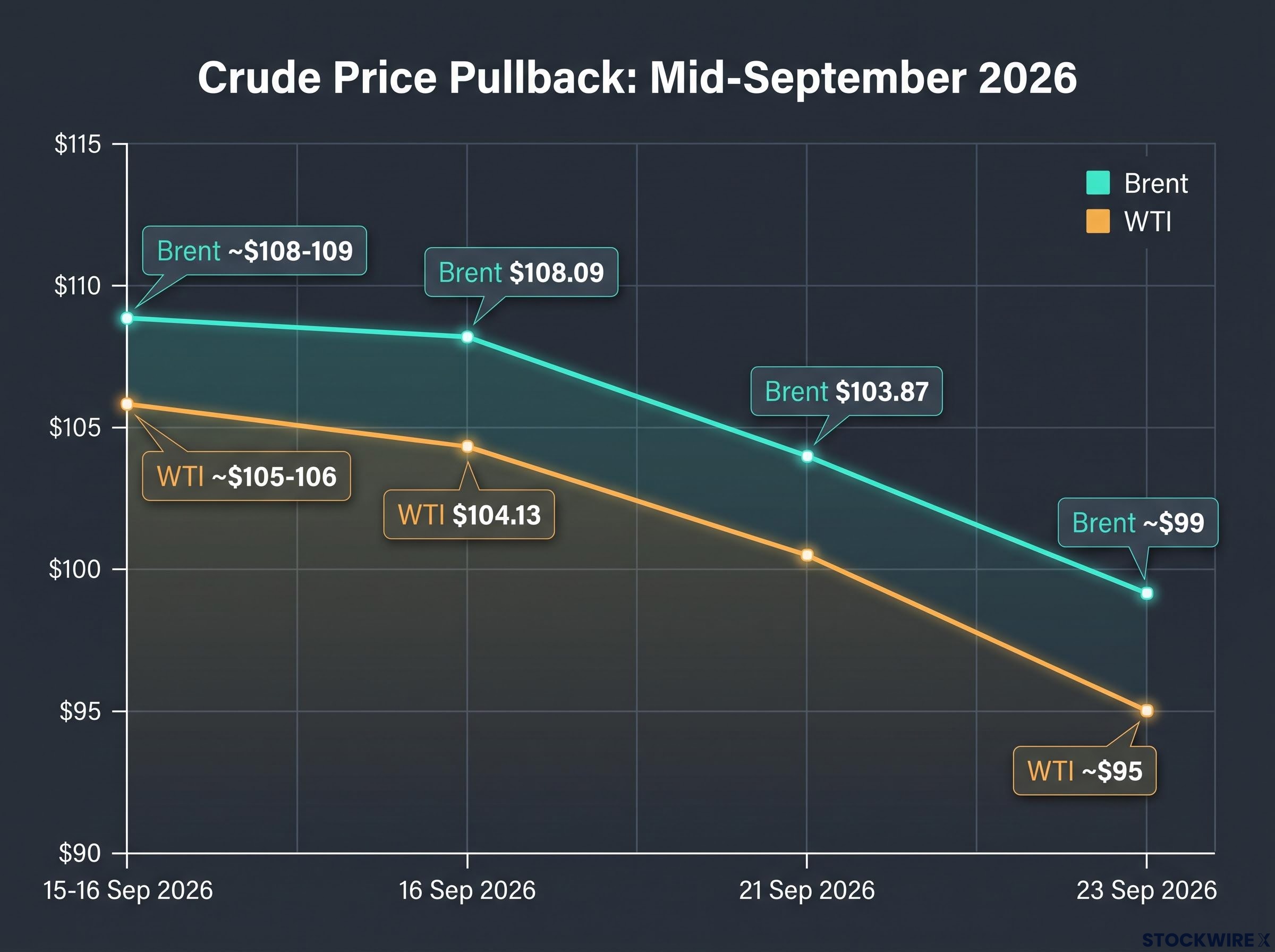
In the 15-16 September 2026 window, Brent sat near $108-109/bbl and WTI around $105-106/bbl. By 16 September 2026, a summary compiled from TradingEconomics and CME Group data put Brent at $108.09 and WTI at $104.13, both down between 0.61% and 1.61% on the session. The pullback had begun.
It continued. On 21 September 2026, The Rio Times reported November Brent futures at $103.87, down 0.9% on the day, easing from crisis levels but still held above $100 by lingering Hormuz concerns. Two sessions later, on 23 September 2026, InvestingLive had Brent settling near $99/bbl and WTI near $95/bbl.
| Date | Brent ($/bbl) | WTI ($/bbl) | Context |
|---|---|---|---|
| 15-16 Sep 2026 | ~$108-109 | ~$105-106 | Start of pullback period |
| 16 Sep 2026 | $108.09 | $104.13 | Down 0.61-1.61% on session |
| 21 Sep 2026 | $103.87 (Nov futures) | – | Down 0.9% on day; The Rio Times |
| 23 Sep 2026 | ~$99 | ~$95 | End of session; InvestingLive |
This was not a demand-side move, and it was not OPEC+ policy. It was a compression of the geopolitical risk premium, pure and simple.
Goldman Sachs has estimated approximately $14 per barrel of the current crude price is a geopolitical risk premium tied to the Hormuz crisis rather than underlying supply and demand, meaning the entire triple-digit price level rests on a factor that can collapse within 24 hours of a credible de-escalation signal.
Rabobank strategist Michael Every linked the price decline directly to market optimism surrounding potential conflict resolution across multiple geopolitical flashpoints.
That $10 figure matters to you as a baseline. It is the market’s own estimate of what the Hormuz threat was worth in price terms, which means it is also the rough measure of how much is still at stake if the talks collapse.
When big ASX news breaks, our subscribers know first
What the New York talks actually produced, and what Iran is asking for
The format of the talks was reported two ways, and both are true. Several outlets, including Al Jazeera and Iran International, described the day as mediated shuttle diplomacy, with intermediaries moving between the two sides. Witkoff himself said on X that the parties held “lengthy talks” through mediators.
Other accounts describe something more direct: an approximately three-hour session in New York between Witkoff and Araghchi, with Jared Kushner also part of the US negotiating team. The likeliest reading is that the day contained both, mediated shuttling and at least one direct meeting.
On the outcome, the language was warm but thin. Witkoff called the round “constructive and promising.” The Trump negotiating team described it as “very productive” and “very good.” President Donald Trump told reporters the discussions “went well,” and left it there.
This round did not appear from nowhere. India Today reported comparable indirect US-Iran contacts in Doha in early July 2026, brokered by Qatari and Pakistani mediators, which places the UNGA session within a broader diplomatic track that already has some momentum.
Iran’s three conditions for a one-week reopening
Iran’s offer to reopen the Strait of Hormuz within roughly seven days came attached to three conditions, presented by Araghchi directly to Witkoff:
- An end to what Tehran describes as US “acts of aggression” and the war across all “resistance” fronts.
- The lifting of Washington’s naval blockade and its broader economic warfare measures.
- The release of frozen Iranian assets.
That seven-day timeline is the detail that moved markets. A named official put a concrete, conditional commitment on the table where previously there had been only vague signals or threats.
For you, the takeaway is that these three conditions are the tripwires. Any official US movement on the blockade, the frozen assets, or the wider hostilities is the leading indicator that the clock has started, and that the next leg of price compression may follow.
Why the Strait of Hormuz commands an instant market response
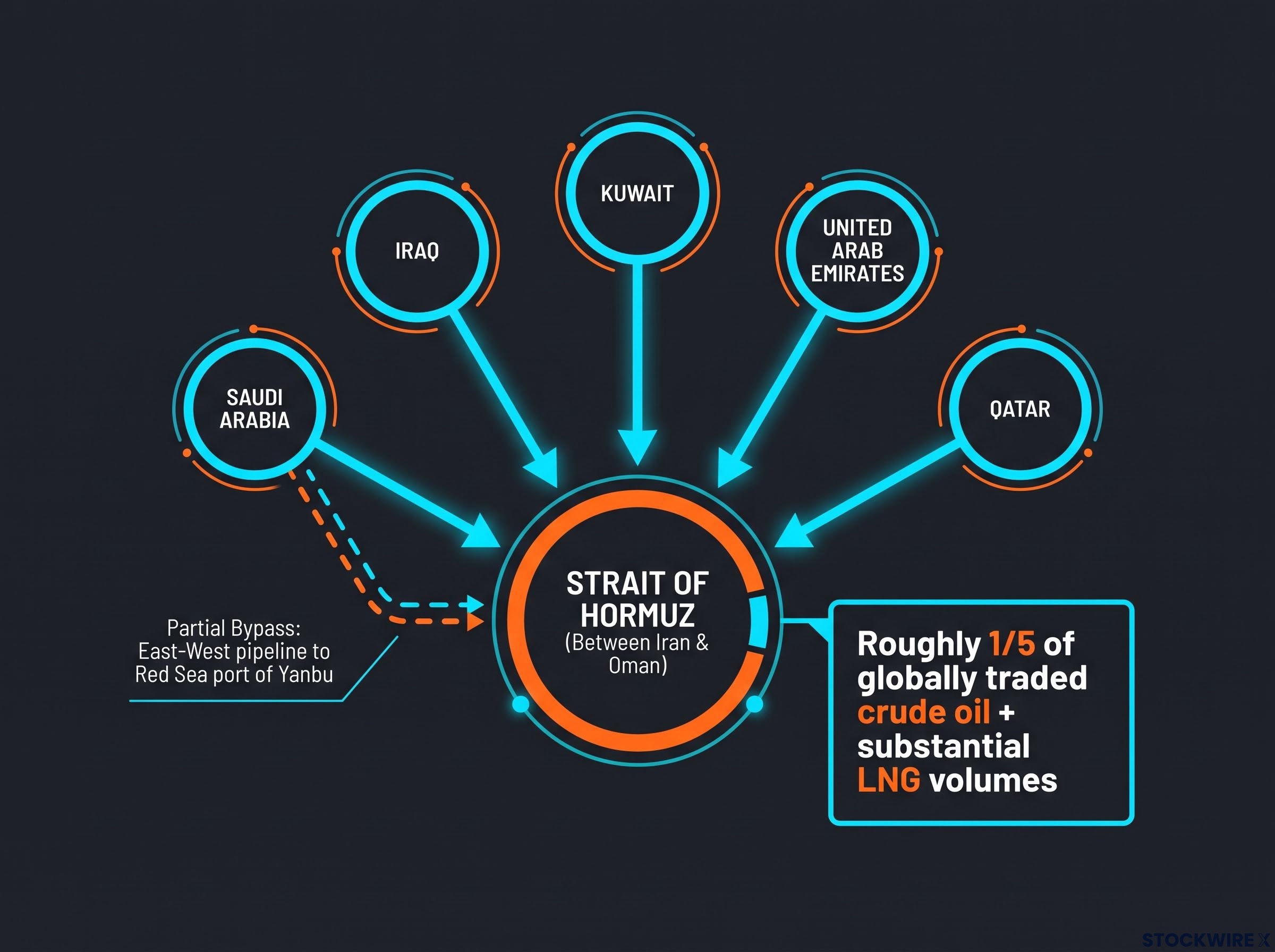
To understand why a conditional, unverified offer can shift global benchmarks by double digits, start with the geography. The Strait of Hormuz is a narrow passage between Iran and Oman, and it is one of the most concentrated chokepoints in the global energy system.
Roughly one-fifth of globally traded crude oil, along with substantial LNG volumes, transits the Strait of Hormuz.
The strait is the primary export route for a cluster of major Gulf producers:
- Saudi Arabia
- Iraq
- Kuwait
- The United Arab Emirates
- Qatar
There is a partial bypass. Saudi Arabia restarted its East-West pipeline to the Red Sea port of Yanbu, a move InvestingLive cited as helping to ease benchmarks alongside the diplomatic progress. China, for its part, warned Houthi forces against disrupting Red Sea shipping. But the pipeline cannot fully substitute for Hormuz transit volumes, which is why the strait itself remains the pivot point for pricing.
Even a diplomatic declaration of openness does not guarantee restored Hormuz shipping flows: commercial transits collapsed to just 3-14 vessels per day against a pre-war baseline of 120-140, because war-risk insurance premiums running at roughly 30 times normal rates and maritime union war-zone classifications persist independently of political announcements.
The mechanism is straightforward. A credible reopening commitment lowers the perceived probability of an extreme supply-cut scenario, raises confidence that physical flows will continue, and adds the prospect of more Iranian barrels reaching the market under a wider deal. Strip out that fear, and the premium deflates.
For anyone holding energy equities or commodity exposure, this is the framework worth keeping. The deeper the world’s dependence on Hormuz, the larger the price response to any credible diplomatic signal, and the equally large response in the opposite direction should the signal reverse.
How durable is this decline, and what could reverse it fast
Here is the uncomfortable part of the current move: it is sentiment, not fundamentals. The pattern of successive small daily declines from the mid-September highs is consistent with a gradual unwinding of war-risk premium, not a repricing of underlying supply and demand. OPEC+ policy, demand trends, and inventory levels have stayed broadly intact.
That makes the downside easy and the upside sharp. If the talks stall, if Hormuz is threatened anew, or if the Red Sea sees renewed attacks on shipping, crude could retrace toward or above its recent highs. The watchlist is short and specific:
- Talks stalling or breaking down.
- A renewed threat to Strait of Hormuz transit.
- Fresh attacks on Red Sea shipping lanes.
- Lean inventories and concentrated Gulf spare capacity, which amplify any of the above.
The premium has been reduced, not removed. Brent sitting near $99/bbl, well above a no-crisis baseline, is the market telling you it still prices in meaningful residual risk rather than a clean diplomatic resolution.
The IEA projects a two-year supply chain recovery timeline even under a best-case resolution, because the physical normalisation of Hormuz depends not only on political agreement but on the restoration of war-risk insurance underwriting and maritime union classifications that move on their own timelines, independent of any ceasefire declaration.
What history says about de-escalation-driven price moves
The 1990-1991 Gulf War is the standard reference point: prices spiked on invasion fears, then fell hard once coalition success and a ceasefire came into view, showing how fast a risk premium can evaporate once the worst case is averted.
The more instructive parallel is the 2015 Iran nuclear deal. Expectations of returning Iranian exports pushed prices down at first. Then the 2018 US withdrawal reversed the move entirely, as the political settlement it rested on came apart.
The lesson for current US-Iran diplomacy is direct. The durability of the settlement, not the warmth of the announcement, determines whether this price decline holds.
What the current moment means for energy markets if talks advance or stall
Pull the threads together and the picture is coherent. The market has priced in meaningful but incomplete progress: a genuine diplomatic opening, backed by a named seven-day offer, discounted by the memory that such openings can unravel.
Brent near $99/bbl rather than a pre-crisis level is the market effectively telling you the probability of a full Hormuz reopening is real but sits below 50%. Any official US statement responding to Iran’s three conditions will reprice that probability almost immediately.
For energy-exposed readers, the sensible move is to track the specific signals rather than the mood music:
- A formal US response to any of Iran’s three conditions.
- Whether the UNGA mediated track extends or breaks down.
- Any confirmed movement on actual Hormuz transit.
- Zelenskyy’s winter-deadline framing on Ukraine as a secondary sentiment softener, noting no formal negotiation or named Russian counterpart has been confirmed.
The seven-day timeline is the near-term tripwire. An affirmative US move within days could bring a sharper leg of price compression; silence or a rebuff would rebuild the premium the market has just spent a week dismantling.
There is a counterintuitive dimension to the current setup: the unpriced resolution risk may be as significant as the residual conflict premium, because sell-side earnings models have absorbed the Hormuz closure as the operating baseline, meaning a genuine deal would force a broad forecast recalibration across energy, shipping, and inflation-linked assets simultaneously.
This article is for informational purposes only and should not be considered financial advice. Investors should conduct their own research and consult with financial professionals before making investment decisions. Past performance does not guarantee future results. These statements are speculative and subject to change based on market developments and company performance.