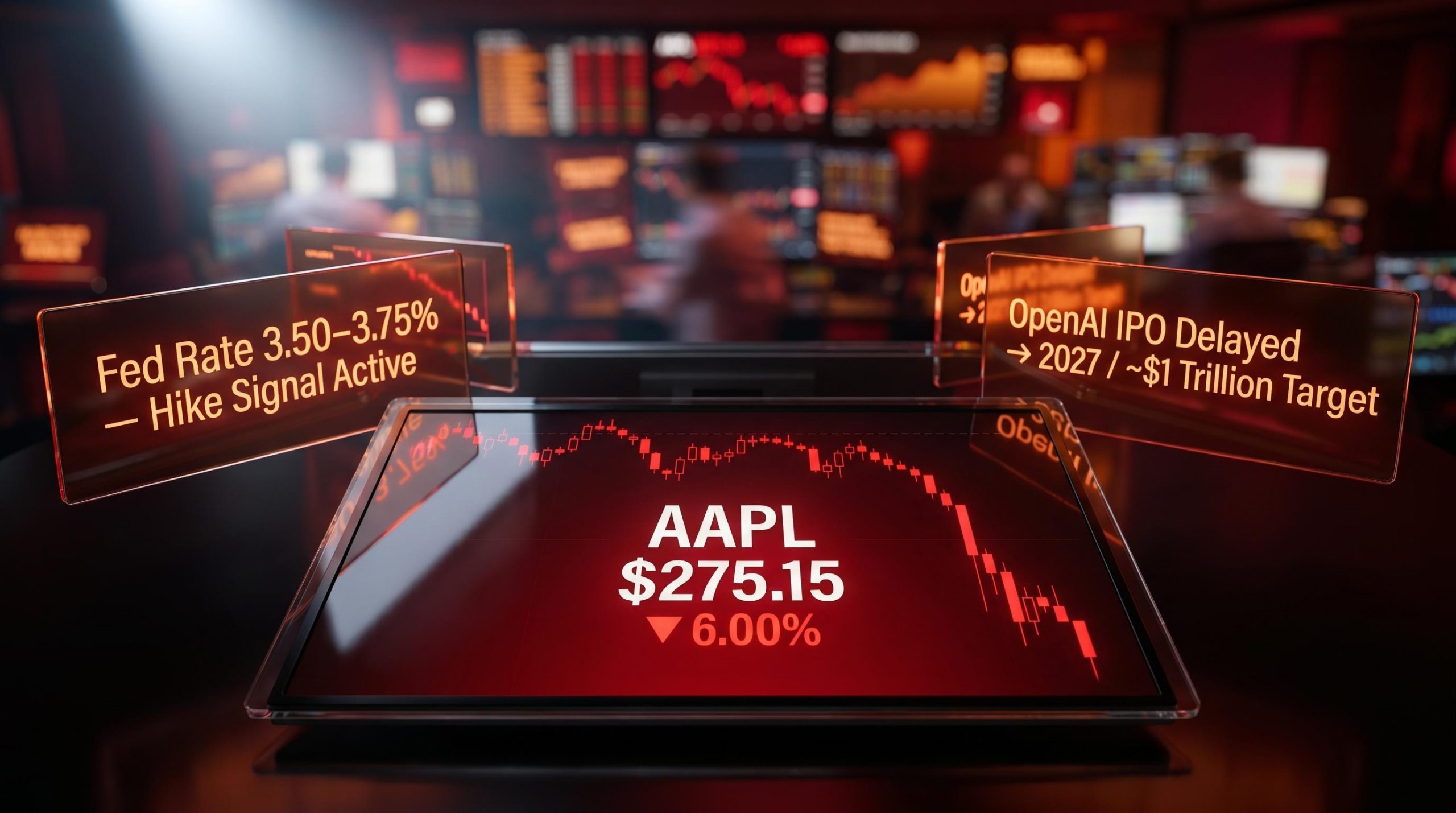
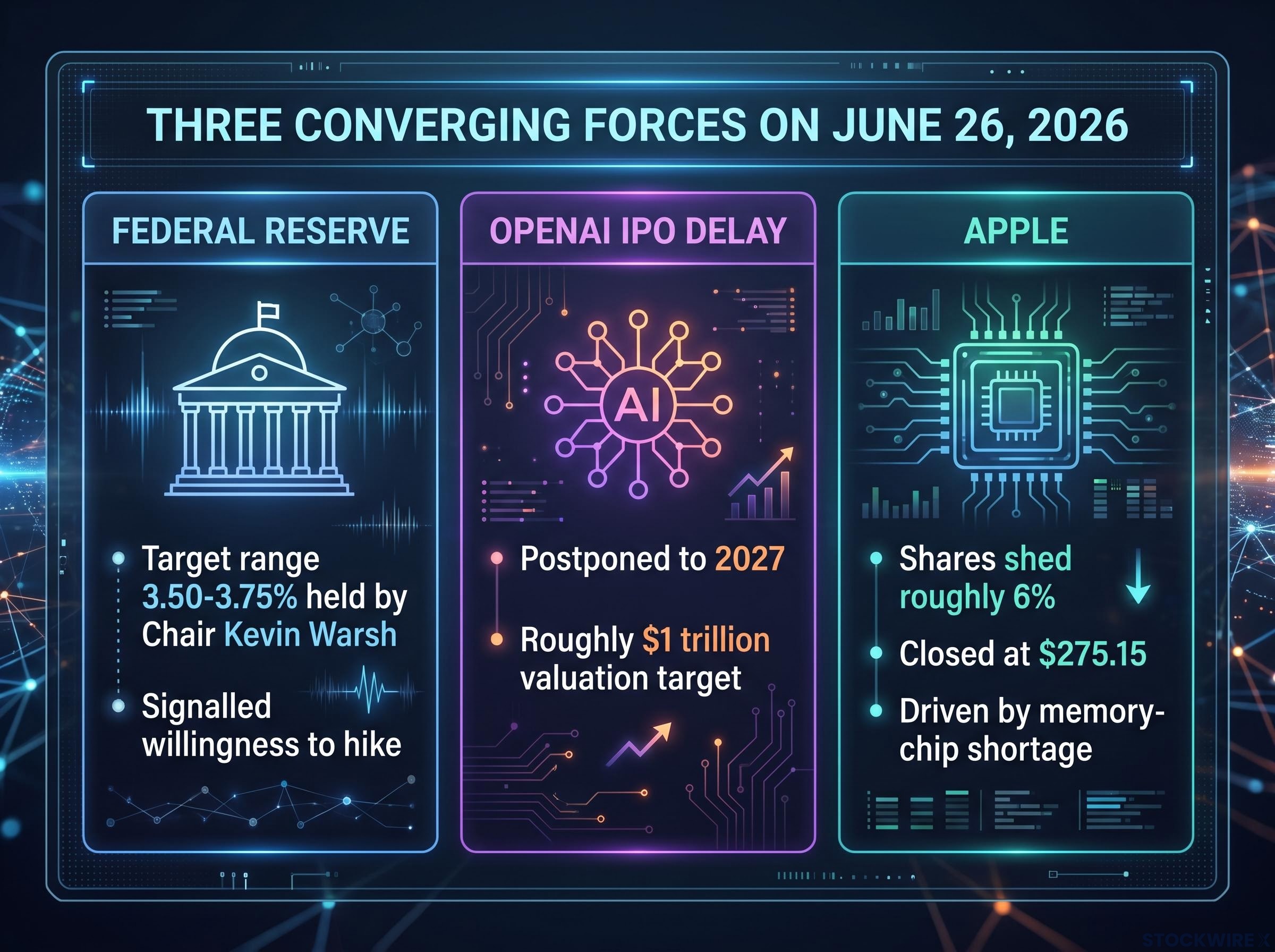
Three separate forces converged on AI-linked technology equities on 26 June 2026, and they arrived in a single session. The Federal Reserve signalled it may raise rates before year-end. According to reports, OpenAI is weighing a postponement of its IPO until 2027. And Apple shed roughly 6% after executives pointed to a global memory-chip shortage, fuelled by AI infrastructure demand, as the driver of product price increases.
For investors who had been riding the AI trade through a prolonged rally, this confluence exposed a structural vulnerability. The same narrative enthusiasm that drove valuations higher left high-multiple tech names with almost no cushion when macro conditions shifted. The session crystallised how fragile sentiment-driven valuations can be when two of the AI cycle’s most anticipated milestones, cheap capital and a landmark IPO, recede at the same moment.
Here is the framework for understanding what just happened, which part of your AI exposure it puts most at risk, and the specific signals to watch before making any portfolio decision.
Why the Fed’s hawkish turn lands hardest on AI stocks
The Federal Reserve held its target range at 3.50-3.75% at its most recent meeting. But three actions taken alongside that hold changed the landscape:
- Raised inflation forecasts above prior projections
- Dropped forward guidance for rate cuts
- Explicitly signalled willingness to hike within the year
Fed chair Kevin Warsh led this shift, and major bank analysts have characterised it not as a slower-cut trajectory but as something qualitatively different.
The FOMC April 2026 policy statement confirmed the target range at 3.50-3.75% while noting the Committee’s explicit consideration of the extent and timing of additional adjustments, language that major bank analysts read as opening the door to further hikes rather than signalling a pause.
Analysts at major banks warned that this meeting marked a clear shift toward a possible rate-hike path, not merely a pause or a slower timeline for cuts.
A Fed willing to hike is a different regime from a Fed simply pausing. The distinction matters because AI stocks are long-duration assets, meaning their valuations depend predominantly on cash flows expected years or decades into the future. When the rate used to discount those distant cash flows rises, their present value compresses sharply. A company generating substantial near-term earnings absorbs that compression with less damage. A company valued almost entirely on future promise does not.
For investors wanting historical context on how equity markets have actually performed across prior tightening cycles, our full explainer on rate hikes and stock returns examines RBC Capital Markets data showing the S&P 500 averaged roughly 13.7% during modest hike windows, and maps where AI-heavy growth names diverge from that historical average.
The rate signal that matters most here is not just the policy rate itself but the behaviour of the 10-30 year Treasury curve. That is the part of the yield curve equity analysts actually use when discounting future cash flows. If the long end moves higher independently of short-term expectations, it signals a repricing of the term premium, and that repricing hits high-multiple AI names hardest.
When big ASX news breaks, our subscribers know first
What the OpenAI IPO delay signals about the AI narrative cycle
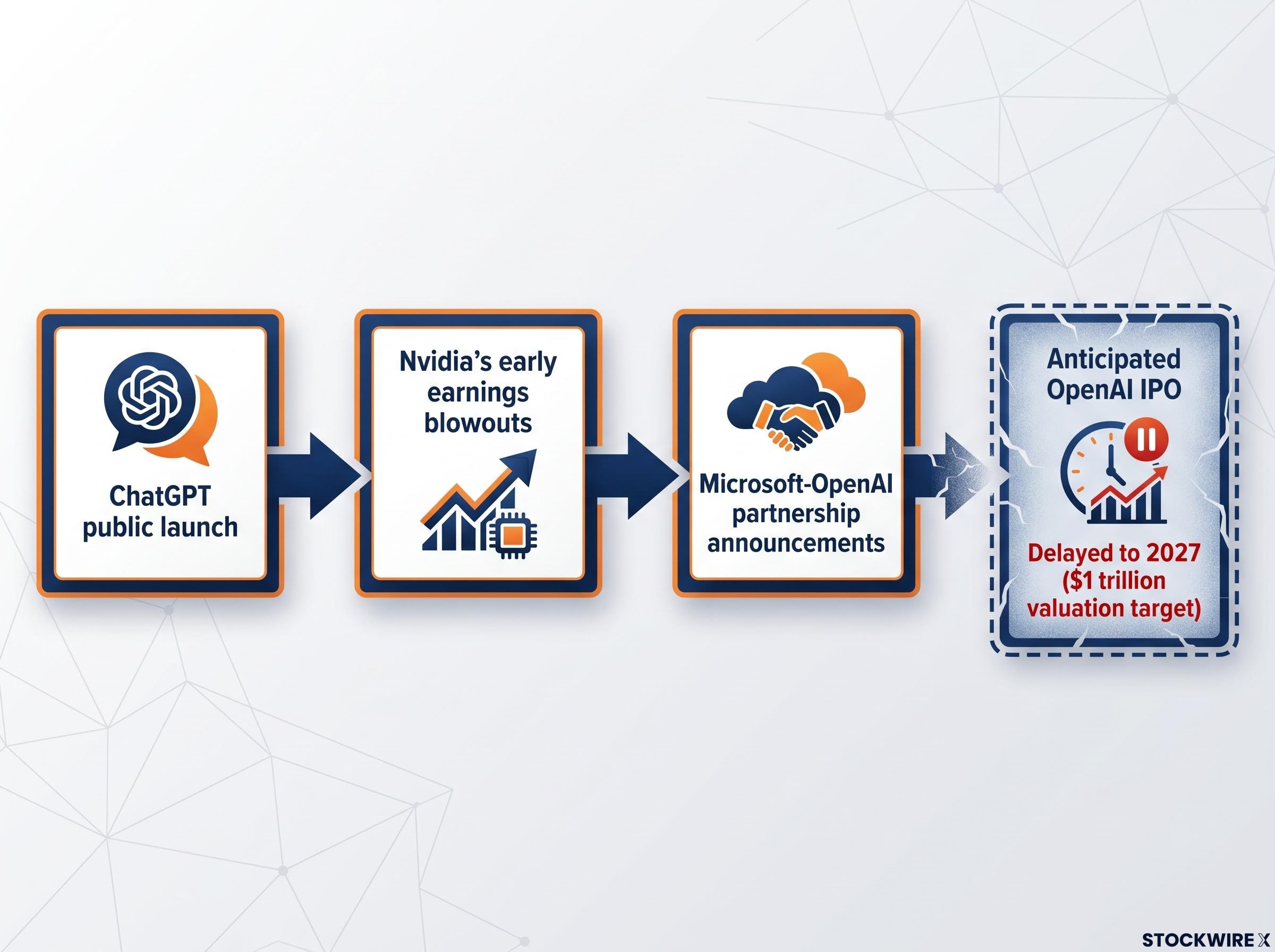
The AI investment cycle has not progressed as a smooth trend. It has moved in a sequence of narrative-validation events, each one ratifying the speculation that preceded it:
- The ChatGPT public launch (broad awareness, initial speculative enthusiasm)
- Nvidia’s early earnings blowouts (hardware revenue validation)
- Microsoft-OpenAI partnership announcements (enterprise integration signal)
- The anticipated OpenAI IPO (the next expected validation event)
That fourth milestone has now been delayed. The New York Times reported in June 2026 that OpenAI is weighing a push of its public listing back to 2027, with advisers indicating that a valuation target of roughly $1 trillion is better suited to a longer runway.
The appropriate framing here is that this is a sentiment shock first, not a fundamental verdict on OpenAI’s business. But it removes one of the clearest near-term catalysts for an AI sector re-rating. Without that validation event on the horizon, speculative positions are left exposed to macro headwinds with no sentiment anchor to absorb them.
The longer the delay persists, the more it risks becoming something more than a timing question in market perception. OpenAI’s business model, built on enterprise licensing, API usage, and partnerships, is still evolving. Translating frontier models into durable, margin-rich revenue at scale remains an open question rather than a solved problem. That uncertainty was easier to carry when the IPO was expected to arrive as a confidence event. Without it, the uncertainty sits more heavily on the trade.
Apple’s 6% drop and what memory chip costs reveal about AI’s supply chain
Apple raised prices on multiple product lines on 26 June 2026, and the company’s executives were explicit about why: elevated memory and storage costs driven by the global AI-demand crunch, not discretionary margin expansion.
Apple characterised the price increases as “unavoidable,” tying them directly to a global memory-chip crunch fuelled by AI infrastructure demand.
On the day, Apple shares closed at $275.15, a decline of approximately 6%. The decline matters on two levels. First, Apple’s index weight means a 6% fall carries outsized impact on broad market benchmarks. Second, Apple sits at the intersection of the hardware stack and AI-enabled consumer devices. When its executives describe memory cost increases as unavoidable and attribute them to AI demand, the supply chain is communicating something concrete: AI infrastructure build-out is creating real, measurable cost pressure now visible in consumer-facing product prices.
Index concentration risk compounds this dynamic: the top five US companies now control roughly 30% of total market capitalisation, meaning Apple’s 6% decline carries a mechanical transmission effect on benchmark returns that is structurally larger than the weight of its fundamentals alone would justify.
| Company/Market | Event on 26 June | Transmission Mechanism |
|---|---|---|
| Apple | Price hike announcement; shares fell ~6% | Index weight decline; consumer cost pass-through signal |
| South Korean memory producers | Added to existing equity weakness | DRAM/NAND proxy for U.S. device-maker demand tightness |
| Broader AI hardware names | Sentiment contagion across the sector | Supply chain cost exposure to memory-chip crunch |
The geographic transmission was immediate. Apple’s Wall Street decline fed through to South Korean and other Asian memory-producer equities, which trade as proxies for DRAM/NAND market tightness. When the world’s biggest consumer electronics firm declares that memory costs cannot be absorbed, that message carries upstream through the entire supply chain.
Not all AI stocks are the same: understanding the dispersion risk
The session’s sell-off hit AI names broadly, but the damage is not distributed equally. The distinction that matters most from here sits between two categories of AI exposure:
| AI Exposure Type | Valuation Driver | Sensitivity to Current Shocks |
|---|---|---|
| Infrastructure leaders (chipmakers, hyperscalers) | Near-term cash flows; measurable AI revenue on income statements | Relatively lower |
| Narrative/platform names (revenue-light AI software) | Future optionality; story-driven multiples | High |
Cash-generating AI infrastructure leaders already show substantial AI-related revenue in their earnings reports. Their valuations rest on near-term fundamentals, which provides a degree of insulation from pure discount-rate compression. High-multiple, revenue-light AI software and platform names carry the full force of rate-driven present-value compression and sentiment shifts like the IPO delay.
For a reader with mixed AI exposure, this distinction is the difference between holding a position that can re-rate on earnings and holding one that requires a sentiment catalyst that has just been delayed.
The expectations gap concept, drawn from Howard Marks and Aswath Damodaran, frames this distinction precisely: investment returns are driven by the difference between what a price already implies and what actually occurs, which is why the infrastructure-versus-narrative dispersion thesis matters more as a return driver than the direction of AI sentiment alone.
What confirms this dispersion thesis
The correction may flush out excess speculation in narrative-heavy names while leaving infrastructure leaders to re-rate on fundamentals. But that thesis requires confirmation. Three signals will tell you whether the market is genuinely differentiating:
- Earnings revision trends: Watch whether sell-side revisions diverge between infrastructure leaders and revenue-light names
- Management guidance divergence: Infrastructure companies maintaining or raising guidance while platform names pull back
- Forward multiple compression: Revenue-light names seeing persistent de-rating while infrastructure multiples stabilise
The fuller picture: regulatory risk and geopolitical factors extending AI timelines
The Fed signal and the OpenAI IPO delay are the headlines, but they are not the complete picture. Regulatory scrutiny on AI safety, data, and competition is active across multiple major jurisdictions, and geopolitical risk remains concentrated in advanced-node semiconductor manufacturing in a small number of countries. Neither of these factors has a near-term resolution.
- Fed and rate conditions: The macro environment supporting narrative valuations has tightened
- IPO and sentiment cycle: A near-term validation event has been removed
- Regulatory and geopolitical timeline risks: Monetisation timelines for frontier AI models extend further when regulatory proceedings are active and when chip supply chains face geographic concentration risk
OpenAI’s path to translating frontier models into durable, margin-rich revenue at scale remains an open question rather than a solved problem.
This matters because the timeline compression affecting AI valuations today is not purely a function of Fed policy or one company’s IPO schedule. It reflects a broader regime in which multiple structural uncertainties are converging on the same window. Investors who frame today’s decline as a simple rates story may be underestimating how durable these headwinds are.
For readers wanting to assess whether today’s convergence of shocks represents a valuation correction or something more structurally significant, our deep-dive into AI stock bubble frameworks applies Minsky, Kindleberger, Sharma, and Shiller CAPE analysis to the current cycle, including the finding that major AI infrastructure investors are currently classified in Minsky’s speculative financing stage.
This article is for informational purposes only and should not be considered financial advice. Investors should conduct their own research and consult with financial professionals before making investment decisions.
Five signals to watch before repositioning around AI exposure
Rather than reacting to today’s headlines, here is a structured monitoring framework. Each signal tells you something specific, and each has a reading that would point toward either stabilisation or further deterioration:
- Fed communications and the 10-30 year Treasury curve. Watch whether the long end is moving independently of policy rate expectations. If it is, that signals a repricing of term premium, which is the worst-case scenario for long-duration AI valuations. A stable or flattening long end would be more reassuring.
- OpenAI secondary market activity. Track private funding round valuations and secondary share sales. These are real-time proxies for how sophisticated investors are pricing frontier AI risk. Declining secondary prices would suggest the delay is becoming a fundamental re-assessment, not just a timing adjustment.
- DRAM/NAND spot and contract pricing. Monitor memory pricing alongside capacity expansion announcements from major producers. If spot prices stabilise and new capacity comes online, Apple-style cost pass-through is transient. If prices continue climbing with no supply relief, it is structural.
- Earnings revision divergence. Compare revision trends between AI infrastructure leaders and revenue-light platform names. Widening divergence confirms the market is differentiating on fundamentals. Uniform downgrades suggest correlated selling is overwhelming the distinction.
- AI regulatory proceedings and semiconductor supply-chain developments. Track regulatory outcomes across major jurisdictions and any changes in advanced-node manufacturing concentration. These can materially extend monetisation timelines independent of financial conditions.
This framework gives you a basis for forming your own view on timing rather than reacting to daily price moves.
What today’s session actually changes for AI investors
Three converging shocks arrived on the same day, and together they revealed something the AI trade’s momentum had been obscuring: the macro environment supporting narrative-driven valuations has tightened, and a near-term sentiment catalyst has been removed.
What has not changed is the underlying structural case for AI infrastructure investment. Leading chipmakers and hyperscalers with measurable AI revenue are still generating durable cash flows. The correction does not invalidate the AI investment thesis.
But it does make clear that not all AI exposure is equal. Macro conditions are no longer a tailwind for the parts of the trade built on future promise alone. The five-signal framework above gives you a set of observable conditions to monitor, whether the correction deepens or stabilises, without prescribing a trade. The session’s message was not that AI is over. It was that the market just started charging for the distinction between what is real and what is still a promise.
Past performance does not guarantee future results. Financial projections are subject to market conditions and various risk factors.