That premium annual fee you pay every year, the one that supposedly buys you lounge access, travel insurance, and a steady stream of frequent flyer points, has been quietly resting on a subsidy you never saw. That subsidy is about to vanish.
On 1 October 2026, a Reserve Bank of Australia (RBA) reform package strips the wholesale fees that banks have long used to fund your rewards. The consumer credit card interchange cap drops to a hard 0.30%, erasing roughly $660 million a year in bank revenue that previously paid for your points, your lounge passes, and your complimentary cover.
Millions of Australian cardholders are already seeing the fallout in their banking apps: shrinking earn rates, worse transfer ratios, and fee notices dressed up in vague language.
This guide gives you a framework to audit what your current card is actually worth under the new rules. It also tells you exactly what to do with your accumulated points before the deadlines hit, so you are not left holding a devalued balance you could have spent while it still meant something.
Why the RBA is cutting the hidden fees that fund your points
Every time you tap or swipe, a fee changes hands that you never see on your receipt. It is called an interchange fee, and it is paid by the merchant’s bank to your bank, the one that issued your card. Card schemes such as Visa, Mastercard, and eftpos set the rate.
That fee is the quiet engine behind rewards. Because the money flows straight to your bank, it has historically bankrolled the points you earn, the airline partnerships you transfer into, the travel insurance bundled with premium cards, and those generous sign-on bonuses.
From 1 October 2026, the RBA changes the maths. The consumer credit card interchange cap falls to a hard 0.30% of transaction value, down from a prior ceiling of 0.80%. The old weighted-average benchmark of 0.50% is abolished entirely. That is roughly a 63% cut on the cap level, and it lands on every domestic consumer transaction.
The RBA interchange fee conclusions paper confirms that the Payments System Board found the previous cap materially exceeded eligible issuer costs, providing the core justification for resetting the consumer credit card ceiling to 0.30% and abolishing the weighted-average benchmark entirely.
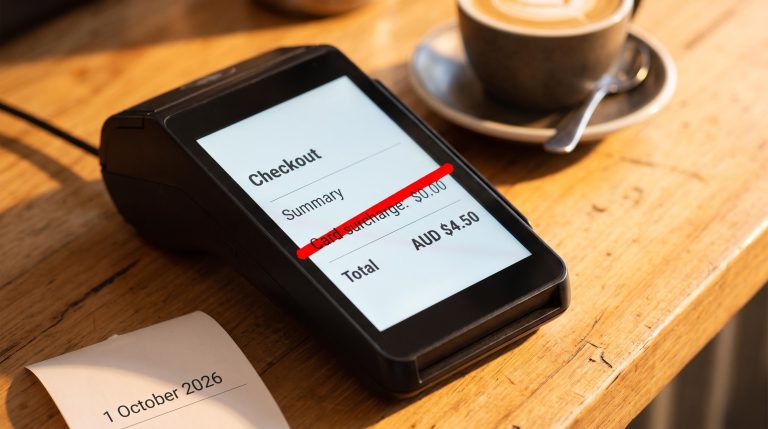
The reform does not stop there. The RBA is also removing the ban on card surcharging, part of a broader package aimed at lowering costs for businesses and making payment pricing more transparent.
The RBA card payment reforms do more than reshape cardholder rewards; they also redistribute competitive advantage across the payments ecosystem, with acquirers and processors whose pricing models already reflect cost-pass-through structures better positioned than peers who rely on bundled or surcharge-led revenue.
The numbers show who wins and who loses. Australian businesses are projected to save approximately $910 million a year. Card-issuing banks are expected to lose approximately $660 million a year in interchange revenue.
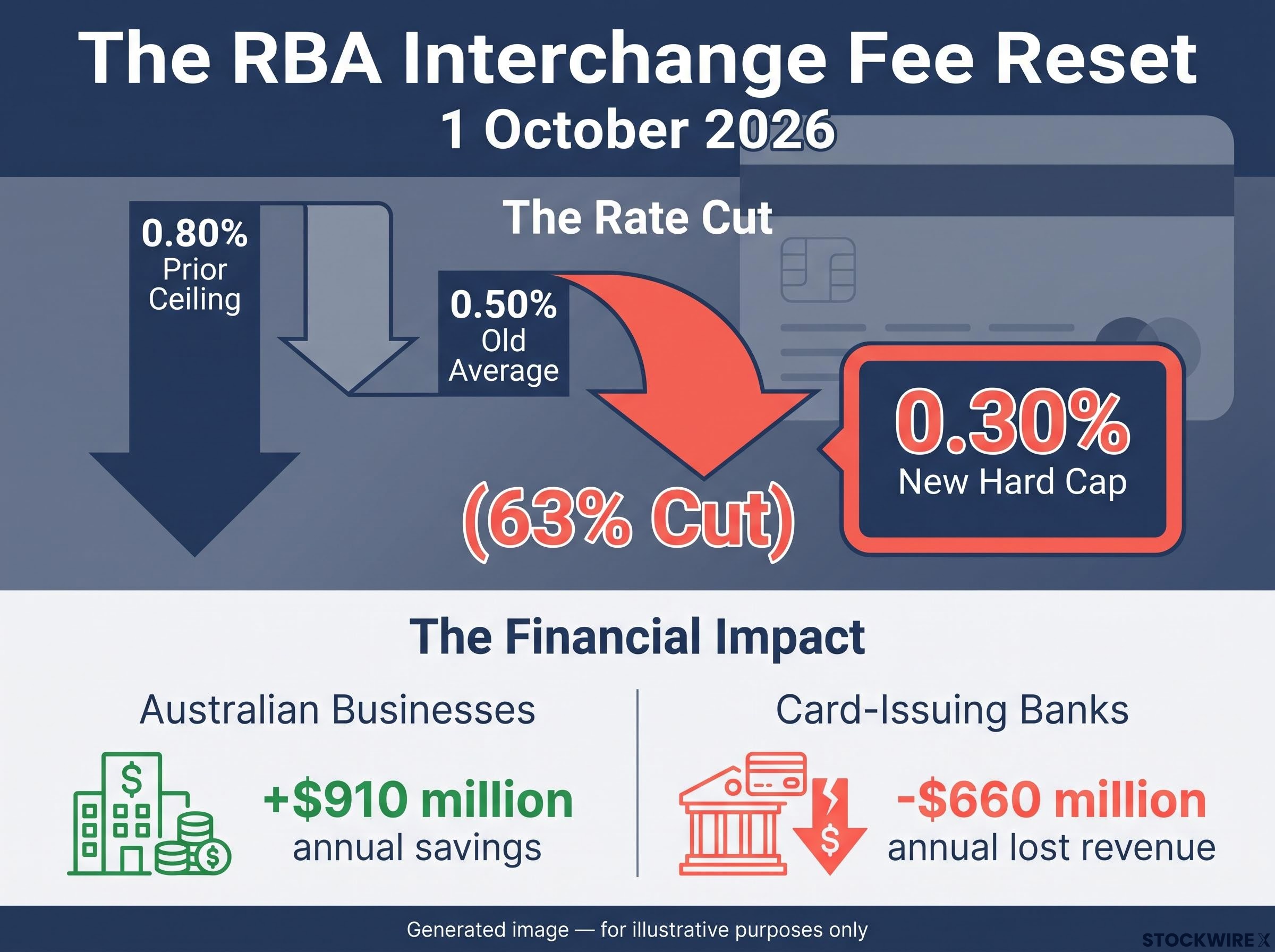
The scale of the shortfall Card-issuing banks are set to lose approximately $660 million per year in interchange revenue. That is the budget that used to buy your frequent flyer points, gone.
Here is what that means for you. Your bank has just lost its main source of funding for your rewards, and it has two levers to pull in response: cut what it gives you, or charge you more to keep it. In practice, expect both. The RBA’s own materials anticipate that issuers will rebalance their economics on the cardholder side, which is the polite way of saying the lost revenue gets clawed back directly from your wallet.
When big ASX news breaks, our subscribers know first
How CommBank, Westpac, and other majors are devaluing programmes
The clearest evidence of that clawback is already public, and it starts with the country’s biggest bank. Commonwealth Bank is not trimming its rewards scheme. It is closing it.
CommBank Awards, the standalone rewards programme, shuts down on 29 September 2026. From that date, you can no longer earn or redeem Awards points. Your card gets migrated into a new bank-wide loyalty currency called CommBank Yello.
The migration itself is where value quietly leaks away. Your Awards points convert to Yello points, but the rate at which those points transfer into airline programmes gets worse on the same day.
| Airline Partner | Prior Rate | New Rate | Change |
|---|---|---|---|
| Qantas Frequent Flyer | 2.5 points = 1 Qantas Point | 3 points = 1 Qantas Point | Devalued; opt-in fee rising from $90 to $149 |
| Velocity Frequent Flyer | 2 points = 1 Velocity Point | 2.5 points = 1 Velocity Point | Devalued; $99 annual opt-in fee introduced |
Read those ratios carefully, because they change what your spending is worth. Under the old Qantas rate, you needed 2.5 points for one Qantas Point. Now you need three. A flight redemption that took you a year to build toward under the old ratios might now take you closer to 18 months, and you will pay a higher opt-in fee for the privilege.
Qantas Frequent Flyer economics sit at the intersection of airline profitability and credit-card partner revenue, and the $660 million in interchange now being capped away from issuers directly threatens the co-branded card agreements that fund points accumulation on both sides of that relationship.
There is a hard stop worth noting too. The cash conversion option for customers who are not eligible for Yello closes on 31 December 2026.
The CommBank Yello migration
You do not need to do anything for the conversion itself. On 1 October 2026, your unredeemed Awards points convert automatically to Yello points on a 1:1 basis, so one Awards Point becomes one Yello Point. Your point count is preserved.
The catch is that a preserved point count is not the same as preserved value. The nominal number stays flat while the transfer ratios beneath it get worse, so the practical worth of that balance for airline redemptions shrinks.
The points appear gradually. Converted Yello points become visible progressively from 1 October 2026, with full visibility in the CommBank app or NetBank by 7 October 2026.
Changes across other major issuers
CommBank is the loudest example, not the only one. ANZ, Westpac, NAB, Bankwest, and Virgin Money have all announced adjustments taking effect around 28-30 September 2026 or 1 October 2026.
The pattern across the market is consistent. Some white-label programmes are cutting earn rates by up to 50%. Purchase interest rates are climbing, reaching 23.99% on some cards and 21.99% on selected Virgin Money products. Monthly spend caps on points earning are appearing, which quietly limits how much you can accumulate no matter how much you spend.
The perks are thinning too. Across the Big Four, complimentary travel insurance and lounge access are being trimmed or pushed into higher-fee tiers, mirroring what happened during the last reform cycle.
Calculating the new maths on premium and entry-level cards
Enough bad news. The more useful question is a personal one: does your specific card still make sense for the way you actually use it? The answer depends almost entirely on how much you spend and how disciplined you are about extracting value.
This is not the first time Australia has run this experiment. When the RBA tightened interchange caps in 2017, major banks responded within months by cutting earn rates, particularly on premium products, while airline programmes demanded more points per flight. The 2026 cycle is a deeper, more structural version of the same reset, with full programme closures rather than mere rate tweaks and a uniform 0.30% cap that hits every issuer at once.
Australian bank stocks have been absorbing a concurrent set of structural shocks in 2026, with the interchange revenue reduction arriving alongside legislated changes to investor mortgage tax incentives and a broad-based contraction in home loan application volumes that is compressing forward earnings growth across the sector.
Here is the analytical lens to apply. If your monthly spending does not fully offset your annual fee through sign-up bonuses or heavy use of travel perks, you are now effectively subsidising other people’s rewards.
Where you land depends on your profile:
- High-spend, fee-tolerant cardholders who clear their balance in full and actively transfer to airline partners can still find value in certain premium cards. Sign-up bonuses, partner promotions, and high-value flight redemptions can outrun the earn-rate cuts, but only if you use them deliberately.
- Low-to-moderate spenders paying a substantial annual fee and cashing points out for gift cards or statement credits are the most exposed. Earn rates and transfer ratios fall while your fee stays put or rises, so the net value erodes underneath you.
- No-annual-fee or debit-linked rewards holders feel the smallest immediate hit, because those products lean less heavily on interchange and more on cross-selling other banking products.
There is a specific trap to watch. If you recently paid a full annual fee for benefits that get slashed mid-year, you are locked into worse value for the rest of that period, often with no pro-rated refund and no penalty-free downgrade. You paid upfront for a package that has since been quietly downgraded.
One more timing detail matters for anyone using overseas-issued cards. The 1.0% cap on foreign-issued card transactions does not arrive on 1 October. It takes effect on 1 April 2027, so cross-border spending follows a different trajectory than your domestic card.
Your October transition checklist
Knowing why your rewards are shrinking is one thing. Protecting your balance and your cash before the deadlines hit is another, and the window is narrow.
The single most important rule is this: the burden of extracting value from a rewards card now sits entirely with you. Holding one passively is no longer neutral. It is an active drain on your finances.
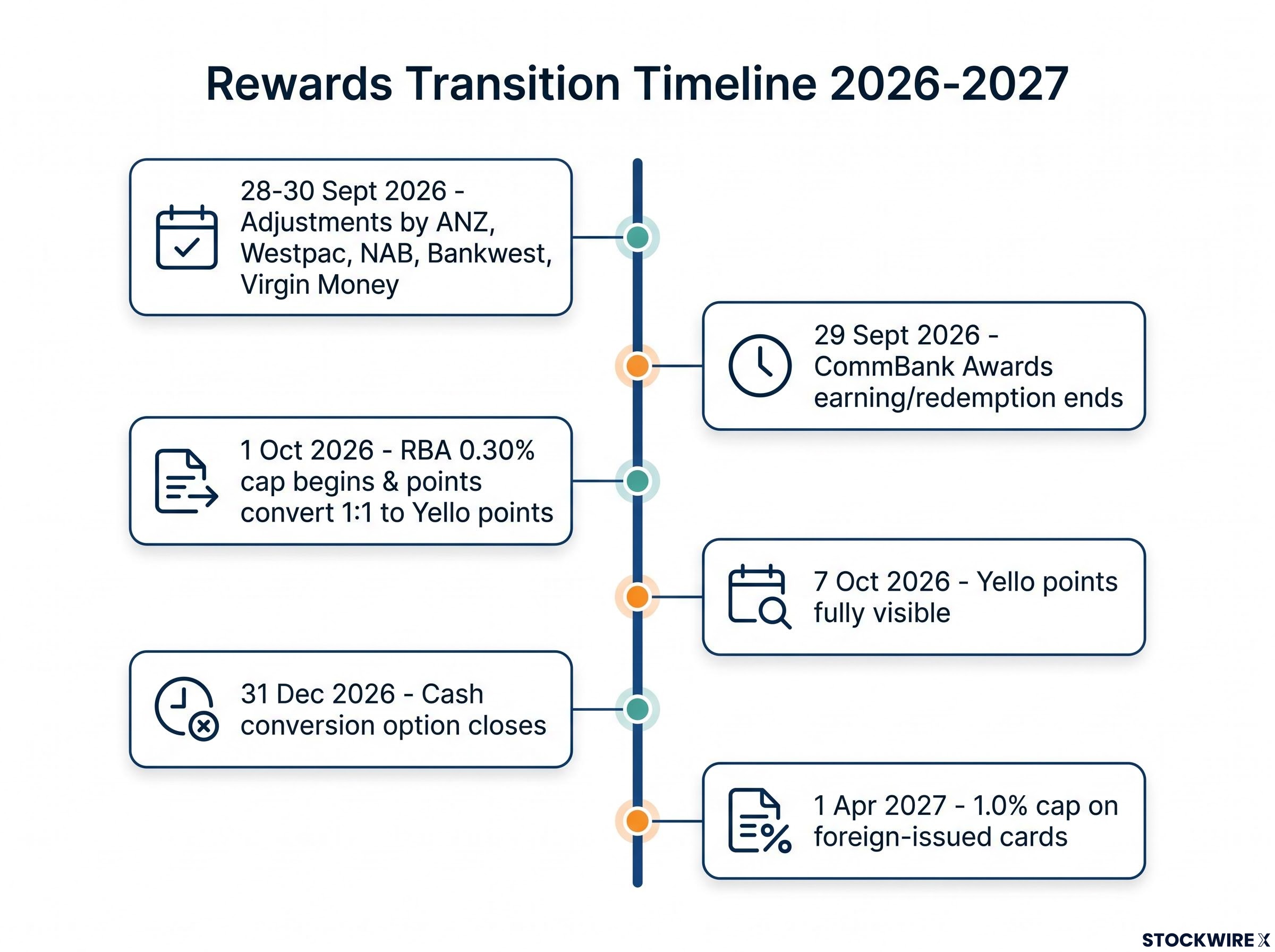
Work through these steps now:
- Check your point balances immediately. If you hold a CommBank Awards card, remember that earning and redemption both end on 29 September 2026. Spend or transfer anything you want to use at the current, better ratios before that date.
- Calculate your earn rate against your annual fee. Take your typical monthly spend, apply your updated points rate, and weigh the annual value against what the card costs you. If the fee outstrips the benefit, it is time to consider a lower-fee or no-fee alternative.
- Monitor surcharges from 1 October 2026. What matters for which rules apply is when payment is actually made, not when the invoice was issued. A bill dated in September that you settle in October is governed by the October regime.
- Report violations. If a card surcharge still shows on your receipt after 1 October, contact the business directly in the first instance, then take the matter to the relevant card network or payment provider if that does not resolve it. If a merchant blames a general price rise on the surcharge change, refer the matter to the Australian Competition and Consumer Commission (ACCC) or your state consumer protection agency.
Consumer financial disclosure standards have been under intensive regulatory scrutiny across multiple product categories in 2026, with the Federal Court’s finding that undisclosed monthly account fees buried in a 60-month interest-free promotion constituted misleading conduct establishing a binding compliance benchmark for any retailer or lender whose promotional terms obscure the true cost of credit.
Act within the three weeks either side of 1 October 2026. That is the window where balances lose value and pricing changes take hold.
This article is for informational purposes only and should not be considered financial advice. Investors should conduct their own research and consult with financial professionals before making investment decisions.
Navigating the new loyalty landscape
The era of richly subsidised rewards is closing. The $660 million that banks pulled from interchange to fund points, perks, and insurance is being capped away, and the market is shifting from a high-margin rewards environment to a tightly audited, low-margin one where every benefit is scrutinised for cost.
Under these rules, downgrading to a low-fee or zero-fee card is not settling for less. For many moderate spenders, it is the rational move, because the premium fee no longer buys premium value.
The deeper mindset shift is this. Treat credit card points as a depreciating asset, not a stable currency. Their value can be cut with a single programme notice, so the sensible approach is to earn them, use them, and avoid hoarding a balance that may be worth less next quarter than it is today.
Past reform cycles suggest further adjustments are likely as issuers settle into the new economics. These outcomes are subject to change based on future bank decisions and market conditions.
—