The race to build artificial intelligence is usually told as a story about chips and code. The reality on the ground looks different.
The hardest part of scaling AI in 2026 is not designing a faster processor. It is finding enough electricity and water to keep the machines running without tripping the local grid.
Modern high-density data centres now draw power and water at volumes that rival small towns. That physical demand, not raw computing talent, has become the defining constraint on how fast the industry can grow.
This has quietly turned facility management into one of the most valuable skills in technology. The companies that can keep dense server racks cool, powered, and legally supplied with water are moving from the back office to the centre of the story.
This breakdown gives you a clear framework for understanding why legacy data centre design fails under modern AI workloads. It also shows you how to evaluate the overlooked operational companies, including a handful of ASX tech stocks, stepping in to solve the problem, and how to separate genuine engineering from thin real estate plays.
The physical ceiling on artificial intelligence capacity
Strip away the software and the chips, and an AI data centre is really an industrial utility site. It consumes electricity, moves water, and rejects heat at a scale that turns local infrastructure into the binding limit on growth.
The numbers make the point. The International Energy Agency (IEA) estimates data centres used about 415 TWh of electricity in 2024, roughly 1.5% of global demand. Its base case sees that figure roughly doubling by 2030.
The IEA’s projection of roughly 950 TWh of data centre electricity demand by 2030 is not an isolated forecast; it is evidence of a structural grid crisis that is already reshaping how utilities, regulators, and infrastructure investors plan capacity across every major market.
IEA projection: Data centre electricity demand is expected to reach approximately 950 TWh by 2030, just under 3% of global electricity use. That is slightly more than the entire annual electricity consumption of Japan.
AI-focused facilities are the accelerant. The IEA reports that total data centre electricity demand grew 17% in 2025, while AI-focused sites grew 50%, against global electricity demand growth of just 3%.
The bottleneck is not only how much power these sites want, but whether they can get connected at all. Grid connections now routinely take more than four years, and in some markets up to a decade, according to the IEA and McKinsey. That has led to a situation where roughly 20% of planned projects could face delays.
SMA Solar’s pivot into data centre power architecture is a reminder that the grid interconnection bottleneck is solvable through power electronics as well as planning processes, with medium-voltage UPS systems now being designed specifically to compress multi-year regulatory wait times into a hardware problem at the point of connection.
The instability runs deeper than slow approvals. A 2026 North American Electric Reliability Corporation (NERC) Level 3 alert reported that some AI facilities are causing sudden single-event load swings of 1,000 MW or more, stressing grids and onsite equipment alike.
Water is the second hard limit. In Chandler, Arizona, municipal rules cap data centre water use at 115 gallons per day per 1,000 square feet of floor space, forcing any excess to be sourced externally.
For Australia, the pressure is already visible. Data centres account for about 3% of national electricity consumption, and the Australian Energy Market Operator (AEMO) expects national power use to rise by roughly 40% over the next decade, driven largely by data centre expansion.
Here is what this means for you as an investor. Judging the growth of this sector on computing power alone is a mistake. The real question is which facilities can actually secure the grid connection and water rights to operate, because a planned site without power is just a plan.
When big ASX news breaks, our subscribers know first
Why high-density racks break traditional cooling models
To understand why old data centres cannot simply be retrofitted for AI, you need to look at a single server rack and how much heat it throws off.
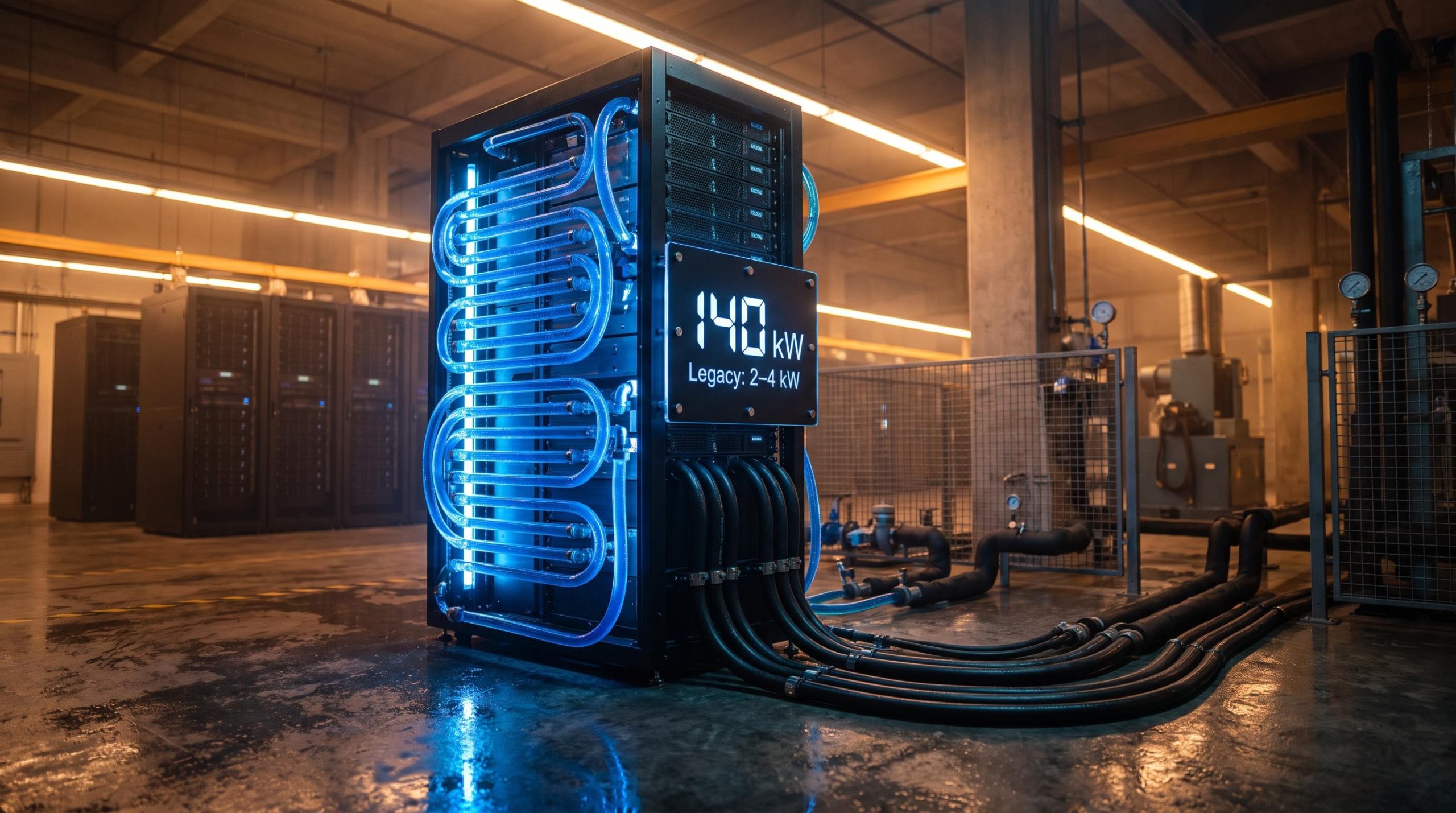
A legacy cloud rack draws around 2 to 4 kW of power. A modern AI rack packed with graphics processing units (GPUs), the chips that handle AI’s heavy parallel calculations, can pull up to 140 kW. That is a step change in heat concentration, not a gentle increase.
Air simply cannot move fast enough to carry that heat away. Fans and cold air worked when racks were measured in single-digit kilowatts, but at high density the physics stops cooperating, which forces a switch to liquid cooling.
The ASHRAE AI data centre energy performance framework, released in April 2026 alongside NEMA and PNNL, establishes design and operational benchmarks that high-density GPU facilities must meet as power-per-rack densities push well beyond what legacy cooling infrastructure was ever engineered to handle.
This is not a minor upgrade. It introduces an entirely new category of risk into the building.
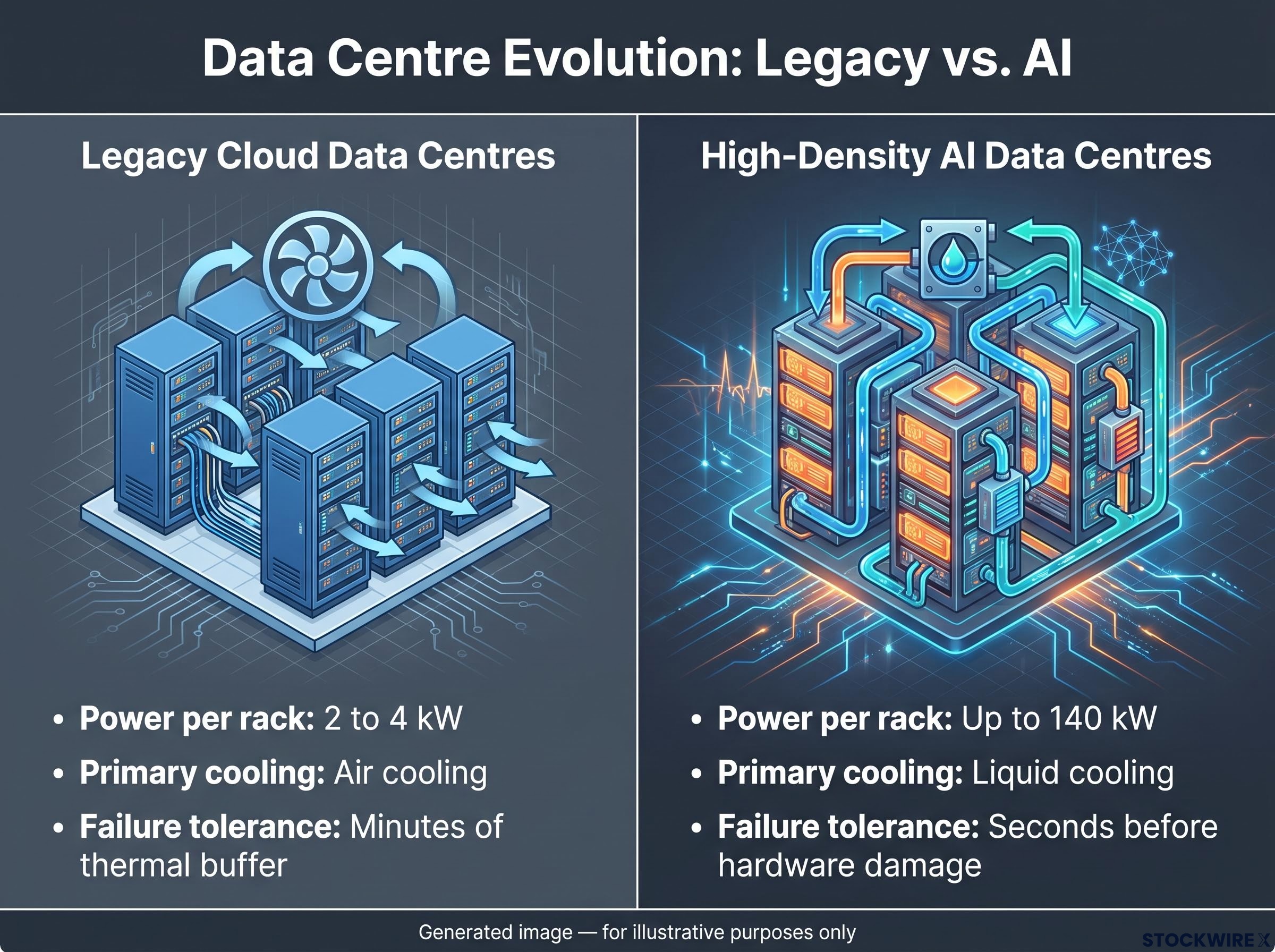
| Metric | Legacy Cloud Data Centres | High-Density AI Data Centres |
|---|---|---|
| Power per rack | 2 to 4 kW | Up to 140 kW |
| Primary cooling method | Air cooling (fans, cold air) | Liquid cooling (direct coolant) |
| Failure tolerance | Minutes of thermal buffer | Seconds before hardware damage |
The scale of the stakes shows up in the outage data. Uptime Institute figures indicate that power and cooling together cause between 64% and 73% of data centre outages, with power failures alone accounting for 45 to 54% and cooling failures around 19%.
The liquid cooling transition
Liquid cooling works by running coolant directly across the hottest components, carrying heat away far more efficiently than air ever could. The trade-off is that it removes the safety margin.
Air-cooled rooms hold a reservoir of cold air. Even if cooling drops, there are minutes of buffer before anything melts. This is what engineers call ride-through time, the window a facility can survive a cooling interruption before hardware is damaged.
In a liquid-cooled environment, that window shrinks toward zero. A coolant leak, a failed pump, or a chilled-water interruption can damage GPUs within seconds. New failure categories arrive with the coolant: leaks, pump failures, and pressure loss that air-cooled sites never had to manage.
Experts warn that these compressed failure timelines are reversing years of improvement in data centre resilience.
What you should take from this is simple. Preparing a facility for AI is not about installing new servers into an old shell. It is a complete re-engineering of how the building tolerates heat and survives failure, and that distinction is exactly what separates a genuine high-density operator from a repackaged warehouse.
Applying municipal utility expertise to high-density environments
If the problem is real-time control of power, water, and cooling, the solution should come from whoever already does that at city scale. That is where the story takes an unexpected turn.
Most technology firms entering the AI data centre space are compute or software specialists. Very few have hands-on experience running live physical utility systems at the density these facilities demand, and that gap has made operational expertise a scarce and valuable resource.
X2M Connect (ASX: X2M) offers a clear worked example of how existing capability is being repurposed. The company has spent over a decade building a patented Internet of Things (IoT) platform, technology that connects physical devices to the internet for remote monitoring and control, for water, gas, and electricity networks.
That platform is not theoretical. It currently connects more than 530,000 devices across Australia, South Korea, Japan, Taiwan, and the UAE.
Its South Korean footprint is the strongest proof point. X2M operates across 59 municipalities, covering more than 240,000 households, and serves approximately 64% of the country’s remote water-monitoring market.
The technical parallel is the whole argument. Coordinating power and water across dozens of municipal networks in real time is functionally the same problem as balancing power, cooling, and water inside a 100 MW data centre precinct. In both cases, you are aggregating live data from distributed assets and triggering automated control before something fails.
To pursue this, X2M established a wholly owned subsidiary, X2MDC Pty Ltd, in mid-2026 to target AI-enabled data centre projects up to 100 MW in Australia. Its Platform Services layer is a mandatory, recurring service priced on a per-megawatt basis, providing unified real-time optimisation across the facility’s core systems.
According to the company, that layer manages:
- Power distribution across the facility
- Water usage and supply
- Cooling systems and thermal load
- Environmental conditions inside the precinct
When you assess the operational management layer of this boom, there is a useful test to apply. Value proven performance in live utility networks over polished software models built purely for the current AI trend. A platform already running 59 real water networks tells you more about execution capability than any pitch deck built around a theme.
Assessing the development pipeline and execution reality
A compelling story and a signed contract are two very different things. This is where enthusiasm has to meet the discipline of reading ASX announcements carefully.
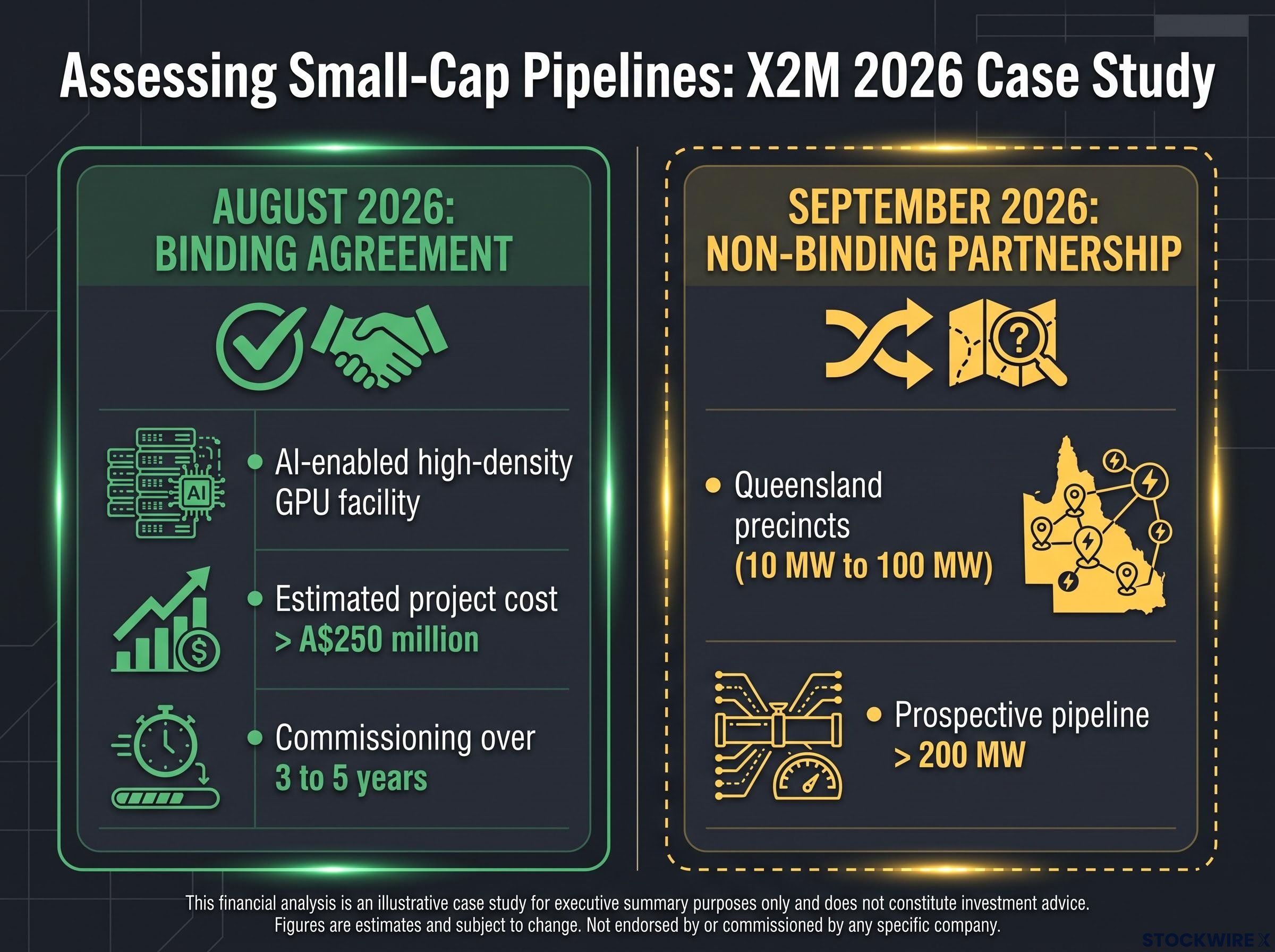
X2M’s commercial activity in 2026 gives you a live case study in that distinction. In August 2026, the company announced its first binding data centre agreement under its Managed Delivery model, an end-to-end facility build, for an AI-enabled, high-density GPU facility with an estimated project cost exceeding A$250 million.
The detail that matters is the word binding. X2M expects to recognise the full project cost as revenue plus a margin, alongside recurring fees, and the contract is conditional only on development approval, with commissioning expected over three to five years.
Then came September 2026, and a very different kind of announcement. X2M revealed a non-binding five-year partnership with an Australian master developer to build high-density GPU precincts in regional Queensland, each ranging between 10 MW and 100 MW.
That partnership pushed the company’s prospective pipeline beyond 200 MW. It is a genuine opportunity, but the label non-binding does heavy lifting here.
Navigating small-cap execution risk
Read those two announcements side by side and the lesson becomes clear. The binding agreement carries defined revenue mechanics. The Queensland partnership is a forward-looking target, subject to regulatory and planning approvals, and should be treated as a pipeline ambition rather than confirmed revenue.
This distinction is the single most important discipline when evaluating small-cap infrastructure plays. Non-binding memorandums and pipeline megawatt figures are targets, not guaranteed income, and they carry inherent uncertainty under standard ASX disclosure obligations.
Execution risk sits on top of that. Small-cap companies face elevated delivery risk on large mega-projects compared with established peers, and they still have to prove capability at the 10 to 100 MW scale.
The wider market backs the caution. Analyst round-ups have flagged concern about “AI data centre optionality” among smaller stocks, where many projects remain stuck at feasibility or early-works stages, constrained by power, water, transmission access, and planning approvals.
The A$60 billion figure attached to the Australian data centre market is a scenario ceiling built from cumulative ecosystem capex, not an annual revenue forecast, and the gap between those two numbers is where most retail investors are currently mispricing the sector’s growth trajectory.
For you, the practical takeaway is to separate binding contracts from non-binding memorandums ruthlessly. In this sector, delivery is the ultimate hurdle, and thematic enthusiasm has to be backed by contract quality.
This article is for informational purposes only and should not be considered financial advice. Investors should conduct their own research and consult with financial professionals before making investment decisions.
Forward-looking statements, including project pipelines and non-binding partnerships, are targets subject to change based on market developments, regulatory approvals, and company performance. Past performance does not guarantee future results.
Navigating the operational shift in digital real estate
The era of simply building warehouses full of servers is closing. What replaces it is far more demanding: real-time utility management ecosystems that keep dense racks cool and powered without breaking the grid or exhausting the local water supply.
That shift changes who wins. The advantage is moving toward operators who can prove control across power, cooling, and water at precinct scale, not just those who can pour concrete and lease floor space.
X2M Connect illustrates the lateral logic at work, established municipal utility expertise being repurposed for a new and much larger market, though its non-binding pipeline is a reminder that the theme still has to survive contact with execution.
As you follow the sector from here, watch the constraints rather than the announcements. Tightening municipal water regulations, lengthening grid connection wait times, and the ratio of binding contracts to non-binding memorandums will tell you far more about who is actually building than any headline pipeline figure. In this market, the companies that solve the physical utility problem are the ones worth watching.
Goldman Sachs framed the AI infrastructure thesis around a single due-diligence variable it calls land-and-power position: which operators secured grid interconnection rights in constrained markets and at what cost basis, a framework that applies directly to evaluating any Australian operator’s capacity to convert pipeline megawatts into billed revenue.