
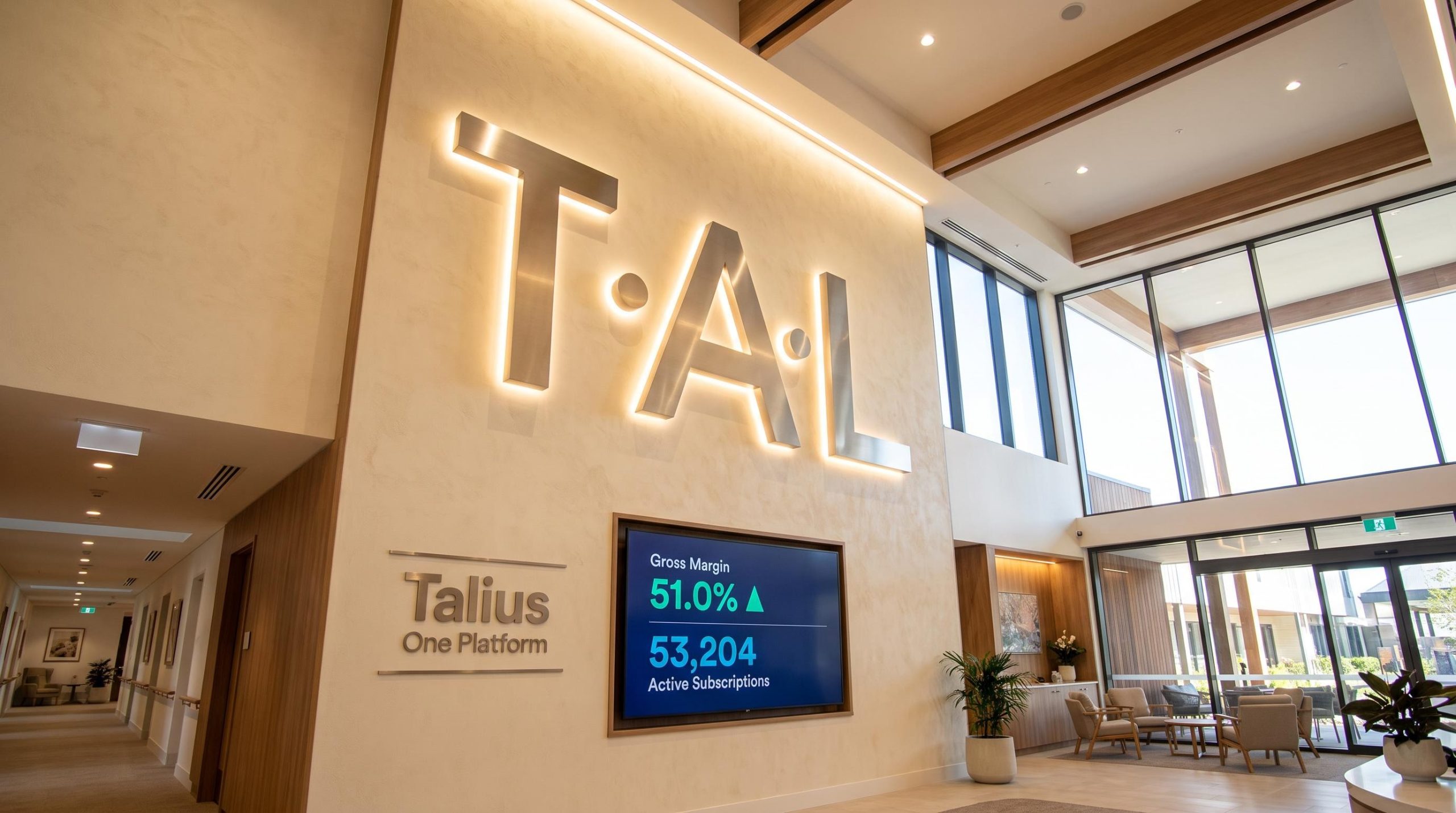
Talius delivers margin transformation as recurring revenue strategy takes hold in HY2026
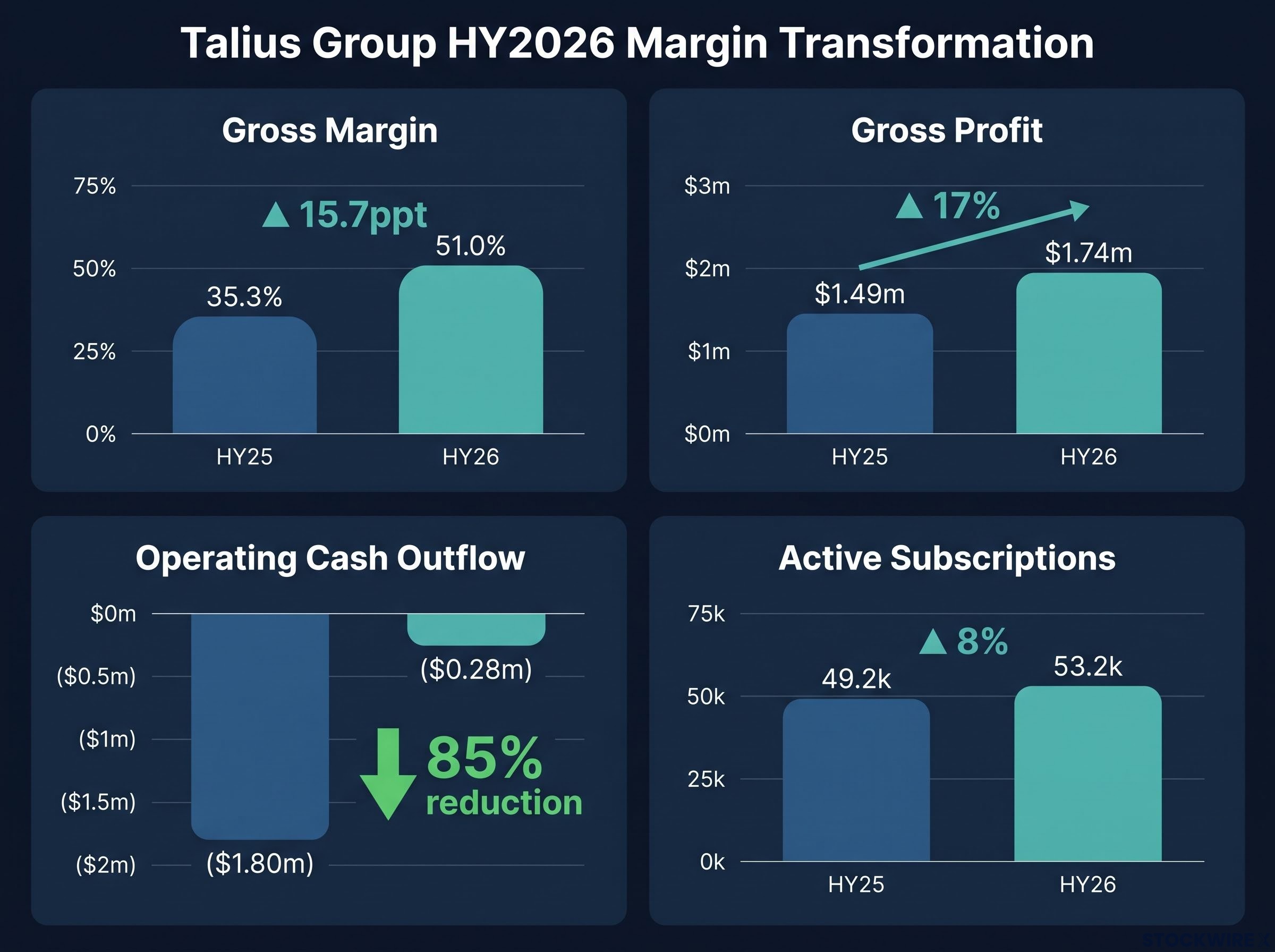
In its HY2026 results presentation covering the six months to 30 June 2026, Talius Group (ASX: TAL) detailed a material shift in the quality of its earnings, with gross margin expanding to 51.0% from 35.3% and operating cash outflow narrowing to $0.28m from $1.80m.
Revenue of $3.41m was down 19% from $4.21m, reflecting the timing of hardware deployments rather than deterioration in the underlying business. The period also marked Patrick Howard’s commencement as Managing Director & CEO of the aged care technology provider.
When big ASX news breaks, our subscribers know first
HY2026 financial results at a glance
Management framed the half as one where gross profit rose despite a lower revenue base, underscoring the growing contribution of higher-margin software.
| Metric | HY25 | HY26 | Change |
|---|---|---|---|
| Revenue | $4.21m | $3.41m | ▼ 19% |
| Gross margin | 35.3% | 51.0% | ▲ 15.7ppt |
| Gross profit | $1.49m | $1.74m | ▲ 17% |
| Normalised loss after tax | ($626k) | ($559k) | ▲ 11% |
| Operating cash outflow | ($1.80m) | ($0.28m) | ▲ 85% |
| Subscriptions | 49.2k | 53.2k | ▲ 8% |
Key takeaways from the scorecard include:
-
Gross margin expanded 15.7 percentage points, lifting gross profit despite the lower revenue line.
-
Operating cash outflow reduced 85%, materially narrowing the cash burn.
-
Active subscriptions grew 8% period-on-period, supporting the recurring revenue base.
The statutory loss of $873,756 included a $314,637 inventory impairment arising from a comprehensive review and rationalisation of inventory holdings. The normalised loss of $559,119 excludes this impairment. On that basis, the business is moving towards cash-flow breakeven on a higher-quality revenue mix.
What Talius does — turning structural demand into recurring revenue
For investors unfamiliar with the company, Talius operates a platform that converts demand for technology-enabled care into embedded workflows and recurring subscription revenue. The model spans three stages.
-
Awareness: multi-sensor data capture across care environments.
-
Analysis: an intelligence layer producing real-time insights, including through the company’s CSIRO collaboration.
-
Action: automated alerts, triage and care workflow processes.
Commercially, the business follows a “land-and-expand” flywheel: enterprise deployment leads to embedded workflows, which drive recurring subscriptions, which in turn open additional sites and modules.
The margin economics explain the HY2026 result. Hardware carries roughly 30% gross margin and provides the installed infrastructure, while subscription software carries approximately 70% margin and drives recurring revenue. As the revenue mix shifted towards software, margins rose. Hardware seeds the base, while high-margin recurring software compounds over time.
A four-decade structural tailwind for aged care technology
Management framed the sector opportunity as a structural build rather than a cyclical one, supported by demographic, workforce and policy data points.
-
Net additions to the Australian population aged 85+ are projected to rise from an average of ~15,000 per year (2016–25) to ~45,000 per year (2026–35), peaking at +62,000 in 2032.
-
Commonwealth aged care spend reached $39.2B annually, up 9.6% year-on-year in FY2024–25.
-
A projected shortfall of 110,000 direct-care workers is anticipated by 2030.
-
Annual workforce turnover of ~25%, with 56% of workers reporting elevated burnout.
-
An independent study found digital point-of-care documentation saved 20% of nursing time.
On policy, the $5.6B Aged Care Reform Package under the Aged Care Bill, effective July 2025, mandates improved quality standards and digital compliance. Management positioned the company’s Safer Smarter Connected Home program to capture demand as government funding drives home-care technology upgrades. The combination of demographics, workforce squeeze and regulation points towards accelerating digital adoption.
Contract wins build the installed base and recurring revenue pipeline
During the half, the company secured Master Services Agreements (MSAs) with Adventist Retirement Plus in Queensland and Seventh-day Adventist Aged Care in Northern New South Wales, with initial agreements representing approximately $1.7 million in contracted revenue.
The Adventist Retirement Plus MSA, signed in April 2026 and covering two Queensland retirement villages, established the commercial template that Talius has since replicated across multiple network relationships, with the MSA-plus-SOW structure allowing new sites to be added without re-running full procurement cycles.
Momentum continued beyond the half, with Longridge Aged Care added as a new customer, further Statements of Work secured with Adventist Retirement Plus, and continued expansion across the broader Adventist network.
| Customer | Deployment | Hardware | ARR | Contract value |
|---|---|---|---|---|
| Adventist Retirement Plus | Melody Park + Victoria Point | $442,948 | $40,768 | $565,253 |
| Seventh-day Adventist Aged Care | Avondale + Alstonville | $838,884 | $102,806 | $1,147,302 |
| Longridge Aged Care | Longridge, SA | $263,589 | $18,616 | $319,437 |
| Adventist Retirement Plus | Victoria Point – Stage 2 | $634,572 | $71,110 | $847,902 |
| Adventist Retirement Plus | Caloundra | $257,965 | $25,584 | $334,717 |
| Adventist Retirement Plus | Capricorn | $353,616 | $37,908 | $467,340 |
Across the 2026 announced contract wins, the company detailed $3.68m in total contracted value, $2.79m in hardware revenue, $296k in incremental ARR and $890k in three-year recurring revenue. The Adventist network alone illustrated the land-and-expand model, with one relationship generating repeat deployments and growing recurring revenue.
International expansion — the New Zealand LifePod opportunity
The company expanded its relationship with Hato Hone St John in New Zealand, with the Talius One Platform deployed across an initial three Metlifecare retirement villages and potential expansion across its broader portfolio.
-
17,442 subscriptions online at HY26 (14,369 panels + 3,073 LifePods), generating $703k ARR.
-
~4,000 LifePods purchased and awaiting commissioning.
-
An additional 4,000 LifePods ordered in August 2026, with delivery commencing November 2026.
Management noted that international hardware installed today converts to recurring SaaS revenue as devices are commissioned.
The Metlifecare retirement village expansion, facilitated through the Talius Stratix Integration Module, is significant because it integrates existing nurse call infrastructure without requiring hardware replacement, removing the capital barrier that would otherwise slow enterprise-wide rollout across Metlifecare’s 37 villages and 7,200 residents.
Recurring revenue base and subscription growth
The company reported 53,204 active subscriptions at 30 June 2026, up approximately 8% on the prior corresponding period, with ARR of approximately $3.26m.
Reported ARR reduced modestly due to adverse AUD/USD foreign exchange movements, not a loss of subscriptions. Recurring revenue concentration reflected enterprise contract depth, with the top 3 customers representing 52% of ARR, the top 5 65% and the top 10 85%.
Leadership, strategy and the road ahead
Patrick Howard commenced as Managing Director & CEO during the half, while Graham Russell continues as Founder and Executive Director – Strategy and Growth, focused on strategic relationships, innovation and business development. The company also appointed Marcus Riley as Strategic Adviser, bringing more than two decades of aged care leadership.
Patrick Howard, CEO
“My focus is clear: scale the business, accelerate recurring revenue growth, convert our commercial pipeline and maintain disciplined execution as we progress towards sustainable profitability.”
The presentation outlined the following FY2026 strategic priorities:
-
Subscription growth via land-and-expand execution.
-
Margin expansion through a higher software revenue mix and workflow lock-in.
-
Scalable growth and sustainable cash flow through disciplined cost management.
Platform development remains focused on scalability, integration, mobility, workflow automation and analytics, including the company’s collaboration with CSIRO.
Corporate snapshot
Established in 2012, Talius Group operates as an APAC aged care and healthcare technology provider on a B2B2C model. The capital structure as at the 30 June 2026 balance date was detailed as follows (market data to be refreshed at lodgement):
-
Share price: $0.059
-
Shares on issue: 344.3M
-
Market cap: $21.7M
-
Cash: $4.52M
-
Debt: Nil
-
52-week range: $0.051–$0.095
Don’t Miss the Next Healthcare Tech Breakout
Get FREE breaking ASX healthcare and technology news delivered to your inbox within minutes of release, complete with in-depth analysis already done for you. Join 20,000+ subscribers who stay ahead of the market the moment announcements drop. Click the “Free Alerts” button at Big News Blast to start receiving alerts today.