

Nanoveu’s ECS-DoT chip delivers up to 27.8% drone efficiency gains in live flight trials
Nanoveu has successfully completed its first live drone flight trials for the ECS-DoT chip, demonstrating cruise-efficiency improvements of up to 27.8% at 4 m/s and 26.7% at 6 m/s, averaging 27.2% in metres travelled per watt-hour consumed. The results validate simulation data under real-world flight conditions without requiring any modifications to the drone’s battery, airframe, or propulsion system.
The trial drone carried a total airborne mass of 2.8kg, including a 6S Li-Polymer battery with 12,400 mAH capacity, and flew at 3.5m altitude. Efficiency gains were measured empirically across fixed flight paths, isolating ECS-DoT as the sole variable. The consistency of gains across both test speeds confirms the chip’s AI adapts across different flight regimes rather than being calibrated for a single operating point.
When big ASX news breaks, our subscribers know first
How the four-phase trial methodology isolated ECS-DoT’s contribution
The trial programme employed a controlled, empirical approach designed for repeatability and scientific rigour. Each phase isolated and measured the precise contribution of ECS-DoT to flight endurance by holding all other variables constant.
- Waypoint and speed selection: Fixed flight paths and target speeds were programmed into the drone’s in-flight controller, creating a repeatable baseline applicable to any standard autopilot stack.
- Control flight under PX4 Autopilot alone: The drone flew the predetermined path under standard autopilot control, establishing the performance baseline through empirical battery discharge measurement.
- ECS-DoT loaded and configured alongside PX4: The chip was integrated to work alongside the autopilot, taking over control at defined points to apply real-time speed and flight path optimisation.
- Like-for-like flight log comparison: Direct empirical comparison of battery discharge across both runs, with flight path and distance held equal, isolating battery savings as the sole variable.
This methodology produces clean, directly comparable results across different drone platforms and operating environments, strengthening credibility for commercial and defence customers requiring verifiable, repeatable performance data.
What is drone energy efficiency and why does it matter for commercial operations?
Energy efficiency in drones measures how far a drone can travel per unit of battery power consumed, expressed in metres per watt-hour. This metric determines flight endurance, the binding constraint on commercial drone adoption across logistics, agriculture, defence, and inspection verticals.
Longer flight time translates directly to more coverage per charge, fewer battery swaps, and lower operating costs. Traditional approaches to improving endurance require hardware changes: bigger batteries add weight, lighter frames reduce payload capacity, and more efficient motors require capital expenditure on new equipment.
ECS-DoT achieves efficiency gains through software and AI control alone. The chip consumes less than 10 mW of total system power (less than 0.0002% of the drone’s total cruise energy in a 120-second flight), delivering 27.2% average efficiency gains without requiring any hardware modifications or additional battery capacity.
The mechanism: real-time speed control, not slower flight
ECS-DoT does not slow the drone to save energy. The chip holds cruise speed tightly around the aerodynamic optimum, cutting the speed variance that wastes energy under standard autopilot control. Control decisions execute at 64 Hz, adjusting drone speed every 15 milliseconds based on real-time telemetry data.
A trained onboard surrogate power model predicts energy consumption for the drone’s current speed, heading, and flight conditions, allowing ECS-DoT to identify and hold the aerodynamic optimum without cloud reliance or external computation. The tighter the cluster of speeds around the target, the greater the efficiency gain.
| Metric | Baseline (PX4 Autopilot) | ECS-DoT |
|---|---|---|
| Speed consistency | Wider spread around target | Tighter cluster at target |
| Energy implication | More variance, higher use | Less variance, lower use |
| Control method | Standard autopilot | Real-time AI optimisation |
Cruise speed distribution charts confirm ECS-DoT flies longer at the target speed versus the broader baseline distribution. This precision control preserves mission utility while delivering efficiency gains, demonstrating a differentiated technical approach through optimisation rather than speed reduction.
GPS overlays show efficiency gains across every flight segment
GPS flight path efficiency overlays map ECS-DoT’s per-segment energy performance against the baseline across the full mission. Colour-coded maps show darker green segments where the chip achieved the highest efficiency gains, with lighter green and yellow segments indicating moderate gains. No segments showed a loss against baseline at either 4 m/s or 6 m/s.
The deepest green concentrates at waypoint turns and corners, precisely where conventional autopilots are least efficient due to deceleration, direction change, and reacceleration demands. ECS-DoT delivers its highest per-segment gains by actively optimising through each transition in real time. The straight cruise legs also showed consistent positive gains, reflecting lighter but continuous efficiency improvements along sustained flight portions.
At 6 m/s, the same pattern held, with the deepest green again concentrated at turns and waypoint transitions. Gains at these points remained consistent with the 4 m/s run, confirming ECS-DoT’s optimisation through transitions is reliable across different cruise speeds. Taken together, the maps validate the chip’s value proposition for commercial routes involving structured, multi-segment paths, the dominant pattern in agriculture, surveillance, delivery, and infrastructure inspection.
Power consumption of less than 10 mW delivers 27.2% efficiency gains
ECS-DoT’s total system power, including continuous telemetry transmission, stays below 10 mW. In a 120-second cruise flight, this represents less than 0.0002% of the drone’s total cruise energy. AI inference runs at less than 1 mW, preserving virtually all battery capacity for propulsion.
The chip executes continuous real-time flight optimisation while consuming negligible energy relative to what it saves. Efficiency gains are essentially “free”, enabling deployment without additional hardware modifications or capacity requirements.
Onboard AI eliminates cloud dependency
A trained surrogate power model predicts energy consumption for the drone’s current speed, heading, and flight conditions. This allows ECS-DoT to identify and hold the aerodynamic optimum without cloud reliance or external computation. The onboard AI approach delivers particular relevance for defence and communications-denied environments where external connectivity cannot be guaranteed.
GPS-free drone swarm navigation adds a complementary layer to ECS-DoT’s onboard AI approach, with Nanoveu holding exclusive global rights to four NTU Singapore localisation technologies that allow autonomous operation in warehouse, mining, and urban logistics environments where GPS infrastructure is unavailable.
Sub-milliwatt power consumption means efficiency gains do not create a battery trade-off, enabling deployment across existing drone fleets without capital expenditure on new equipment.
Efficiency gains by flight region
Flight log analysis revealed efficiency gains distributed across all flight segment types: long legs, short legs, and turns or cornering. The magnitude of gains on short legs and turns proved particularly notable, where conventional autopilots are least efficient.
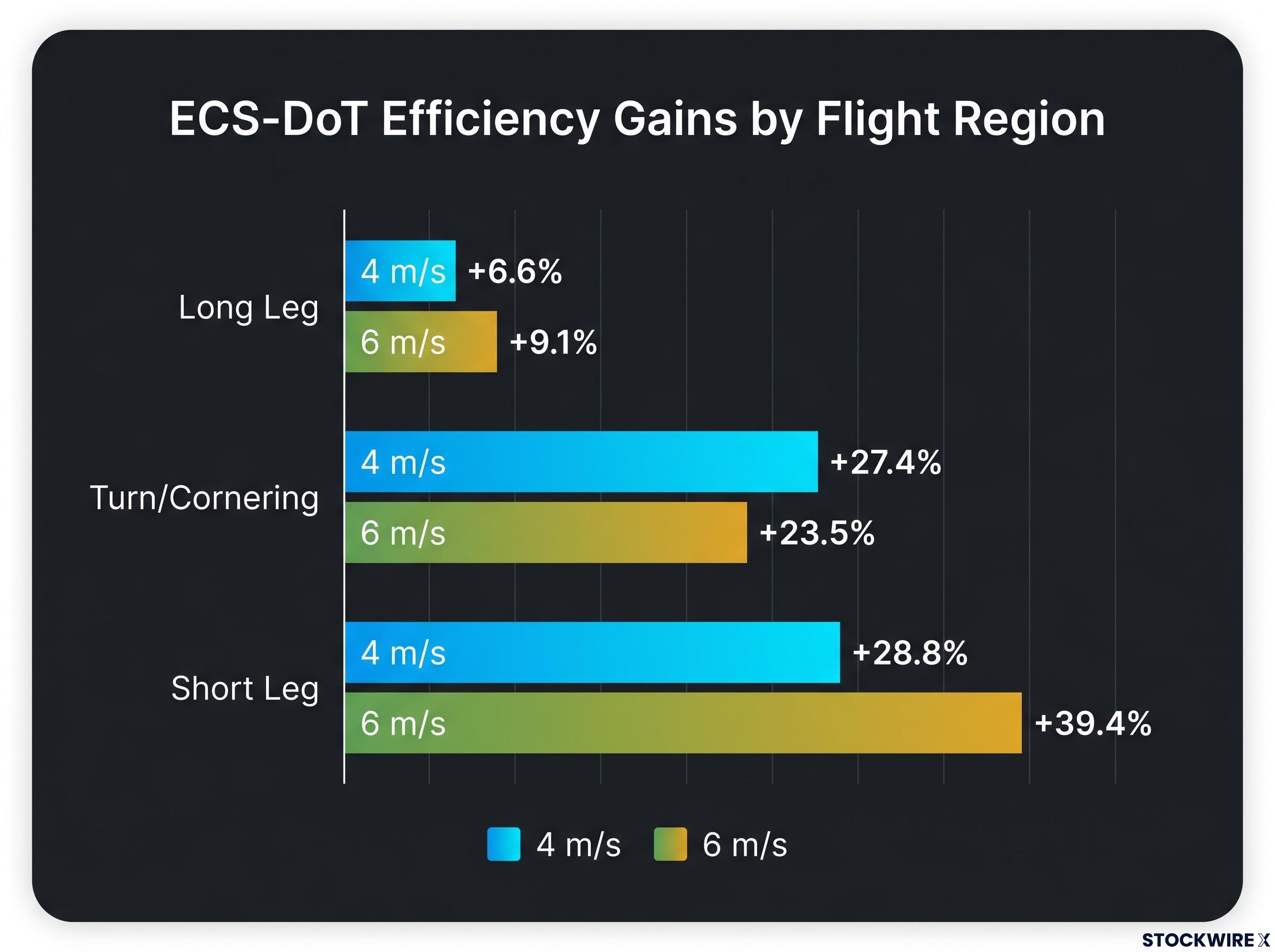
| Flight Region | 4 m/s Gain | 6 m/s Gain |
|---|---|---|
| Long Leg | +6.6% | +9.1% |
| Short Leg | +28.8% | +39.4% |
| Turn/Cornering | +27.4% | +23.5% |
Commercial drone operations, particularly agriculture, surveillance, and delivery, involve frequent turns and short legs. Gains of 28-39% on these segments translate directly to more mission coverage per charge, lower battery cycle consumption, and reduced operating costs across any application where drones fly structured, multi-segment routes.
The accumulated energy curves showed ECS-DoT consistently consumed less energy per metre flown than the baseline autopilot at both speeds, with the gap widening progressively across the full length of the mission. This compounding behaviour reflects the continuous nature of real-time speed optimisation: every metre of cruise flight presents an opportunity for the AI to reduce energy consumption, and those savings accumulate over the duration of the mission.
Commercial applications and market opportunity
ECS-DoT’s efficiency gains demonstrate particular applicability across key commercial verticals where tight turns, acceleration, and deceleration create the most energy-intensive flight phases:
- Urban reconnaissance and surveillance: Tight turning radii, constant acceleration and deceleration, and variable speeds in confined airspace create high energy variance. More coverage per charge in dense environments; viable in communications-denied or contested urban settings.
- Precision agriculture – crop spraying: Lawnmower patterns with repeated short legs and turns; battery swaps interrupt operations across large paddocks. Fewer battery swaps per session, lower cost per hectare, reduced labour downtime.
- Precision agriculture – multispectral surveying: Fixed lawnmower survey patterns at defined speeds; larger areas require more passes and more battery changes. Larger areas completed in a single flight; fewer multi-pass stitching operations.
- Defence – perimeter surveillance: Repetitive boundary-trace routes at consistent speeds; battery swaps create vulnerability windows. More perimeter coverage per charge; fewer and shorter vulnerability windows.
- Last-mile delivery: Fixed point-to-point routes at defined cruise speeds; range per charge determines the serviceable delivery radius. Wider delivery radius, improved unit economics, no additional hardware capital expenditure.
The addressable market spans logistics, agriculture, defence, and infrastructure inspection, sectors with acute endurance constraints and high willingness to pay for efficiency solutions that do not require fleet replacement or airframe modifications.
The Spinoff Robotics acquisition adds proprietary airframes and sensing hardware to the ECS-DoT silicon layer, completing a full silicon-to-airframe stack that positions the combined entity to pursue defence ISR, critical infrastructure surveillance, and hazardous facility inspection markets.
IP filings and commercial development pathway
Nanoveu is in the final stages of its first major intellectual property filings covering the proprietary AI flight optimisation framework, speed-based endurance modelling, and the ECS-DoT chip’s integration architecture for UAV control systems. The IP programme is designed to establish long-term defensibility across the drone sector and create the foundation for a global licensing strategy as the technology scales.
In parallel, EMASS is working with a U.S.-based drone partner to integrate ECS-DoT alongside proprietary flight-control systems. Some commercial and defence drone platforms operate closed, proprietary flight-control architectures that cannot be modified or accessed by third parties. ECS-DoT is being developed to work alongside these systems through telemetry input alone, receiving data and applying real-time AI speed optimisation without requiring access to the controller’s internal parameters.
The company outlined two parallel development tracks:
- Further optimisation: Testing across more stringent environments, additional speed profiles, varied payload configurations, and more complex drone classes to stress-test AI models across a broader range of real-world conditions.
- Commercial engagement: Positioning for drone OEMs and avionics integrators across logistics, agriculture, defence, and infrastructure inspection as the trial programme matures.
Dr Mohamed M. Sabry Aly, Director and Founder of EMASS
“Taking ECS-DoT from simulation into live flight and seeing the data hold up is a significant validation. What these results demonstrate is that meaningful endurance gains do not require hardware changes. They require better control. ECS-DoT runs a full AI optimisation loop at under ten milliwatts, holds the drone tighter to its aerodynamic optimum than a conventional autopilot, and does so continuously across every metre of the mission. These are early-stage results and we expect them to grow as the models mature and we expand across more platforms and speeds.”
IP filings establish long-term defensibility and licensing optionality. U.S. partner engagement signals a near-term commercial pathway into closed, proprietary drone platforms used in defence and enterprise applications.
Early-stage results treated as a lower bound
Management expects gains to scale as AI models mature and testing extends to heavier and more complex drone classes. The company identified three scaling vectors: heavier and more complex drone platforms, multi-chip deployment compounding endurance and onboard AI capability, and broader speed profile testing.
The 27.8% efficiency gains recorded in initial trials represent the lower bound of what the technology is anticipated to deliver. As the AI models are further refined and tested across a wider range of speeds and airframes, the company expects gains to scale materially.
Dr Tan Chee How, CEO of Spinoff Robotics and Ph.D in Aerial Robotics
“Flight endurance has been the binding constraint on commercial drone adoption for years… What ECS-DoT demonstrates here is that meaningful gains are achievable through software and AI control alone, at a negligible power cost using ECS-DoT. That changes the economics of the problem entirely.”
If 27% gains represent the floor rather than the ceiling, the commercial proposition strengthens materially as the technology matures across additional platforms and operating conditions. The empirically validated results position ECS-DoT for engagement with drone OEMs and avionics integrators as the trial programme advances.
Want the Next AI Breakthrough in Your Inbox?
Join 20,000+ investors receiving FREE breaking ASX tech news within minutes of release, complete with in-depth analysis. Click the “Free Alerts” button at StockWire X to get real-time alerts and expert coverage delivered straight to your inbox the moment market-moving announcements drop.