

Nanoveu’s ECS-DoT drone trials record efficiency gains of up to 51.0% on complex flight paths
Nanoveu Limited has reported that EMASS completed a second phase of live drone flight trials with the ECS-DoT edge-AI chip, delivering peak cruise-efficiency gains of up to 51.0% at 7 m/s and average gains of 48.5% at 7 m/s across all trajectories tested.
The result builds on first-phase trials that recorded gains of up to 27.8% on simpler flight paths at speeds up to 6 m/s (ASX announcement dated 22 June 2026). The key distinction this time was the use of complex flight paths representative of commercial drone operations, rather than simple grid patterns.
The data indicates that efficiency gains scale with both speed and path complexity, meaning value grows precisely where conventional autopilots are weakest.
When big ASX news breaks, our subscribers know first
What the second-phase results delivered
The second phase introduced three new flight trajectories designed to replicate the complexity of real-world commercial drone operations, moving away from the straight-line lawnmower patterns used in initial trials.
The three trajectories tested were:
- Trajectory 1 — Irregular polygon with diagonal crossings, featuring sharp angular turns and highly non-linear segments.
- Trajectory 2 — Sinusoidal pattern requiring repeated S-curves and continuous direction reversals.
- Trajectory 3 — Dense zigzag with diagonal crossings, representing the most complex path tested.
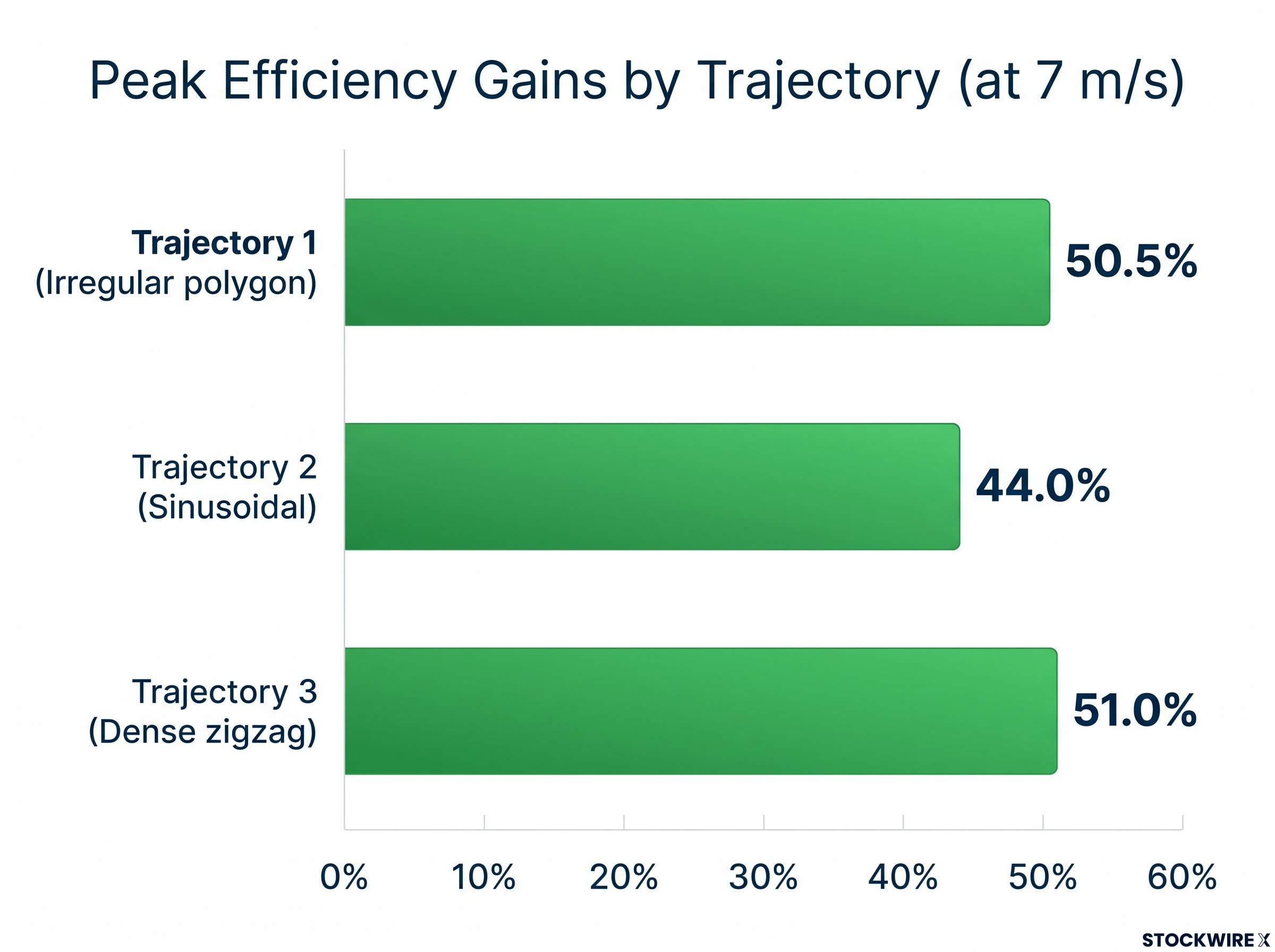
The following table summarises the peak efficiency gains recorded across the three trajectories at the highest tested speed of 7 m/s:
| Trajectory | Path Description | Peak Efficiency Gain (7 m/s) |
|---|---|---|
| Trajectory 1 | Irregular polygon, diagonal crossings | +50.5% |
| Trajectory 2 | Sinusoidal / repeated S-curves | +44.0% |
| Trajectory 3 | Dense zigzag, diagonal crossings | +51.0% |
The scaling story is the headline finding. Average gains rose from +5.7% at 3 m/s to +48.5% at 7 m/s across all three trajectories, increasing consistently with flight speed.
At 6 m/s, the speed common to both testing phases, gains on the complex paths (+33.2% to +40.7%) exceeded the +27.8% recorded on the simpler first-phase paths.
The first-phase live flight trials established the controlled methodology carried forward into this second phase, with ECS-DoT recording its strongest gains on short legs and turning segments, the same path features that dominate commercial agriculture, delivery, and surveillance routes.
How ECS-DoT works — real-time edge AI explained
ECS-DoT is EMASS’s onboard edge-AI chip that optimises drone flight in real time, working alongside the standard PX4 Autopilot. In plain terms, it processes decisions on the device itself rather than relying on an external computer or cloud connection.
The mechanism is straightforward. Conventional autopilots waste energy by constantly decelerating into turns and over-accelerating out of them, creating wide speed variance. ECS-DoT holds the drone tighter to its aerodynamic optimum speed, reducing that wasteful variance.
Key performance specifications reported for the chip include:
- Consumes less than 10 mW of total system power
- Executes control decisions at 64 Hz
- Adjusts drone speed approximately every 15 milliseconds
- Uses an onboard surrogate power model, requiring no cloud reliance or external computation
A surrogate power model is a trained AI model that predicts energy consumption for the drone’s current speed, heading, and flight conditions. This allows the chip to identify and hold the aerodynamic optimum for each specific path. According to the company, these gains require no additional battery capacity or hardware modifications.
Why this matters for commercial drone markets
The significance lies in where the largest gains occur. ECS-DoT delivers its greatest value during tight turns, acceleration, and deceleration, the phases most common to real commercial operations and least efficient under conventional autopilot control.
The trial maintained the same controlled, empirical, like-for-like methodology as the first phase. Testing used a 2.8 kg quadcopter (inclusive of a 1.3 kg Li-Polymer 6S battery) at an altitude of 3.5 m, with efficiency measured as metres travelled per watt-hour of battery energy consumed.
The table below outlines how the trajectories translate across key commercial use cases:
| Drone Use Case | Typical Baseline Flight Time | Most Representative Trajectory |
|---|---|---|
| Urban reconnaissance & surveillance | 20–30 min | Trajectory 1 (Irregular Polygon) |
| Precision agriculture – crop spraying | 10–15 min per tank | Trajectory 3 (Dense Zigzag) |
| Precision agriculture – multispectral surveying | 25–40 min | Trajectory 3 (Dense Zigzag) |
| Defence – perimeter surveillance | 30–45 min | Trajectory 2 (Sinusoidal) |
| Last-mile delivery | 20–35 min | Trajectory 1 (Irregular Polygon) |
Dr. Mohamed M. Sabry Aly, Director and Founder of EMASS
“When we published our first live flight results, we were clear that 27.8% was a starting point, not a ceiling. These latest results support that. Flying more complex, real-world flight paths at higher speeds, we are now seeing gains of up to 51.0%. The mechanism is the same; ECS-DoT holds the drone tighter to its aerodynamic optimum than any conventional autopilot can, at under ten milliwatts of power. What changes with more complex paths is that the baseline gets worse, and ECS-DoT does not. That gap is where the value lives.”
What management says the data proves
Management framed the results as evidence of software-led efficiency gains, contrasting this with the drone industry’s traditional pursuit of endurance through hardware.
Dr Tan Chee How, CEO of Spinoff Robotics (a wholly owned Nanoveu subsidiary)
“A 51.0% efficiency gain on a real-world flight path is not an incremental improvement. It is a fundamental shift in what is achievable through software and AI control alone. The drone industry has spent years chasing endurance through hardware. What this data shows is that the bigger gains were always in the control layer. ECS-DoT is now demonstrating that on the most demanding paths operators actually fly, not simplified test grids.”
For balance, the company noted that results were recorded on a single 2.8 kg quadcopter at low altitude in controlled outdoor conditions, and may differ with other airframe classes, payloads, higher altitudes, or variable wind.
The road ahead for Nanoveu
The announcement did not disclose specific commercial timelines, contracts, or revenue figures. Instead, the value lies in what the validated data enables across the company’s target markets.
Per the company’s description, ECS-DoT is positioned for applications spanning drones, wearables, hearables, industrial IoT, robotics, and autonomous systems.
ECS-DoT’s multi-model edge AI capability extends beyond drone flight control; EMASS has separately demonstrated the chip running keyword detection and voice recognition concurrently at under 500 µW, underscoring that the same silicon architecture is targeting wearables, hearables, and industrial IoT alongside autonomous flight applications.
Nanoveu operates alongside entities including EMASS, a fabless semiconductor company developing the ECS-DoT edge-AI architecture, and Spinoff Robotics, a wholly owned subsidiary that designs proprietary drone platforms, including the tethered ALICE system and the METRON camera-based 3D measurement system.
For investors, the second-phase trials represent a validated, scalable software efficiency layer with clear applicability across multiple commercial drone segments, achieved without additional battery capacity or hardware modifications.
Don’t Miss the Next ASX Tech Breakout
Big News Blast delivers FREE breaking ASX tech news directly to your inbox within minutes of release, complete with in-depth analysis. Over 20,000 subscribers are already getting the edge on market-moving announcements before the broader market catches up. Click the “Free Alerts” button to start receiving alerts the moment news breaks.