

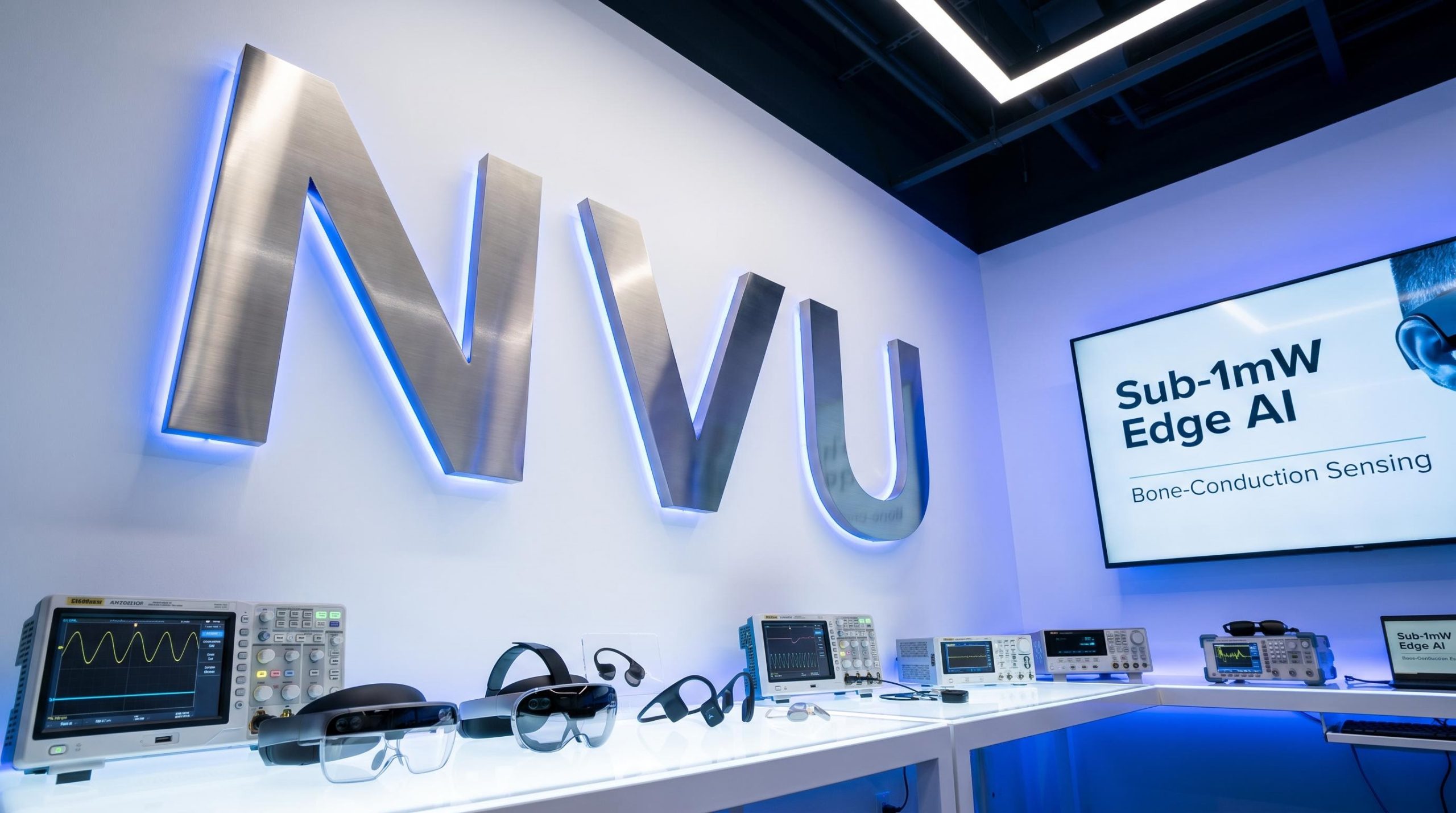
Nanoveu’s EMASS demonstrates microphone-free keyword spotting at under 1 milliwatt
Nanoveu has announced that EMASS achieved real-time keyword spotting using bone-conduction vibration sensing on its ECS-DoT edge AI SoC, operating at under 1 milliwatt of computational power. This removes the microphone from the detection path entirely, capturing speech through the user’s jawbone rather than through the air.
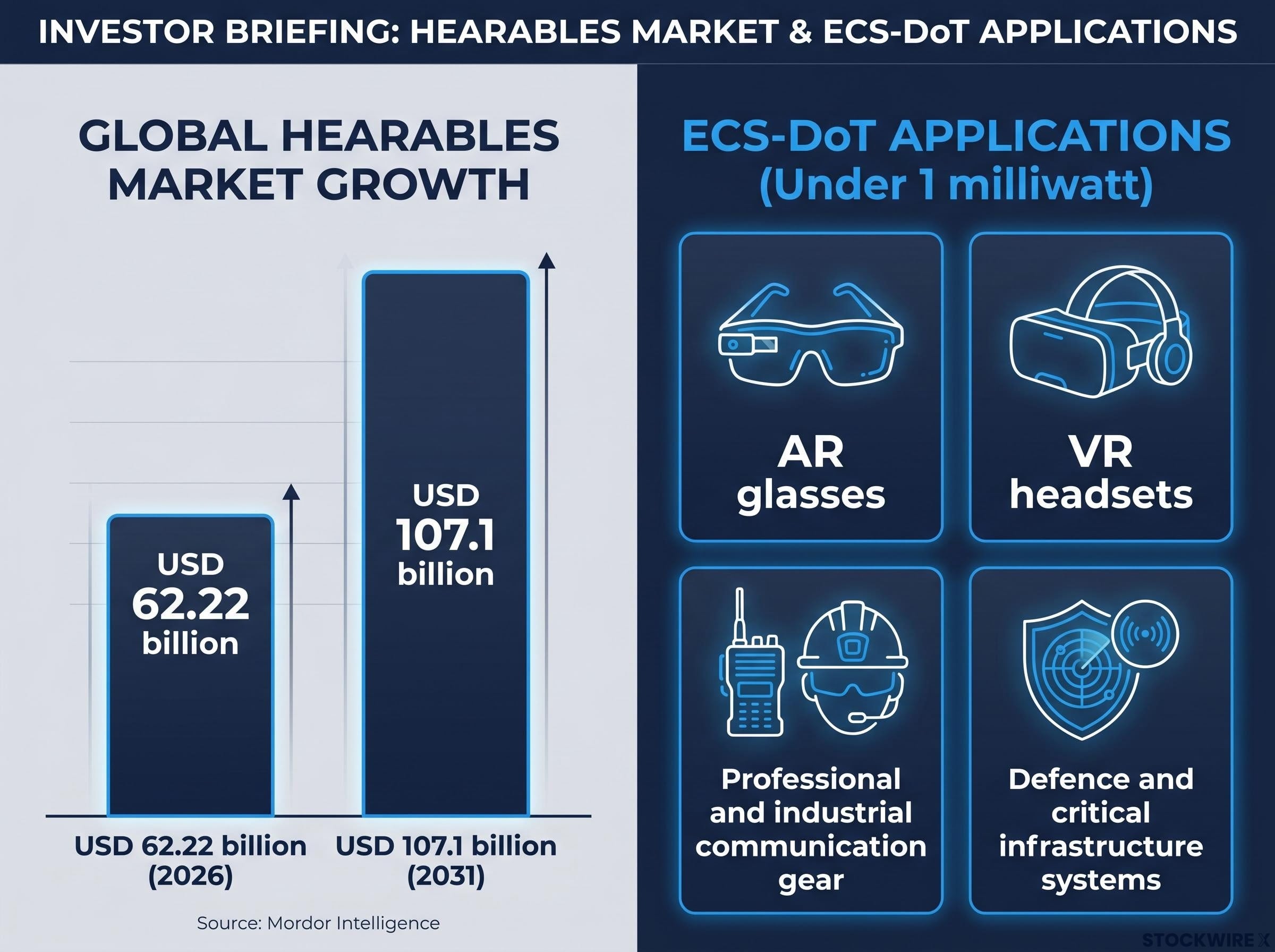
The development advances the bone-conduction hearables reference design announced in March 2026. The architecture addresses two persistent constraints in wearable voice interface design: power consumption and ambient noise. The hearables market is forecast to grow from USD 62.22 billion in 2026 to USD 107.1 billion by 2031, according to Mordor Intelligence.
ECS-DoT has been independently benchmarked at up to 20x the energy efficiency of leading edge-AI chips. The demonstration used a standard STMicroelectronics inertial measurement unit (IMU), with no specialised hardware required.
When big ASX news breaks, our subscribers know first
Why the hearables market has been stuck on a three-way trade-off
Hearables manufacturers have faced a fundamental challenge: designers have been forced to choose between noise immunity, low power and real-time response. Traditional microphone-based systems capture everything in the air, requiring continuous noise-cancellation processing that drains battery. Motion-triggered wake systems preserve power but introduce latency and still depend on activating higher-power processors.
Achieving all three simultaneously has remained out of reach until now.
| Property | Always-on Microphone | Motion-triggered Wake | Bone Conduction + ECS-DoT |
|---|---|---|---|
| Noise immunity | Processing-dependent | None | Structural |
| Low power | No | Partial | Sub-1mW demonstrated |
| Low latency | Yes | Wake delay | Real-time at sensor |
| Privacy | Always listening | Partial | Audio never captured |
This explains why EMASS’s solution represents a technical breakthrough rather than incremental improvement.
How bone-conduction sensing works for voice detection
Bone-conduction sensing captures micro-vibrations that propagate through the user’s jawbone when they speak. Because the signal comes from vibration rather than air, ambient noise from wind, crowds or machinery never enters the signal path. No specialised hardware is required, with the technology demonstrated using a standard STMicroelectronics IMU.
The sensing method provides a privacy benefit. Ambient conversations cannot be inadvertently captured because audio is never recorded. The technique offers noise immunity without additional processing cost, fundamentally changing the power equation for always-on voice interfaces.
Sub-milliwatt performance enables always-on operation
The complete keyword-spotting application runs always-on at under 1 milliwatt of computational power. This was achieved through aggressive model compression and AI model scaling tailored to ECS-DoT’s architecture, combined with advanced on-chip energy management. The sub-milliwatt inference budget allows the system to remain always on without materially affecting battery life in compact devices such as earbuds.
ECS-DoT’s architecture delivers up to 20x energy efficiency versus leading edge-AI chips. Battery life and thermal limits remain the primary technical hurdles in hearable design. Solving the power constraint unlocks commercial deployment across devices where continuous operation was previously impractical.
The 20x energy efficiency advantage over competing edge-AI chips was validated through MLCommons 2025 benchmarking data, a benchmark result that underpins the commercial case for ECS-DoT across hearables, IoT, and drone applications.
Applications extend beyond earbuds into AR, VR and defence
ECS-DoT’s capability extends to extracting meaningful signal from mechanical vibration at under 1 milliwatt, applicable across multiple markets. Target applications include:
- AR glasses with discreet, hands-free voice control designed to work when the user speaks quietly
- VR headsets enabling natural voice interaction without controller dependence or battery penalty
- Professional and industrial communication gear where noise immunity and battery life are mission-critical
- Defence and critical infrastructure systems requiring reliability and discretion
Future potential applications include voice authentication, user-intent detection, context-aware wearable AI, and other advanced human-machine interfaces. The total addressable market extends well beyond hearables, with AR/VR and defence representing high-value verticals.
Commercial pathway and next steps
Nanoveu outlined a three-pronged commercialisation approach for the bone-conduction sensing solution.
Technical development will focus on expanding the keyword vocabulary, hardening detection performance across users and operating conditions, and progressing toward production-ready reference designs. Commercial engagement is underway, with active discussions with device manufacturers and module makers across the hearables and AR ecosystem. The company is pursuing design-in engagements to integrate ECS-DoT-based vibration sensing into next-generation products.
Mark Goranson, Nanoveu’s CEO of Semiconductor Technologies
“This demonstration matters as much for what it confirms about ECS-DoT as a platform as for what it enables in wearables. Recognising speech directly from bone-conduction vibration at under one milliwatt, with no microphone in the signal path, shows the chip can extract a meaningful signal from mechanical vibration in real time, within a power budget that compact, battery-powered devices can support. We see that core capability as applicable well beyond hearables, to other products that need to interpret vibration on tight power and thermal budgets, and it is central to how we are positioning ECS-DoT.”
Active customer engagement signals movement from R&D demonstration toward commercial design-ins.
Investors exploring the financial runway supporting this development program can find our detailed coverage of the $7.5M raise and commercialisation roadmap, which outlines the dual-track strategy spanning TSMC manufacturing progression and live drone field trials expected to validate commercial readiness.
Market opportunity in numbers
The global hearables market is forecast to grow from USD 62.22 billion in 2026 to USD 107.1 billion by 2031, according to Mordor Intelligence (January 2026). The growth driver is demand for smarter, more capable devices in smaller form factors, with voice emerging as the primary control interface. As hearables evolve from audio accessories into AI-assistant endpoints, users expect to activate and command devices through speech alone, without buttons, taps or gestures.
Nanoveu is targeting a large and growing market with a solution that addresses previously unsolved technical constraints. The company’s technology delivers noise immunity, low power and real-time response simultaneously, where traditional architectures have required compromising at least one of these properties.
Want the Next Edge-AI Breakthrough in Your Inbox?
Join 20,000+ investors receiving FREE real-time alerts on ASX tech news, delivered within minutes of release with expert analysis included. Click the “Free Alerts” button at StockWire X to get breaking announcements and in-depth coverage before the market moves.