


Nanoveu’s EMASS teams with Bosch Sensortec on edge AI asset-tracking design
Nanoveu (ASX: NVU, OTCQB: NNVUF) has confirmed that its wholly owned subsidiary EMASS has collaborated with Bosch Sensortec, a wholly owned subsidiary of Robert Bosch GmbH, to develop an intelligent asset-tracking reference design built on the ECS-DoT ultra-low-power edge AI system-on-chip (SoC).
The design processes sensor data locally and transmits only meaningful events rather than continuous streams of raw data, significantly reducing both power consumption and wireless data transmission for battery-powered tracking devices.
Announced on 23 July 2026, the collaboration is positioned as a technical evaluation platform rather than a commercial sales contract. The reference design is now available for evaluation by customers, adding to EMASS’s growing range of ECS-DoT reference platforms.
Bosch Sensortec brings considerable weight to the collaboration. Founded in 2005, the company has emerged as a MEMS (microelectromechanical systems) technology leader, with Bosch operating as a provider in the MEMS sensor segment since 1995 and having sold more than 26 billion MEMS sensors to date.
For investors, the involvement of a global tier-one sensor supplier lends technical credibility to EMASS’s silicon and broadens the range of reference platforms available to prospective customers evaluating the ECS-DoT platform.
When big ASX news breaks, our subscribers know first
How the event-driven design works
The reference design combines the EMASS ECS-DoT platform with five Bosch Sensortec sensors spanning motion, environmental, pressure, magnetic and gas sensing. ECS-DoT fuses data from these multiple sensing modalities and executes edge AI models locally, converting raw sensor inputs into meaningful contextual events before wireless transmission.
The event-driven architecture enables continuous sensing and AI inference at ultra-low power. Higher-power resources such as wireless communications and GPS are activated only when a meaningful event is detected.
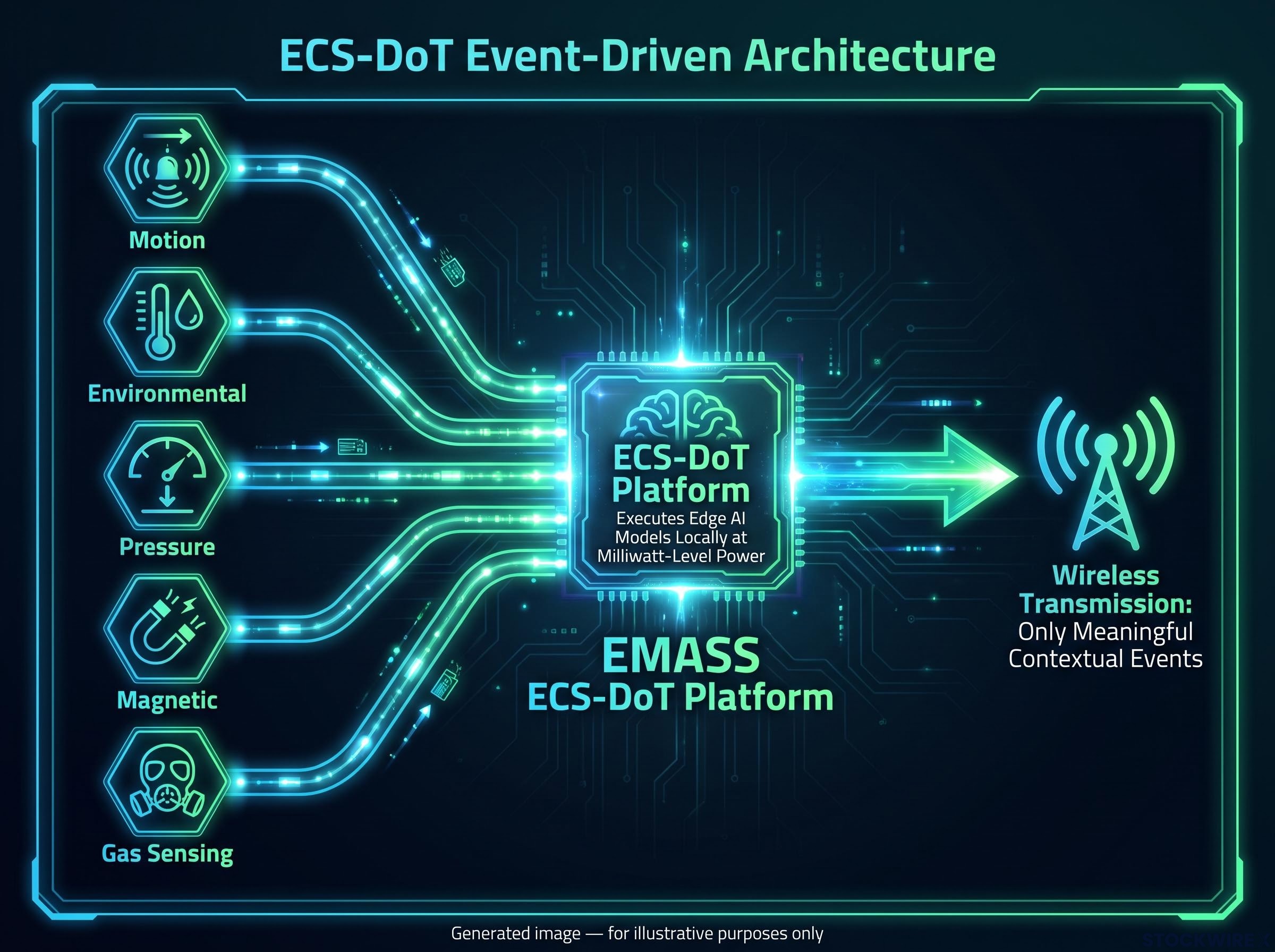
Notably, the platform tracks not only asset location, including in GPS-denied environments, but also handling and environmental conditions during transit. This contrasts with traditional trackers, which typically collect and transmit large volumes of sensor data regardless of whether meaningful changes have occurred, increasing power draw and shortening battery life.
Designed as a configurable platform, the architecture can be adapted across multiple applications:
-
Warehouse logistics
-
Cold-chain monitoring
-
Industrial IoT
-
High-value and sensitive cargo protection
Marcellino Gemelli, Director, Global Business Development, Bosch Sensortec
“By intelligently activating sensing, processing, and connectivity resources only when needed, the solution transforms raw sensor data into actionable events, enabling smarter, more sustainable, and highly configurable asset-tracking solutions across a wide range of logistics and industrial applications.”
What is edge AI, and why it matters here
Edge AI refers to processing data directly on the device itself rather than sending it to a remote cloud server for analysis. For battery-powered trackers, this distinction carries direct commercial consequences.
When a device processes data locally and transmits only meaningful events, it sends far less information over wireless networks. Less data transmitted means less power consumed, which translates into longer battery life and lower operating costs over the life of the device.
This is where the ECS-DoT platform’s core advantage sits. Its ability to run AI inference at milliwatt-level power addresses a long-standing engineering tradeoff between device intelligence and battery life.
The ECS-DoT platform’s 20x energy efficiency advantage over leading edge-AI chips, validated through MLCommons 2025 benchmarking, is the foundational performance claim underpinning EMASS’s commercial partnerships with Arrow Electronics, Semtech Corporation, and STMicroelectronics.
| Feature | Traditional Trackers | ECS-DoT Event-Driven Design |
|---|---|---|
| Data handling | Transmits continuous raw sensor data | Processes locally, transmits only meaningful events |
| Power consumption | Higher, due to constant transmission | Significantly reduced |
| Battery life | Shorter | Extended via ultra-low-power operation |
| GPS-denied capability | Not specified | Tracks location in GPS-denied environments |
| Contextual awareness | Not specified | Location, handling and environmental conditions |
Building the EMASS partner ecosystem
The collaboration forms part of EMASS’s broader strategy to expand its ecosystem of industry-leading technology partners and accelerate customer adoption of the ECS-DoT edge AI SoC across high-growth markets.
By working alongside leaders in sensing, connectivity and embedded systems, EMASS aims to create reference platforms that enable customers to rapidly evaluate and deploy next-generation edge AI solutions. This latest design adds to EMASS’s growing range of ECS-DoT reference platforms.
EMASS operates as a fabless semiconductor company specialising in ultra-low-power, AI-enabled SoC solutions for always-on sensing and intelligent processing at the edge. Its ECS-DoT architecture enables real-time AI inference at milliwatt-level power, supporting applications across drones, wearables, industrial IoT, robotics and autonomous systems.
Mark Goranson, Nanoveu CEO of Semiconductor Technologies
“Developers have long faced a tradeoff between intelligence and battery life in asset-tracking systems. Our collaboration with Bosch Sensortec demonstrates that those compromises are no longer necessary. By processing information where it’s created and transmitting only meaningful events, this reference design gives developers a blueprint for building a new generation of smarter, longer-lasting tracking devices.”
Each new tier-one partner has the potential to broaden the addressable market for ECS-DoT and support the platform’s commercial roadmap.
The investment takeaway and what’s next
Collaborating with a global MEMS leader validates the ECS-DoT technology and positions it within several high-growth markets, including logistics, industrial IoT and cold-chain monitoring.
Investors should note the precise commercial stage. The reference design is available for evaluation by customers developing next-generation asset-tracking solutions. The announcement discloses no revenue, order value or commercial timeline attached to the collaboration.
For readers assessing the development, four points stand out:
-
Tier-one validation from Bosch Sensortec, which has sold more than 26 billion MEMS sensors
-
An expanding library of ECS-DoT reference platforms
-
Addressable markets across logistics, industrial IoT, cold-chain and high-value assets
-
A design that addresses the intelligence-versus-battery-life tradeoff at the silicon level
As stated in the announcement, customers can evaluate the ECS-DoT platform via nanoveu.com/emass/products. Whether this technical validation converts into signed commercial agreements remains the key question for the next phase of the ECS-DoT roadmap.
For readers assessing where the Bosch Sensortec collaboration sits on EMASS’s broader execution timeline, our dedicated guide to ECS-DoT’s commercial funding milestones covers the $7.5 million capital raise, TSMC fabrication progression, and the dual-track strategy linking chip manufacturing to real-world field validation.
Don’t Miss the Next ASX Tech Breakout
Get FREE breaking ASX tech news delivered to your inbox within minutes of release, complete with in-depth analysis already done for you. Join 20,000+ investors who stay ahead of the market the moment announcements drop. Click the “Free Alerts” button at Big News Blast to start receiving alerts before the market moves.