

archTIS and Pexip partner on clearance-based access for secure video meetings
archTIS Limited (ASX:AR9, OTCQB:ARHLF) and Pexip have announced a strategic partnership to integrate archTIS Trusted Data Integration (TDI) with Pexip Secure Meetings. The archTIS Pexip partnership combines real-time, attribute-based access control with Pexip’s video conferencing, on the Pexip Infinity platform.
The joint solution uses archTIS TDI to enforce nationality and security-clearance rules, including the ability to admit, deny, or remove participants mid-call. According to the announcement dated 14 October 2026, the capability has been long requested by defence, intelligence, and regulated government customers.
The integration is available immediately from both Pexip and archTIS. Proof-of-concept engagements are underway with several allied government customers.
For archTIS shareholders, the partnership extends the company into a new channel through a partner that serves defence and government organisations. Commercial terms were not disclosed in the announcement.
Kurt Mueffelmann, Chief Strategy Officer and U.S. President, archTIS
“…Pexip and archTIS TDI elevate the enforcement point to the meeting itself, validating clearance, nationality and need-to-know authorization prior to entry to secure mission-critical communications.”
When big ASX news breaks, our subscribers know first
How the integration controls who joins a call
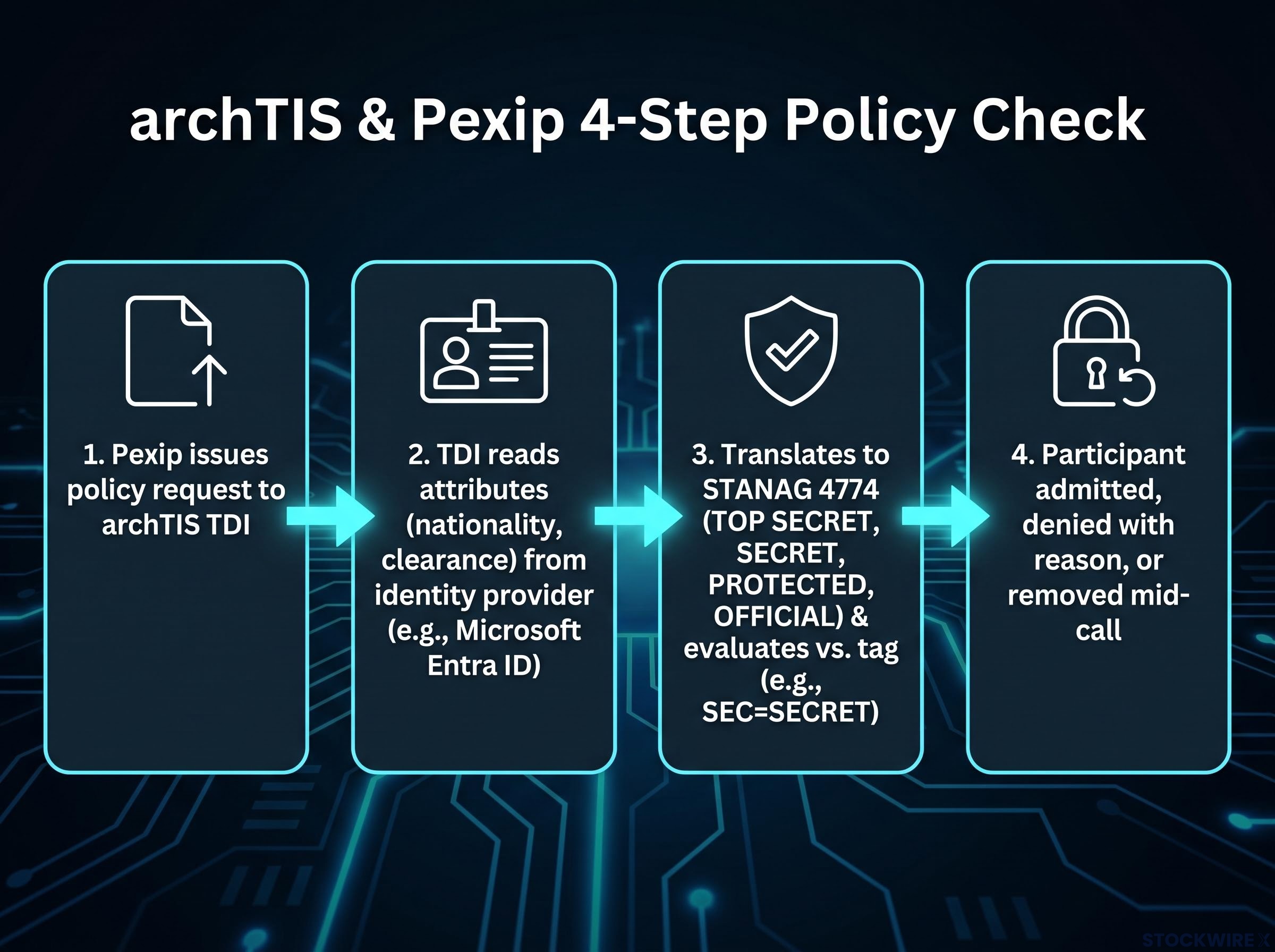
The policy check in four steps
The integration enables Pexip to dynamically issue a policy request to archTIS TDI each time a participant attempts to join a conference. The process works as follows:
- Pexip issues a policy request to archTIS TDI each time a participant attempts to join.
- TDI reads the participant’s attributes, including nationality and clearance, from the customer’s identity provider (for example, Microsoft Entra ID).
- Country-specific clearance codes are translated into a common STANAG 4774 classification (such as TOP SECRET, SECRET, PROTECTED, or OFFICIAL) and evaluated against the meeting’s required level, encoded in a service tag (for example, SEC=SECRET).
- Participants who meet or exceed the requirement are admitted, while those who do not are denied with a reason. If a participant’s attributes change during a session, the system can remove them immediately.
Why attribute-based access control matters
Attribute-based access control is an approach where access decisions rest on verified details about a person, such as nationality and security clearance, rather than only on possession of a link or password.
According to the announcement, video conferencing platforms have traditionally relied on meeting links, PINs, or lobby controls to manage who joins a call. None of these evaluate a user’s real-time clearance, nationality, or need-to-know principles.
The source describes this as a long-standing gap for defence organisations operating under multinational classification regimes.
The U.S. DoD has already validated NC Protect against attribute-based access control requirements, with all 60 Warfighter Command production test cases passed in a pilot report issued in May 2026.
Built for allied and coalition operations
Defence organisations operating under multinational classification regimes face differing clearance standards across countries. The announcement states that by combining Pexip Infinity’s video conferencing capabilities and deployment flexibility (on-premises, sovereign cloud, or hybrid) with archTIS TDI’s attribute-based policy engine, customers can run multinational meetings with the confidence that every participant is continuously authorized regardless of infrastructure.
Jordan Owens, CTO Americas, Pexip
“For defense organizations, the policy governing a meeting should come from the same systems that govern the rest of their mission environment. Pexip makes those policies actionable in video…”
Owens also said the integration lets organisations extend established access controls to conferences and participants, “while retaining ownership of the rules and data behind every decision.”
Allied demand for policy-enforced access is already visible in archTIS revenue, including a A$1.22 million military alliance contract for NC Protect that covers US and European defence users.
The table below contrasts the traditional controls described in the announcement with the combined offering.
| Capability | Links, PINs, lobby controls | archTIS TDI with Pexip |
|---|---|---|
| Real-time clearance check | Not evaluated | Enforced |
| Nationality check | Not evaluated | Enforced |
| Need-to-know authorization | Not evaluated | Validated prior to entry |
| Mid-call removal | Not described in source | Participants can be removed immediately if attributes change |
What the partnership means for archTIS investors
The partnership adds an integration and distribution pathway alongside Pexip, which is listed on the Oslo Stock Exchange and serves large enterprises and government organisations worldwide. The solution is available from both companies.
The proof-of-concept engagements with several allied government customers offer early validation. Customer names and conversion timing were not disclosed.
Key facts from the announcement:
- Available immediately from both Pexip and archTIS
- Aligned to the STANAG 4774 classification
- Reads attributes from identity providers such as Microsoft Entra ID
- Works with Pexip Infinity deployment options: on-premises, sovereign cloud, or hybrid
The announcement also notes archTIS’ broader product suite, which includes Trusted Data Integration, Kojensi, NC Protect, and Spirion.
The key item to watch is whether the proof-of-concept engagements convert into paying customers. The announcement gives no revenue guidance and does not disclose contract value or fees.
Get Tech News Before the Market Moves
Get FREE breaking ASX tech news delivered to your inbox within minutes of release, with in-depth analysis already done. Join 20,000+ subscribers who stay ahead of the market with Big News Blast. Click the “Free Alerts” button to start receiving real-time alerts the moment news breaks.