
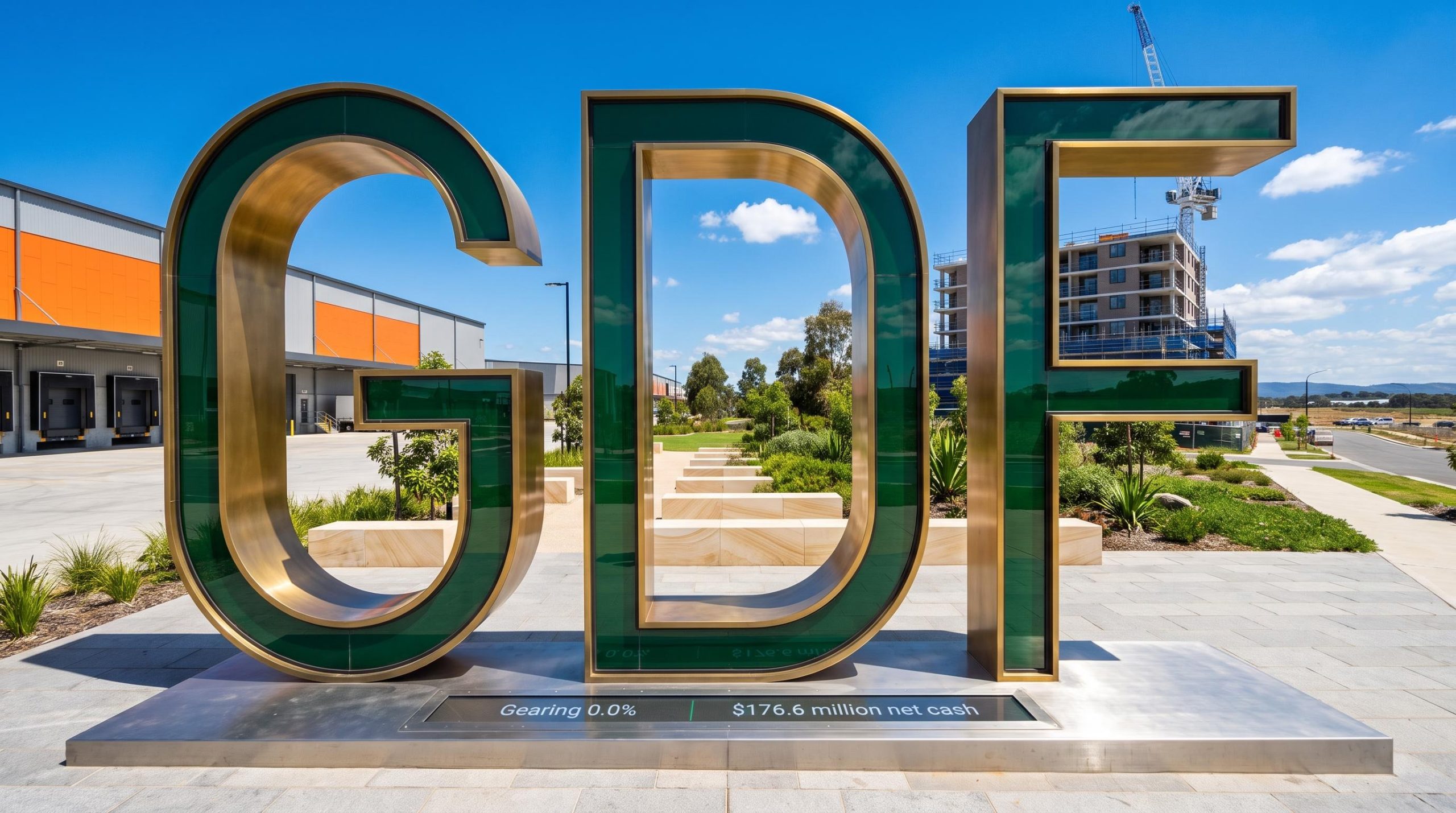
In its 21 October 2026 investor presentation, Garda Property Group outlined a portfolio divestment that positions it as a lending-led real estate investor. The presentation set out the sale of its remaining seven property assets to a Charter Hall managed fund for $300.0 million, alongside the Heathwood and Pinkenba divestments (together, the Transactions).
Gross proceeds total $350.8 million, a 1.4% discount to the $355.8 million carrying value. The presentation notes the discount increases to 5.2% after all settlement adjustments.
Management indicated the Transactions would result in repayment of all Group debt ($185.3 million), net cash of $176.6 million and gearing of 0.0%. Garda securities continue to trade at a 38% discount to pre-transaction NTA of $1.65 per security. Post-transaction NTA of $1.56 per security reflects a 52% premium to the ASX close of $1.025 on 20 October 2026.
Upgraded FY27 guidance
The presentation detailed upgraded FY27 guidance across earnings and distributions. Ordinary FY27 distributions increase to 12.5 cents per security, up from 9.0 cents.
| Metric | Pre-transaction | Post-transaction | Change |
|---|---|---|---|
| FFO per security | 10.5 cps | 12.5 cps | +19% from guidance |
| Distributions per security | 9.0 cps | 12.5 cps | +39% from guidance |
| Payout ratio | 85% | 100.0% | Nil tax deferred income |
The final three quarterly distributions increase to 3.4 cents, commencing in the December 2026 quarter.
Garda also intends to pay special distributions to assist with capital gain outcomes. The presentation cites anticipated special distributions totalling 10 cents per security in its NTA bridge, while the capital gain slide refers to special distributions totalling 9.8 cents per security.
The NTA composition of $1.56 is split 55% deployable cash and 45% loan receivables, according to the presentation.
When big ASX news breaks, our subscribers know first
Why management chose to sell now
Management framed the sale as a deliberate capital allocation decision, aimed at crystallising value at near carrying value in a market with significant uncertainty ahead. The presentation cited persistent inflation, elevated bond yields, weakening economic growth and rental growth requirements well beyond current market evidence.
Five rationale points were presented:
- The macro repricing: the property premium to the 10-year bond yield is ~63 bps, against a historical spread of 2% to 3%.
- Higher discount rates: long-duration property cash flows face stronger valuation headwinds as bond yields and funding costs rise.
- Narrower risk premium: the spread between the portfolio capitalisation rate and the 10-year bond yield leaves less compensation for illiquidity and asset risk.
- Rental growth uncertainty: valuation support requires sustained further rental growth well beyond current leasing market experience.
- More valuable optionality: selling crystallises value for redeployment into lending, while preserving flexibility to re-enter ownership or pursue a “develop-to-own” strategy when risk-adjusted returns justify the investment.
Supporting data included the Australian 10-year government bond yield of 5.23%, Garda’s portfolio weighted-average capitalisation rate of 5.88% and Garda’s cost of debt (before hedging) of 6.30%.
The 5.88% weighted-average capitalisation rate was drawn from the June 2026 portfolio valuations, which lifted the industrial portfolio by $8.3 million on Brisbane rental growth and rising land values.
The Charter Hall sale was struck at a 5.8% fully leased yield, compared with GDF’s implied capitalisation rate of 9.2%.
Understanding cap rates and the bond spread
A capitalisation rate is the annual rental income of a property divided by its value, expressed as a percentage. It is a common way to compare the income return of one property with another.
The bond yield is the return on a government bond, which carries minimal risk. The gap between the two is intended to compensate investors for the risks of owning property, including the difficulty of selling it quickly.
A thin spread therefore means less reward for illiquidity and asset risk. Management’s presentation linked this to its decision to crystallise value.
Timetable and settlement proceeds
The presentation set out four sale transactions expected to produce total gross settlement proceeds of $350.8 million.
| Transaction | Announced | Settlement | Proceeds |
|---|---|---|---|
| Pinkenba | 28 September 2026 | 22 January 2027 | $33.3m |
| Heathwood | 29 September 2026 | 20 November 2026 | $17.5m |
| Charter Hall fund (ex. Morningside) | 19 October 2026 | 20 November 2026 | $219.3m |
| Morningside | 19 October 2026 | March 2027 | $80.7m |
The detailed tax table in the presentation lists 1 December 2026 and 1 March 2027 as settlement dates for the Charter Hall assets, which differ from the timetable above. The timetable dates are used here.
The settlement bridge presented was:
- Current Group cash: $25.2m
- Heathwood and Pinkenba net sale proceeds: $50.2m
- Charter Hall gross proceeds: $300.0m
- Charter Hall transaction adjustments: ($12.6m)
- Debt repaid (exc. unamortised cost adjustment): ($186.0m)
- Net cash after settlements: $176.6m
Net sale proceeds total $337.6 million, with a gross capital gain of $90.7 million (41.7 cps gross and 20.8 cps net). Morningside is under construction, with a $10.896 million cost to complete for the facility expansion.
A lending-led platform with $321.0 million of investable capital
Post-transaction, lending becomes the primary capital deployment focus, while direct ownership and “develop to own” remain within the mandate when prospective returns justify the risk. The presentation described the platform as an owner-led, internally managed real estate capital allocator.
Capital capacity was presented as follows:
- Existing loan assets (prior to provisions): $144.4m
- Undrawn pipeline loans: $81.6m
- New lending capacity: $176.6m
- Total Group investable capital: $321.0m
The presentation also lists investable capital other than undrawn pipeline loans of $95.0m, which sits within the capacity table and is not additive to the total.
Four deployment pathways
- Committed lending: fund contracted and approved lending commitments as project milestones are achieved, subject to market conditions.
- Securities buy-back: acquire stapled securities where market pricing represents attractive value, subject to market conditions.
- New lending: originate residential and industrial lending opportunities across SEQ, subject to hurdle rates.
- Direct property and development: retain capacity where prospective equity returns exceed the applicable hurdle rate.
Loan book snapshot
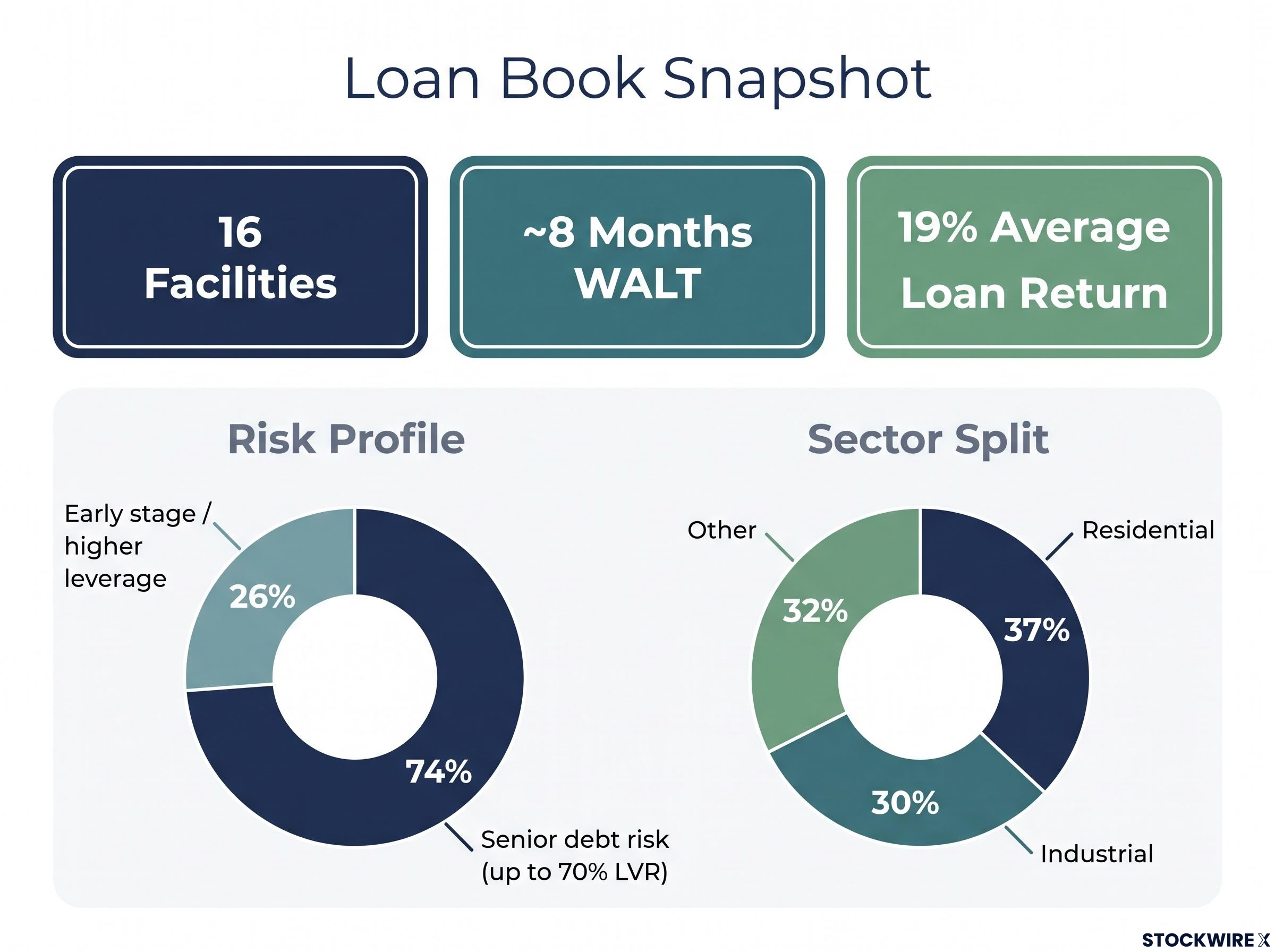
The loan book comprises 16 facilities with a loan WALT of ~8 months on drawn loan term and an average loan return of 19% per annum. Approximately 74% of the committed loan book is senior debt type risk of up to 70% LVR, while ~26% is in early stage and/or higher leverage positions where returns are intended to compensate for higher risk.
By loan limit, the sector split is 37% residential, 30% industrial and 32% other.
Management cited real estate expertise, milestone-based controls and project supervision, and active management of work-outs as differentiators. Executive Chairman Matthew Madsen, who has +30 years in real estate and funds management, sits on the board of the internally managed platform.
For readers wanting to see how the lending book reached this scale, our full explainer on Garda’s FY26 results walks through the 54% FFO per security increase, the near doubling of loan assets and the shift in revenue mix toward lending.
Don’t Miss the Next Real Estate Move on the ASX
Get FREE breaking ASX news on non-resource sectors delivered to your inbox within minutes of release, complete with in-depth analysis. Join 20,000+ subscribers already ahead of the market with Big News Blast. Click the “Free Alerts” button to receive alerts the moment market-moving announcements land.