
MPW 6061 aluminium powder qualified for US Department of Defence cold spray
The US Army Combat Capabilities Development Command has qualified Metal Powder Works 6061 aluminium powder for production cold spray repairs, moving the material beyond research and development trials and into approved defence use. The qualification was completed following testing by the University of Dayton Research Institute (UDRI).
As a result, MPW’s 6061 powder will be added to the Defense Logistics Agency (DLA) Qualified Parts List (QPL) and assigned a National Stock Number (NSN), establishing it as a standard catalogue consumable across US Department of Defence (DoD) logistics systems.
The Company noted the qualification was initiated in response to demand from DoD cold spray end-users seeking access to higher-performing materials through standard logistics channels. For investors, the outcome establishes a pathway to recurring US defence powder sales rather than one-off project orders.
When big ASX news breaks, our subscribers know first
What the QPL and NSN listing means for MPW
Inclusion on the DLA Qualified Parts List (QPL) confirms that MPW’s 6061 powder meets the stringent quality and performance standards required for defence applications. It also provides a streamlined procurement pathway for the thousands of defence manufacturers and repair facilities that rely on DLA-approved materials.
Once listed with a National Stock Number (NSN), the powder becomes a repeat-use consumable, linking demand to ongoing cold spray repair activity rather than single project purchases. This is the core of the recurring-revenue thesis: consumption tied to routine sustainment work across the DoD’s installed base.
Key procurement benefits of the listing include:
-
Orderable directly by depot-level maintenance and manufacturing facilities
-
Reduced purchasing friction and lead times
-
Access to thousands of DoD defence manufacturers and repair facilities
-
Standard catalogue consumable across US DoD logistics systems
Understanding cold spray technology and the DoD opportunity
Cold spray is an advanced additive manufacturing technology used by defence and industrial organisations to restore high-value components, extend platform service life and reduce maintenance downtime. Rather than replacing an entire part, operators repair critical components, delivering sustainment savings.
Why does this matter to investors? Each approved repair creates recurring demand for qualified metal powders. As the number of approved applications grows, so does the pull-through volume of consumable powder required to service them.
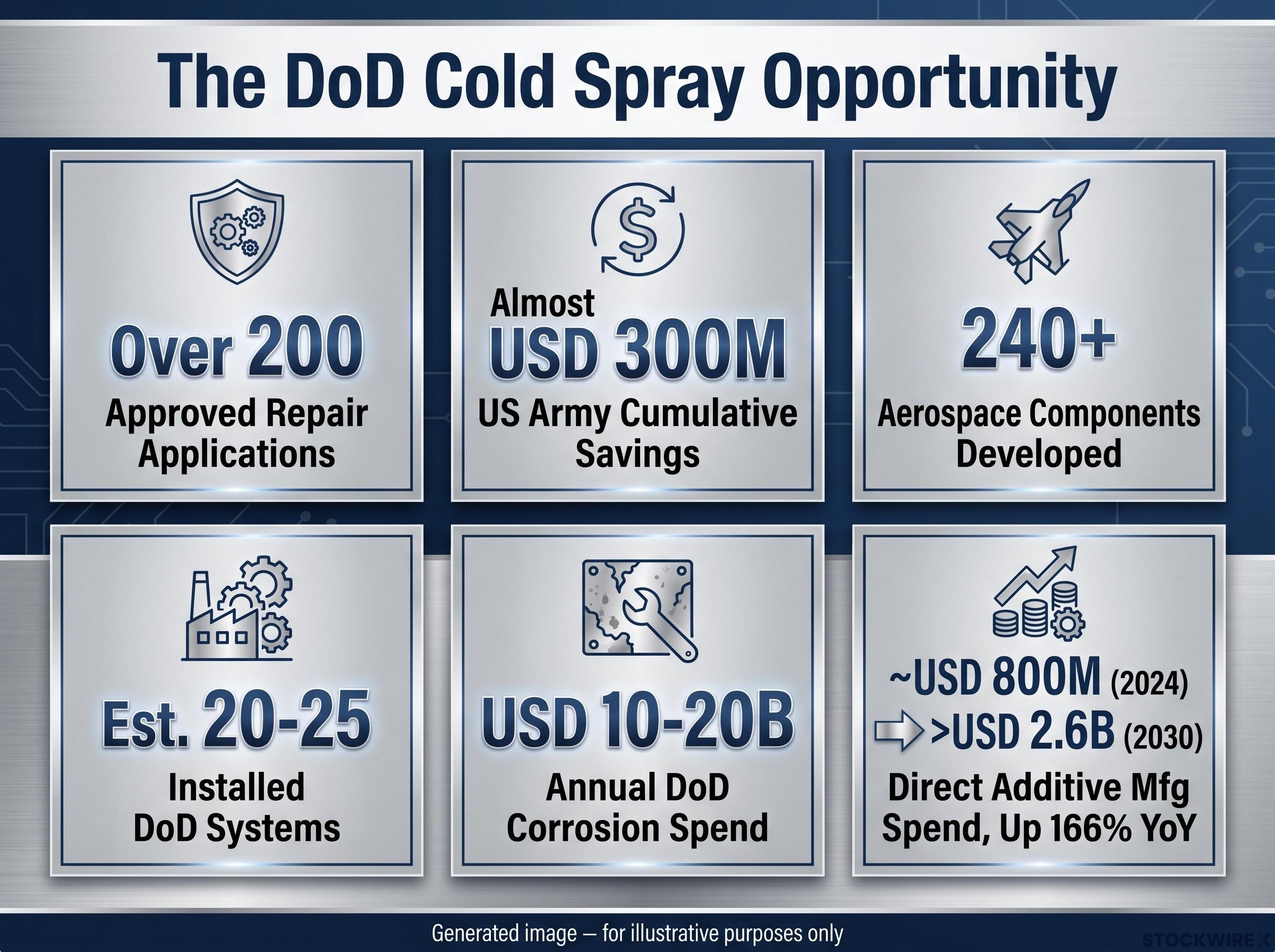
The scale of the DoD cold spray opportunity is substantial, as the following figures illustrate.
| Metric | Figure |
|---|---|
| DoD cold spray repair applications approved | Over 200 |
| US Army cumulative savings from cold spray repairs | Almost USD 300 million |
| Aerospace components with cold spray repair processes developed | 240+ (B-1 Lancer, AH-64 Apache, UH-60 Blackhawk, F-15, F-18) |
| Installed high-pressure cold spray systems at DoD facilities | Est. 20–25 |
| Annual DoD corrosion prevention/mitigation spend | USD 10–20 billion |
| Direct DoD additive manufacturing spend (2024) | ~USD 800 million (up 166% YoY); forecast >USD 2.6 billion by 2030 |
Supporting this trajectory, an April 2025 US defence directive called on all military services to extend advanced manufacturing, including additive manufacturing, to operational units by 2026. The Navy is expanding its network of cold spray “pop-up” production cells near major fleet concentration areas, and the DoD’s cold spray fleet is expected to grow materially in the near term.
The DirectPowder™ performance advantage
MPW’s patented DirectPowder™ technology produces powders through a non-melt production method. The process delivers a high yield across a narrow range of sizes and does not produce fines or satellites, which can cause poor flow characteristics.
Because of this morphology, powder acceleration is superior to legacy atomised material, a key success factor in cold spray. The microstructure and temper of the feedstock are also preserved, resulting in more consistent deposits with improved mechanical properties.
Independent validation across two alloy systems supports these claims:
-
UDRI testing found MPW’s 6061 aluminium powder delivered better strength than conventional atomised powders in cold spray applications.
-
In September 2025, HAMR Industries LLC independently confirmed that MPW’s CP Ti (commercially pure titanium) powder delivered performance consistent with MMPDS handbook strength values, versus approximately 80% typically achieved by legacy atomised powders.
-
HAMR also reported exceedingly high deposition efficiency with the CP Ti powder, meaning more of the powder bonds to the target surface, reducing waste and consumption.
Taken together, the results across CP Ti and 6061 aluminium provide independently verified evidence of MPW’s performance advantage. The Company believes this should position its powders as a preferred, cost-competitive choice for defence and industrial cold spray operations where component integrity is critical.
L-PBF process validation has reinforced the same performance thesis across a second additive manufacturing method, with independent testing confirming MPW’s CP Titanium Grade 2 powder exceeds all three ASTM B384 structural benchmarks, delivering Grade 4 mechanical performance within Grade 2 chemistry limits.
Beyond defence, the wider cold spray market
The performance advantages carry implications beyond US defence. According to Grand View Research (2025), the global cold spray technology market was valued at approximately USD 1.05 billion in 2024 and is projected to reach USD 1.56 billion by 2030, growing at a CAGR of 7.0%.
Aerospace and defence applications account for approximately 44% of global cold spray revenue, with the balance spread across automotive, energy, electronics, maritime and heavy industrial sectors. The Company expects US DoD qualification and QPL listing to provide a powerful reference standard for commercial aerospace, energy and industrial users, supporting its broader market entry strategy beyond defence.
CEO John Barnes on the qualification
John Barnes, Founder and Managing Director
“Cold spray is now a production sustainment tool, not an R&D experiment. I have been using cold spray in aerospace and defence applications for more than 20 years, and my teams at Lockheed Martin and CSIRO have spent much of that time working to qualify restorations and repairs for everyday use.
With this US Army qualification, MPW powders meet or exceed the performance of legacy atomised powders, with better consistency – no fines, and no satellites. That combination is exactly what cold spray operators need as they move from one-off demonstrations to routine, fleet-wide repairs. Coupled with the US Navy’s expeditionary DirectPowder™ system which recently completed trials at sea during RIMPAC 2026, MPW is indeed in a unique position for powder manufacturers.”
Ongoing qualification programme and next steps
The qualification decision was driven by end-user demand from DoD maintenance and repair facilities seeking access to higher-performing consumables. UDRI qualifies materials at the direction of the DoD and is funded by the US Air Force Rapid Sustainment Office (RSO).
The forward roadmap points to expanding the recurring-revenue base through additional qualified alloys:
-
UDRI is currently qualifying several additional MPW powder alloys, driven by end-user demand.
-
The Company’s objective is to have 3–5 alloy/process combinations qualified through UDRI and listed on the DLA QPL.
-
Each additional qualified alloy expands approved repair applications and increases pull-through powder volumes per system.
-
Once qualified via the US Army Research Laboratory, all US military services can source MPW powders.
By progressing a portfolio of alloys through UDRI and onto the DLA QPL, MPW is building a catalogue of qualified consumables intended to reinforce its role as a default supplier across defence and industrial cold spray fleets. For investors, each additional qualified alloy strengthens the pathway toward repeatable, consumption-linked powder revenue.
For investors exploring how MPW intends to supply a growing portfolio of qualified alloys at defence and industrial volumes, our deep-dive into MPW’s NextGen production scale-up covers the 100 tpa commercial validation, the capital efficiency advantage over conventional gas atomizers, and the pathway to 800 MT installed capacity.
Get Defence Sector News Before the Market Moves
Big News Blast delivers FREE breaking ASX announcements straight to your inbox within minutes of release, complete with in-depth analysis already done for you. Join 20,000+ investors who never miss a market-moving update. Click the “Free Alerts” button at StockWire X to start receiving alerts the moment news breaks.