
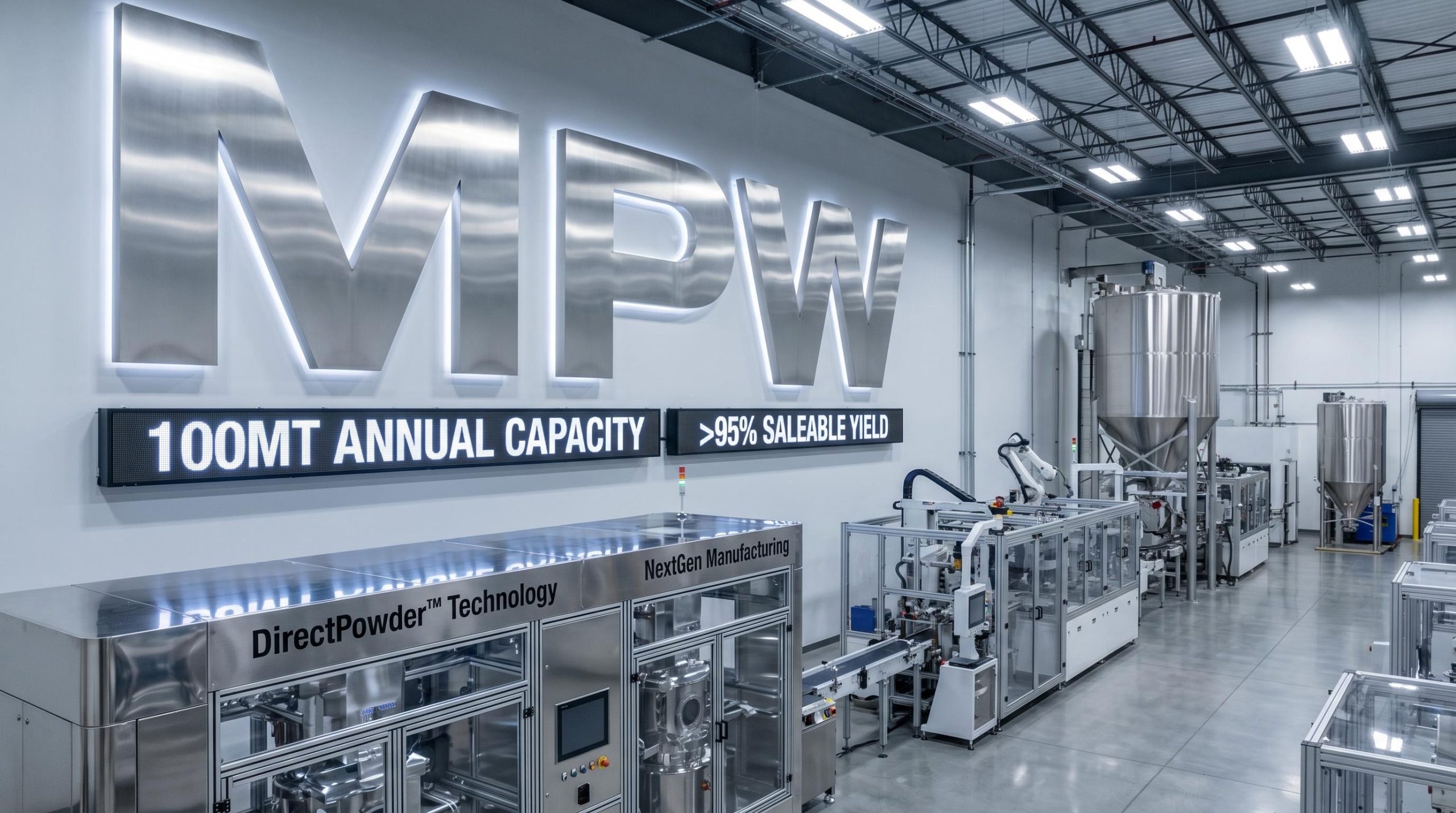
Metal Powder Works scales to 100-tonne annual capacity with 95% saleable yield
Metal Powder Works (ASX: MPW) has announced its NextGen production unit has achieved 100 tonnes per annum (tpa) sustained capacity with in-specification saleable yield exceeding 95%. This performance validates the company’s DirectPowder™ technology at commercial scale and immediately increases total production capacity from 20 tpa to 120 tpa within its existing Pittsburgh facility.
The yield differential represents a fundamental shift in metal powder economics. Conventional gas atomizers typically achieve 30-50% saleable yield, meaning roughly half of the processed material fails to meet specification and must be reprocessed or scrapped. MPW’s platform delivers more than 95% saleable product from the same raw input, translating directly into lower effective production costs and higher margins per tonne produced.
Co-Founder and CEO John Barnes stated: “The numbers speak for themselves. Our technical team met the 100 tpa rate as expected, whilst preserving industry-leading yield above 95%. We immediately scale capacity from 20 tpa to 120 tpa within our existing facility.”
The NextGen achievement provides an operational blueprint for the company’s pathway to 800MT of installed capacity by 2028, with the first additional NextGen unit targeted for deployment in H2 2026.
When big ASX news breaks, our subscribers know first
How DirectPowder™ technology disrupts conventional metal powder production
Metal powder serves as the raw feedstock for additive manufacturing (3D printing) applications across aerospace, defence, and industrial sectors. The quality, consistency, and cost of powder directly impact the viability of manufacturing critical components through additive processes rather than traditional machining or casting methods.
Conventional gas atomization involves melting metal, spraying it with inert gas to create droplets that solidify into powder particles, then sieving to separate material meeting specification. This process typically yields only 30-50% saleable product, with the remainder requiring reprocessing or disposal. The inherent inefficiency stems from limited control over particle size distribution during the atomization event.
MPW’s DirectPowder™ process takes a fundamentally different approach. The patented, non-thermal method converts premium bar stock directly into powder without melting, enabling precise control over particle characteristics. The company describes this as “the first true innovation in powder manufacturing in over 50 years.”
The commercial implication is straightforward: conventional methods waste approximately half the input material, creating cost and environmental inefficiencies that compound at production scale. MPW’s technology addresses this structural inefficiency by delivering more than 95% saleable yield from each production run.
Capital efficiency sets MPW apart from conventional atomizer economics
The capital efficiency differential between DirectPowder™ and gas atomization creates a structural cost advantage that compounds as the company scales production.
MPW’s NextGen unit requires US$250,000 in capital expenditure and delivers approximately 95 tonnes of saleable product annually. This equates to effective capital cost of approximately US$2,600 per saleable tonne. Conventional gas atomizers require US$20,000-80,000 per saleable tonne when accounting for their lower yield rates.
The company’s pathway to 800MT total installed capacity requires approximately US$2 million in capital outlay. This represents less than the cost of a single conventional atomizer whilst delivering eight times the current NextGen output.
Additional operational advantages include reduced facility space requirements, lower personnel costs, and decreased energy consumption compared to thermal atomization processes.
| Metric | MPW NextGen | Gas Atomiser | MPW Advantage |
|---|---|---|---|
| CAPEX per unit | US$0.25M | ~US$2M | 8x lower |
| Total capacity | ~100 MT/yr | ~200 MT/yr | Half the nameplate capacity |
| In-spec saleable yield | >95% | ~50% | 1.9x higher |
| Saleable capacity | ~95 MT/yr | ~100 MT/yr | Comparable output |
| CAPEX efficiency | ~US$2,632/saleable MT | ~US$20,000/saleable MT | 7.6x more efficient |
Capital efficiency at this scale means MPW can build production capacity 8-10x cheaper than competitors relying on conventional technology. This structural cost advantage compounds as the company scales, enabling capacity expansion without the dilutive capital raises typically required for manufacturing scale-ups.
Two-machine platform creates qualification-to-production pipeline
MPW operates a two-machine commercial model designed to de-risk customer adoption. The current generation machine handles customer-specific alloy qualification work, whilst the NextGen platform processes high-volume commercial production.
The current generation unit remains in active qualification discussions with customers across alloys beyond the company’s current production scope. Once a new alloy achieves qualification and demonstrates commercial demand, production transfers seamlessly to NextGen at 100MT capacity increments.
Barnes highlighted the platform’s flexibility: “Testing has shown that we can flexibly and reliably move between our low-volume and high-volume systems, allowing us to scale easily and match customer needs.”
This approach reduces adoption friction for customers. Aerospace and defence manufacturers can test alloys on smaller equipment before committing to volume orders, minimising technical and commercial risk whilst maintaining a clear pathway to scaled production.
John Barnes, Co-Founder and CEO
“Our growth is tied to bringing more powder choice to the market rather than being constrained by the growth of one or two alloys.”
The statement reflects MPW’s strategic positioning: rather than betting on one or two specific alloys achieving market dominance, the platform enables the company to respond to diverse customer demand across multiple material specifications.
Aerospace powder gap represents significant market opportunity
The SAE Aerospace Material Specifications (AMS) contains more than 2,000 active aerospace material specifications covering wrought metal alloy forms currently used across the aerospace industry. As of 2025, fewer than 20 metal alloy powder feedstock specifications have been formally approved for aerospace additive manufacturing.
This specification gap quantifies the addressable market. Aerospace manufacturers work with hundreds of alloy specifications in traditional wrought forms but lack powder equivalents certified for additive manufacturing processes. MPW’s DirectPowder™ platform is designed to close this gap by qualifying customer-demanded alloys and scaling them efficiently for commercial production.
The company currently produces 25+ powders across multiple categories:
- High-strength aluminium alloys
- Copper and copper-nickel alloys
- Specialty alloys including CP-Ti
- Zircaloy
MPW received the 2024 Material Company of the Year award from the 3D Printing Industry Awards, providing third-party validation of its technical and commercial positioning within the additive manufacturing sector.
The 2,000 vs 20 specification differential frames the commercial opportunity: manufacturers seeking powder versions of alloys they already use in traditional forms represent a defined addressable market that DirectPowder™ technology is positioned to serve.
Pathway to 800MT installed capacity by 2028
MPW has outlined a clear expansion timeline anchored by the NextGen platform’s validated performance. The first additional NextGen unit is targeted for deployment in H2 2026 within the existing Neighborhood 91 Pittsburgh facility.
The company aims to reach 800MT installed capacity by 2028, representing an approximately 8x increase from the current 100MT NextGen output. Total capital requirement for the full 800MT build-out is estimated at approximately US$2 million.
Current production capacity breakdown:
- Current generation machine: 20 tpa
- NextGen platform: 100 tpa
- Total installed capacity: 120 tpa
Expansion milestones:
- Current: 120 tpa total capacity (20 tpa current gen + 100 tpa NextGen)
- H2 2026: First additional NextGen unit deployment
- 2028: 800MT installed capacity target
The company will complete remaining commissioning activities on the NextGen platform and continue integrating the system into commercial production workflows ahead of the first additional unit deployment.
The capital efficiency outlined earlier means MPW can fund significant capacity expansion without the equity dilution typically associated with manufacturing scale-ups. Approximately US$2 million in total capital outlay to achieve 8x output growth represents a structural advantage relative to conventional powder production economics.
Want the Next Manufacturing Breakthrough in Your Inbox?
Join 20,000+ investors receiving FREE breaking ASX news within minutes of release, complete with expert analysis. Click the “Free Alerts” button at Big News Blast to get real-time alerts on Manufacturing, Tech, Healthcare, and Finance stocks the moment market-moving announcements drop.