

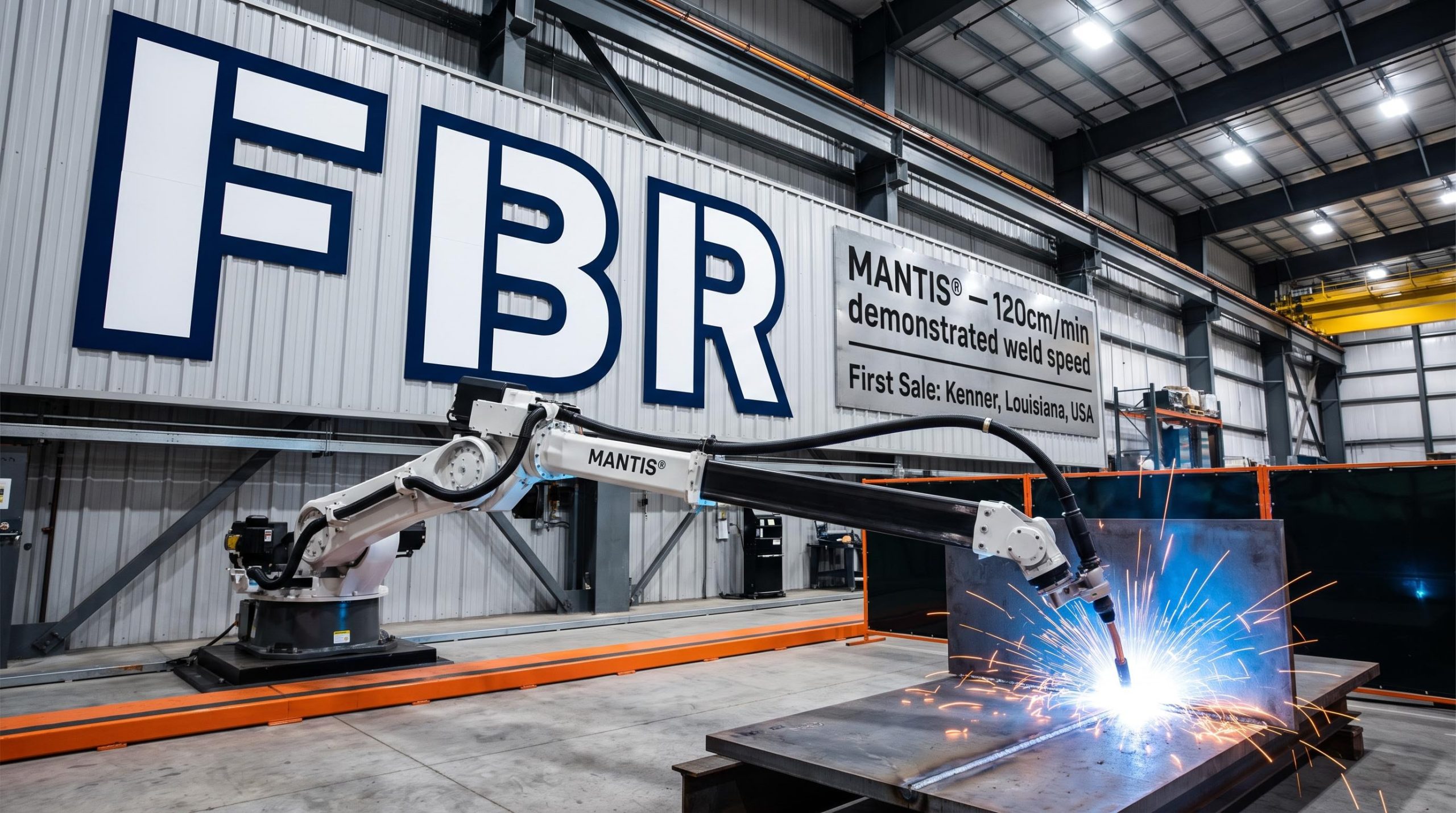
Mantis® robot progresses through welding trials ahead of factory acceptance test
FBR Limited (ASX: FBR) has announced that its first DST®-powered Mantis® high deposition welding robot has completed construction, commissioning, and calibration, and is now undertaking active welding trials ahead of its Factory Acceptance Test (FAT). The FAT is the sole remaining conditional requirement on the company’s first sale contract, with passing it serving as the precursor to payment and shipping to buyer State Machinery and Equipment Sales in Kenner, Louisiana, USA. Trial results to date have been described as “pleasing.”
The Mantis® is a large welding robot with an 8m (26ft) reach, incorporating the company’s proprietary Dynamic Stabilisation Technology® (DST®).
When big ASX news breaks, our subscribers know first
Welding performance that benchmarks against human operators
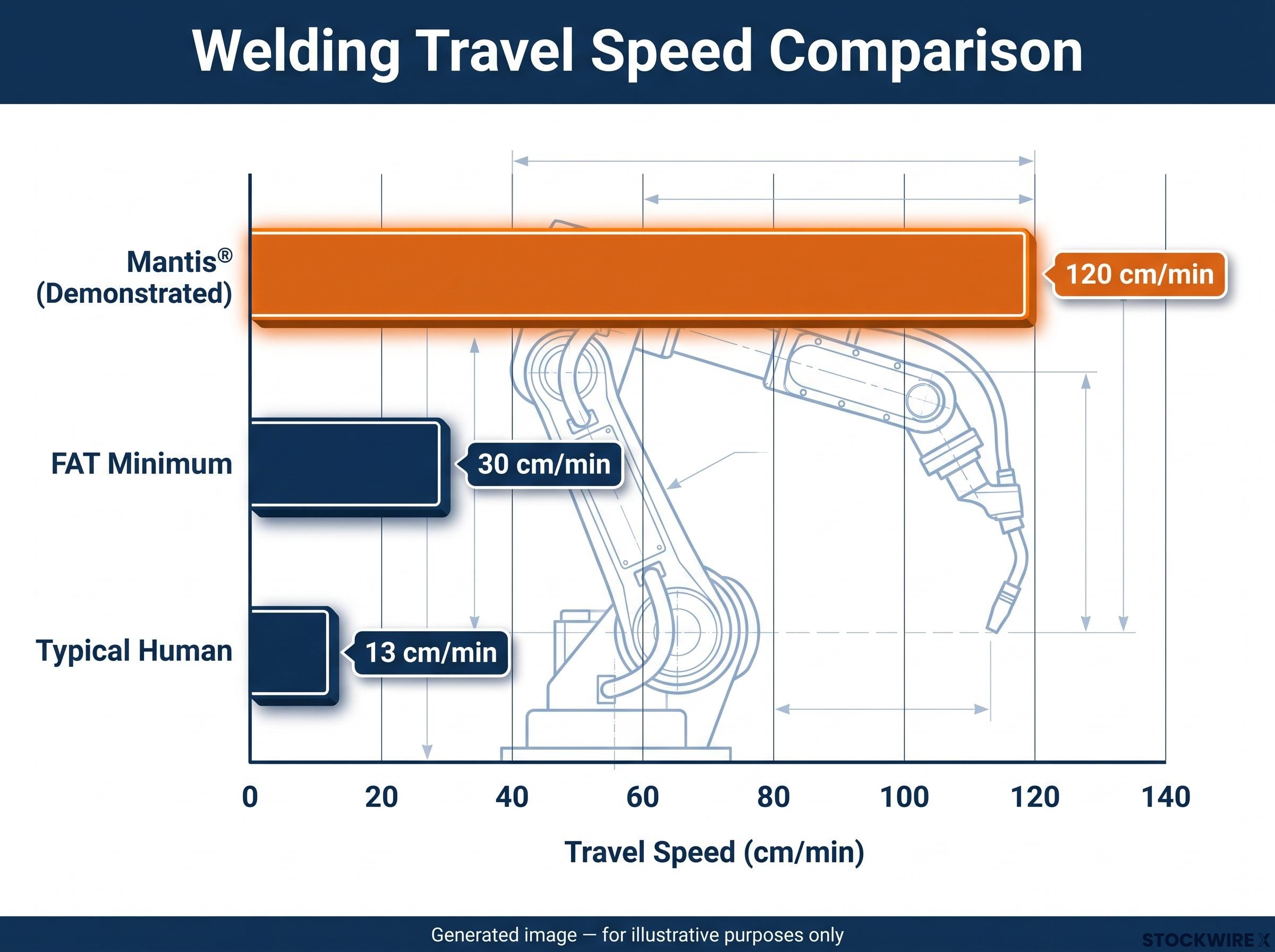
The performance data emerging from trials positions Mantis® well ahead of both the FAT minimum threshold and typical human welding output. The FAT requires a minimum fillet weld travel speed of 30cm/min. Mantis® has demonstrated speeds of 120cm/min, four times that minimum, while human welders typically operate at around 13cm/min.
The announcement also references a specific weld example that illustrates the quality achieved during trials:
- A 6.5mm 2F weld produced at 90cm/min travel speed, using 10mm 350MPa mild steel with 1.2mm ER70S6 80/20Ar/CO2 Twin wire configuration.
The comparison across operators is presented below:
| Operator | Travel Speed | Notes |
|---|---|---|
| FAT Minimum | 30 cm/min | Contractual threshold for fillet welds |
| Mantis® (demonstrated) | 120 cm/min | 4x the FAT minimum requirement |
| Human welder (typical) | 13 cm/min | Typical manual operator speed |
The twin wire welding system on Mantis® is designed to produce high-quality welds at very high production rates, and the trial data suggests the robot is commercially ready to meet and significantly exceed the contractual benchmark.
What is Dynamic Stabilisation Technology® and why does it matter?
DST® is FBR’s proprietary core technology. In plain terms, it stabilises a long boom to the level of precision required for welding, solving a fundamental limitation of conventional welding robots: limited reach.
Standard industrial welding robots lack the extended reach needed for large-scale fabrication tasks. DST® addresses this by enabling a long boom to be stabilised to the accuracy needed for consistent, high-quality welds. This is the same technology FBR originally developed for its Hadrian® bricklaying robot, and the accumulated experience with Hadrian® has allowed the company to rapidly design, manufacture, commission, and test Mantis®.
Key technical and commercial points from the announcement include:
- DST® enables long-boom stabilisation to welding-grade accuracy
- Previously proven through the Hadrian® bricklaying robot platform
- AI-assisted robot programming is now a core FBR competency, addressing ease of use
- Target industries: heavy fabrication, shipbuilding, mining, and defence
Mantis® was initially conceived as a tool for robots to manufacture large robot components, such as those used on Hadrian®, reflecting FBR’s broader “robots making robots” vision. The company subsequently identified a wider industrial opportunity for a welding robot that combined extended reach, high productivity, and ease of use. Because Mantis® is a direct commercial extension of FBR’s existing DST® intellectual property rather than a greenfield technology development, the technology risk profile is materially lower than it would be for an entirely novel platform.
US distribution, international interest, and the path to revenue
The commercial picture around Mantis® encompasses both the confirmed first sale and a developing distribution and customer interest pipeline.
- The first Mantis® unit has been sold to State Machinery and Equipment Sales in Kenner, Louisiana. Payment and shipping remain contingent on passing the FAT.
- FBR has appointed Industrial Robotics as its US distributor. Industrial Robotics currently holds leads with a number of potential customers.
- Industrial Robotics will promote Mantis® at the International Workboat Show in New Orleans from 2 December 2026, ahead of the first unit’s arrival in the USA.
- Demonstrations are scheduled following the FAT to showcase Mantis® capabilities to Australian and global customers.
- FBR has received strong interest from Australian and global customers, though the announcement does not quantify the pipeline further.
The North American distribution agreement signed with Industrial Robotics covers the United States and Canada on a non-exclusive basis, with an initial commercial focus on Louisiana, Alabama, Mississippi, the Florida Panhandle, and Eastern Texas.
The first Mantis commercial sale to State Machinery was secured at $990,000, with milestone-based payments structured to align delivery risk between buyer and seller.
CEO Mark Pivac
“Our team has made excellent progress with the development of the DST®-powered Mantis® robot. We are achieving excellent weld quality and production speeds faster than human welders typically achieve.”
Pivac also noted in the announcement that the company looks forward to completing the FAT and demonstrating Mantis® to interested parties who have been “very helpful with application information and supportive during its development.”
With the FAT expected soon and US market activation underway through Industrial Robotics, the first commercial transaction now hinges on a single remaining milestone.
Don’t Miss the Next ASX Manufacturing Breakout
Get FREE breaking ASX manufacturing and industrials news delivered to your inbox within minutes of release, complete with in-depth analysis already done for you. Over 20,000 subscribers rely on Big News Blast to stay ahead of the market. Click the “Free Alerts” button to start receiving alerts the moment news breaks.