
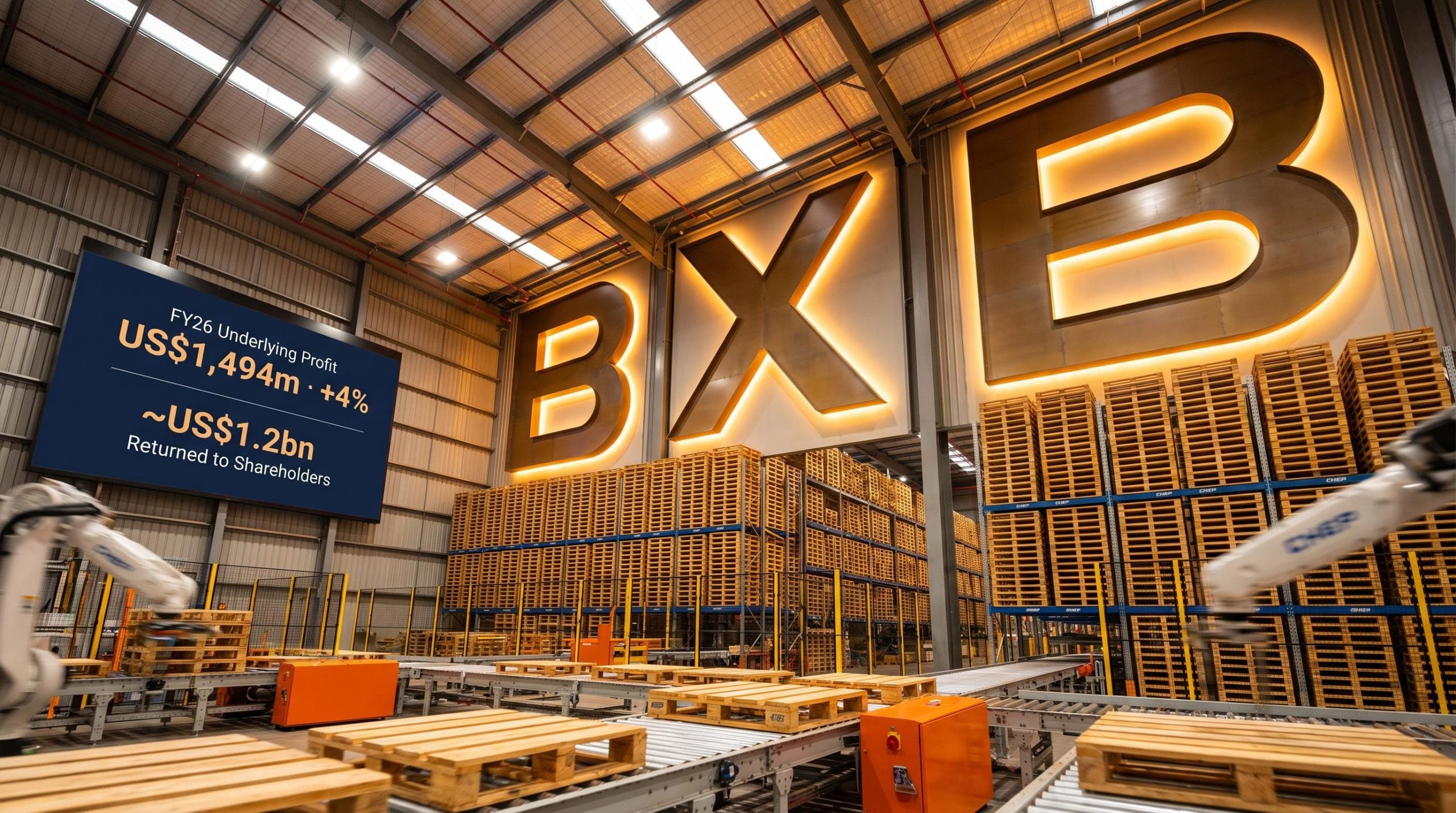
Brambles delivers 4% profit growth as US network challenges test resilience
In its Full-Year 2026 results presentation delivered on 20 August 2026, Brambles reported Underlying Profit up +4% to US$1,494m and sales revenue up +2% to US$7,043m for the twelve months ended 30 June 2026, with both metrics landing in line with revised guidance. The results were delivered by CEO Graham Chipchase and CFO Joaquin Gil.
The headline numbers carried a notable counterweight. Repair capacity constraints across the US service centre network delivered a ~US$90m adverse earnings impact in 4Q26. Excluding this, Underlying Profit rose ~11%. Across the year, the company returned ~US$1.2 billion to shareholders through dividends and share buy-backs.
When big ASX news breaks, our subscribers know first
FY26 results at a glance
The presentation set out a scorecard combining earnings growth, strong cash generation, and improved returns. Total dividends rose +16% to 46.15 US cents (20% franked, at a 64% payout ratio), while Free Cash Flow before dividends of US$1,048m was down US$47m versus FY25. Return on Capital Invested (ROCI) improved to 22.6%.
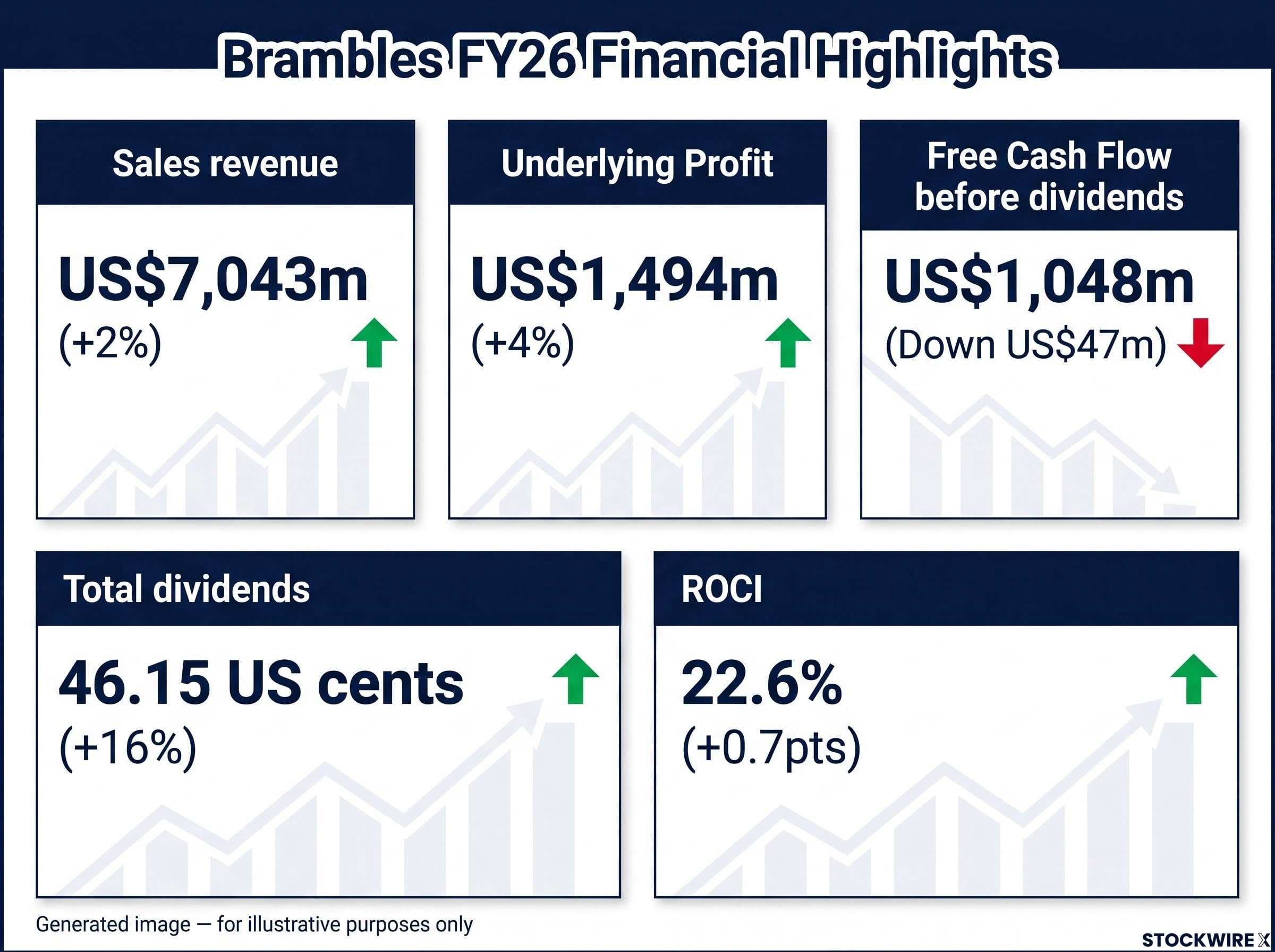
| Metric | FY26 | Change vs FY25 | Note |
|---|---|---|---|
| Sales revenue | US$7,043m | +2% | Constant FX |
| Underlying Profit | US$1,494m | +4% | ~11% normalised |
| Free Cash Flow before dividends | US$1,048m | Down US$47m | |
| Total dividends | 46.15 US cents | +16% | 20% franked, 64% payout |
| Basic EPS (continuing ops) | 69.9 US cents | +6% | |
| ROCI | 22.6% | +0.7pts |
Management noted total value creation of 9% for the year, sitting just below the 10%+ investor value proposition target.
A story of underlying strength
Revenue growth was driven by net new business wins of +3% and price realisation of +1%, partly offset by a like-for-like volume decline of (2)% amid subdued consumer demand across the US, Europe, and Latin America. The presentation highlighted that operating leverage was delivered despite the US headwinds, supported by supply chain initiatives and overhead cost efficiencies.
The US repair capacity challenge explained
Brambles operates a circular pallet-pooling model, renting reusable pallets to customers and then repairing and recirculating them across its network. Repair capacity is therefore core infrastructure. A convergence of factors created constraints at certain US service centres from 4Q26.
The presentation detailed the following drivers:
-
Planned quality initiatives increasing component repairs per pallet, lowering daily repair output at certain service centres.
-
A tightening US labour market impacting the attraction and retention of repair bench operators.
-
Two subcontractors choosing to exit the network, primarily because pooling was non-core to their main business.
-
Unplanned pallet relocations across the network at significantly higher spot transport rates.
-
Higher-than-anticipated customer demand ahead of the FIFA World Cup and other consumption events.
The combined effect limited Brambles’ ability to fully service existing demand and onboard new business in the Central and Northeastern parts of the US network. Management quantified the financial cost at a ~US$90m earnings impact plus ~US$40m of additional pooling capex, with the associated cash outflow recognised in 1H27.
Progress already underway
The presentation reported no missed customer orders since June 2026. Management attributed the improvement to new pallet purchases (~60%), lower demand (~35%), and increased repair capacity (~5%).
Stabilisation measures included 1.3m new pallets purchased in 4Q26, with ~2m additional pallets expected in 1H27, alongside additional shifts, overtime, and subcontractor transition plans. On a structural basis, management outlined a ~20% increase in repair capacity by FY28 against the FY26 baseline, including 8 new service centres for a total investment of ~US$25m, together with AI-driven demand planning.
Incremental supply chain costs are expected to be recovered through efficiencies and price from 2H27, funded within the existing medium-term non-pooling capex estimate of US$200–300m per annum to FY28.
CEO Commentary
Graham Chipchase, CEO, emphasised the company’s continued focus on the customer as central to guiding the US recovery plan, with a comprehensive programme in place to restore service levels by the end of 1H27 while strengthening the long-term resilience of the US network.
Segment performance
The three CHEP segments delivered contrasting outcomes, with the US constraints concentrated in the Americas.
CHEP Americas recorded sales up +2% with Underlying Profit broadly flat at US$750.6m, bearing the brunt of the US constraints. Excluding these, the presentation noted Underlying Profit and margin would have improved by ~13% and ~2.0pts respectively. CHEP EMEA delivered sales up +2% with continued net new business momentum, though margin declined (0.6)pts on higher relocation costs and uncompensated losses in Europe. CHEP Asia-Pacific was the standout, with sales up +3%, Underlying Profit up +14% to US$214.6m, margin up +1.8pts, and ROCI up +2.9pts.
| Segment | Sales revenue | Sales growth | Underlying Profit | Margin movement |
|---|---|---|---|---|
| CHEP Americas | US$3,867.1m | +2% | US$750.6m | (0.2)pts |
| CHEP EMEA | US$2,579.9m | +2% | US$727.5m | (0.6)pts |
| CHEP Asia-Pacific | US$595.9m | +3% | US$214.6m | +1.8pts |
Balance sheet and shareholder returns
The presentation set out net debt of US$2,926m with a net debt/EBITDA ratio of 1.17x, comfortably within the company’s <2.0 policy, and interest cover of 20.7x. Management highlighted that Standard & Poor’s upgraded Brambles’ credit rating from BBB+ to A- in October 2025, based on their view that enhanced operating efficiency and profitability had strengthened the company’s competitive position and resilience.
The Brambles class action judgment delivered in April 2026 dismissed the majority of shareholder claims while upholding liability for a narrow two-month window in late 2016, with damages yet to be quantified pending the completion of the quantification process and any appeals.
Underpinned by strong Free Cash Flow generation, ~US$1.2 billion was returned to shareholders across the year through dividends and buy-backs.
What Brambles expects in FY27
Management outlined FY27 guidance built around continued operating leverage and strong Free Cash Flow, with the US repair capacity constraints expected to be resolved by the end of 1H27.
The outlook ranges are as follows:
-
Sales revenue growth: 2–4%
-
Underlying Profit growth: 2–6% (a mid-to-high single-digit decline in 1H27, followed by low double-digit growth in 2H27)
-
Free Cash Flow before dividends: US$800m–US$950m
-
Dividend payout ratio: 50–70% of Underlying Profit
-
On-market share buy-back: up to US$400m
The structural cost impact of the US constraints is expected to be fully offset beyond 2H27. Looking further ahead, the presentation reaffirmed the FY28 ambition to deliver the 10%+ investor value proposition and ~3pt+ margin expansion versus the FY24 baseline.
Management also detailed progress with Serialisation+ in Chile, where the rollout contributed a +9pt increase in Net Promoter Score and 15 net new customers. A decision on a potential US rollout is due in 3Q27, offering forward optionality subject to further learnings.
The investment takeaway
Brambles’ FY26 results combined resilient earnings growth, sustained cash generation, and a strengthened balance sheet with a genuine operational setback in the US network. Management has set out a costed remediation roadmap, targeting restored service levels by the end of 1H27 and a clear path back to the 10%+ total value creation target, though delivery remains dependent on macroeconomic conditions, consumer demand, and input-cost inflation.
Don’t Miss the Next ASX Industrials Move
Big News Blast delivers FREE breaking ASX announcements straight to your inbox within minutes of release, complete with in-depth analysis so the work is already done. Join 20,000+ subscribers staying ahead of the market on ASX industrials and beyond. Click the “Free Alerts” button at Big News Blast to start receiving alerts today.