
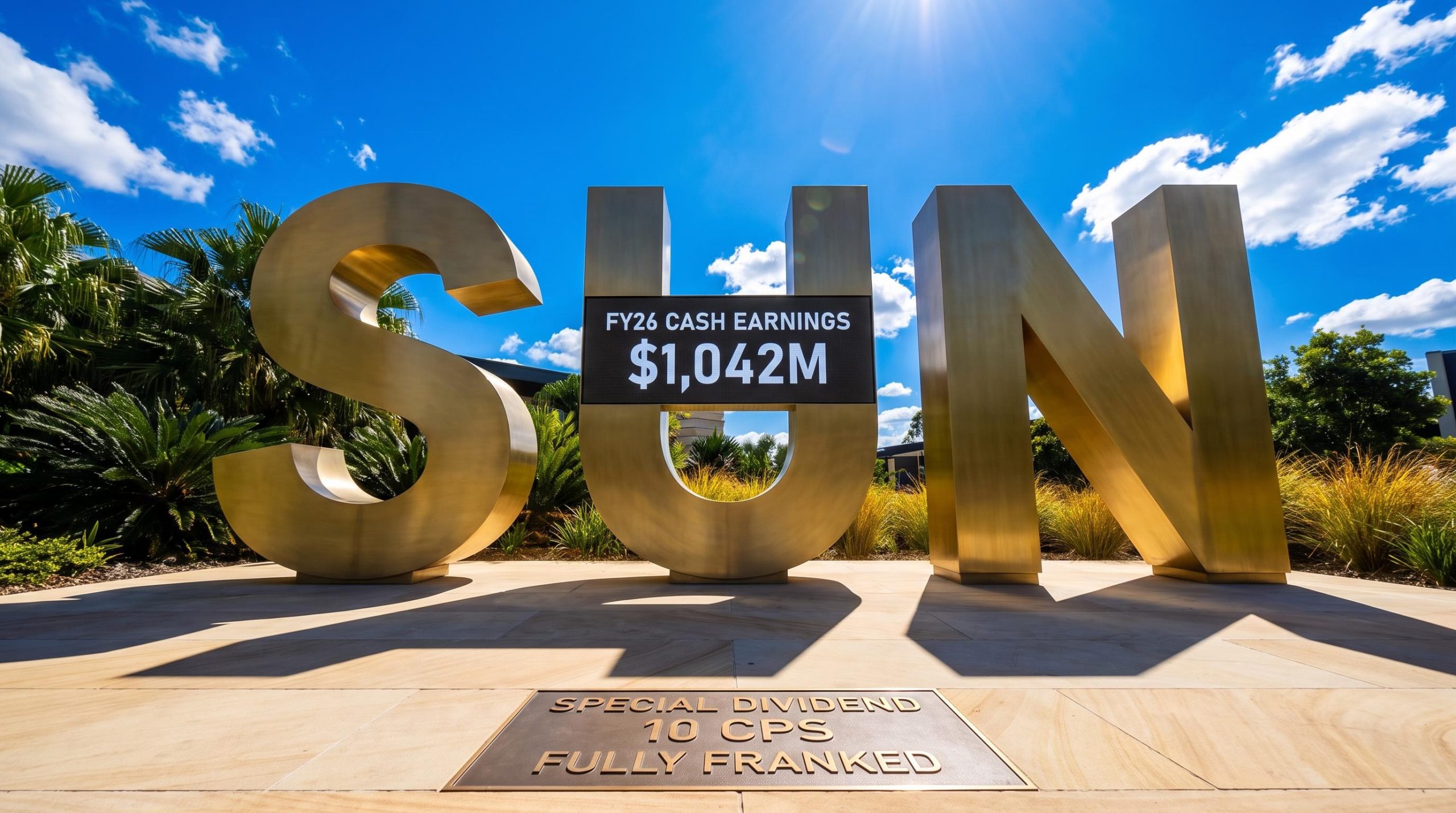
Suncorp rewards shareholders with special dividend and $250m buyback on strong FY26 result
In its financial results for the year ended 30 June 2026, Suncorp Group determined a fully franked special dividend and an on-market share buy-back of up to $250 million, underpinned by margins at the top end of its target range and a 4.5% rise in underlying earnings.
The insurer reported net profit after tax (NPAT) of $1,027 million and cash earnings of $1,042 million, alongside a fully franked final ordinary dividend of 52 cents per share and a special dividend of 10 cents per share.
Headline NPAT sat below the prior year’s $1,823 million, but that comparison warrants context. The FY25 figure included one-off gains on the sale of Suncorp Bank and New Zealand Life. Stripped of those divestment gains, the underlying insurance business grew, with underlying earnings up 4.5%.
When big ASX news breaks, our subscribers know first
FY26 result headlines — margins hold at top of target range
The result was delivered despite a heavy catastrophe year in which Suncorp exceeded its $1,770 million natural hazard allowance by $254 million and paid out more than $10 billion in claims. Underlying strength, rather than headline optics, defined the period.
The underlying insurance trading result rose 4.5% to $1,636 million, with the underlying insurance trading ratio holding at 11.8%, near the top of the 10–12% target range.
| Metric | FY26 | FY25 | Movement |
|---|---|---|---|
| Gross written premium | $15,407m | $15,009m | +2.7% |
| Underlying insurance trading result | $1,636m | $1,566m | +4.5% |
| Underlying insurance trading ratio | 11.8% | 11.9% | Top of 10–12% range |
| Net incurred claims | $10,244m | $9,251m | Higher hazard/inflation |
| Total expense ratio | 18.1% | 18.6% | Improved |
Steve Johnston, Suncorp CEO
“This result demonstrates that a well-run insurance company can deliver for both customers and shareholders.”
Weathering the storms — a record natural hazard year met with new protection
FY26 brought a sustained run of severe weather across the Trans-Tasman region. Suncorp responded to a high volume of events while introducing new financial protection intended to reduce future earnings volatility.
Key features of the catastrophe year and the response include:
-
32 separate weather events across Australia and New Zealand
-
18 declared natural hazard events over $10 million each
-
More than 120,000 natural hazard claims managed
-
Natural hazard costs of $2,024 million (FY25: $1,355 million), $254 million above the $1,770 million allowance
-
FY27 natural hazard allowance increased to $1.8 billion
-
The FY27 reinsurance program, including the aggregate reinsurance cover, expected to limit FY27 downside to $50 million in 90% of scenarios
The aggregate cover is central to the forward earnings resilience narrative. By capping the downside from severe weather, it is expected to materially reduce the volatility that has historically swung insurer results.
The Suncorp aggregate reinsurance cover, secured in April 2026, provides $800 million of annual protection over five years, with the capital release of approximately $100 million at broadly neutral economic cost underpinning the shareholder returns announced alongside the FY26 result.
Steve Johnston, Suncorp CEO
“Going forward, Suncorp will have significant financial protection from a multi-year aggregate reinsurance cover which came into effect on 30 June. The aggregate cover is an important component for Suncorp post the bank sale, significantly reducing natural hazard risk and earnings volatility.”
How the divisions performed
Two of the three divisions expanded underlying margins, with softness in New Zealand largely reflecting cyclical and currency factors rather than structural weakness.
Consumer Insurance — GWP up 5.8%
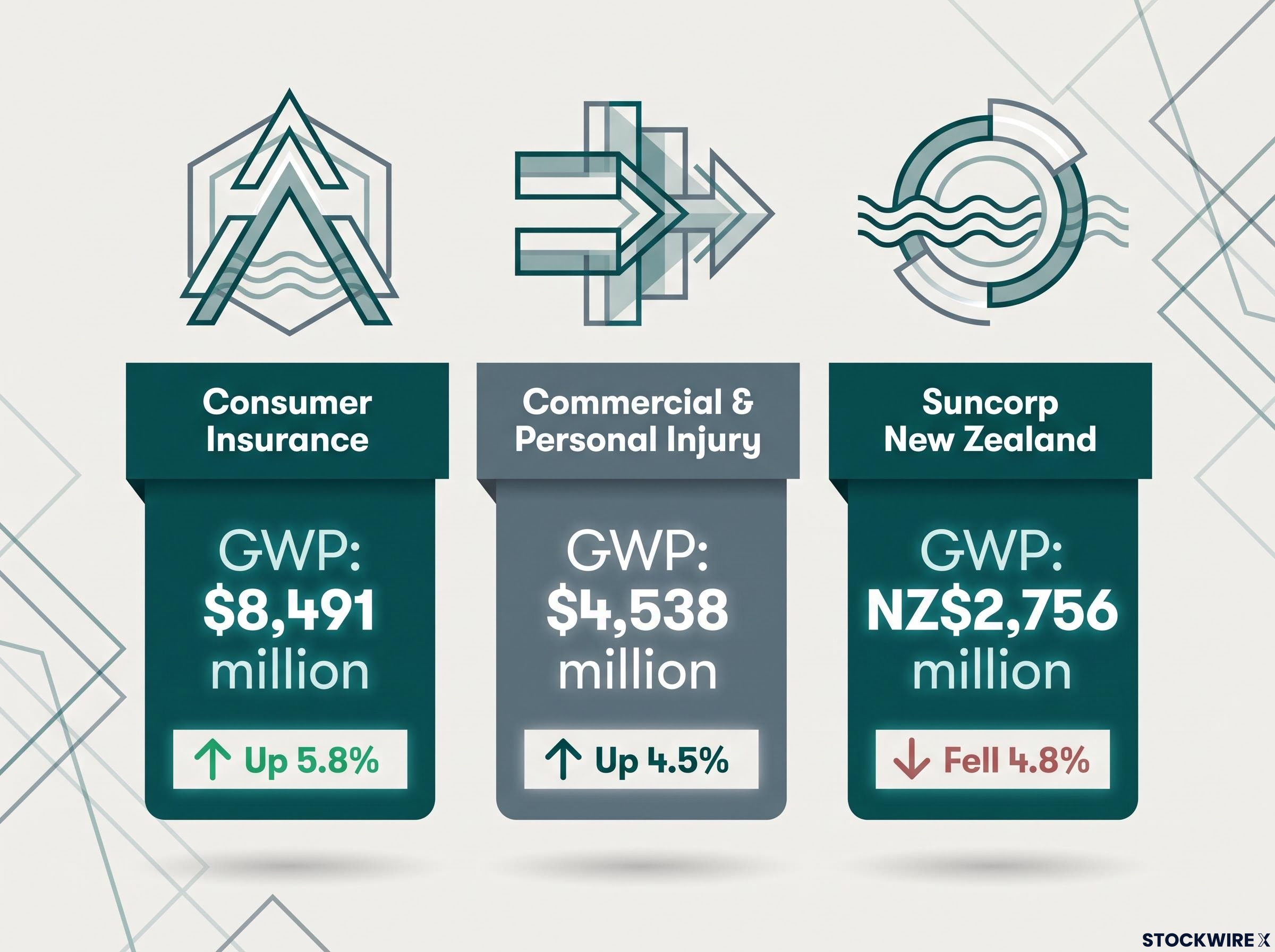
The Consumer division reported gross written premium (GWP) of $8,491 million, up 5.8%, driven by average written premium and unit growth across the Home and Motor portfolios. The underlying insurance trading ratio (UITR) improved to 9.9% (from 9.6%), supported by the earn-through of pricing. The Home portfolio composition continued to shift toward a higher proportion of lower-risk properties.
Commercial & Personal Injury — margins expand to 11.0%
GWP rose 4.5% to $4,538 million, with growth across Compulsory Third Party pricing in New South Wales and Queensland, Workers’ Compensation retention, and Commercial Fleet. The UITR increased to 11.0% (from 10.3%). On a reported basis, the insurance trading result rose 26.5%, aided by prior year reserve releases of $177 million.
Suncorp New Zealand — margin resilience in a soft market
In New Zealand dollar terms, GWP fell 4.8% to NZ$2,756 million, reflecting the soft commercial cycle and the exit of an intermediated consumer book, partly offset by 3.2% growth in the direct AA Insurance business. The underlying insurance trading ratio increased to 19.5%, with NZD-terms underlying trading result rising on benign working claims.
What is an underlying insurance trading ratio, and why does it matter?
The underlying insurance trading ratio measures the core profitability of an insurer’s business, stripped of one-off distortions such as natural hazard costs above or below allowance and short-term investment market swings. It offers a cleaner read on how well a company is pricing risk and managing expenses.
Suncorp targets a 10–12% range, and sitting near the top at 11.8% signals disciplined underwriting and pricing. Investors often watch this measure more closely than headline NPAT, which can be distorted by severe weather events and asset market movements in any given year.
Capital strength underpins the shareholder returns
The capital being returned stems from excess released through the placement of the aggregate reinsurance cover and receipt of the deferred New Zealand Life proceeds. Suncorp announced the return of $356 million of excess capital via the special dividend and the FY27 buyback.
Key capital metrics include:
-
Common Equity Tier 1 (CET1) $518 million above the mid-point of the target range, post the final dividend
-
Pro forma CET1 reduces to $162 million after the capital returns
-
FY26 ordinary dividends of 69 cents per share, a payout ratio of 70.5% of cash earnings
-
A $400 million FY26 on-market buyback (22.9 million shares) completed in May 2026
A further on-market share buy-back of up to $250 million is targeted for completion over FY27, subject to market conditions. The disciplined return of surplus capital supports earnings per share and return on equity accretion, reinforcing the shareholder-friendly framing of the result.
Building the digital insurer — investment in platforms and AI
Suncorp continued a multi-year investment in core platforms, data systems and Artificial Intelligence capabilities, positioned as the foundation for how products are manufactured, sold and how claims are managed across the Trans-Tasman business.
Customer and AI highlights included:
-
Total claims paid of $10.14 billion
-
Consumer Australia Net Promoter Score of +11.7
-
74.2% of sales made online and 63.9% of service transactions online
-
3.3 million customer conversations with AI chatbots
-
More than 20 GenAI initiatives launched across service, claims, underwriting and fraud management, with over 3,900 personal productivity agents built
Steve Johnston, Suncorp CEO
“As we bring these new systems online, we will be well placed to reshape how insurance products are manufactured and sold in both Australia and New Zealand.”
What Suncorp guided for FY27
The report set out forward-looking guidance for FY27, signalling continued growth alongside margin discipline and ongoing capital returns.
-
GWP growth expected between 3% and 5% (assuming an AUD/NZD FX rate of 0.85)
-
Underlying insurance trading ratio expected in the top half of the 10–12% range, including the premium for the aggregate cover
-
Prior year reserve releases anticipated at around 0.4% of Group net insurance revenue
-
Total expense ratio expected to be broadly in line with FY26
-
Payout ratio around the mid-point of the 60–80% range, with the up to $250 million buyback targeted for completion by end FY27
-
Strategic target of a sustainable return on equity above the through-the-cycle cost of equity
Management said Suncorp is well positioned to deliver for shareholders and customers given the strength of its foundations and enhanced resilience, despite ongoing geopolitical uncertainty and elevated inflationary pressures. The company noted its low-risk investment portfolios are expected to benefit from current higher yields and provide an organic hedge to inflation.
Stay Ahead on ASX Finance and Insurance News
Breaking ASX announcements from the finance and insurance sector land in your inbox within minutes, complete with in-depth analysis already done. Join 20,000+ subscribers receiving FREE real-time alerts the moment news breaks. Click the “Free Alerts” button at Big News Blast to stay ahead before the market moves.