
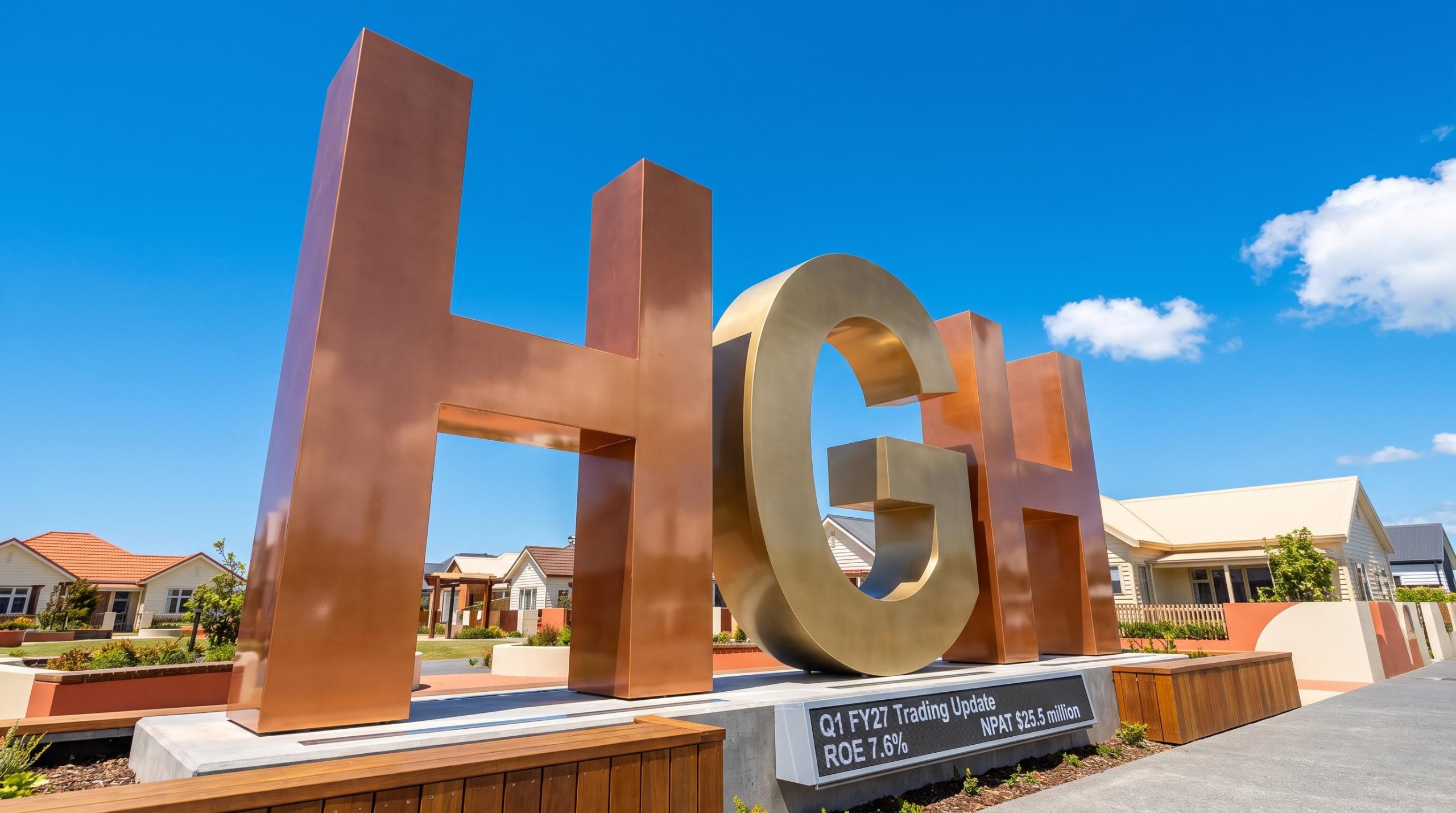
Q1 FY27 highlights: Heartland on track for ROE of at least 7.5% and NPAT of at least $102 million
In its Q1 FY27 (1Q2027) trading update for the three months ended 30 September 2026, Heartland Group Holdings (ASX: HGH) said it is on track to deliver return on equity (ROE) of at least 7.5% and net profit after tax (NPAT) of at least $102 million in FY2027. Guidance is provided on a reported basis and excludes costs related to the Proposed Transaction, where applicable.
The company recorded 1Q2027 ROE of 7.6% and NPAT of $25.5 million, both excluding Proposed Transaction costs. Reported NPAT was $24.5 million and reported ROE was 7.3%.
Heartland noted that quarterly improvement in ROE and NPAT continued, driven by strong Reverse Mortgage growth, stable operating expenses and improved asset quality. All key profitability metrics are aligned to its FY2027 guidance.
Other key metrics for the quarter included:
- Average net interest margin (NIM) of 3.92%, above FY2027 guidance of greater than 3.88%.
- A cost-to-income (CTI) ratio of 54.7%, below guidance of less than 55.7%. The reported CTI ratio was 55.7%.
- An impairment expense ratio of 0.34%, against guidance of less than 0.32%.
The table below sets the group’s 1Q2027 result against FY2027 guidance. All figures are in NZD.
| Metric | 1Q2027 | FY2027 guidance |
|---|---|---|
| Net operating income (NOI) | **$93.4m** | No guidance provided |
| Operating expenses (OPEX) | **$51.1m** | <$212m |
| NPAT excluding Proposed Transaction costs | **$25.5m** | ≥$102m |
| Average NIM | **3.92%** | >3.88% |
| CTI ratio | **54.7%** | <55.7% |
| ROE | **7.6%** | ≥7.5% |
When big ASX news breaks, our subscribers know first
NZ and AU banking performance
Heartland Bank (NZ): asset quality improves
Heartland Bank recorded NPAT of $12.2 million against FY2027 guidance of more than $48 million. Average NIM was 4.09%, OPEX was $32.7 million, and the CTI ratio was 56.9%, down from 57.4% in 4Q2026.
Asset quality continued to improve. The total non-performing loan (NPL) ratio was 1.87% at 30 September 2026, compared with 1.92% at 30 June 2026, while the core portfolio NPL ratio was 1.37%.
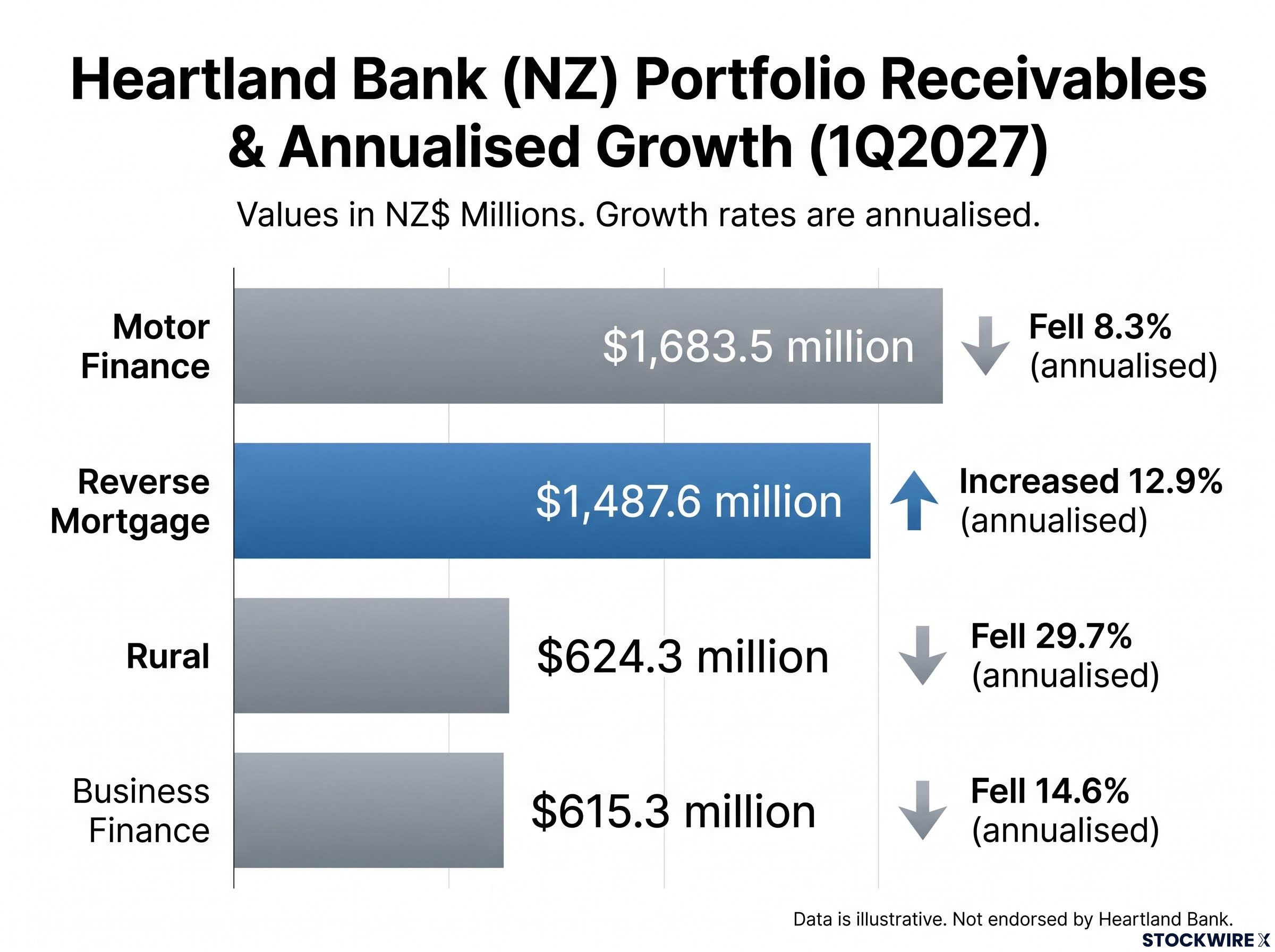
Reverse Mortgage receivables increased $46.9 million (12.9%, annualised) to $1,487.6 million. Growth was affected by lower productivity during the implementation of the technology transformation programme, but the pipeline has rebounded.
Three portfolios contracted in the quarter:
- Rural receivables fell 29.7% (annualised) to $624.3 million, reflecting a change in funding strategy for a single large borrower.
- Motor Finance receivables fell 8.3% (annualised) to $1,683.5 million, due to the exit of a Wholesale Lending borrower combined with delayed shipping arrivals. Growth is expected further into FY2027.
- Business Finance receivables fell 14.6% (annualised) to $615.3 million, amid subdued credit demand.
Heartland Bank Australia: Reverse Mortgages surge
Heartland Bank Australia delivered NPAT of AU$11.3 million against guidance of more than AU$46 million. Its NIM was 3.72%, CTI ratio 46.4% and NPL ratio 1.78%.
Reverse Mortgage receivables rose AU$117.0 million (19.6%, annualised) to AU$2,488.1 million. Livestock Finance receivables fell 33.8% (annualised), reflecting the portfolio’s usual seasonal contraction.
In FY2026, the bank refined the accounting methodology used to recognise Reverse Mortgage intermediary commission costs. This produced a one-off AU$3.7 million uplift in NOI and a one-off AU$2.9 million improvement in OPEX in 4Q2026. Compared with a 4Q2026 NIM of 3.81% on a like-for-like basis, the 1Q2027 NIM was 3.72%.
| Metric | Heartland Bank 1Q2027 | Heartland Bank FY2027 guidance | Heartland Bank Australia 1Q2027 | Heartland Bank Australia FY2027 guidance |
|---|---|---|---|---|
| NPAT | **$12.2m** | >$48m | **AU$11.3m** | >AU$46m |
| Average NIM | **4.09%** | >4.05% | **3.72%** | >3.68% |
| CTI ratio | **56.9%** | <58.4% | **46.4%** | <47.2% |
| ROE | **6.7%** | >6.3% | **9.5%** | >9.3% |
Reverse Mortgages and Heartland’s technology transformation explained
A Reverse Mortgage is a loan secured against the equity in a home, generally used by older homeowners. Heartland cites strong Reverse Mortgage growth as a driver of its quarterly improvement in ROE and NPAT, making the product central to the group’s earnings.
Reverse Mortgage growth was already a standout in the FY2026 Q3 trading update, when Australian receivables rose AU$95.9 million and New Zealand receivables rose $49.4 million in a single quarter.
In New Zealand, the technology transformation programme is now live for all new Reverse Mortgage loans. It brings settlement and ongoing servicing in-house and introduces mobile app access, with early results indicating a meaningful reduction in the time from application to settlement, alongside positive customer feedback.
In Australia, the transition to the Constantinople platform continues. New Reverse Mortgage loans from the direct channel and selected brokers are now being processed successfully on the platform.
What happens next for Heartland and the TSB transaction
Two items stand out for investors:
- Completion of the Proposed Transaction: Heartland proposes to purchase all of the shares in TSB Bank Limited and subsequently merge Heartland Bank and TSB. Shareholders approved it at the Special Shareholder Meeting on 30 September 2026, and Heartland continues to target completion no earlier than December 2026, subject to satisfaction of all remaining conditions.
- Guidance update: FY2027 guidance will be updated on completion of the Proposed Transaction to reflect the merger, subject to all remaining conditions being satisfied.
Heartland expensed $0.9 million of Proposed Transaction costs in 1Q2027, in line with expected FY2027 transaction costs of $9.5 million. The majority of those costs are expected on successful completion.
The original merger agreement with TSB set consideration at $620 million and cited EY-assessed cost synergies of about $34 million a year, underpinning management’s forecast of EPS accretion above 20% in the first year after completion.
The Proposed Transaction is expected to create a stronger New Zealand bank with greater scale, a broader customer offering and enhanced capacity to deliver long-term value for customers and shareholders.
Stay Ahead on Financials News Before the Market Moves
Join 20,000+ investors getting FREE breaking ASX news from Big News Blast within minutes of release, with in-depth analysis already done. Click the “Free Alerts” button to receive banking and finance updates the moment news breaks, so you are never left reacting after the market has moved.