

In its F26 Full Year Results investor and analyst presentation dated 13 August 2026, Treasury Wine Estates (TWE) reported EBITS of $492.3m, ahead of its Investor Day guidance range of $480–$490m and led by Penfolds. Management clarified that the group also recorded a statutory net profit after tax (NPAT) loss of $1,078.7m, driven predominantly by a non-cash impairment of US-based assets. TWE guided that F27 EBITS is expected to be at least equivalent to F26.
F26 results at a glance
The presentation detailed group performance shaped by moderated category trends, initiatives to protect brand and channel health, and the cycling of elevated shipments in the prior year. The headline metrics are summarised below.
| Metric | F26 | Movement |
|---|---|---|
| NSR | $2.6bn | down 12.8% |
| EBITS | $492.3m | down 36.1% |
| EBITS margin | 19.2% | down 7.0 ppts |
| NPAT (before material items & SGARA) | $275.3m | down 41.5% |
| Statutory NPAT | loss of $1,078.7m | driven by material items |
| EPS | 34.1cps | down 41.3% |
| Net Debt/EBITDAS (leverage) | 2.8x | up 0.9x |
| Dividend | nil | down 40cps |
Three points stand out from the results:
-
EBITS of $492.3m beat the upper end of guidance.
-
The statutory loss is overwhelmingly non-cash impairment driven, not an operational cash outflow.
-
Dividends have been suspended pending progress on deleveraging.
When big ASX news breaks, our subscribers know first
Penfolds leads with strong depletions growth
Penfolds was the standout division, reporting EBITS of $404.3m, down 15.2% versus the prior corresponding period (pcp). Management attributed the moderation to a deliberate reduction of China customer inventory cover (0.2m cases reduced in F26, with the remainder expected to complete in F27) and to the restriction of shipments contributing to parallel imports.
Depletions, which reflect sell-through to end customers, remained strong across key markets:
-
China depletions up 34.7% (approximately half of which reflects the transition of previously parallel-imported volumes into TWE’s authorised distribution channels)
-
Asia ex-China depletions up 18.1%
-
Australia depletions up 5.7%
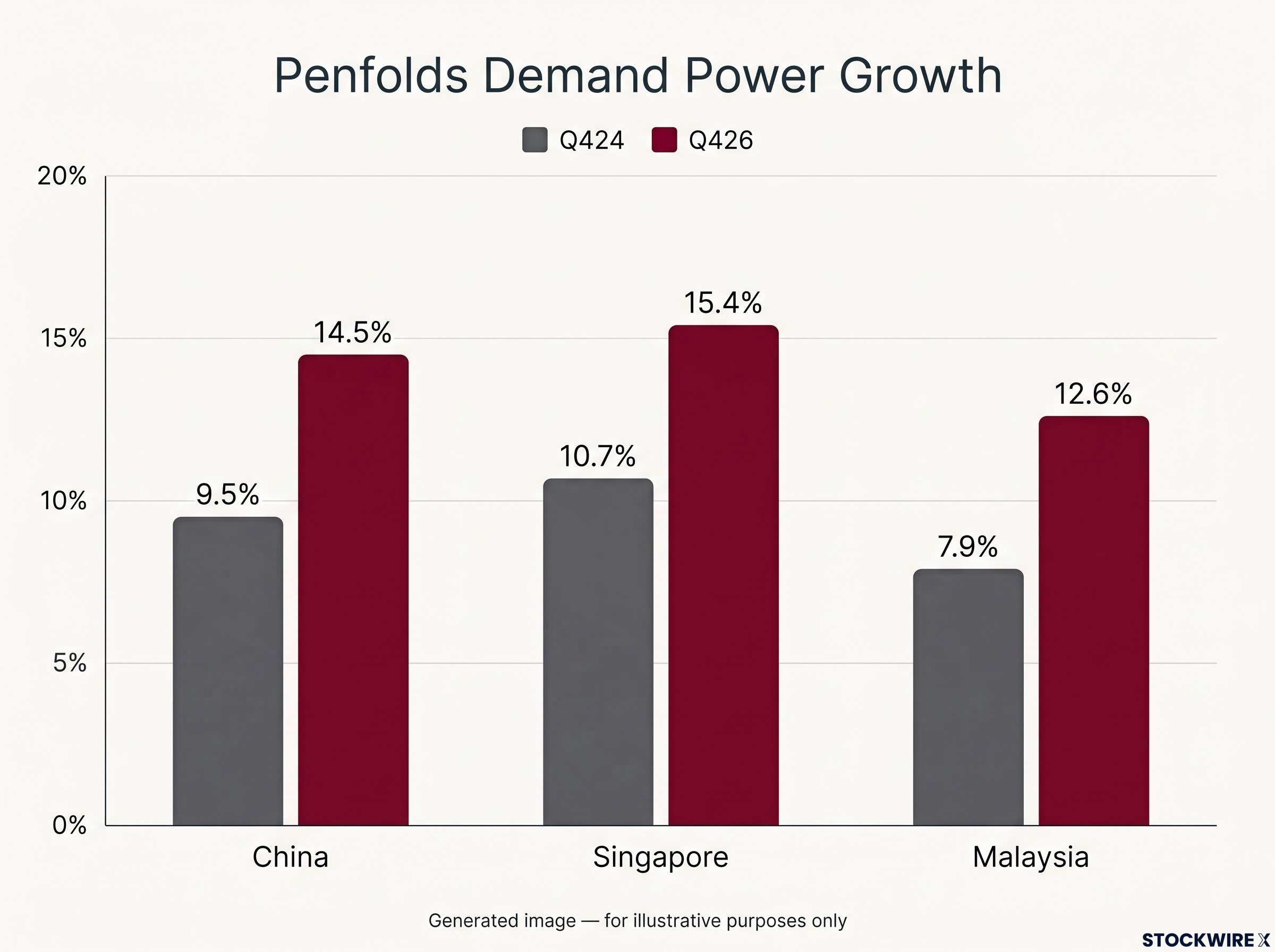
Kantar Brand Health data (June 2026) showed Penfolds Demand Power strengthening across key markets between Q424 and Q426, including China (9.5% to 14.5%), Singapore (10.7% to 15.4%) and Malaysia (7.9% to 12.6%).
Understanding depletions vs shipments (educational)
Two terms recur throughout the results, and the distinction matters to investors. Shipments refer to the wine TWE sells to distributors and wholesalers. Depletions refer to the wine those distributors then sell through to their own customers, providing a clearer read on true underlying consumer demand.
Depletions matter because they strip out the noise of inventory build-up or de-stocking. TWE’s strong depletions amid falling shipments signals that the sales decline reflects a deliberate inventory-rebalancing effect rather than collapsing consumer demand. This distinction helps explain why F27 EBITS is guided to appear flat even as underlying momentum improves.
Americas under pressure as strategic review continues
Treasury Americas reported EBITS of $90.2m, down 61.4% versus pcp. Management pointed to softer US wine market conditions, disruption from the Californian distribution transition, and the cycling of prior-year excess shipments.
Momentum improved in the second half. Total US depletions rose 4.2%, returning to growth in California and nationally, led by DAOU (up 5.0%), Frank Family Vineyards and Stags’ Leap. The US strategic review remains ongoing, with advisors appointed to support a review of all available options. Initiatives to rebalance the US supply chain are underway, and residual RNDC exposure is now below 3% of Americas NSR.
Treasury Collective reported EBITS of $68.0m, down 47.8% versus pcp. Australia was a highlight, while the US result reflected a decline for 19 Crimes, partly offset by continued growth for Matua.
The material items behind the statutory loss
The bridge from underlying earnings to the statutory loss is dominated by non-cash items. The table below summarises the post-tax material items recognised in F26.
| Item | Post-tax P&L ($m) |
|---|---|
| Non-cash impairment of US-based assets | (866.3) |
| TWE Ascent related costs (incl. US strategic review / supply chain) | (478.9) |
| RNDC settlement | +19.6 |
| Other items | +17.1 |
| Total material items | (1,308.7) |
The $866.3m US impairment is entirely non-cash, comprising goodwill, brand and inventory write-downs. Notably, the total material items carried a cash impact of only $(56.5)m, underscoring that the statutory loss reflects accounting write-downs rather than an equivalent cash outflow.
The US supply chain reset announced ahead of these full year results included a $558.4m post-tax non-cash write-down covering vineyards, bulk wine inventory and several American brands, structurally aligning supply with a lower future demand outlook.
Balance sheet strength and the path to deleveraging
Management framed capital structure strength as a stated priority. Leverage stood at 2.8x at 30 June 2026, which the company expects to be the peak, with a return to target below 2.0x by the end of F28. Deleveraging is expected to be driven by free cash flow, divestment proceeds and, from F28, earnings improvement.
Liquidity totalled $1.3bn, supported by $300m in additional commitments established in March 2026 and a weighted average debt duration of 3.2 years. Dividends remain suspended, with the Board to consider resumption as leverage trends towards target.
Net operating cash flow was $535.3m, down 34.7%, with cash conversion of 81.4%. F27 capital expenditure is expected to be approximately $75m.
TWE Ascent transformation and F27 outlook
The presentation outlined management’s forward roadmap under the TWE Ascent transformation agenda. The company plans to transition to its new regional operating model on 1 October, which is the key driver of Ascent cost savings.
Key Ascent initiatives include:
-
A $100m per annum cost reduction, on track to be fully realised by F29, with a $40m benefit expected in F27
-
Brand and asset divestment processes underway, with Ascent expected to be cash positive post-divestments
For F27, group EBITS is expected to be at least equivalent to F26, weighted approximately 55% to the second half. Regional guidance was outlined as follows.
| Region | F27 EBITS guidance |
|---|---|
| Greater China | $280–310m |
| Emerging Markets | $95–115m |
| Americas | ~$50m |
| ANZ & Europe | $100–120m |
Longer term, management targets revenue growth from F28, progressive EBITS margin expansion toward its long-term 25%+ target, and a return to leverage below 2.0x by F28.
What it means for investors
Underlying operating momentum improved in the second half of F26, led by Penfolds, while the statutory loss was overwhelmingly non-cash in nature. The gap between strong depletions and flat F27 EBITS guidance reflects a deliberate inventory-rebalancing effect that management indicates is nearing completion, setting up for revenue growth from F28.
Key watch-points for investors include the outcome of the ongoing US strategic review, completion of the China and US customer inventory rebalancing, deleveraging progress, and the eventual timing of any dividend resumption.
Management outlook
In its presentation, TWE set out a vision for a more focused, market-centred, simpler and financially stronger wine company, framed in the presentation as a bright future for the group.
Don’t Miss the Next Consumer Staples Move on ASX
Big News Blast delivers FREE breaking ASX news and in-depth analysis directly to your inbox within minutes of release. Join 20,000+ investors who stay ahead of market-moving announcements across Consumer, Tech, Healthcare and more. Click the “Free Alerts” button at StockWire X to get the next big story before the market moves.