
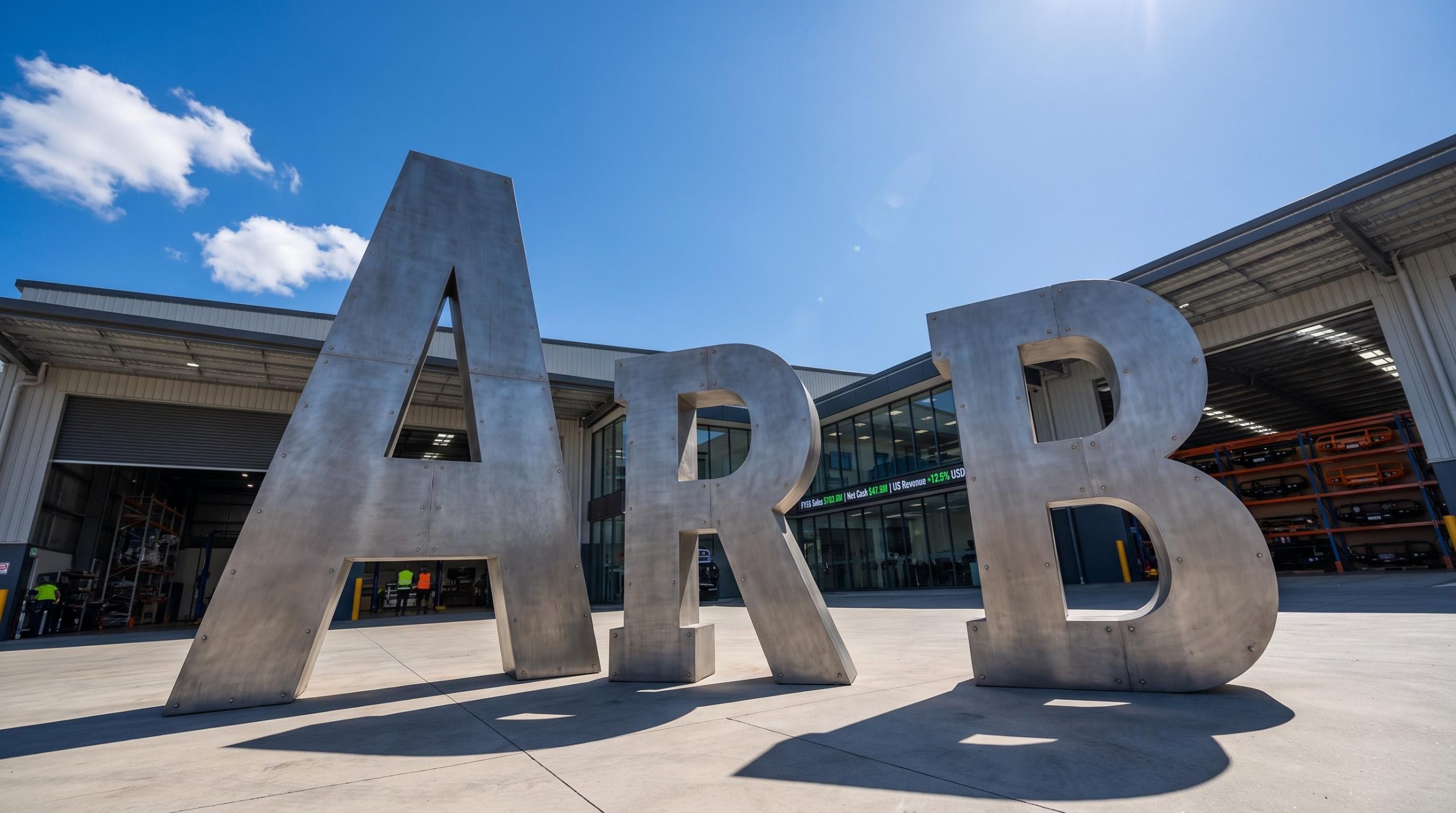
ARB delivers resilient FY26 result as second-half recovery cushions tough 4×4 market
In its FY26 results presentation delivered on 25 August 2026, ARB Corporation reported sales revenue of $702.0M, down 3.8%, and net profit after tax of $92.4M, down 5.2%, for the financial year ended 30 June 2026.
Management framed the year as a tough market, with softer new 4×4 vehicle supply and demand across multiple countries weighing on sales. A stronger second half brought margins back in line with FY25, protecting profitability against currency and market headwinds. The company ended the year with $47.9M net cash and no debt.
When big ASX news breaks, our subscribers know first
FY26 financial highlights at a glance
The result reflected lower sales volumes across a challenging economic and geopolitical backdrop, partly cushioned by a more favourable currency position in the second half.
| Metric | FY26 | FY25 | Change |
|---|---|---|---|
| Sales revenue | $702.0M | $729.9M | −3.8% |
| Net profit before tax | $123.0M | $134.9M | −8.9% |
| Net profit after tax | $92.4M | $97.5M | −5.2% |
| Basic EPS | $1.11 | — | −5.9% |
| Net cash | $47.9M | — | down $21.3M |
Additional detail disclosed in the presentation included:
- Underlying profit before tax of $118.6M, down 10.5%
- Effective tax rate improved from 27.7% to 24.9%, attributable to higher profits generated in Thailand
- A 10-year sales CAGR of +7.0% and profit before tax CAGR of +6.7% since FY16
Set against a debt-free balance sheet and long-term compounding, the modest declines reflected cyclical market softness rather than structural deterioration.
A first-half dip, then a second-half turnaround
The half-on-half story was central to management’s “profit protected” message. Reported profit before tax fell 18.8% in 1H FY26 but grew 1.9% in 2H FY26 compared with the prior corresponding periods.
The first-half weakness reflected a historically weak Australian dollar against the Thai baht and an over-recovery of factory fixed costs in the prior period. In the second half, the Australian dollar returned to levels consistent with the prior period, restoring margins across the financial year.
Improved performance in the second half brought margins back in line with FY25, delivering a resilient financial result given the headwinds and FX challenges.
Sales by channel — Aftermarket holds, exports edge up
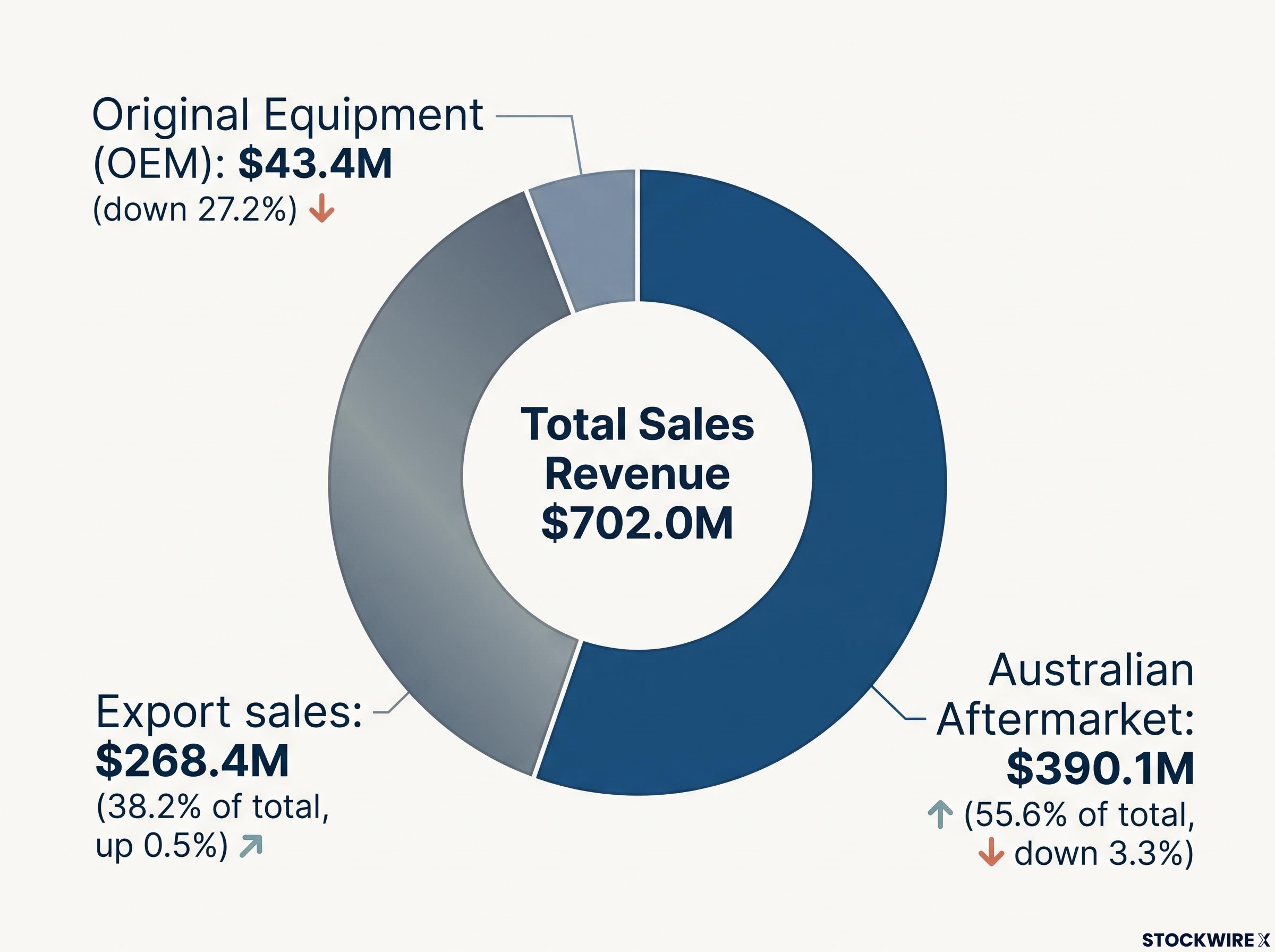
The result was shaped by three distinct sales channels, each responding differently to market conditions.
Australian Aftermarket
Australian Aftermarket sales recorded $390.1M, down 3.3%, representing 55.6% of total sales. Key Australian vehicle platforms declined 4%, with dealer and fleet channels most significantly impacted by lower new vehicle deliveries and constrained discretionary consumer spending.
Export sales
Export sales edged up to $268.4M, up 0.5%, now 38.2% of total sales. The US delivered growth of 10.2% (13.5% in USD terms) despite tariff and economic headwinds, while the UK was materially impacted by lower new vehicle registrations.
Original Equipment (OEM)
OEM sales declined to $43.4M, down 27.2%. Management described the decline as temporary, driven by the timing and lull between major vehicle programs and constrained vehicle supply, rather than any change in ARB’s competitive position.
The company noted it has recently secured contracts for two future platforms with new US OEMs, which typically carry development cycles of two to four years.
Export diversification, particularly the sustained US momentum, is helping buffer softness in the domestic market.
What drives ARB’s business — the 4×4 accessory model explained
For newer investors, understanding why ARB is structured the way it is helps explain how it protects margins even as vehicle volumes soften.
ARB sells and fits premium 4×4 accessories that require specialist knowledge, custom-designed facilities and skilled fitters to sell and install. This premium, service-led model supports the company’s largest sales channel.
A key concept is the “fitment rate”, which measures how often accessories are attached to a given vehicle, alongside revenue per fitment. Higher-value vehicles drive more accessory spend. The average LandCruiser 300 Series customer spends around twice as much on ARB accessories as the average Mitsubishi Triton customer.
This is why management prioritises established, high-value platforms that account for the majority of accessory demand, rather than chasing vehicle volume alone. The strategy underpins strong gross margins even when overall vehicle volumes decline.
Growth engines — US expansion, engineering and new markets
The presentation grouped several forward-momentum initiatives that management said are converting into sustainable growth.
-
US business: USD growth of 13.5%, with all channels performing. The Norco, California distribution centre migration was completed, the Ascent canopy was launched with an exclusive Meyer distribution partnership, and the US engineering centre is now fully operational, completing its first fully US-led development (4Runner suspension).
-
Off Road Warehouse / 4 Wheel Parts: High double-digit ARB sell-through growth, with the store-in-store rollout progressing, 8 of 47 stores completed and a further 22 due by the end of CY26.
-
Emerging markets: ARB China Co., Ltd commenced operations, with its official opening in May, while a direct South Africa wholesale operation is beginning in FY27.
-
Engineering investment: Increasing 10-15% per year to lift new-product cadence.
-
LandCruiser FJ and FLA/Ford partnership: Toyota FJ accessory sales exceeded expectations, while ARB was first to market with accessories for the Ranger Super Duty with record fitment rates.
These strategic foundations, laid in prior years, are described by management as continuing to materialise into sustainable growth.
Cash, dividends and a debt-free balance sheet
ARB generated operating cash flow of $103.7M during the year, with $36.6M in payments for property, plant and equipment.
The company ended the year with $47.9M net cash and no debt. Net cash declined $21.3M, reflecting the 50 cents per share special dividend paid during the period.
Dividends recognised across the period included:
- FY25 special dividend of 50.0 cps plus a final dividend of 35.0 cps
- FY26 interim dividend of 34.0 cps
- FY26 final dividend declared of 35.0 cps
All dividends were fully franked at the 30% tax rate.
FY26 outlook — positioned for an FY27 recovery
Management outlined a constructive forward view, anchored to improving vehicle supply and continuing international expansion.
- Improving supply of key Toyota 4x4s, including the reintroduction of the LandCruiser 70 Series and much improved availability of the HiLux, Prado and 300 Series, is expected to create opportunities in FY27.
- The US outlook remains positive, growth in South-East Asia is expected to continue, and the newly established presences in China and South Africa position ARB for growth over the coming years.
- Sales to OEMs are expected to improve in FY27 following the temporary decline, subject to OEM supply chains and future platform release timing.
- Continued engineering investment is expected to support a higher cadence of new product releases.
- Further detail on product strategy, engineering investment and international expansion, including China and South Africa, is to be provided at the AGM.
The Board believes the company is well-positioned for long-term success through a strong balance sheet, deepening engineering capability, diversified export growth supported by its own US distribution channels, and a market-leading Australian Aftermarket network as vehicle supply recovers.
Don’t Miss the Next Consumer Discretionary Winner
Big News Blast delivers FREE breaking ASX news straight to your inbox within minutes of release, complete with in-depth analysis already done for you. Join 20,000+ subscribers staying ahead of the market the moment announcements land. Click the “Free Alerts” button at Big News Blast to start receiving alerts today.