

Pentanet delivers 74% EBITDA lift as cloud gaming fuels FY26 turnaround
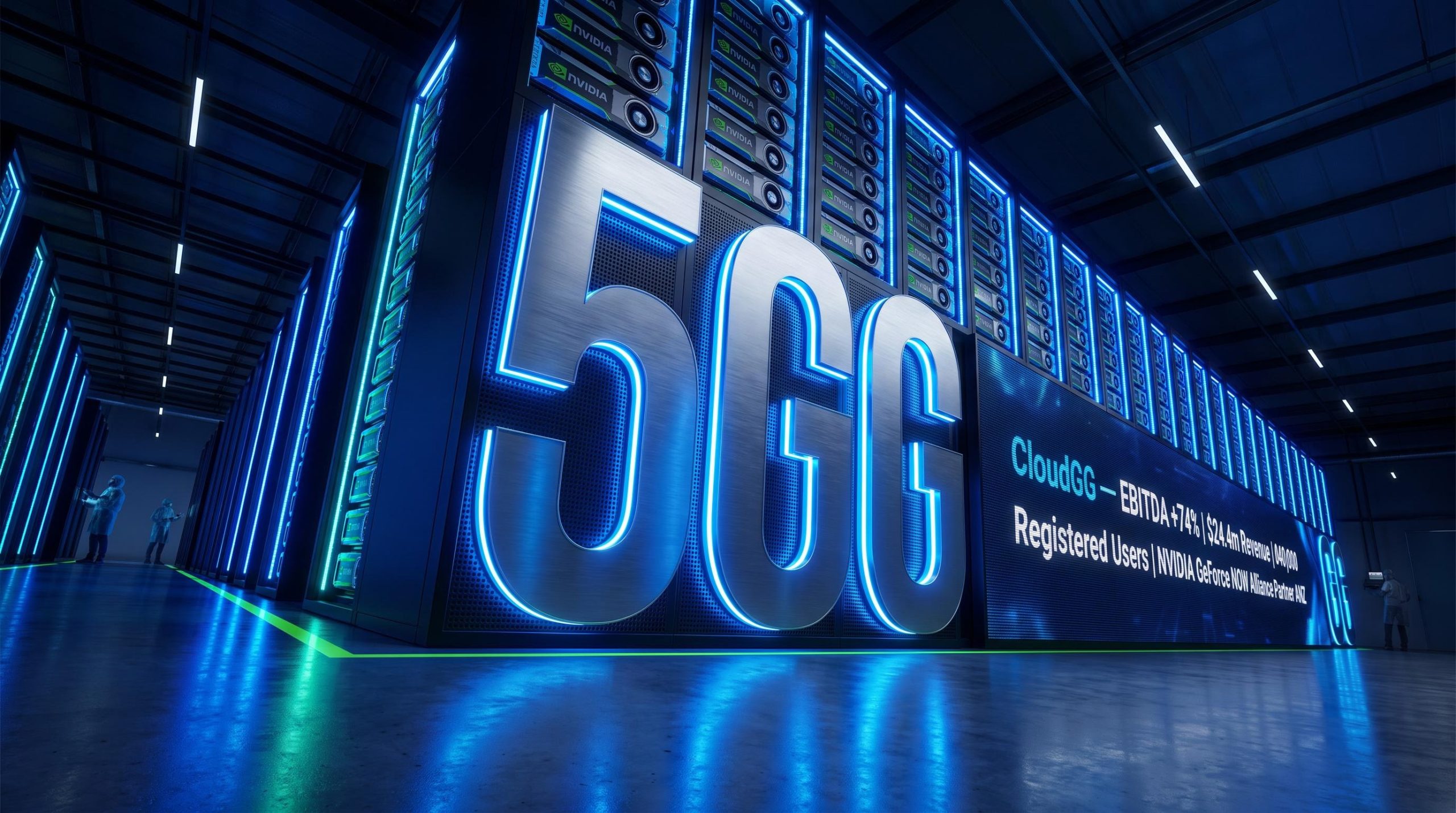
In its September 2026 investor presentation covering FY26 results for the year ended 30 June 2026, Pentanet (ASX:5GG) detailed a marked improvement in operating performance, with Group EBITDA up 74% to $2.4 million and Group revenue up 8% to $24.4 million.
Net operating cash inflow rose 17% to $1.6 million. Management framed the result around a single strategic thread: higher-margin cloud gaming is driving operating leverage, while the telco segment provides a recurring-revenue foundation.
Pentanet is the sole NVIDIA GeForce NOW Alliance Partner for Australia and New Zealand. The presentation positioned the FY26 outcome as a step-change from the $1.3 million EBITDA loss recorded in FY24, signalling what management described as a pivotal point in the company’s journey.
When big ASX news breaks, our subscribers know first
FY26 financial results at a glance
The presentation detailed a three-year Group trend, showing consistent revenue growth alongside a swing from operating losses to profit.
| Metric | FY24 | FY25 | FY26 | Change |
|---|---|---|---|---|
| Group revenue | $20.9m | $22.6m | $24.4m | +8% |
| Group EBITDA | ($1.3m) | $1.4m | $2.4m | +74% |
| Operating cash flow | ($0.6m) | $1.4m | $1.6m | +17% |
Operating cash flow of $1.6 million represented a $2.2 million turnaround from FY24’s outflow. On the balance sheet, management outlined the following cash position:
-
Cash at bank of $1.5 million.
-
Investing outflow of ($2.3 million), which narrowed 16% on the prior year.
-
The final $1.6 million payment to the Australian Communications and Media Authority (ACMA) for the 15-year Spectrum License, included within payments for intangibles.
Cloud gaming: the higher-margin growth engine
Management framed cloud gaming as the strategic priority, centred on margin expansion. Segment metrics presented for FY26 included:
-
Revenue up 16% to $2.8 million.
-
Gross margin up 11pp to 68%.
-
Segment EBITDA up 61% to $1.7 million, now 46% of Group EBITDA before corporate costs, up from 35% in FY25.
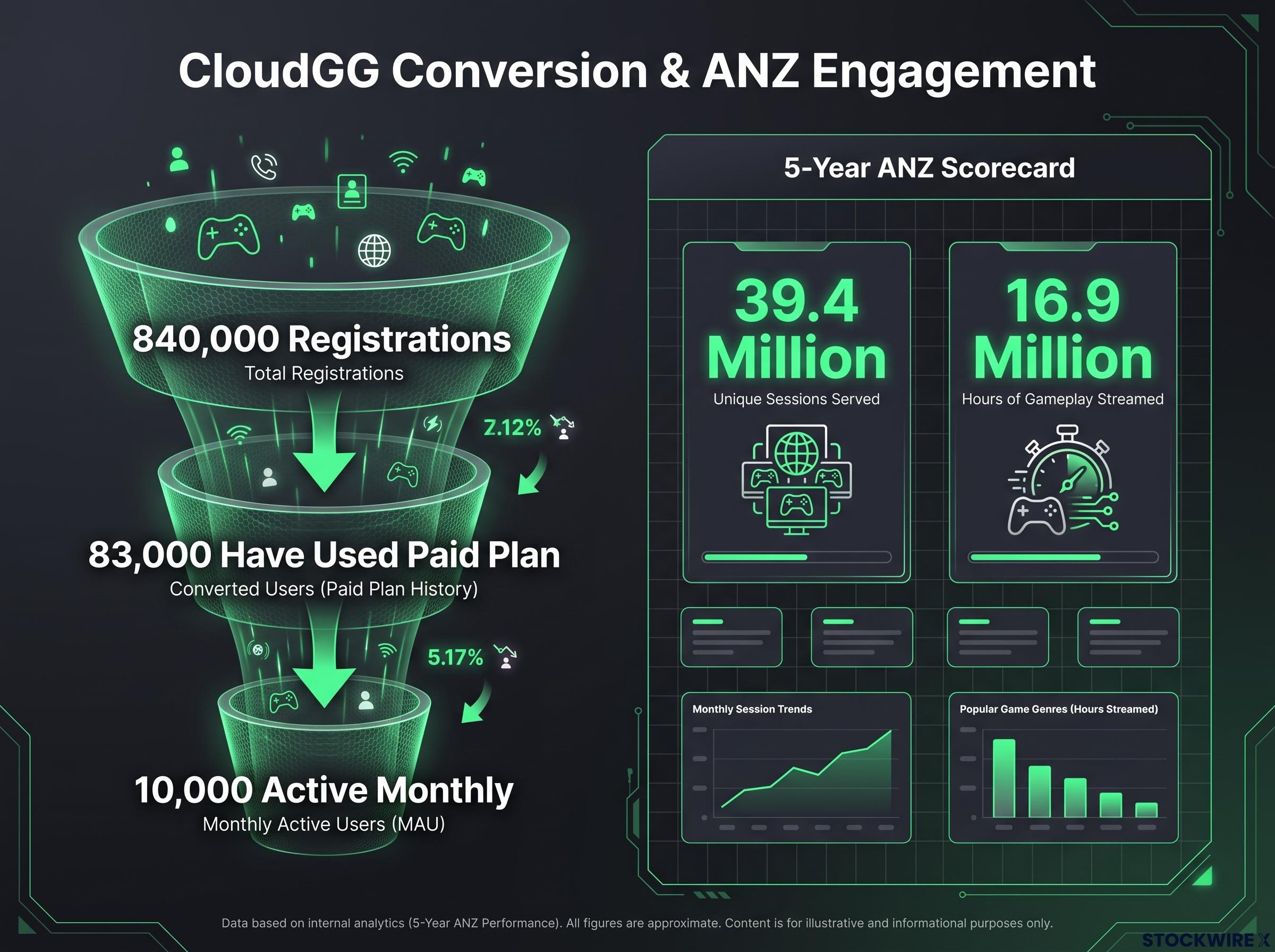
Operational proof points reinforced the shift toward premium tiers. Gaming ARPU rose 36% to $24 per month, and the Ultimate plan now carries 59% of the paying base, up 20pp on the prior year. The presentation reported roughly 10,000 monthly active paying users against 840,000 registered CloudGG users.
Management noted it is in advanced negotiations with NVIDIA, under the alliance agreement, to acquire additional Blackwell servers, expected to conclude soon. The company flagged that negotiations remain ongoing and there is no certainty that an agreement will be concluded.
Investment highlight
The cloud gaming segment is EBITDA positive in isolation, with proven unit economics sitting behind a large registered-user funnel awaiting conversion.
What is cloud gaming, and why the market is turning
GeForce NOW is a cloud gaming platform where games run on Pentanet’s local NVIDIA graphics processing units (GPUs) and stream to any device. There are no downloads and no requirement to own gaming hardware. The service links to games players already own on Steam, Epic and Xbox.
For investors, the relevance now stems from rising hardware costs. The presentation set out several data points:
-
The flagship RTX 5080 GPU is priced at $2,000 to $3,000 AUD.
-
Computer memory market prices have risen approximately 200% since the start of 2025, with a standard retail PC memory kit moving from $140 to $392 between late 2025 and August 2026.
-
No new consumer GPU generation is expected until 2027 at the earliest.
Context from the IGEA / Bond University Australia Plays 2025 study showed that 82% of Australians play video games, with 58% of gaming households owning a PC, the cohort management identified as the direct conversion pool. On the presentation’s illustrative figures, a $2,500 build takes 10.4 years to break even at $20 per month, keeping ownership economics under pressure.
The NVIDIA alliance moat
The presentation described the alliance as the core competitive advantage. Pentanet has been the sole operator of GeForce NOW in Australia and New Zealand since January 2021.
The operating moat
Every Australian and New Zealand gamer who wants GeForce NOW comes through CloudGG, representing 100% of the region’s GFN demand landing on the platform.
Management presented a five-year scorecard for the ANZ operation, including:
-
39.4 million unique sessions served.
-
16.9 million hours of gameplay streamed.
-
46 million GeForce NOW registered users globally since launch.
The conversion opportunity sits within the funnel: of 840,000 registrations, 83,000 have used a paid plan, with roughly 10,000 active in any given month, a rotating base. Management identified the value proposition gap for casual and seasonal gamers as the next monetisation lever.
Telco segment holds firm as the cash engine
Management framed the telco segment as a recurring-revenue foundation funding the GPU build-out rather than a growth story.
| Metric | Value |
|---|---|
| Segment revenue | $21.6m (+7%) |
| Segment EBITDA | $2.0m (+5%) |
| Total subscribers | 18,936 (+4%) |
| 5G subscribers | 1,039 (+15%) |
| Average monthly churn | 1.3% |
| Blended ARPU | $96 |
The presentation noted that NBN Speed Boost lifted acquisition, with eligible higher-speed fibre and HFC connections automatically upgraded during September 2025 at no additional cost. Management described the strategic focus as utilisation over expansion.
The Gen 2 impairment explained
The presentation addressed a ($4.0 million) impairment on legacy Gen 2 hardware, presenting two distinct net profit after tax (NPAT) figures.
-
As reported, the loss widened 55% to ($6.9 million).
-
Excluding the Gen 2 impairment, the underlying loss was ($2.9 million), a 36% or $1.6 million improvement on FY25.
Gen 2 hardware was deployed in 2021 to meet the NVIDIA commitment and unlock exclusivity. As users migrated to the Gen 3 platform across 2025, the decision was made to bring Gen 2 to end-of-life in 2026. Management characterised current Gen 3 and Blackwell deployments as incremental, entering service on delivery and depreciating from day one, describing the impairment as a legacy technology decision rather than a recurring pattern.
Four strategic priorities and the road ahead
Management outlined four strategic focuses for the business:
-
Telco, positioned as a predictable cash engine funding the GPU build-out, measured on EBITDA and cash conversion rather than growth.
-
Fixed Wireless, held for its moment with no new capital, with re-entry considered when a competing gigabit-class product can lead the market on price.
-
NBN enablement, described as a configuration change rather than a build, turning CloudGG users into a low-touch acquisition base.
-
GPU expansion, a “triple down” on Blackwell, with every incremental dollar of free cash prioritised toward NVIDIA GPU capacity, added incrementally as demand dictates.
The presentation set out an indicative roadmap across four horizons: Horizon 1 covers the Blackwell upgrade and the RTX 5080 flagship plan; Horizon 2 targets a move from 10k to 20k paid users; Horizon 3 targets 20k to 100k paid users; and Horizon 4 envisions a scaled NVIDIA GPU deployment. Management flagged these as aspirational operational milestones and indicative sequencing only, not forecasts or guidance.
Management’s view
The presentation closed with remarks from Managing Director Stephen Cornish.
Stephen Cornish, Managing Director
“To our talented team, board, customers, partners and loyal shareholders, your support has been instrumental in reaching this pivotal point in Pentanet’s journey. We’re excited for the next phase of growth in 2026 and beyond.”
Don’t Miss the Next Tech Breakout on the ASX
Big News Blast delivers FREE breaking ASX tech news to your inbox within minutes of release, complete with in-depth analysis already done for you. Join 20,000+ subscribers who stay ahead of the market the moment announcements drop. Click the “Free Alerts” button at Big News Blast to start receiving alerts today.