

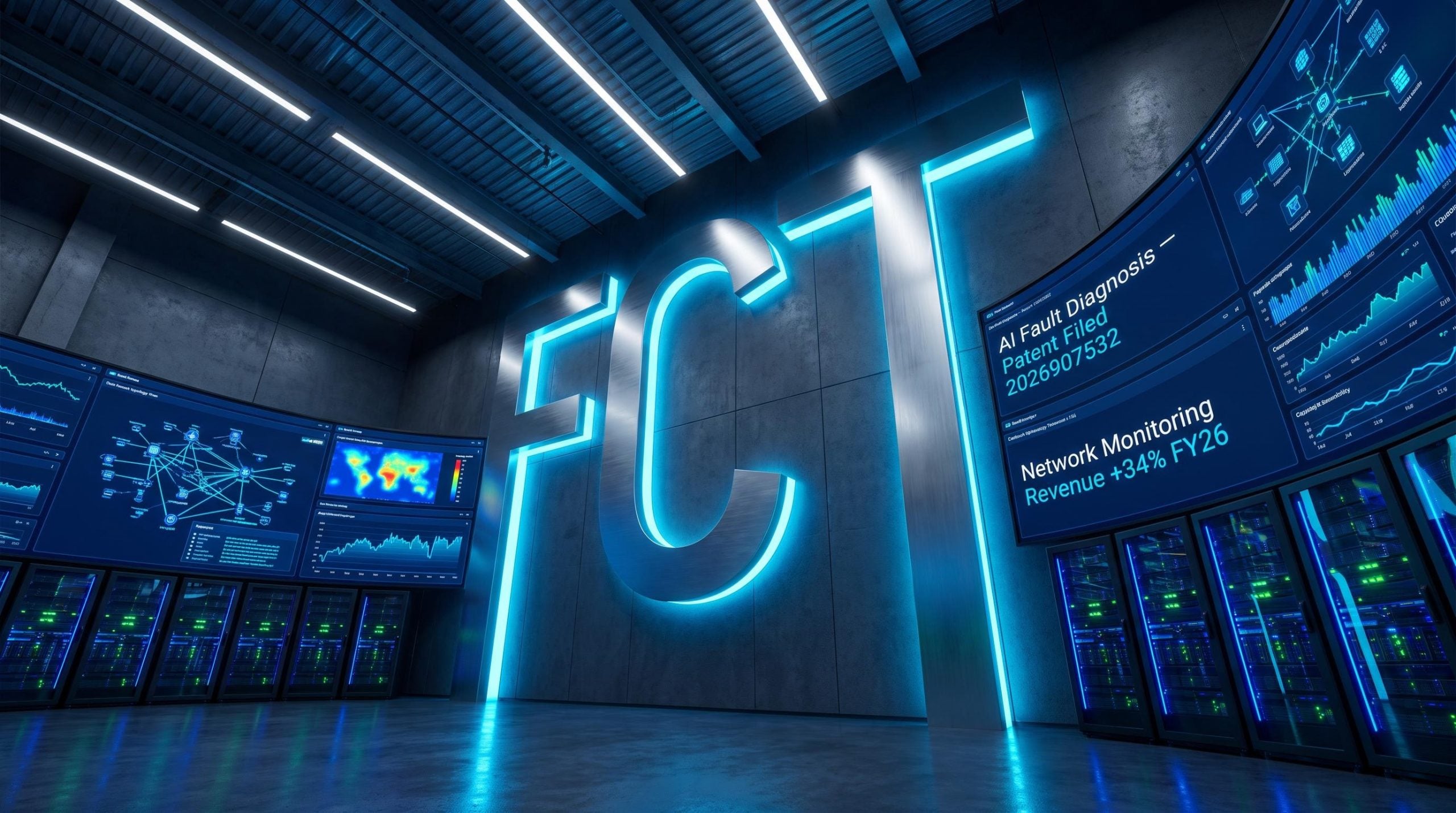
FirstWave files patent for AI-driven network fault diagnosis system
FirstWave Cloud Technology Limited (ASX: FCT) has filed a provisional patent application with IP Australia for an AI-driven network monitoring and fault diagnosis system, positioning artificial intelligence at the centre of its strongest revenue line.
The application, titled Network Monitoring and Fault Diagnosis System, was filed on 3 September 2026 and carries provisional patent application number 2026907532. FirstWave is the sole applicant and owner of the invention.
The technology emerged from the previously announced (ASX 5 February 2026) Australian government-backed collaboration with the University of the Sunshine Coast (UniSC) and CSIRO. According to the Company, the filing represents a deliberate strategic decision to grow its fastest-growing revenue segment through AI, rather than a speculative new venture.
When big ASX news breaks, our subscribers know first
A strategic bet on the company’s fastest-growing revenue line
The filing is designed to extend momentum in FirstWave’s strongest revenue line. Network monitoring revenue grew 34% to A$6,932,196 in FY26 (ASX 31 August 2026), and the Company states the new technology is already a commercial product it is preparing to launch, either as new features to be upsold or as a stand-alone module.
The product extends FirstWave’s existing network management portfolio, including NMIS, opEvents and opCharts, and is built directly into the NMIS suite. Key clients including John Deere and Telmex have asked FirstWave for this capability.
FirstWave states the technology gives it a significant advantage over standalone AI offerings. The system draws on device history and telemetry that the Company’s products are already collecting, and is delivered through software FirstWave already licenses to its clients.
Danny Maher, CEO of FirstWave
“Network monitoring is our largest and fastest-growing revenue line and this patent is a deliberate decision to put AI at the centre of it. The core strength of our NMIS platform is its ability to collect, manage and present enormous amounts of data from a wide range of technologies. This data sits on premise within our software and as such we are in a prime position to apply AI technologies to make that data more valuable for our clients and therefore better monetise that data for FirstWave.”
How the multi-agent AI system works
The technology was developed to solve one of the biggest challenges in network operations: finding the root cause of a problem or potential problem fast enough to prevent or reduce the impact of an outage. Manual investigation requires human engineers, leaving businesses absorbing the cost of downtime while the cause and resolution are determined.
FirstWave closes that gap with a multi-agent AI architecture, orchestrated by large language models. Rather than a single model making a single guess, specialised AI agents reason over network context, apply operational knowledge and coordinate with each other the way a team of engineers would, testing and ruling out explanations until they reach a verified, explainable diagnosis.
The system introduces AI-driven adaptive thresholds that learn the normal operating behaviour of each device. Alerts are raised and automatically investigated when abnormal operational patterns occur, often flagging faults as they form and before they cause an outage.
Engineers direct the process through a conversational interface, and every approved fix is captured as operational knowledge. The Company states this addresses the false-positive and explainability limits of existing monitoring tools, building toward self-healing networks.
The diagnosis-to-fix workflow proceeds as follows:
-
A fault or abnormal pattern is detected.
-
The AI automatically investigates the root cause.
-
A diagnosis is delivered with supporting telemetry, logs and diagnostic results.
-
The engineer works with the AI through a conversational interface, directing it to investigate further or request alternative solutions.
-
The engineer approves the final fix.
-
The approved fix is captured as operational knowledge for future faults.
A large and fast-growing market opportunity
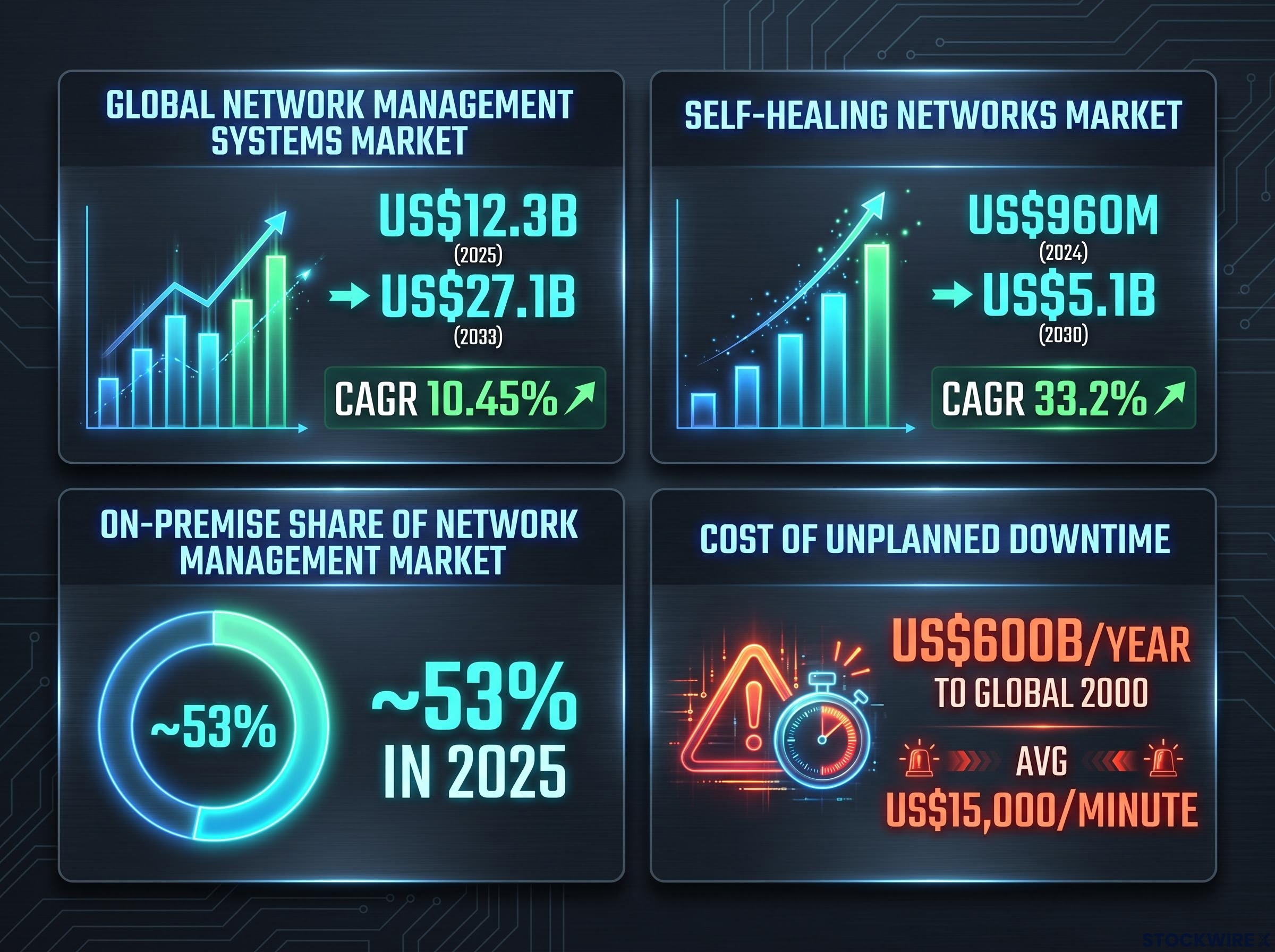
FirstWave has framed the opportunity against a large and growing market for network management technology. The following figures are drawn from cited third-party research reports rather than the Company’s own forecasts.
| Metric | Figure | Source | Investor Relevance |
|---|---|---|---|
| Global network management systems market | US$12.3B (2025) → US$27.1B (2033), CAGR 10.45% | Data Bridge Market Research | Sizes the addressable market FirstWave operates within |
| Self-healing networks market | US$960M (2024) → US$5.1B (2030), CAGR 33.2%; root cause analysis fastest-growing application at 34% | Grand View Research | Directly aligned with the patented capability |
| On-premise share of network management market | ~53% in 2025 | Data Bridge Market Research | Segment cloud-delivered AI cannot reach |
| Cost of unplanned downtime | US$600B/year to Global 2000; avg US$15,000/minute; only 38% of tech execs consistently identify root cause | Splunk (a Cisco company) with Oxford Economics | Quantifies the problem the technology targets |
The on-premise angle is central to FirstWave’s positioning. Secure organisations such as banks, defence, government and telcos will not send sensitive IT infrastructure data to a cloud, and as a result need to run their network management systems on their own servers. On-premise systems made up around 53% of the network management market in 2025, and cloud-delivered AI cannot reach them.
On-premise government deployments have already proven to be a material revenue source for FirstWave, with Services Australia signing a $1.85 million software licence deal in 2026, demonstrating that the secure-organisation segment the new AI system targets is an active and paying customer class.
The Company states it is one of few companies serving this market with multi-agent AI fault diagnosis, with its software installed on premise collecting the data the AI needs.
Research collaboration behind the invention
The invention arose from research undertaken by FirstWave with CSIRO and the University of the Sunshine Coast, jointly funded by the three parties under CSIRO’s Regional University Industry Collaboration (RUIC) program. The named inventors include technologists from both FirstWave and UniSC.
CSIRO RUIC program funding has featured in FirstWave’s R&D strategy before this patent filing; the same collaborative structure backed an earlier AI compliance project with UniSC, reducing FirstWave’s direct capital outlay while advancing its broader product roadmap.
FirstWave holds the rights to the invention and is the sole applicant.
Sharon Hunneybell, VP of Products at FirstWave
“These are exciting times for our product and development teams. We’re applying agentic AI to a problem network engineers have lived with since the invention of networks, turning huge volumes of telemetry into insight, and for the first time providing automated root cause analysis and remediation using artificial intelligence rather than humans working with traditional diagnostic tools. I’m grateful to the Queensland Government and CSIRO for their support through the Regional University Industry Collaboration program, and to the University of the Sunshine Coast for the collaboration on this project. It’s a great example of research translating into a real, tangible outcome for industry and I’m extremely excited to get this technology into the hands of our existing and future clients and to showcase it to the world.”
The “for the first time” reference in Hunneybell’s statement relates to FirstWave’s own product capability, providing automated root cause analysis and remediation, rather than an industry-wide first.
What it means for FirstWave investors
The filing augments FirstWave’s strongest and fastest-growing revenue line rather than introducing an unproven new business. With the technology already positioned as a commercial product near launch, monetisation could occur via upsell or as a stand-alone module, though the Company has not provided a specific launch date.
Key considerations for investors include:
-
The technology extends the network monitoring line, which grew 34% to A$6,932,196 in FY26.
-
It works immediately with existing customer data, while new customers can leverage FirstWave’s existing collection capability.
-
Blue-chip client demand from John Deere and Telmex has already been validated.
-
The on-premise focus targets secure organisations that cloud-delivered AI cannot reach.
-
The pathway toward self-healing networks, where faults are understood and resolved with minimal human intervention, represents the strategic upside described by the Company.
FirstWave remains the sole applicant and owner of the invention, with the provisional patent application now lodged with IP Australia.
Ready to Explore FirstWave’s AI-Driven Network Monitoring Opportunity?
FirstWave’s provisional patent filing marks a deliberate move to embed multi-agent AI into its fastest-growing revenue line, with network monitoring already up 34% to A$6,932,196 in FY26 and blue-chip clients such as John Deere and Telmex validating demand. The technology targets the on-premise segment that cloud-delivered AI cannot reach, positioning FirstWave in a self-healing networks market projected to grow at a 33.2% CAGR through 2030.
To explore the full scope of FirstWave’s product portfolio and commercial strategy, visit the FirstWave investor centre for the latest updates on the NMIS platform and the company’s AI roadmap.