

ColoSTAT study points to $72.4 million in annual public hospital savings
An independent health economic study of ColoSTAT® estimates that public hospitals would need around 29,400 fewer colonoscopies each year, a 36% reduction for the modelled group of patients. Rhythm Biosciences (ASX: RHY) received the results on 7 October 2026.
The study was carried out by Value-Based Access Pty Ltd (VBA), a Sydney healthcare consultancy, and was paid for by Rhythm. After allowing for the cost of the blood tests, the model estimates a net saving in public hospital activity of about $72.4 million a year.
The study will form part of Rhythm’s work towards an application to the Medical Services Advisory Committee (MSAC) seeking Medicare reimbursement for ColoSTAT®. The figures are estimates from a model, not measured results.
When big ASX news breaks, our subscribers know first
What the model found
The model looked at public hospital activity per year for people with bowel symptoms who would otherwise be referred directly for a colonoscopy.
Fact vs. impact table
| Public hospitals, per year | Estimate |
|---|---|
| People with bowel symptoms included in the study | 82,662 |
| Colonoscopies avoided | 29,427 (36%) |
| Public hospital costs avoided | $93.1 million |
| Cost of ColoSTAT® blood tests ($250 each) | $20.7 million |
| Net saving in public hospital activity | $72.4 million |
| Hospital costs avoided for every $1 spent on testing | About $4.50 |
Source: Value-Based Access Pty Ltd, ColoSTAT®: reducing colonoscopy demand and cost in the Australian public sector (September 2026). These are estimates from a model, not measured results.
How the model works
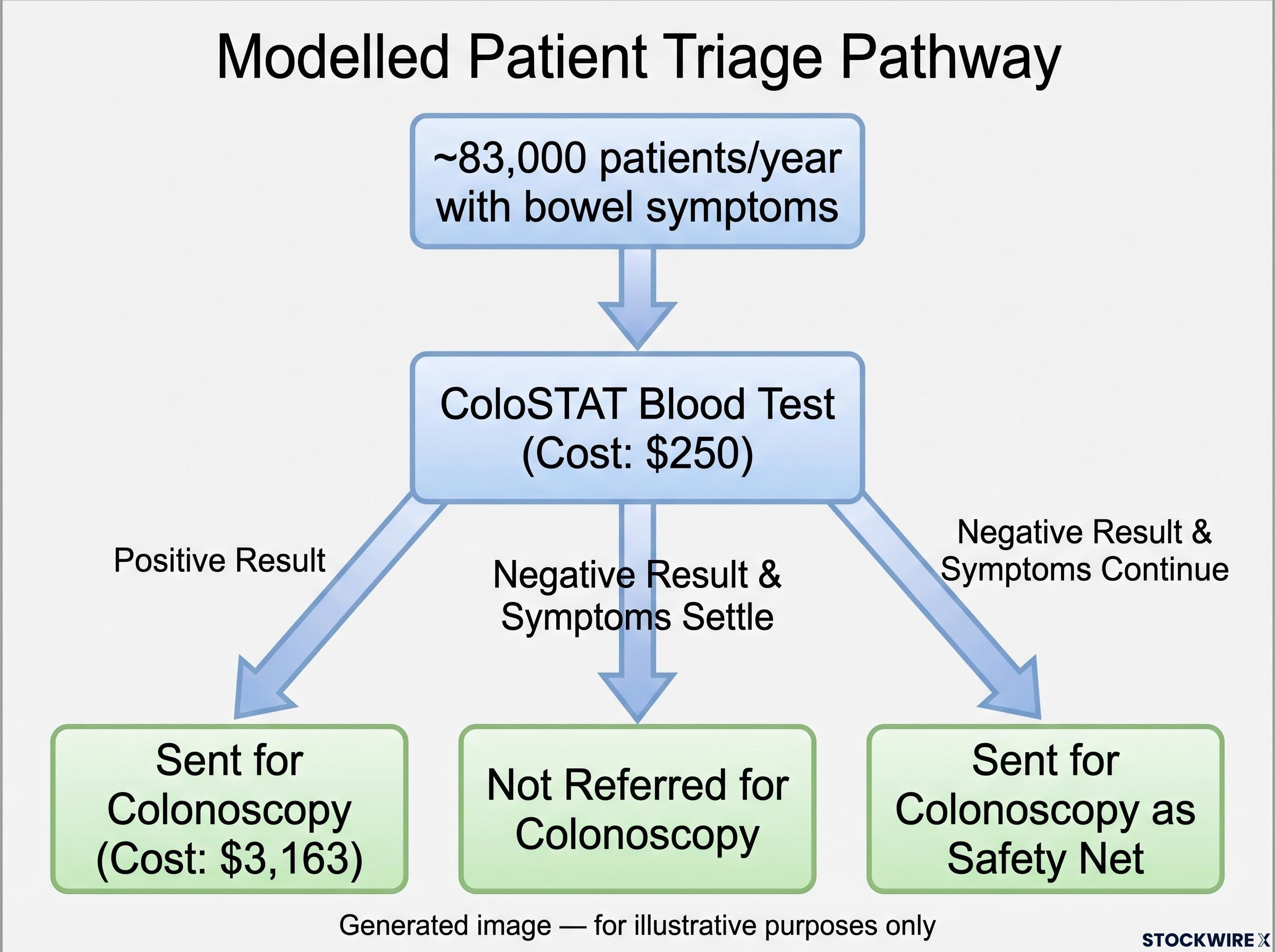
The study modelled about 83,000 people a year who see their GP with possible bowel cancer symptoms, have not done the stool test, and would today be referred directly to a public hospital for a colonoscopy. It compared this with the GP first ordering a ColoSTAT® blood test, using the following pathway:
- Positive result: the patient is sent for a colonoscopy.
- Negative result and symptoms settle: the patient is not referred for a colonoscopy.
- Negative result but symptoms continue: the patient is still sent for a colonoscopy, as a safety net.
The study assumed a cost of $250 for each ColoSTAT® test, compared with $3,163 for a colonoscopy in a public hospital.
GP ordering through MedicalDirector went live on 1 August 2026, and the same software workflow is the channel through which a GP would order the blood test ahead of any referral for colonoscopy.
Why colonoscopy demand matters
Bowel cancer is one of the most common cancers in Australia, and finding it early saves lives. The free national screening program uses a stool test done at home, but fewer than half of the people sent one use it.
When people see their GP with bowel symptoms, they are usually sent for a colonoscopy. Public waiting lists are long, with some people waiting four to six months, yet most people who have a colonoscopy do not have bowel cancer.
Field research across New South Wales, Queensland and Victoria has confirmed colonoscopy backlogs at 10 institutions, with high-risk patients waiting two to three times the recommended 30-day window.
ColoSTAT® is a blood test that measures five specific protein biomarkers that indicate the likelihood of colorectal cancer. It is intended for individuals with symptoms associated with the disease, is based on research from Australia’s CSIRO and is patent protected internationally.
The announcement notes that hospitals could use the resources from colonoscopies avoided to treat patients on waiting lists sooner.
Medicare pathway and private hospital upside
Investment thesis
ColoSTAT® is not currently funded by Medicare. Rhythm intends to use this study, together with other relevant evidence and future studies, to support a future application to MSAC seeking Medicare reimbursement.
The company describes obtaining Medicare reimbursement as a “significant commercial milestone” for Rhythm. It will update the market as appropriate on material developments in relation to the MSAC pathway.
Private hospitals
The study did not cover private hospitals, where about two-thirds of colonoscopies in Australia are done. Rhythm believes there is potential for a larger benefit there.
The company intends to do further work to assess how ColoSTAT® could be used in private hospitals, and its health economic impact there. No figures have been disclosed.
Director quote callout
Dr David Atkins, Managing Director and CEO
“This independent study indicates that ColoSTAT®, ordered by a GP, could free up almost 30,000 colonoscopies a year for the patients who need them most… In Australia, obtaining reimbursement is a key milestone for the commercial success of any medical diagnostic test…”
Next steps
Rhythm will share the study with GPs, specialists, hospitals and health insurers. The study and a plain-English summary are available at www.colostat.com/resources.
Key assumptions behind the estimates
The announcement states that the results come from an economic model, not from real-world use, and actual results may differ materially from the estimates presented. The source lists the following points:
- The model assumes that ColoSTAT® testing is funded through Medicare, which is not yet the case. There is no guarantee of Medicare reimbursement or wide adoption.
- The accuracy figures used (the test detects 90.3% of bowel cancers and gives a negative result for 54.3% of people who do not have cancer) come from a study that is still being reviewed by independent scientists (peer review).
- The model estimates that a small number of cancers would be missed by the blood test at first. Sending patients whose symptoms continue for a colonoscopy helps reduce this risk.
Get Healthcare News Before the Market Moves
Healthcare investors on the ASX can receive FREE breaking news within minutes of release, complete with in-depth analysis and the full announcement. Join 20,000+ subscribers and click the “Free Alerts” button at Big News Blast to stay ahead the moment market-moving news breaks.