

Promarker®Endo validated: up to 90% sensitivity in Oxford cohort
Proteomics International (ASX: PIQ) has completed refinement and independent validation of its Promarker®Endo blood test for endometriosis. The validation used more than 400 samples from the University of Oxford in England.
The refined model was originally developed using samples from The Royal Women’s Hospital in Melbourne. The Oxford cohort is described in the announcement as geographically unique.
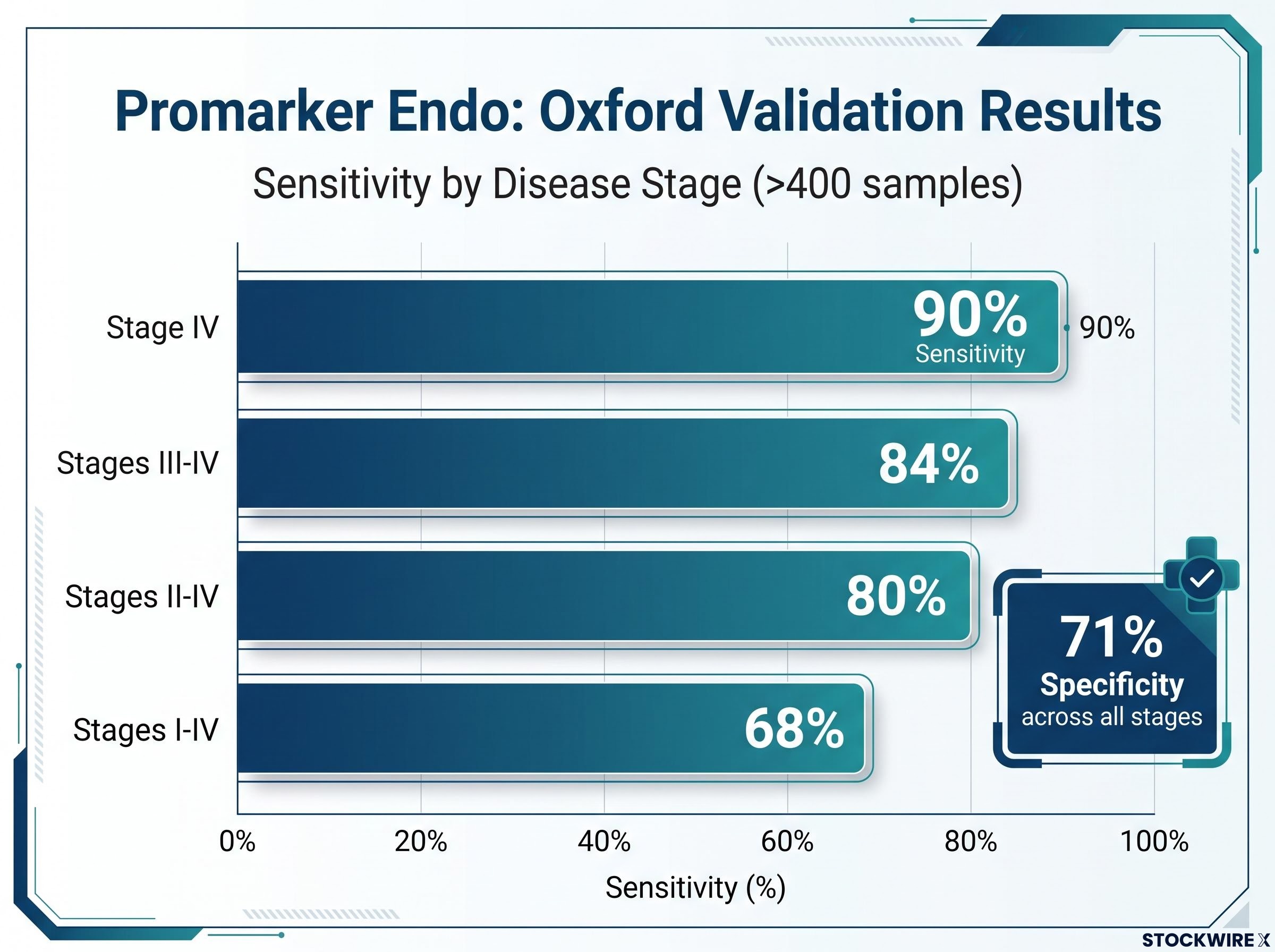
Independent validation showed the following results:
- 90% sensitivity for Stage IV endometriosis
- 84% sensitivity for Stages III–IV
- 80% sensitivity for Stages II–IV
- 68% sensitivity for all stages combined (I–IV)
- 71% specificity across all stage groupings
The Company expects to make Promarker®Endo commercially available during FY27 Q3, subject to applicable clinical deployment and regulatory requirements. Independent validation moves the test a step closer to market.
David Morris, CEO and Managing Director
“Completing independent validation of Promarker®Endo is a pivotal milestone for the Company as we bring our three core Promarker® tests to market…”
When big ASX news breaks, our subscribers know first
Oxford results broken down by disease stage
The table below sets out results from the independent validation cohort, as presented in the announcement.
| Endometriosis Group | Number of Endometriosis Cases | Number of Controls | Sensitivity | Specificity |
|---|---|---|---|---|
| Stage IV (Severe) | 62 | 125 | 90% | 71% |
| Stages III–IV (Moderate to Severe) | 109 | 125 | 84% | 71% |
| Stages II–IV (Mild to Severe) | 153 | 125 | 80% | 71% |
| Stages I–IV (All Stages) | 303 | 125 | 68% | 71% |
Specificity is identical across groupings for the following reasons:
- Every comparison used the same 125 controls and corresponding test results.
- Controls were patients with similar disease symptoms who were surgically confirmed not to have endometriosis.
- Cases were patients with surgically confirmed endometriosis.
- Thresholds were set in advance, and the same model and cutoffs were applied consistently across all disease stages.
Stage I disease is more difficult to distinguish from symptomatic controls. The strongest sensitivity was observed in patients with advanced disease.
Why independent validation matters
A statistical model is trained on samples from patients with known diagnoses. It may fit the characteristics of that development cohort particularly well, so its performance must be assessed in an independent cohort to determine how well it generalises to new patients.
Independent validation evaluates the fixed model in a separate cohort without further refinement. Differences in performance may reflect differences in disease prevalence, patient characteristics or sample collection.
The initial performance figures from The Royal Women’s Hospital cohort related to initial model development only. The refined model is the one now validated using the University of Oxford cohort.
Promarker®Endo is a mass spectrometry-based blood test that measures protein biomarkers. It combines them with clinical factors in a statistical model to provide a risk profile for endometriosis.
For investors, a geographically distinct validation cohort offers a data point on how the test may generalise to new patients.
Addressing a long diagnostic delay in endometriosis
The announcement cites the following context on the condition:
- Endometriosis affects around one in seven women, according to the Australian Government Department of Health, Disability and Ageing.
- The Australian Institute of Health and Welfare (AIHW) reports an average delay of six to eight years between symptom onset and diagnosis.
- The AIHW estimates Australian health-system spending on endometriosis at $293 million in 2022–23, more than double the 2013–14 figure. This measures healthcare spending, not the wider economic cost of lost productivity and reduced quality of life.
- An August 2026 AIHW report found endometriosis hospitalisation rates had risen 23% over the preceding decade.
Clinical assessment and imaging can support diagnosis and treatment. Promarker®Endo was developed to provide additional blood-based information to help clinicians assess the likelihood of endometriosis and prioritise further investigation.
Dr Johan Conradie, Clinical Pathologist at Proteomics International
“…I look forward to seeing how this test can be integrated into existing clinical pathways to support earlier diagnosis and improve patient care.”
Next steps toward FY27 Q3 availability
The Company expects to make Promarker®Endo commercially available during FY27 Q3, subject to:
- preparing the assay for clinical deployment
- establishing clear reporting and follow-up guidance for clinicians
- completing applicable quality, accreditation and regulatory requirements
The announcement states that the refinement and validation provide “a robust foundation” to enable final assay deployment and preparation for clinical use. This sits alongside the Company’s plan to bring its three core Promarker® tests to market.
Management’s four-test commercial roadmap places Promarker®Endo alongside PromarkerD, PromarkerEso and OxiDx, using a distributor-led model through FY29 instead of building direct sales infrastructure.
The announcement does not disclose revenue, pricing, reimbursement or approval timelines. The Company states that commercial outcomes may depend on factors including implementation timing, clinician adoption, patient utilisation and reimbursement pathways. Deployment readiness and regulatory progress are the next areas to watch.
Investors exploring how the first Promarker® tests reached market can read our detailed coverage of the Promarker® Healius rollout, which sets out pricing for PromarkerD and PromarkerEso, the controlled release in WA and the NT, and the path to national sales.
Get Healthcare News Before the Market Moves
Join 20,000+ investors receiving FREE breaking ASX news within minutes of release, complete with in-depth analysis. Click the “Free Alerts” button at Big News Blast to get the next healthcare announcement in your inbox the moment it breaks, and stay ahead of the market.