
Proteomics International repositions for commercial execution across three lead prognostic and diagnostic tests
In its July 2026 investor presentation, titled “Disciplined Path to Commercial Success,” Proteomics International outlined a refocused strategy built around commercial execution, stronger accountability and disciplined capital allocation. Management detailed the advancement of three lead tests, Promarker®D, Promarker®Eso and Promarker®Endo, addressing diabetic kidney disease, oesophageal disease and endometriosis.
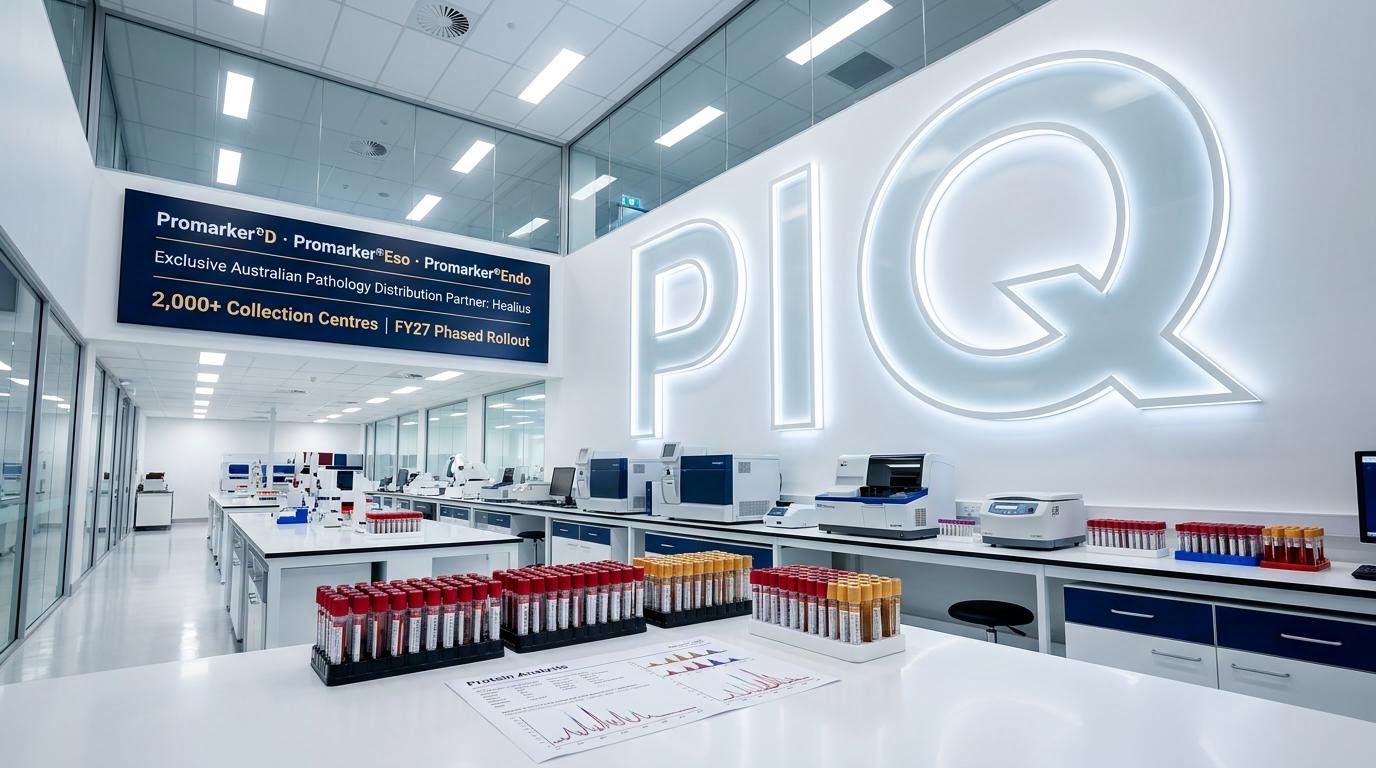
Central to the strategy is Healius Pathology access to more than 2,000 collection centres under an initial three-year term with a mutual three-year extension option. The presentation framed a transition from validated diagnostics toward recurring test revenue as adoption develops.
When big ASX news breaks, our subscribers know first
The Healius partnership: a scalable national distribution pathway
The presentation positioned the Healius agreement as a key commercial milestone within the broader strategy, establishing a scalable national distribution pathway for the Promarker® portfolio in Australia. The strategic rationale centres on leveraging trusted diagnostic and provider networks while avoiding the cost, complexity and risk of building proprietary infrastructure.
Management noted the model integrates into established clinical workflows and reduces operational and compliance risk through validated platforms, creating a repeatable framework for long-term growth. Responsibilities are divided as follows:
-
Proteomics International: retains responsibility for the Promarker® portfolio, performs all testing through accredited laboratory infrastructure, provides clinical reporting, and leads product strategy, evidence generation and market access.
-
Healius Pathology: acts as the exclusive Australian pathology distribution partner, provides access to more than 2,000 collection centres, and leverages established GP, specialist, hospital and referrer relationships.
The agreement runs an initial three-year term with a mutual three-year extension option. Implementation across operational, laboratory and commercial workstreams is underway, with a phased commercial rollout scheduled to commence during FY27.
The Healius distribution agreement was announced in July 2026, giving the Promarker® portfolio immediate access to established GP, specialist, and hospital referrer relationships alongside the physical collection centre network.
For investors, the structure offers national reach without the capital burden of building distribution, a factor that supports the company’s disciplined capital allocation focus.
Three lead tests targeting large, underserved markets
The presentation detailed three prognostic and diagnostic tests, each addressing a distinct area of unmet clinical need. All three are minimally invasive, blood-based tests designed to integrate into routine clinical practice, supporting earlier risk identification and more efficient use of healthcare resources.
The table below summarises clinical performance and the serviceable obtainable market (SOM), which reflects the company’s estimate of realistic medium-term commercial penetration. Management noted the Promarker®Endo assay is still being validated across independent cohorts.
The PromarkerEndo US patent, granted in July 2026 with protection running to 2041, reinforces the commercial foundation for the test ahead of its validation completion and adds leverage to future partnership and licensing discussions in the largest healthcare market globally.
| Test | Clinical Use | Key Performance | AU SOM (annual tests) | US SOM (annual tests) |
|---|---|---|---|---|
| Promarker®D | Diabetic kidney disease risk (up to 4 years early) | 76–85% sensitivity, 92–95% specificity, NPV 95–97% | 20,000 | 390,000 |
| Promarker®Eso | Rule-out oesophageal adenocarcinoma in reflux patients | 91% sensitivity, 98% specificity, NPV 99.9% | 15,000 | 240,000 |
| Promarker®Endo | Endometriosis assessment (assay being validated) | 83% sensitivity, 95% specificity, NPV 75% | 50,000 | 360,000 |
Promarker®D supports risk stratification for Type 2 diabetes patients, Promarker®Eso triages reflux patients for endoscopy referral, and Promarker®Endo supports the assessment of women with suspected endometriosis. Together, the three tests target sizeable patient populations across Australia and the United States.
Understanding the value: why blood-based diagnostics matter
Proteomics is the analysis of proteins that drive disease activity. By analysing proteins that drive disease activity, this approach enables richer clinical insight than genomics alone.
Earlier, minimally invasive testing carries both clinical and economic weight. Identifying risk sooner can enable timely intervention and, in doing so, reduce the higher costs associated with late-stage disease. The presentation illustrated the standard-of-care burden across each indication:
-
Chronic kidney disease (CKD): dialysis costs approximately A$50K to A$85K per year, compared with risk insight available up to four years earlier.
-
Oesophageal disease: surveillance endoscopy costs A$500 to A$2,500 every two to three years, compared with a lower-burden blood-test triage.
-
Endometriosis: a 4 to 11 year diagnostic delay and an average A$3K to A$5K per patient annually, compared with potential clarity in weeks.
For investors, this cost-avoidance value proposition is significant. A clear economic case supports reimbursement discussions and clinician adoption, both of which underpin the potential for recurring test demand.
Reimbursement and market access strategy
Management outlined a structured reimbursement pathway that combines initial private pay with ongoing evidence generation to support sustainable reimbursed market access. The approach applies across both Australia and the United States.
A tangible early step is the CMS PLA code obtained for Promarker®D in the United States. A Proprietary Laboratory Analysis (PLA) code is recognised by the Centers for Medicare & Medicaid Services and uniquely identifies a specific test for Medicare pricing and billing purposes.
The company operates NATA-accredited laboratories in Australia and CLIA/CAP-certified laboratories in the United States, providing regulated testing capacity across both markets. For investors, reimbursement is the gateway to volume, and private pay is intended to bridge revenue while clinical and economic evidence builds.
The execution roadmap: FY26 to FY29
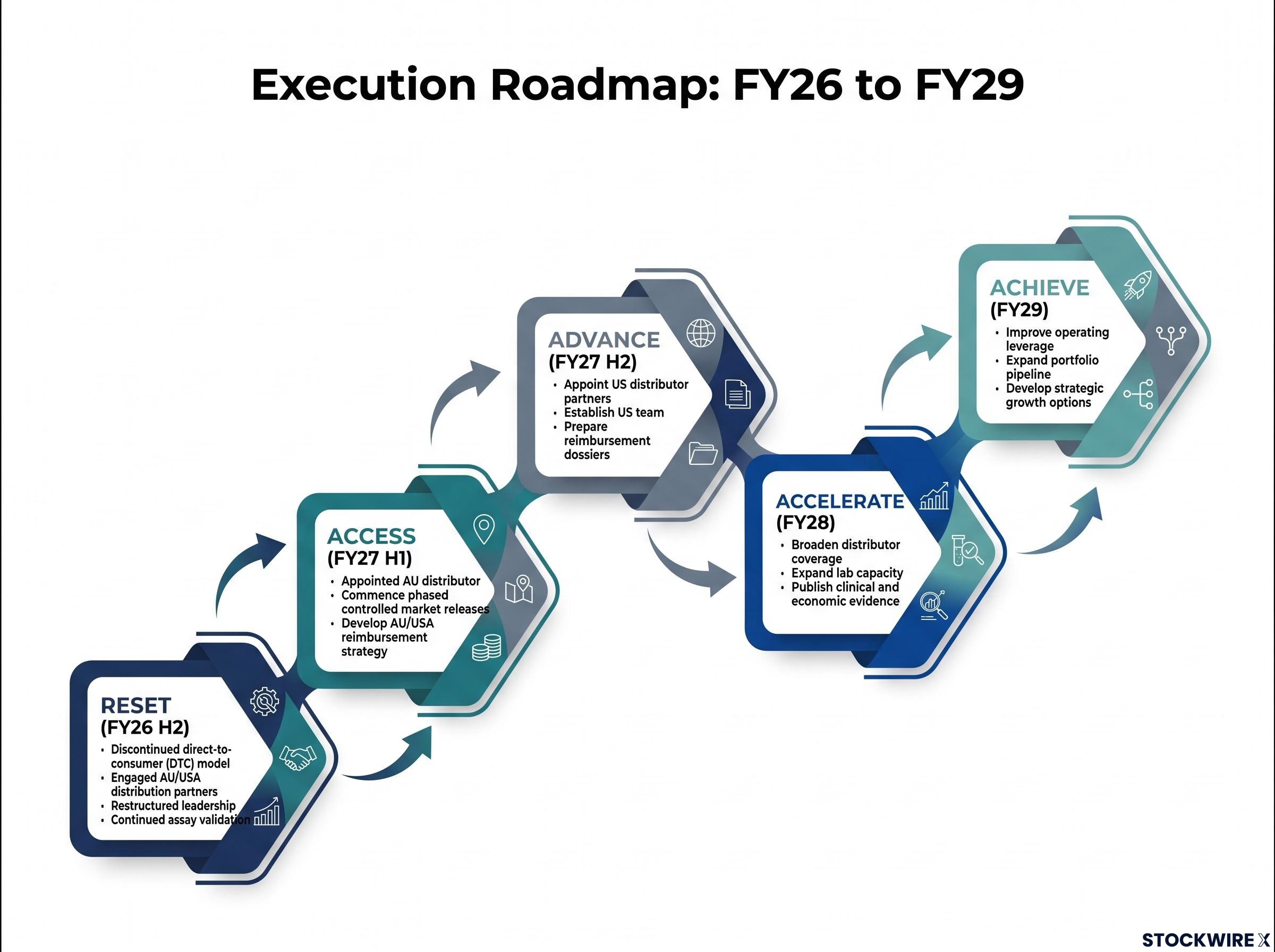
Management outlined a phased commercial roadmap spanning FY26 to FY29, structured around five defined stages that give investors clear progress markers.
-
RESET (FY26 H2): discontinued the direct-to-consumer (DTC) business model as part of a deliberate strategic repositioning, engaged distribution partners in Australia and the USA, restructured the leadership team, and continued assay validation.
-
ACCESS (FY27 H1): appointed distributor partner in Australia, commence phased controlled market releases, and develop the reimbursement strategy for Australia and the USA.
-
ADVANCE (FY27 H2): appoint US distributor partners, establish a US team, and prepare reimbursement dossiers.
-
ACCELERATE (FY28): broaden distributor coverage, expand laboratory capacity, and publish clinical utility and health economic evidence.
-
ACHIEVE (FY29): improve operating leverage, expand the portfolio pipeline, and develop strategic growth options.
The staged structure links strategy to execution, offering defined milestones against which progress can be measured over the next three years.
What it means for investors
The presentation set out an investment thesis combining clinically validated diagnostics, an exclusive national distribution pathway, sizeable addressable markets and disciplined capital allocation. As adoption develops, the model points toward recurring test revenue, the primary long-term value driver management highlighted.
The phased commercial rollout commencing in FY27 stands as the near-term catalyst for investors to watch.
Management Positioning
In presenting its “Disciplined Path to Commercial Success,” management framed the strategy around converting clinical validation into a scalable, repeatable commercial model, supported by stronger accountability and disciplined capital allocation.
The combination of validated tests and an established distribution network positions the company to pursue scalable, recurring revenue, though execution against the roadmap and progress on reimbursement remain the key factors to monitor.
Don’t Miss the Next Healthcare Diagnostic Breakthrough
Big News Blast delivers FREE breaking ASX healthcare news directly to your inbox within minutes of release, complete with in-depth analysis. Join 20,000+ investors already staying ahead of the market. Click the “Free Alerts” button at StockWire X to get the next market-moving announcement the moment it drops.