
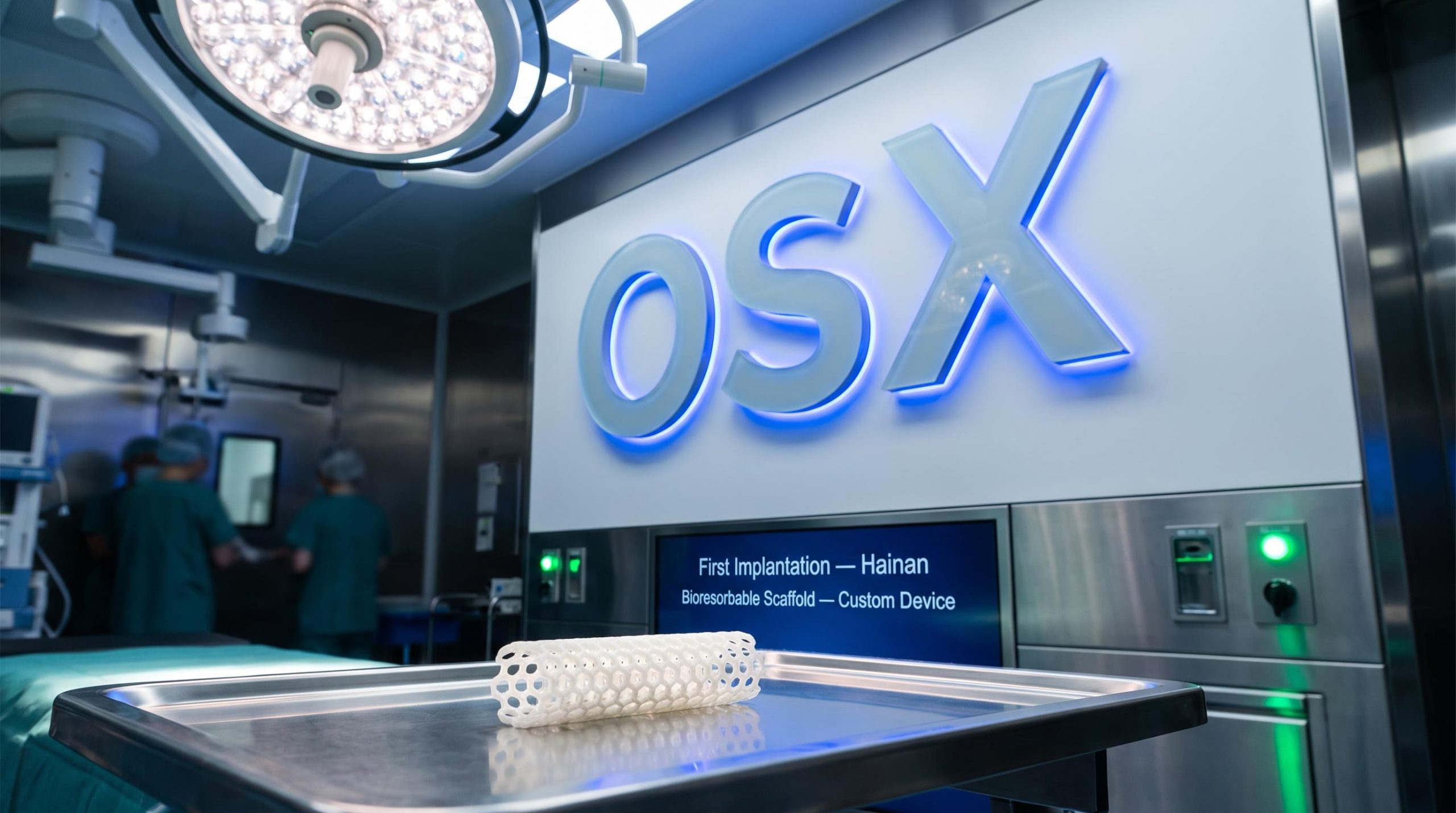
Osteopore completes first custom orthopaedic implantation in Hainan
Osteopore Limited (ASX: OSX) has completed its first custom orthopaedic implantation in Hainan, reconstructing a 12cm bone defect in a patient’s upper limb following the resection of a malignant tumour.
The procedure was carried out on a 6-year-old patient at the Hainan branch of Shanghai Ruijin Hospital. It marks the first clinical use of an Osteopore device in Hainan since the 26 May 2026 Hainan FDA approval, translating regulatory clearance into a real-world commercial application.
When big ASX news breaks, our subscribers know first
Inside the landmark procedure
The surgical team used a customised Osteopore device to reconstruct the 12cm upper-limb bone defect after the tumour was removed. Under standard circumstances, the patient would have received a permanent device.
Based on the surgical team’s clinical experience, such a device would only be functional for 5-10 years, with subsequent revision surgeries becoming necessary. Given the patient’s age, a regenerative solution was considered a better fit, with the potential to avoid multiple procedures over the patient’s lifetime.
The clinical rationale can be summarised as follows:
-
Standard treatment: a permanent device functional for only 5-10 years
-
Problem: repeated revision surgeries needed over the patient’s lifetime
-
Osteopore solution: a regenerative scaffold that supports natural bone healing
-
Outcome potential: the potential to avoid multiple revision surgeries
For investors, a successful first case demonstrates clinical utility and begins building a real-world evidence base, an important input for future demand and potential regulatory expansion.

Understanding Osteopore’s regenerative technology
Osteopore’s core technology centres on 3D-printed, bioresorbable micro-structured scaffolds that guide the body’s natural bone regeneration. The scaffold’s polymer naturally dissolves over time, leaving only healthy, natural bone tissue behind.
The Company describes its implants as biomimetic and bioresorbable. Unlike permanent implants, this approach leaves no permanent foreign material in the body, which the Company states significantly reduces the post-surgery complications commonly associated with permanent bone implants.
This differentiated, patent-protected technology sits at the heart of Osteopore’s competitive positioning, and is particularly relevant in paediatric cases where permanent implants would require multiple revision surgeries.
| Feature | Permanent Implant | Osteopore Scaffold | Patient Impact |
|---|---|---|---|
| 3D-printed bioresorbable polymer | No | Yes | Dissolves, leaves natural bone |
| Functional lifespan | 5-10 years | Regenerates natural bone | Long-term solution |
| Revision surgeries | Often required | Potential to avoid | Fewer procedures |
Why the Hainan approval matters for OSX investors
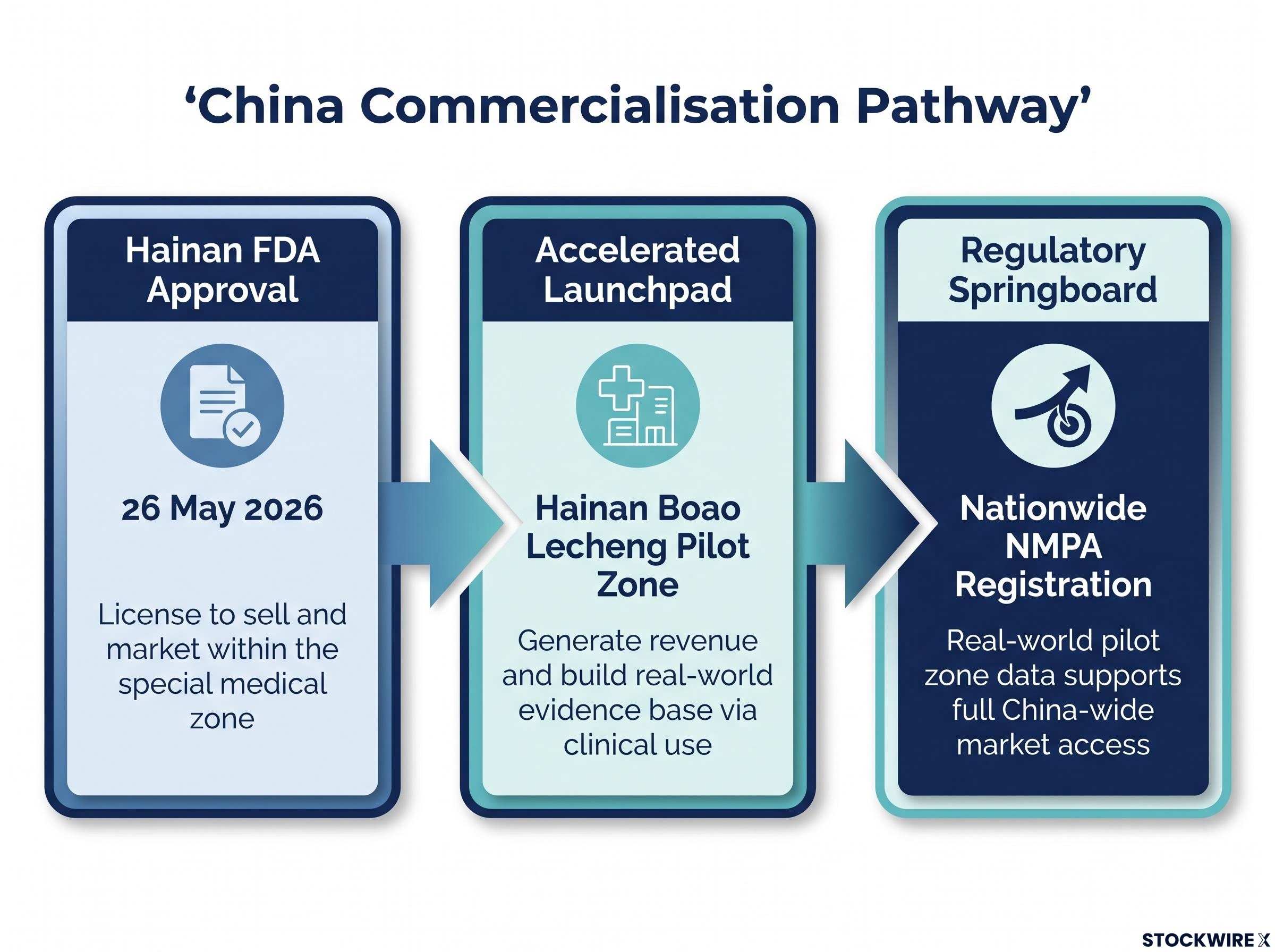
The procedure took place within the Hainan Boao Lecheng International Medical Tourism Pilot Zone, described by the Company as China’s strategic and only special medical zone. The zone benefits from preferential national-level policies that allow innovative medical technologies and devices to be used clinically prior to receiving full mainland approval.
The 26 May 2026 Hainan FDA approval is a license that enables the Company to sell and market its devices within the zone. According to Osteopore, the approval delivers two strategic benefits:
The Hainan FDA approval, granted on 26 May 2026, positions China’s orthopaedic devices market as a structured growth pathway, with the sector projected to expand from USD 2.5 billion in 2024 to USD 4.5 billion by 2035 at a 5.6% CAGR driven by demographic ageing and hospital modernisation.
-
Accelerated commercial launchpad — the ability to sell and generate revenue within the pilot zone.
-
Regulatory springboard — real-world data generated here can later support nationwide NMPA registration toward full China-wide market access.
The venue reinforces the significance of the milestone. The Hainan branch of Shanghai Ruijin Hospital is a top-tier, 3A-ranked hospital under the Shanghai Jiao Tong University School of Medicine.
For investors, this first implantation helps de-risk the commercialisation story, marking the transition from regulatory approval to active clinical adoption in a strategically important market.
What comes next for Osteopore
The completed case establishes clinical proof and begins the collection of real-world data within the pilot zone. The Company has outlined a pathway in which pilot zone data can support future NMPA registration and potential China-wide access.
The Asia Pacific bone graft market is projected to grow at 8.2% CAGR through 2030, a structural backdrop that underpins Osteopore’s parallel expansion across the region, including a first custom implant procedure completed at Queen Mary Hospital in Hong Kong in June 2026.
The source does not disclose specific future milestone dates. What is clear is that Osteopore now holds both regulatory approval and a proven clinical case in China, positioning the Company for the next stage of its China commercialisation strategy.
Don’t Miss the Next Healthcare Breakthrough on ASX
Big News Blast delivers FREE breaking ASX healthcare news directly to your inbox within minutes of release, complete with in-depth analysis. Over 20,000 active subscribers already rely on it to stay ahead of market-moving developments. Click the “Free Alerts” button at StockWire X to start receiving alerts the moment news breaks.