
Osteopore Ltd Treats First Patient in Jawbone Reconstruction Trial at PAH

Osteopore treats first patient in Princess Alexandra Hospital jaw reconstruction trial
Osteopore (ASX: OSX) has successfully treated the first patient in its jawbone reconstruction clinical trial at Princess Alexandra Hospital (PAH). The Australian-Singaporean regenerative medicine company, described as a global leader in 3D-printed biomimetic and bioresorbable implants, used its novel implant for the procedure. The trial is led by Dr. Michael Wagels, a Plastic and Reconstructive Surgeon based at PAH. This milestone marks the practical commencement of patient treatment in a study first approved in 2025.
At a glance:
-
First patient successfully treated with Osteopore’s novel implant
-
Single-arm feasibility study design
-
Target of at least 10 adult patients in Australia by 2028
-
Each patient assessed 36 months post-surgery
When big ASX news breaks, our subscribers know first
What the trial involves and where it stands
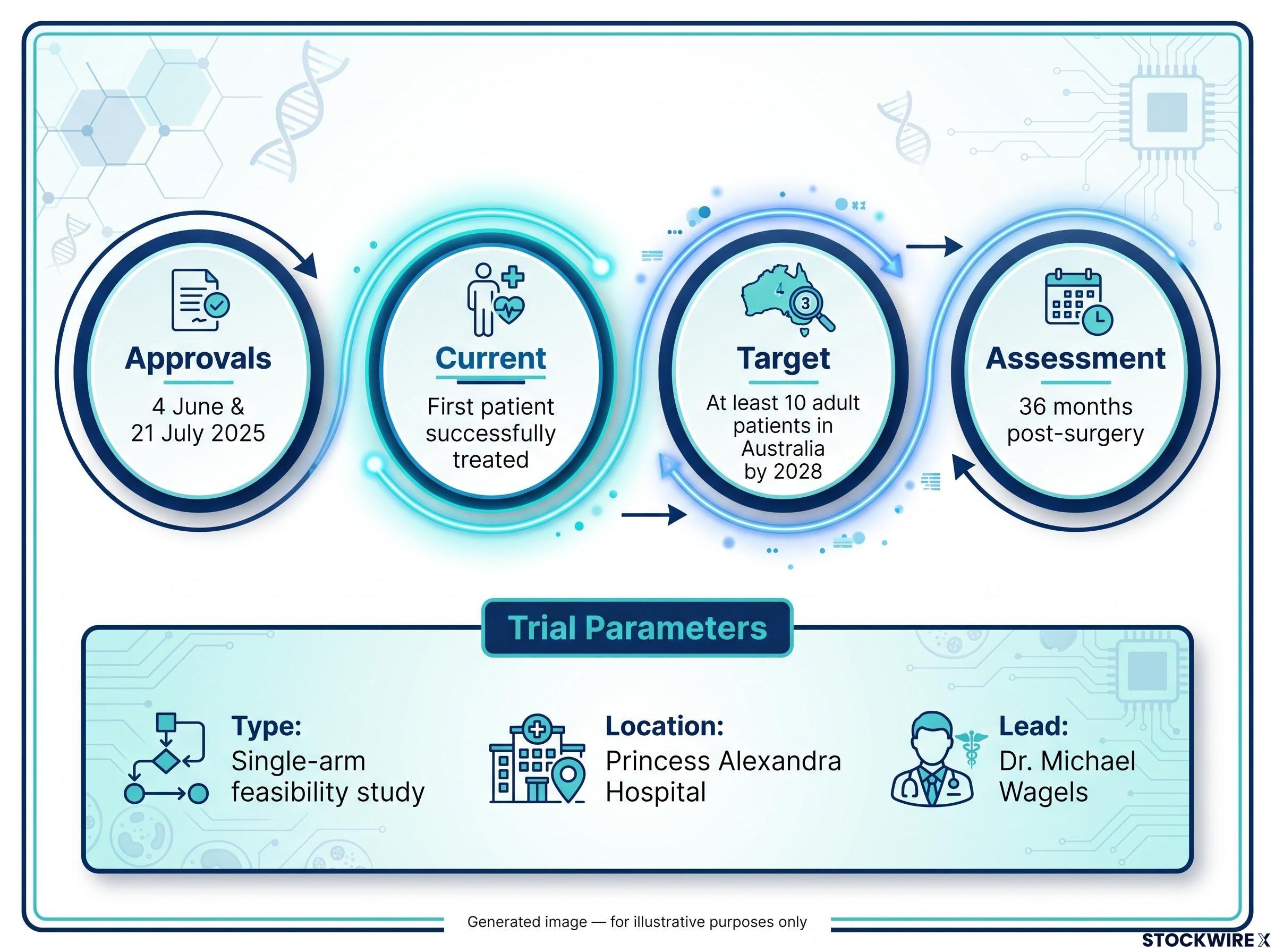
The trial is a single-arm feasibility study. It aims to recruit at least 10 adult patients in Australia by 2028, with each patient assessed at 36 months post-surgery.
The study did not require a new approval at this stage. As previously announced on 4 June 2025 and 21 July 2025, Osteopore and Princess Alexandra Hospital received approval to commence the jawbone reconstruction trial using the Company’s novel implant. The current announcement covers the treatment of the first patient, progressing the study from approval into active clinical use.
| Parameter | Detail |
|---|---|
| Trial type | Single-arm feasibility study |
| Lead investigator | Dr. Michael Wagels (PAH) |
| Recruitment target | At least 10 adult patients by 2028 |
| Assessment period | 36 months post-surgery |
| Location | Australia (Princess Alexandra Hospital) |
Why jawbone reconstruction matters: the clinical problem
The loss of bone in the maxilla (upper jaw) or mandible (lower jaw) can significantly affect both function and appearance. It can impair basic abilities such as breathing, chewing, swallowing and speaking. These bones also play a key role in facial aesthetics, which is closely linked to psychosocial well-being.
Currently, autologous free tissue transfer is considered a state-of-the-art treatment. Despite its standing, the technique carries several limitations:
-
Intrinsic donor site morbidity
-
Limited adaptability for complex defects
-
Shortage of available donor site bone
-
Insufficient bone height for effective dental rehabilitation
These constraints point to a meaningful unmet clinical need, which Osteopore’s technology aims to address through a different approach to bone regeneration.
How Osteopore’s technology addresses the gap
The novel implant addresses these limitations directly. It is made specific to each patient’s anatomy using 3D printing, allowing the device to match the individual’s bone structure. The implant also allows the incorporation of bone-inducing factors to regenerate high-quality bone for the patient.
The technology sits within Osteopore’s broader platform of patented bioresorbable scaffolds. These are manufactured using a proprietary technique with a polymer that naturally dissolves over time, allowing natural and healthy bone tissue to form. This is intended to significantly reduce the post-surgery complications commonly associated with permanent bone implants. As the Company states, its 3D printing technology is unique to Osteopore.
Osteopore’s 3D printing platform underpins both its patient-specific implant design and a broader hospital services business, with the company having expanded 3D printing services across Singapore’s entire hospital network as a capital-efficient way to deepen institutional relationships.
For investors, the trial represents the Company’s technology being applied in a real-world clinical setting within a new therapeutic application: jaw reconstruction.
The next major ASX story will hit our subscribers first
What this milestone means for investors
The treatment of the first patient marks the practical commencement of a study that broadens Osteopore’s clinical evidence base into jaw reconstruction. This is an early-stage feasibility study, and at this point no efficacy data has been disclosed.
The trial provides a clear forward timeline. Recruitment targets at least 10 adult patients by 2028, with each participant assessed at 36 months post-surgery. Conducting the study at a recognised Australian hospital, under a named specialist surgeon, adds clinical credibility to the programme.
The novel implant is made specific to the patient’s anatomy using 3D printing, while allowing the incorporation of bone-inducing factors to “regenerate high quality bone for the patient.”
The announcement does not disclose any financial figures, funding amounts, efficacy results or commercial revenue projections. Investors should view this as a clinical progress milestone rather than a regulatory approval or commercial event.
Next steps centre on continued recruitment toward the 2028 target, with assessments to follow as each patient reaches the 36-month post-surgery mark.
For investors exploring how the company is converting clinical credibility into commercial agreements, our detailed coverage of Osteopore’s China distribution strategy outlines the RMB 12 million Majeton partnership structure, the 13,500-hospital distribution network it unlocks, and the NMPA regulatory pathway that represents the key near-term milestone to monitor.
Don’t Miss the Next Healthcare Breakthrough on ASX
Big News Blast delivers FREE breaking ASX healthcare news directly to your inbox within minutes of release, complete with in-depth analysis. Join 20,000+ subscribers already staying ahead of the market. Click the “Free Alerts” button at StockWire X to receive the moment market-moving healthcare announcements drop.