
Nyrada’s PROTECT-MI Phase IIa trial on track for CY2027 completion
Nyrada Inc (ASX: NYR) has confirmed its PROTECT-MI Phase IIa clinical trial of Xolatryp® remains on schedule for completion in calendar year 2027. The trial is assessing the safety and preliminary efficacy of Xolatryp in reducing heart tissue damage and improving heart function in patients suffering a heart attack.
This first-in-patient study of Xolatryp follows successful Phase I completion. The company has reported close to 20 patients pre-screened since first site activation, though no patients have yet been enrolled. Nyrada has also announced its site network is expanding, with two additional sites nearing activation and Royal Perth Hospital selected to participate.
The trial represents a critical step in evaluating whether Xolatryp can modify injury to heart tissue and improve early clinical outcomes in heart attack patients undergoing percutaneous coronary intervention (PCI).
When big ASX news breaks, our subscribers know first
Understanding ischemia-reperfusion injury and the unmet medical need
A heart attack occurs when an artery supplying blood to the heart becomes blocked. The standard lifesaving treatment is percutaneous coronary intervention — a procedure involving balloon angioplasty and stent implantation to reopen the occluded artery and restore blood flow.
However, this reopening creates a paradox. The sudden return of oxygenated blood following PCI is linked to irreversible cell damage in the heart muscle, a phenomenon known as ischemia-reperfusion injury. This damage occurs due to a cycle of calcium overload when the blocked artery is manually opened. Critically, there is currently no way to avoid reperfusion injury.
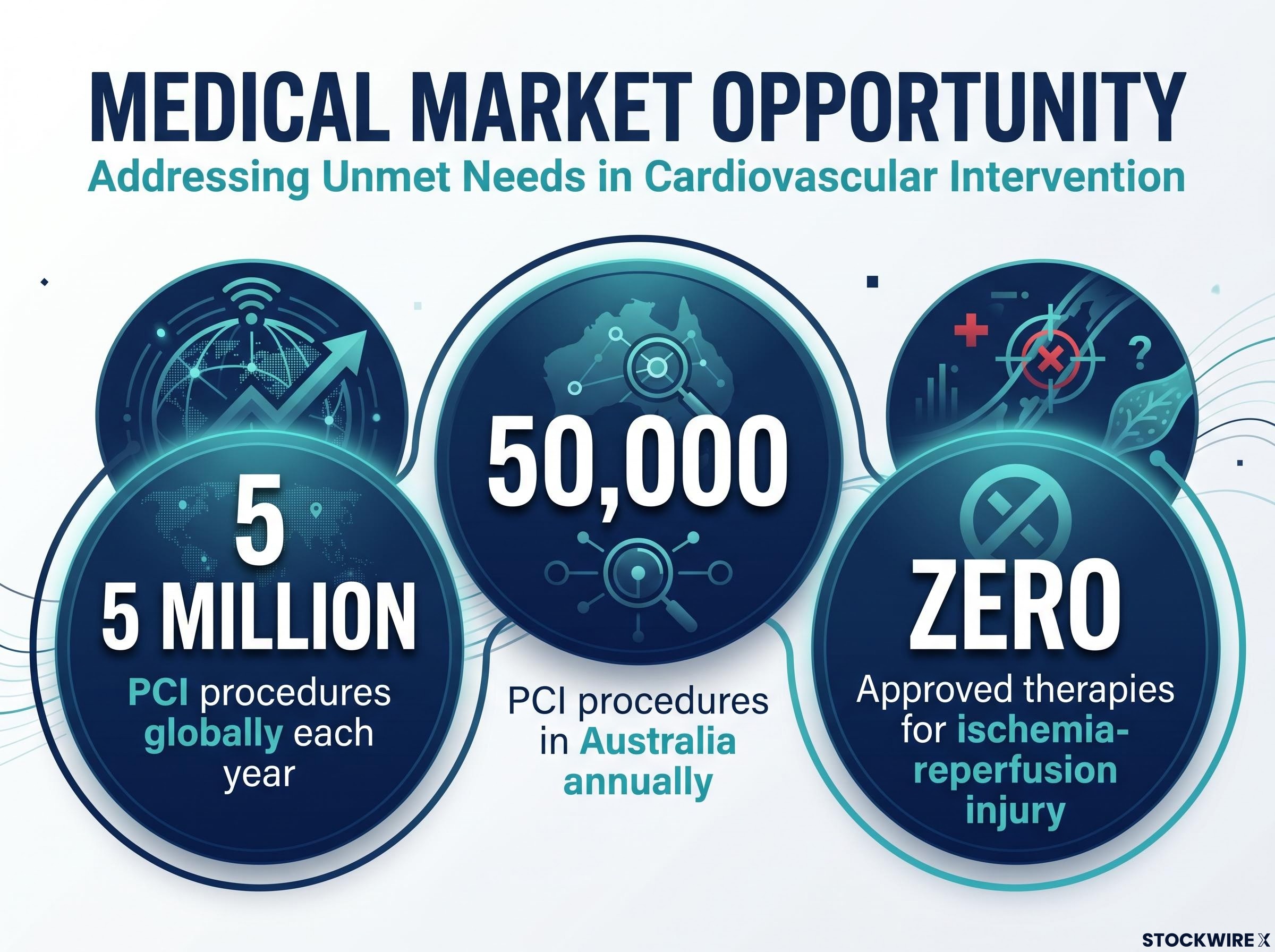
Approximately 5 million PCI procedures are performed globally each year, including about 50,000 in Australia annually. Despite this large patient population, there are currently zero approved therapies that address ischemia-reperfusion injury in this setting. Xolatryp is targeting this significant unmet medical need.
Pre-screening progress and staged recruitment design
The PROTECT-MI trial was designed to begin with in-hours recruitment at each site. This staged approach allows clinical teams to establish full familiarity with Xolatryp, protocol requirements, and trial workflow before scaling. This methodology is standard practice for first-in-patient cardiovascular studies.
Since activation of the first clinical trial site, close to 20 patients have been pre-screened, though no patients have yet been enrolled. Nyrada has stated this is not a significant deviation from the trial plan. Pre-screened patients who did not proceed to enrolment largely presented outside pharmacy operating hours or did not meet protocol eligibility criteria.
The Nepean Hospital activation in April 2026 marked the formal transition from regulatory planning to live patient recruitment, with Phase I data in 48 healthy volunteers having already confirmed Xolatryp’s safety profile and linear pharmacokinetics, including therapeutic plasma levels reached within 10 minutes of infusion start.
The most common exclusion factor was the upper age limit of 75 years. These factors were anticipated in the trial’s scaling design.
Pathway to accelerated recruitment from Q3 CY2026
Nyrada expects recruitment to accelerate from the third quarter of CY2026, driven by two primary operational changes:
-
Cath Lab storage transition: Selected sites will move to storing Xolatryp directly in the cardiac catheterisation laboratory (Cath Lab), enabling 24-hour recruitment capability and capturing eligible patients who present outside pharmacy hours.
-
Site network expansion: Activation of further trial sites will broaden the recruitment base across centres.
This transition from staged in-hours recruitment to round-the-clock capability addresses the key constraint identified during the pre-screening phase. By storing Xolatryp in the Cath Lab rather than relying on pharmacy hours, sites can enrol patients presenting at any time, significantly expanding the eligible patient pool. The pathway to accelerated recruitment provides a clear operational de-risking milestone for trial timeline confidence.
Expanding site network and Royal Perth Hospital selection
Previously announced trial sites continue to progress through their respective Research Governance Office (RGO) approval processes. Two further sites are nearing RGO approval and are expected to activate soon thereafter. Site activation reflects completion of all key start-up activities, including governance approvals, site initiation, staff training, and receipt of Xolatryp and placebo.
Nyrada actively monitors recruitment performance across all participating sites. Subject to local governance approvals, the company retains the flexibility to activate additional sites or discontinue underperforming ones, directing resources to centres demonstrating the strongest recruitment potential.
Royal Hobart Hospital has withdrawn due to local resourcing constraints. However, the company has selected Royal Perth Hospital to participate in the trial and is progressing discussions with several additional hospitals, including sites in New Zealand. This expansion is consistent with the multicentre design of the study and broadens the recruitment base across centres. Active portfolio management of trial sites demonstrates operational discipline and commitment to recruitment targets.
Xolatryp’s mechanism and preclinical cardioprotection signals
Xolatryp is a small-molecule inhibitor of TRPC 3/6/7 ion channels. By limiting pathological calcium influx, Xolatryp is designed to help protect heart muscle cells from processes associated with irreversible injury, including mitochondrial dysfunction, ATP depletion, osmotic imbalance, and excess reactive oxygen species formation, which are known contributors to ischemia-reperfusion injury.
In preclinical myocardial ischemia-reperfusion injury animal models, Xolatryp showed:
-
86% cardioprotection at 30 mg/kg over 24 hours with improved cardiac function and reductions in biomarkers (AST, LDH, Troponin I)
-
42% cardioprotection at 9 mg/kg over 3 hours with 90% reduction in arrhythmias and lower Troponin I levels
These preclinical results provide the scientific rationale and efficacy signals that the Phase IIa trial is designed to validate in humans. The demonstrated cardioprotection across different dosing regimens and the reduction in key biomarkers of cardiac injury support the mechanistic hypothesis underpinning Xolatryp’s development.
Trial design and regulatory progress
The PROTECT-MI Phase IIa trial is a randomised, double-blind, placebo-controlled, multicentre study in Australia. The primary endpoint is safety and tolerability, including cardiac-related safety. Exploratory endpoints include cardiac function, extent of cardiac injury, biomarkers such as Troponin I levels, and the incidence of arrhythmias of interest. Cardiac MRI will be used to determine infarct size in participants.
| Parameter | Detail |
|---|---|
| Population | First-time STEMI; primary PCI within 6h of symptom onset |
| Patients | ~100 evaluable (1:1 Xolatryp:placebo) |
| Intervention | IV Xolatryp for ~6h at 3 mg/kg |
| Primary endpoint | Safety/tolerability (including cardiac-related safety) |
| Exploratory endpoints | Cardiac MRI infarct size, arrhythmias, Troponin I, PK, Day-30 PROs |
Nyrada is also advancing preparation of its Investigational New Drug (IND) application, with submission to the US FDA targeted for the second half of CY2026. This dual-track regulatory progress — executing the Australian trial while preparing for US FDA submission — positions Nyrada for a potential global development pathway.
The trial is registered on ClinicalTrials.gov under identifier NCT07362446, with participating sites and trial status publicly available through the U.S. National Library of Medicine clinical trial registry. Further information is available on the PROTECT-MI website.
What success could mean for investors
If successful, Xolatryp has the potential to become the first drug on the market to mitigate ischemia-reperfusion injury. This represents a significant commercial opportunity in a large, well-defined patient population with an unmet medical need. The 5 million PCI procedures performed globally each year currently have no approved adjunctive therapy to address reperfusion injury.
Near-term catalysts for investors to track include site activations, recruitment updates, and the IND submission to the US FDA in the second half of 2026. The transition to 24-hour recruitment capability and expansion of the site network in Q3 2026 will provide key operational milestones to assess trial momentum. Nyrada will continue to update the market on site activations, recruitment progress, and other material developments as the trial advances.
Investors exploring the funding runway supporting PROTECT-MI should review our full explainer on Nyrada’s R&D tax rebate, which details how the AU$2.45 million non-dilutive cash receipt was secured under Australia’s R&D Tax Incentive Program and why the mechanism could generate additional receipts in future years as Xolatryp expenditure continues.
The first-in-class potential in a large addressable market, combined with a clear pathway to accelerated recruitment and advancing regulatory preparation, positions the PROTECT-MI trial as a critical value inflection point for the company.
Want the Next Biotech Breakthrough in Your Inbox?
Join 20,000+ investors getting FREE breaking ASX news delivered within minutes of release, complete with in-depth analysis. Click the “Free Alerts” button at StockWire X to start receiving alerts the moment market-moving announcements hit the ASX.