
Island Pharmaceuticals showcases ISLA-101 dengue data at major regional summit
Island Pharmaceuticals presented new analysis from its Phase 2a/b PROTECT study at the 9th Asia Dengue Summit in Singapore on 16 June 2026. Dr David Foster, CEO and Managing Director, delivered the presentation at the Orchard Hotel Singapore, introducing previously unpublished findings from the company’s dengue antiviral candidate, ISLA-101. The manuscript detailing these results is currently in preparation.
The Asia Dengue Summit serves as a prominent regional forum for infectious disease specialists and stakeholders focused on dengue prevention and treatment across high-burden markets. Presenting at this venue provides exposure to potential partners and collaborators in regions where dengue poses substantial public health and economic burdens.
Island Pharmaceuticals (ASX: ILA) is an Australian antiviral drug development company focused on addressing urgent viral diseases and biosecurity threats. The company is executing a dual development strategy across two clinical-stage assets: ISLA-101 for dengue and other mosquito-borne diseases, and Galidesivir, a broad-spectrum antiviral.
When big ASX news breaks, our subscribers know first
What is dengue fever and why does it matter for drug development?
Dengue fever is a mosquito-borne viral infection transmitted primarily by Aedes mosquitoes. The disease exists in four distinct serotypes (DENV 1-4), meaning infection with one type does not provide immunity against the others. This creates complexity for both treatment development and vaccination strategies.
The disease represents significant unmet medical need globally. No approved antiviral treatment currently exists for dengue, despite hundreds of millions of infections occurring annually. The Asia-Pacific region bears the highest disease burden, making Singapore an appropriate location for the summit and Island’s presentation.
Island’s development approach addresses two distinct clinical scenarios: prophylaxis (preventing infection in at-risk populations) and treatment (reducing disease severity in infected patients). Each pathway represents separate commercial opportunities with different target populations and regulatory pathways.
PROTECT study demonstrates antiviral signals across both cohorts
The PROTECT study was conducted using a dengue human infection model at SUNY Upstate. The trial enrolled participants across two sequential cohorts. The Phase 2a prophylactic cohort included three subjects receiving active treatment and one receiving placebo. Following safety review, the study advanced to the Phase 2b treatment cohort, which enrolled eight active participants and two placebo controls.
The Safety Review Committee conducted an interim assessment after the prophylactic cohort completed. The committee’s findings supported advancing to the treatment phase:
- Administering ISLA-101 was safe
- Study achieved appropriate ISLA-101 blood concentrations
- Dosed subjects exhibited evidence of antiviral activity versus control
- Unanimous decision to advance to treatment cohort
Animal model data provided preclinical support for the human trial. In mouse models of lethal dengue infection, two daily doses of ISLA-101 prevented 70% of deaths that would otherwise occur. These findings established the proof-of-concept foundation for testing the compound in humans.
Key virologic findings from treated participants
Management highlighted pharmacokinetic data demonstrating ISLA-101 achieved target plasma concentrations in treated participants. Concentration-time profiles across dosing days showed the compound reached levels anticipated to produce antiviral effects based on preclinical models.
The presentation detailed a statistically significant negative correlation between timing of treatment initiation and peak viremia in the treatment cohort. The correlation coefficient was R = -0.7698, with p = 0.02547.
Correlation Finding
The data suggests initiating ISLA-101 treatment earlier in infection leads to lower peak viral levels. This negative correlation indicates that subjects who began treatment closer to the onset of detectable virus had reduced cumulative viral loads.
This finding suggests a relationship between treatment timing and viral suppression, though the small sample size requires confirmation in larger trials.
Symptom reduction observed in prophylactic group
The presentation outlined differences in dengue-associated symptoms between the prophylaxis and treatment group (N=3) compared to controls. Key symptom reductions included:
| Symptom | Control (N=3) | Prophylaxis & Treatment (N=3) |
|---|---|---|
| Fever ≥38°C | 66.7% | 0% |
| Abdominal Pain | 66.7% | 0% |
| Vomiting | 33.3% | 0% |
No subjects in the prophylaxis and treatment group experienced fever above 38°C, abdominal pain, or vomiting during the study period. In contrast, two of three control subjects developed fever and abdominal pain, while one experienced vomiting.
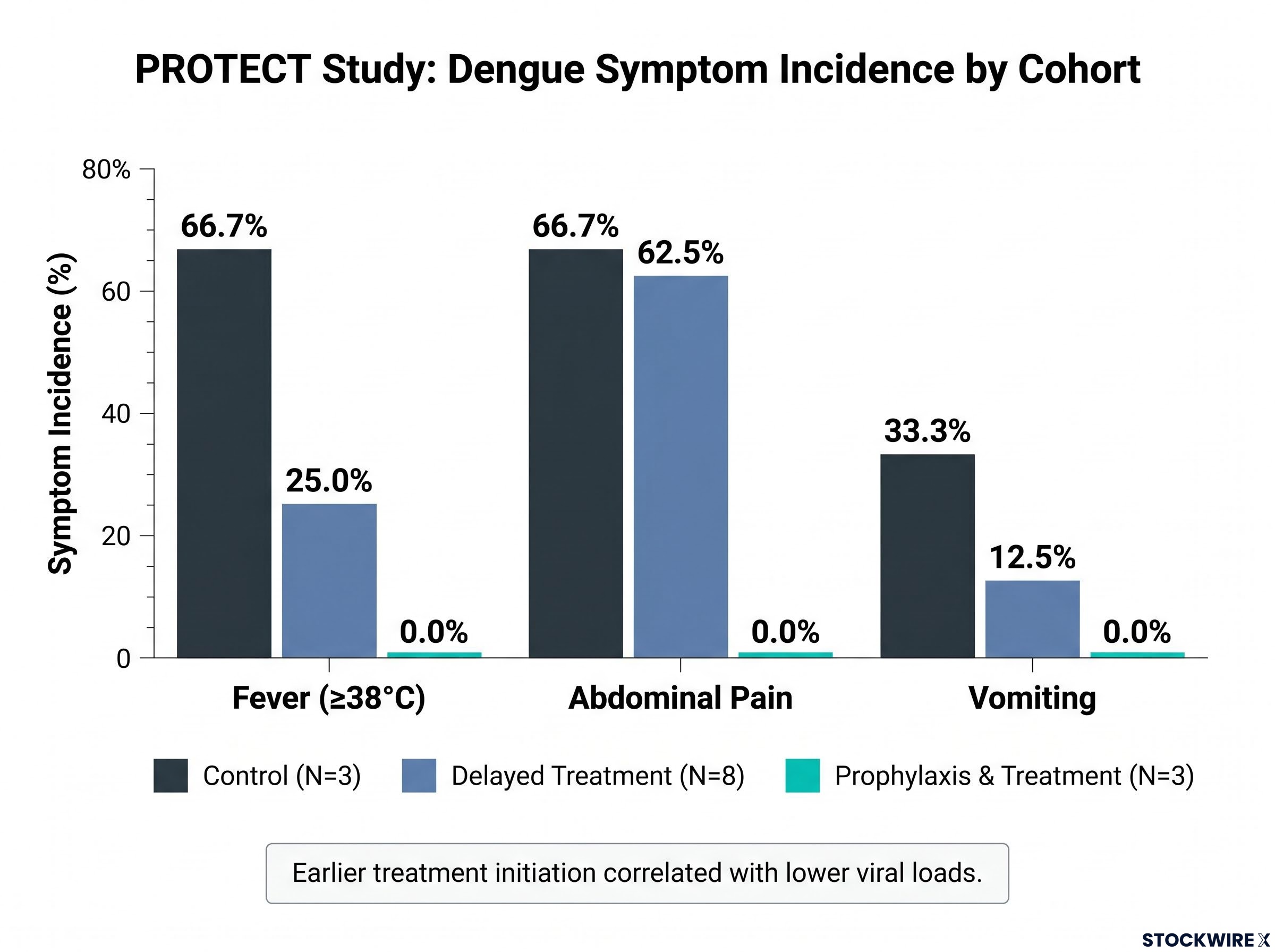
The delayed treatment cohort (N=8) showed symptom profiles more similar to controls, with 25% developing fever, 62.5% experiencing abdominal pain, and 12.5% reporting vomiting. This pattern aligns with the virologic finding that earlier treatment initiation correlated with lower viral loads.
Defined pathway towards future clinical development
Dr Foster outlined a dual-pathway regulatory strategy for ISLA-101. The company plans to advance both treatment studies and prophylactic studies in parallel, each progressing towards Phase 3 trials and regulatory submissions.
The presentation detailed ongoing engagement with the US FDA planned throughout development. This regulatory consultation aims to ensure study designs align with agency expectations for approval pathways in both prevention and treatment indications.
Management stated that discussions are advancing with multiple potential strategic partners for Phase 2 and Phase 3 trials. These partnership discussions could provide non-dilutive funding and validation for the programme while sharing development risks.
Island is also working on formulation optimisation efforts. The company aims to develop an oral formulation for prophylaxis applications and an intravenous (IV) formulation for treatment scenarios. Different routes of administration suit the distinct use cases: oral dosing for prevention in at-risk populations and IV administration for hospitalised patients requiring treatment.
CEO Commentary
The presentation’s top-line results summary noted that positive findings advocate for ongoing clinical development of ISLA-101 in dengue, with encouraging results supporting advancement to future clinical trials in both prevention and treatment.
Broader pipeline context and Priority Review Voucher potential
Island’s second clinical-stage asset, Galidesivir, is a broad-spectrum antiviral demonstrating activity against more than 20 RNA viruses. The compound has shown efficacy in preclinical models against high-priority threats including Ebola, Marburg, MERS, Zika, and Yellow fever.
Both ISLA-101 and Galidesivir carry Priority Review Voucher (PRV) potential.
The company reported receiving positive FDA feedback on the Animal Rule regulatory pathway for Galidesivir. The Animal Rule allows approval based on animal efficacy studies when human trials are not ethical or feasible, which applies to many of the viruses Galidesivir targets.
The US Army biodefence collaboration, formalised through a CRADA with USAMRIID and the Geneva Foundation, gives Galidesivir access to the Department of Defense’s only BSL-4 laboratory and positions the compound on the FDA Animal Rule pathway for Marburg Virus Disease approval.
The dual-asset strategy provides multiple development pathways and potential value creation mechanisms. ISLA-101 addresses a large infectious disease market with no approved antivirals, whilst Galidesivir targets rare but high-consequence viral threats with distinct regulatory pathways and PRV eligibility.
For investors exploring how Galidesivir’s development timeline is tracking toward a pivotal efficacy study, our detailed coverage of the Galidesivir GMP manufacturing milestone outlines the PI Health Sciences agreement, the earmarked batch for the Animal Rule submission, and what the production timeline means for an eventual FDA filing.
Want the Next Biotech Breakthrough in Your Inbox?
Join 20,000+ investors receiving FREE breaking ASX healthcare news within minutes of release, complete with expert analysis. Click the “Free Alerts” button at Big News Blast to get market-moving announcements delivered straight to your inbox before the market reacts.