


Alterity maps out Phase 3 pathway after FDA alignment on MSA trial design
In its June 2026 corporate presentation, Alterity Therapeutics outlined the regulatory and clinical pathway for its lead candidate ATH434, following successful alignment with the US Food and Drug Administration on Phase 3 trial design for Multiple System Atrophy (MSA). The presentation detailed the company’s progress in securing FDA endorsement of key trial parameters, including patient population, dosing regimen, and endpoints, positioning the programme for pivotal data generation.
Management highlighted the End-of-Phase 2 meeting outcomes, which confirmed regulatory alignment on approximately 200 patients, 50 mg twice-daily dosing for 12 months, and 1:1 randomisation between active treatment and placebo. The FDA endorsed the 11-Item Unified MSA Rating Scale Part I (UMSARS I) as the primary endpoint, a validated measure of functional impairment across domains affected in MSA. Key secondary endpoints include the Swallowing Disturbance Questionnaire (SDQ), Orthostatic Hypotension Symptom Assessment (OHSA), and Clinical Global Impression of Severity (CGIS). The company expects to initiate trial start-up activities by year-end 2026.
Alterity holds US FDA Fast Track Designation and Orphan drug designation in both the US and EU. FDA alignment on the Phase 3 design de-risks the regulatory pathway and provides a clear route to pivotal data generation in a disease with no approved treatments.
When big ASX news breaks, our subscribers know first
What is Multiple System Atrophy?
Multiple System Atrophy is a rare, rapidly progressive Parkinsonian disorder characterised by motor symptoms, autonomic dysfunction, and brain atrophy. The disease affects up to 50,000 patients in the US, with over 50% requiring wheelchair assistance within 5 years and a median survival of 7.5 years after symptom onset.
Motor symptoms include Parkinsonism, uncoordinated movements, balance problems, and falls. Autonomic dysfunction affects blood pressure maintenance, bladder control, and bowel function. The underlying pathology involves atrophy and alpha-synuclein accumulation in multiple brain regions, with excess reactive iron driving protein aggregation and oxidative injury. The absence of approved treatments and the disease’s rapid progression create significant unmet medical need and commercial opportunity for therapies capable of slowing disease progression.
Phase 2 results showed up to 46% slowing of disease progression
The ATH434-201 double-blind, placebo-controlled study enrolled 77 patients with clinically diagnosed MSA and elevated brain iron on MRI. The trial evaluated two doses over 12 months: 50 mg twice daily and 75 mg twice daily, compared to placebo in a 1:1:1 randomisation. The primary clinical endpoint was the modified UMSARS Part I, an FDA-endorsed measure of functional impairment.
The 50 mg dose demonstrated a treatment difference of -3.7 points versus placebo on the modified UMSARS Part I, representing a 46% relative treatment effect (p<0.05). The 75 mg dose showed a treatment difference of -2.7 points, representing a 34% relative treatment effect. Both doses exceeded the minimal clinically important difference threshold of -1.5 points, providing clinical validation ahead of Phase 3.
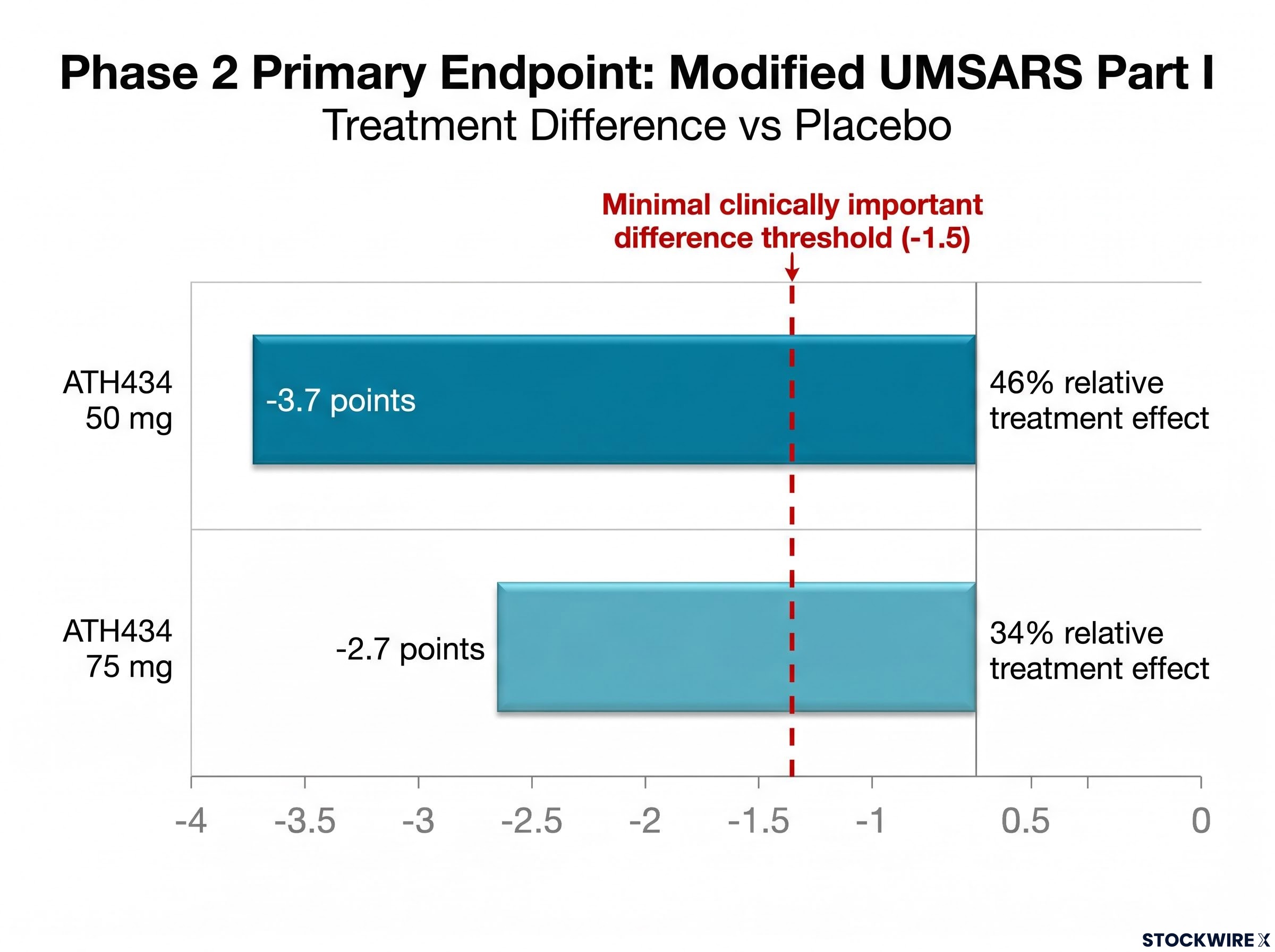
A separate MuSyCA composite scale analysis of the same Phase 2 cohort showed a 41% relative treatment effect for the 50 mg dose versus placebo (p=0.034), with the MMRM approach on modified UMSARS Part I reaching a 53% relative treatment effect (p=0.029), corroborating the efficacy signal across multiple validated outcome measures.
| Treatment Group | Difference vs Placebo (LS mean) | Relative Treatment Effect |
|---|---|---|
| ATH434 50 mg | -3.7 | 46% |
| ATH434 75 mg | -2.7 | 34% |
The safety profile showed no drug-related serious adverse events and no haematologic side effects. Similar rates of adverse events occurred in ATH434 and placebo participants. Exceeding the minimal clinically important difference threshold provides clinical validation ahead of Phase 3 and supports the disease-modifying mechanism of action.
Secondary endpoints reinforced efficacy across multiple symptoms
The presentation outlined consistent efficacy signals across multiple secondary endpoints, reinforcing the therapeutic profile observed on the primary measure:
- Clinical Global Impression of Severity (CGIS): The 50 mg dose showed statistically significant improvement versus placebo (p=0.006), with both doses demonstrating a consistent pattern of benefit on this clinician-rated assessment of overall disease severity.
- Orthostatic Hypotension Symptom Assessment (OHSA): Both doses demonstrated trends toward improvement in symptoms of low blood pressure when transitioning from sitting to standing (p=0.08 for 50 mg, p=0.14 for 75 mg).
- Swallowing Disturbance Questionnaire (SDQ): The 50 mg dose showed statistically significant improvement (p=0.003), indicating preservation of swallowing function, a critical symptom domain in MSA progression.
- Wearable sensor data: The 50 mg dose preserved walking ability in the outpatient setting, with step count improvements reaching statistical significance (p=0.0436).
Efficacy across multiple symptom domains strengthens the therapeutic profile and supports the breadth of the target product profile, particularly the ability to address both motor and autonomic dysfunction.
ATH434’s mechanism targets the underlying pathology
ATH434 is an oral, blood-brain barrier penetrant small molecule designed as an iron chaperone. The compound redistributes excess labile (reactive) iron in the central nervous system through three mechanisms: efflux from cells via ferroportin, increased iron storage in ferritin, and buffering in the labile iron pool. This iron chaperoning action is designed to reduce alpha-synuclein aggregation and oxidative injury, which are driven by iron dysregulation in MSA.
The presentation detailed MRI biomarker data showing that ATH434 “decouples” iron accumulation from clinical worsening. In placebo-treated patients, change in brain iron strongly correlated with change in disease severity as measured by UMSARS I. In ATH434-treated patients, this correlation was substantially weakened across all brain regions assessed, including the substantia nigra, putamen, globus pallidus, and lentiform nucleus. In the globus pallidus, the correlation coefficient in the placebo group was r = +0.69 (p<0.01), while in the 50 mg and 75 mg groups it was r = +0.27 and r = +0.38, respectively.
Evidence of target engagement via imaging biomarkers supports the disease-modifying mechanism of action thesis and provides objective confirmation that the drug is affecting the underlying iron-driven pathology in MSA-affected brain regions.
Independent assessment supports US$2.4 billion peak sales opportunity
The company presented findings from an independent commercial assessment conducted in 2025, which projected approximately US$2.4 billion in global peak sales for ATH434 in MSA. The assessment was based on a target product profile reflecting the positive Phase 2 data and incorporated physician survey results from neurologists treating MSA patients.
Over 70% of neurologists surveyed indicated they were “extremely likely” or “very likely” to prescribe ATH434 based on its profile. The assessment used a US prevalence figure of approximately 19,000 patients and identified efficacy in slowing disease progression as the key driver of physician interest. Stabilising orthostatic hypotension, one of the most challenging symptoms in MSA, was highlighted as a differentiating factor likely to drive adoption in clinical practice.
Third-party commercial validation provides an independent assessment of market opportunity and supports the strategic rationale for advancing the programme through Phase 3.
Broader pipeline extends ATH434 into additional indications
Management outlined the company’s broader development pipeline, which extends ATH434 into additional neurodegenerative diseases characterised by iron dysregulation and alpha-synuclein pathology:
- Parkinson’s disease: Phase 1 programme in collaboration with The Michael J. Fox Foundation for Parkinson’s Research
- Friedreich’s ataxia: Discovery/pre-clinical programme in collaboration with University at Buffalo
- Natural history study: The bioMUSE observational study at Vanderbilt University Medical Center continues to identify biomarkers to improve accuracy of patient selection in clinical trials
- ATH434-202: Open-label study in advanced MSA patients showed comparable efficacy to the double-blind study and a favourable safety profile
The platform potential for ATH434 creates multiple value inflection points beyond the lead MSA programme, with preclinical and early clinical data supporting the mechanism across multiple alpha-synucleinopathies.
2026 catalysts and next steps
The presentation outlined near-term milestones and execution priorities for the remainder of 2026:
- Regulatory alignment: Completed Type C meetings with the FDA on clinical pharmacology, Chemistry Manufacturing and Controls (CMC), and End-of-Phase 2 trial design
- Phase 3 readiness activities planned: Clinical site identification and qualification, manufacture of clinical drug supply
- Trial initiation target: Phase 3 start-up activities expected to commence by year-end 2026
- Corporate development: Expanding intellectual property protection, evaluating additional indications, and strengthening team capabilities
Clinical pharmacology FDA alignment was the first regulatory milestone secured in the Phase 3 preparation sequence, with the FDA confirming support for ATH434’s non-clinical development programme following a Type C Meeting in March 2026, before CMC and trial design sign-off followed in subsequent months.
The clear execution roadmap with near-term de-risking milestones positions the company for Phase 3 initiation and provides multiple catalysts for investor assessment of programme progress.
Want the Next Biotech Breakthrough in Your Inbox?
Join 20,000+ investors receiving FREE ASX healthcare alerts within minutes of release, complete with expert analysis and full announcements. Click the “Free Alerts” button at Big News Blast to get breaking biotech news before the market moves.