

New response data from azer-cel’s BTKi combination cohort
Four additional patients in Cohort 3 of Imugene’s azer-cel Phase 1b trial have reached their Day 28 assessment, with two patients responding to treatment. The updated results, reported on 5 October 2026, bring the total evaluable patient count in this cohort to seven.
Of the two responses recorded, one patient with Mantle Cell Lymphoma (MCL) achieved a Complete Response (CR) and one patient with Chronic Lymphocytic Leukemia (CLL) achieved a Partial Response (PR). Among the remaining two patients, one with Richter’s Transformation (DLBCL/RT) achieved Stable Disease (SD), while one MCL patient had Progressive Disease (PD).
All patients enrolled in Cohort 3 had previously relapsed on or were refractory to BTKi therapy, representing a heavily pre-treated population with high unmet medical need and limited remaining treatment options. Across the now seven evaluable patients in this cohort, the Overall Response Rate (ORR) stands at 71%. Enrolment remains ongoing across 10 US and 5 Australian trial sites.
When big ASX news breaks, our subscribers know first
azer-cel’s overall Phase 1b picture
Cohort 3’s results sit within a broader Phase 1b dataset that has now accumulated data across 55 evaluated patients spanning three distinct cohorts. Across this full population, azer-cel has demonstrated a combined 75% ORR, with 41 of 55 patients responding to treatment.
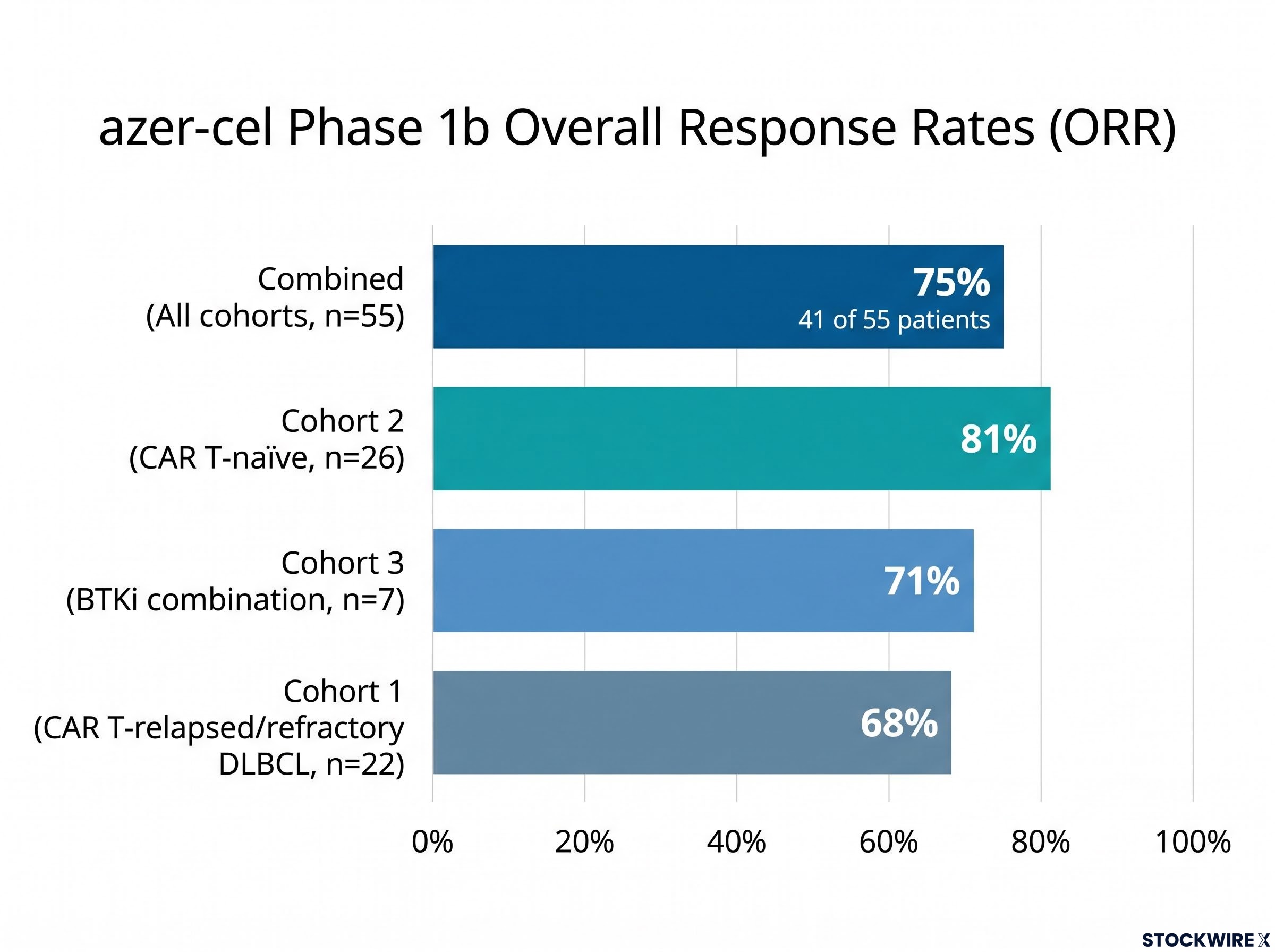
The per-cohort breakdown is as follows:
- Cohort 1 (CAR T-relapsed/refractory DLBCL, n=22): 68% ORR
- Cohort 2 (CAR T-naïve patients, n=26): 81% ORR
- Cohort 3 (BTKi combination cohort, n=7): 71% ORR
The table below summarises the Phase 1b dataset across all three cohorts:
| Cohort | Patient Population | n | ORR | Key Tumour Types |
|---|---|---|---|---|
| Cohort 1 | CAR T-relapsed/refractory | 22 | 68% | DLBCL |
| Cohort 2 | CAR T-naïve | 26 | 81% | Various B-cell malignancies |
| Cohort 3 | BTKi combination | 7 | 71% | MCL, CLL, DLBCL/RT |
| Combined | All cohorts | 55 | 75% | Diverse B-cell malignancies |
The consistency of response rates across three cohorts covering meaningfully different patient populations is a clinically relevant signal. Cohort 1 and Cohort 2 patients differ in their prior CAR T exposure, while Cohort 3 targets a distinct BTKi-refractory group, and all three cohorts have produced ORR figures of at least 68%.
The 81% response rate in CAR T-naive patients, presented at ASCO 2026 in May, covered 16 evaluable patients across six blood cancer subtypes and included four indications achieving 100% response rates, providing the clinical foundation against which the BTKi cohort’s emerging data is now being assessed.
What is allogeneic CAR T therapy and why does azer-cel’s off-the-shelf design matter?
CAR T therapy involves engineering a patient’s T cells (a type of immune cell) to recognise and attack cancer cells. The engineered cells are then infused back into the patient to target the tumour.
There are two main manufacturing approaches. Autologous CAR T therapy uses the patient’s own cells, which must be extracted, modified, and expanded in a laboratory before infusion. This process typically takes three to six weeks, which can be a significant constraint for patients with rapidly progressing disease. Allogeneic CAR T therapy, by contrast, uses T cells derived from healthy donors, allowing a ready-made product to be stored and administered within days of a treatment decision.
Azer-cel (azercabtagene zapreleucel) is an off-the-shelf, allogeneic CAR T cell therapy that targets the CD19 protein found on B-cell cancers. Its allogeneic design bypasses the manufacturing delay characteristic of autologous products.
BTK inhibitors (BTKis) are a class of targeted therapies commonly used in B-cell malignancies including CLL, MCL, and certain lymphomas. They work by blocking Bruton Tyrosine Kinase (BTK), a protein that cancer cells rely on to grow and survive. Patients whose disease progresses on or becomes refractory to BTKi therapy face a narrowing set of treatment options. The global BTKi market reached over US$12.0 billion in 2025, reflecting the scale of this patient population and the commercial relevance of therapies targeting this disease setting.
Cohort 3 is specifically designed to evaluate whether combining azer-cel with continued BTKi administration can generate antitumour activity in this difficult-to-treat group.
The first patient dosed in the BTKi combination cohort was treated at Baylor University in May 2026, marking the formal opening of this third arm and targeting BTKi-relapsed patients across mantle cell lymphoma, follicular lymphoma, and chronic lymphocytic leukemia.
Executive Chairman’s commentary and what comes next
Paul Hopper, Executive Chairman
“Observing additional responses in our BTKi combination cohort provides compelling further validation of this strategy. The key here is that we are treating patients who have all progressed on BTK inhibitors and who have high unmet need hematologic cancer with few therapeutic options. With the combination of azer-cel and continuation of the BTK inhibitor, we are seeing a high response rate including in challenging tumor types like MCL and CLL.”
The combination approach in Cohort 3 is a deliberate strategic design choice. Rather than withdrawing the BTKi upon progression, the trial evaluates concurrent administration of azer-cel alongside continuation of the BTKi, with the aim of generating enhanced antitumour activity in a patient population that has already exhausted this class of therapy.
According to the announcement, further clinical updates will be reported as patient enrolment continues and data matures. No additional milestones or timelines beyond this were specified in the source. Enrolment remains ongoing across the trial’s 15 sites, comprising 10 in the United States and 5 in Australia.
Ready to Explore the Full Clinical Picture Behind Azer-cel’s 75% Overall Response Rate?
Imugene’s azer-cel Phase 1b trial is demonstrating consistent response rates across three distinct patient cohorts, including a 71% ORR in heavily pre-treated BTKi-refractory patients with limited remaining options.
Investors seeking the complete data behind this emerging allogeneic CAR T programme can explore Imugene’s latest ASX announcements for the full clinical disclosure and ongoing trial updates.