
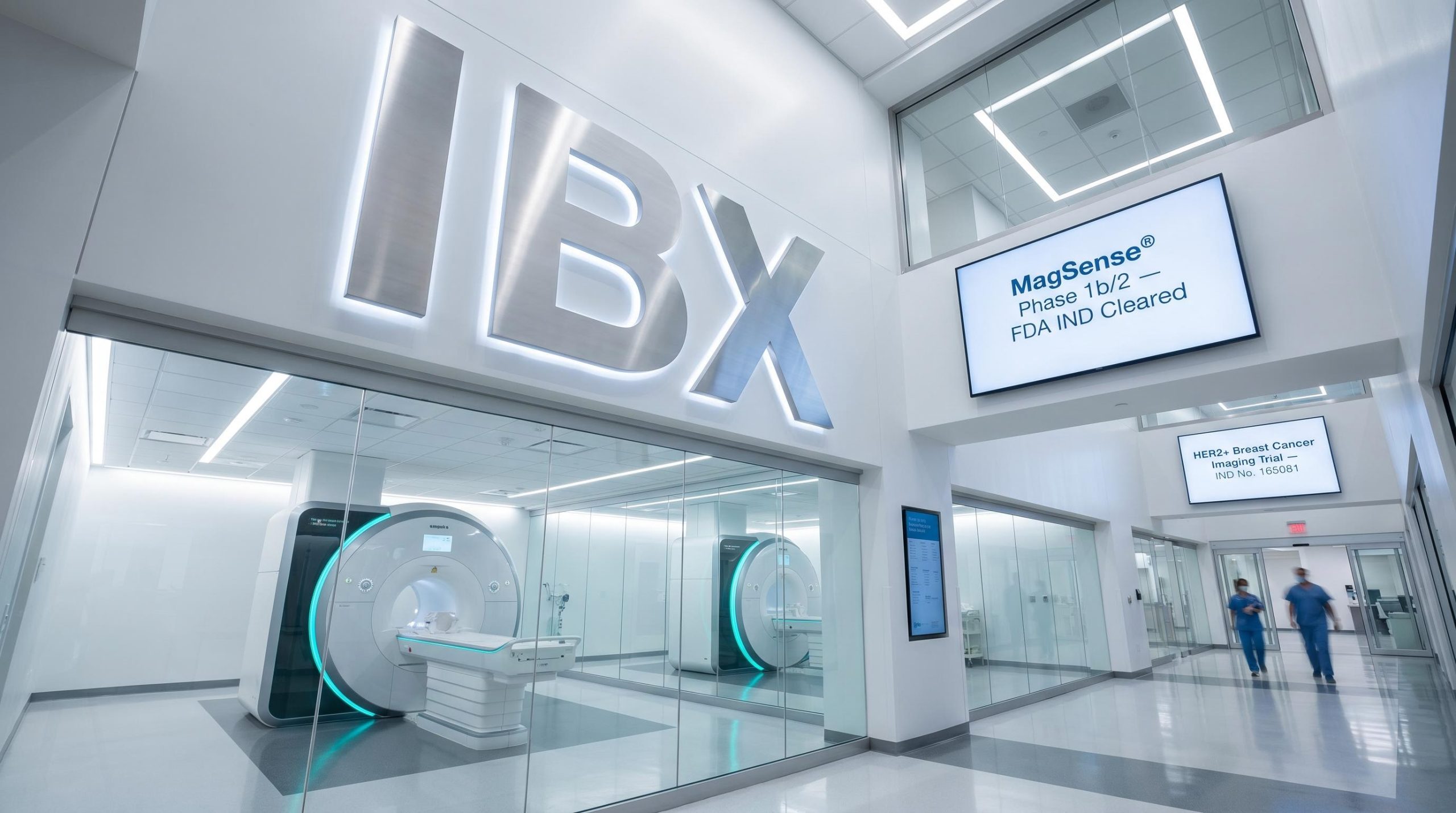
FDA clears the path: Imagion’s MagSense® Phase 1b/2 trial gets the green light
The U.S. Food and Drug Administration (FDA) has issued a Study May Proceed Notice for Imagion Biosystems’ (ASX: IBX) Investigational New Drug (IND) application, clearing the MagSense® HER2 Imaging Agent to proceed into a Phase 1b/2 clinical trial in HER2-positive breast cancer patients. The clearance follows an extensive submission encompassing preclinical data, manufacturing and quality controls, and a detailed clinical protocol, representing a significant regulatory validation for the company’s lead programme.
Key details from the announcement include:
- FDA assigned IND number 165081 to the application
- Phase 1b/2 trial targeting HER2-positive (HER2+) breast cancer patients
- Patient recruitment anticipated to commence in Q3 2026, following site activation
- Clinical-trial site contracting is currently underway
- Principal Investigator: Dr. Eghtedari, Section Chief, Women’s Imaging, Department of Diagnostic Radiology, City of Hope, Los Angeles
Ward Detwiler, President, Imagion U.S. Subsidiary
“This marks a significant milestone for Imagion and our stakeholders, validating both our science and strategic progress… MagSense has the potential to transform medical imaging by combining molecular-level precision with MRI’s tissue visualisation capabilities.”
When big ASX news breaks, our subscribers know first
Understanding the unmet need: why HER2+ breast cancer diagnosis is overdue for a breakthrough
Approximately 450,000 women receive a HER2+ breast cancer diagnosis globally each year. The HER2-positive subtype is considered an aggressive phenotype, carrying a high rate of recurrence and metastasis, which makes accurate early detection especially consequential for patient outcomes.
Following a new cancer diagnosis, clinicians perform nodal staging: a process that evaluates whether cancer has spread to nearby regional lymph nodes. This assessment combines clinical evaluation with radiographic imaging, and its findings directly shape treatment decisions, as treatment plans depend on the characteristics of the primary tumour, nodal status, and any evidence of distant metastatic spread.
The most commonly employed imaging modality for this purpose is ultrasound. While relatively convenient and cost-effective compared to MRI, ultrasound faces a number of diagnostic challenges, resulting in wide variability in both sensitivity and specificity and a limited ability to assess the extent of disease spread. Accurate nodal assessment to support early cancer diagnosis therefore represents a critical unmet need in breast cancer management.
This is where MagSense® is positioned to intervene. In the successfully completed Phase 1 study, independent radiologists confirmed that the MagSense® HER2 Imaging Agent produced a readily identifiable change in MRI images, enabling differentiation between tumour-involved nodes and non-involved nodes. For investors, this section of the clinical picture matters: it establishes both the addressable patient population and the clinical gap that MagSense® is designed to fill, underpinning the commercial rationale for the Phase 1b/2 programme.
Inside the trial: how MagSense® will be put to the test
A three-part design built for rigour
The Phase 1b/2 trial is structured in three sequential parts, each building on the data generated before it:
-
Part A (N <10): Safety-focused cohort with additional pharmacokinetic (PK) blood sampling and MRI performed at multiple time points. The objective is to establish a further safety profile for MagSense® and identify the optimal imaging window post-dose.
-
Part B (N <20): Evaluates a reduced dosing regimen and an optimised imaging protocol. This part aims to establish the lowest effective dose and the ideal post-dose imaging schedule to carry forward into Part C. Duration is anticipated at approximately 6 months.
-
Part C (N 40): The diagnostic performance cohort. MRI is conducted at the optimum time identified through Parts A and B, with the objective of comparing MagSense® diagnostic performance directly against the Standard of Care.
Interim analyses are anticipated after Part A and after Part B, providing progressive data readouts throughout the trial window.
What the data will deliver
Beyond the core diagnostic performance assessment, the trial protocol is designed to generate data across several additional dimensions. These include the potential impact on cost of care and patient outcomes, overall clinical value assessment, and the development and training of AI diagnostic tools through the integration of quantitative imaging techniques into the protocol.
The trial is expected to be completed within 18 to 24 months.
| Trial Part | Cohort Size | Primary Objective | Key Output |
|---|---|---|---|
| Part A | N <10 | Safety profile & imaging timing | PK data, optimal MRI window |
| Part B | N <20 | Dose optimisation & imaging schedule | Lowest effective dose for Part C |
| Part C | N 40 | Diagnostic performance vs. Standard of Care | Definitive efficacy data |
What this milestone means for Imagion’s investment case
The FDA IND clearance carries several layers of significance for IBX shareholders:
- Scientific and operational validation: The Study May Proceed Notice confirms that Imagion has comprehensively addressed all logistical, analytical, quality, and safety prerequisites required by the FDA, demonstrated through a complex and resource-intensive submission process.
- Platform credibility: Clearance signals that the MagSense® platform has satisfied Good Manufacturing and Good Clinical Practices standards, reinforcing confidence in the company’s execution capabilities.
- Pathway to commercialisation: The Phase 1b/2 trial is the next material step toward commercialisation, with multiple discrete data outputs expected across Parts A, B, and C providing investors with a series of progressive milestones.
- Pipeline optionality: MagSense® technology extends beyond HER2+ breast cancer. Two additional agents targeting prostate cancer and ovarian cancer have been identified and could progress into IND-enabling studies as resources allow, broadening the long-term commercial opportunity.
- Execution risk reduced: Strategic trial partners are already engaged, site contracting is underway, and the company is targeting participant enrolment to commence in Q3 2026, with the necessary support materials and compliance frameworks already in development.
The Phase 1b/2 trial represents the next major value catalyst for IBX shareholders. With interim readouts anticipated after both Part A and Part B, investors can expect progressive data milestones across an 18 to 24 month trial window as MagSense® advances toward a potential commercialisation pathway.
Don’t Miss the Next Healthcare Breakthrough on ASX
Big News Blast delivers FREE breaking ASX healthcare news directly to your inbox within minutes of release, complete with in-depth analysis so the work is already done. Join 20,000+ subscribers staying ahead of market-moving announcements. Click the “Free Alerts” button at StockWire X to start receiving alerts the moment news breaks.