
Cynata Therapeutics has received top-line results from the University of Sydney’s Phase 3 SCUlpTOR trial of CYP-004 in knee osteoarthritis patients, with the trial failing to meet its co-primary endpoints. The randomised, placebo-controlled study was led by Professor David Hunter at the University of Sydney and Royal North Shore Hospital, with funding provided by an Australian Government NHMRC project grant.
Co-primary endpoints show no statistical difference between active and placebo groups
The trial did not demonstrate statistically significant differences between the active and control groups on either of its co-primary endpoints. The first endpoint measured the proportion of participants reaching the patient-acceptable symptom state (PASS) threshold for knee pain at 24 months, whilst the second assessed changes in cartilage thickness in the central medial femorotibial compartment.
Key results for the co-primary endpoints:
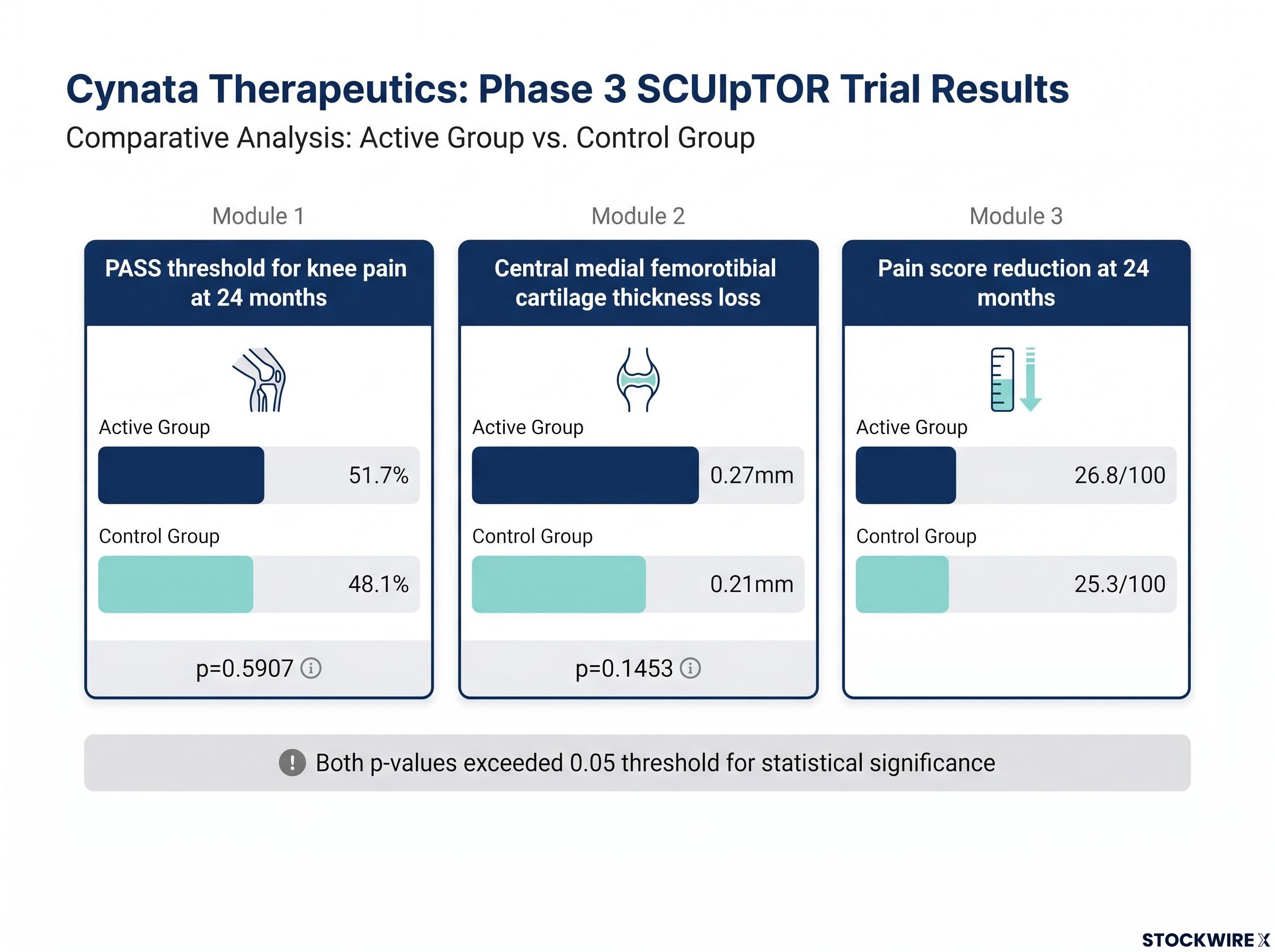
- PASS threshold for knee pain at 24 months: 51.7% (active group) vs 48.1% (control group), p=0.5907
- Central medial femorotibial cartilage thickness loss: 0.27mm (active) vs 0.21mm (control), p=0.1453
Both p-values exceeded the 0.05 threshold typically required to demonstrate statistical significance, indicating the treatment did not show measurable superiority over placebo on the trial’s designated success measures. Analysis of additional outcome measures is ongoing and will be reported in due course.
| Endpoint | Active Group | Control Group | P-value | Study Design Assumption |
|---|---|---|---|---|
| PASS threshold at 24 months | 51.7% | 48.1% | 0.5907 | 35% of control patients assumed |
| cMFT cartilage thickness loss | 0.27mm | 0.21mm | 0.1453 | N/A |
| Pain score reduction at 24 months | 26.8/100 | 25.3/100 | Not significant at any timepoint | N/A |
When big ASX news breaks, our subscribers know first
What is a Phase 3 clinical trial and why do endpoints matter?
Phase 3 trials represent the final stage of clinical testing before a treatment can be submitted for regulatory approval. These large-scale studies test whether a therapy works in real-world conditions across hundreds or thousands of patients. Co-primary endpoints are the specific, pre-defined measures a trial must meet to be considered successful.
In this case, SCUlpTOR had two co-primary endpoints: pain improvement (measured by the PASS threshold) and structural change (measured by cartilage thickness). The trial needed to demonstrate statistical superiority on both measures to be considered a success.
A p-value above 0.05 typically indicates the observed difference could have occurred by chance rather than due to the treatment itself. Placebo-controlled trials compare the active treatment against an inactive substance to isolate the drug’s true effect, ensuring any benefit observed is attributable to the therapy rather than the placebo effect or natural disease progression.
Substantial pain reduction observed in both groups
Both the active and control groups experienced substantial and durable pain reduction from baseline across all timepoints from 3 to 24 months. This was measured as a secondary endpoint. The active group’s pain reduction was in line with expectations, however the control group performed much better than the study design assumed.
The average pain score reduction at 24 months was 26.8/100 in the active group compared to 25.3/100 in the control group, with no significant differences between groups at any timepoint.
Critically, the study design assumed that 35% of control patients would reach the PASS threshold at 24 months. In reality, almost 50% of the control group reached this threshold. This unexpectedly strong placebo response is a key factor in understanding the trial outcome.
Safety profile confirmed with no concerns identified
No safety concerns were identified in the trial. The adverse event profile was similar between the active and control groups, confirming CYP-004’s safety profile in this patient population.
A clean safety record preserves optionality for the Cymerus platform in other indications, even as efficacy questions emerge in osteoarthritis.
Management response and strategic review underway
Management acknowledged the trial team and participating patients whilst confirming a strategic review is underway. Following these results and the recently announced Phase 2 CYP-001 results in acute graft versus host disease (17 June 2026), Cynata is actively reviewing options for further development of the Cymerus technology. The company has committed to providing an update as soon as possible.
The Phase 2 CYP-001 GvHD trial failure, reported on 17 June 2026, followed a near-identical pattern: a Day 28 Overall Response Rate of 57.7% in the active arm versus 54.8% in the control arm, with a p value exceeding 0.9999 and the programme subsequently terminated.
Dr Kilian Kelly, CEO & Managing Director
“The results of this trial are disappointing. The pain reduction in the control group was much better than expected: the study design assumed that 35% of control patients would reach the PASS threshold, but it has turned out that almost 50% have done so. The pain reduction in the active group was in line with our expectations, but unfortunately there is no evidence of a reduction in cartilage loss. We would like to thank Professor Hunter and the rest of the study team for conducting the trial, as well as the patients who participated.”
The strategic review signals Cynata is reassessing the commercial pathway for its Cymerus platform following two challenging trial readouts in quick succession. Investors face uncertainty regarding the platform’s development trajectory and whether the company will pivot to alternative indications, seek partnerships, or reconsider capital allocation.
Investor webinar scheduled for 22 June
An investor webinar will be held on Monday 22 June 2026 at 8:30am AEST, hosted by CEO Dr Kilian Kelly and Chair Dr Geoff Brooke. Registration is available at: https://cynata.com/webinars/rvJo2r-cynata-investor-webinar
The webinar provides investors with an opportunity to hear directly from management on next steps and ask questions about the strategic review.
About CYP-004 and the Cymerus platform
CYP-004 is Cynata’s Cymerus off-the-shelf iPSC-derived MSC product candidate for intra-articular injection. The Cymerus platform uses induced pluripotent stem cells to manufacture mesenchymal stem cells at commercial scale, aiming to overcome limitations of conventional MSC production including donor variability and inconsistent products.
Key terminology:
- iPSC – induced pluripotent stem cell
- MSC – mesenchymal stem (or stromal) cell
- Intra-articular injection – injection into a joint
The platform’s value proposition centres on scalable, consistent manufacturing without the need for ongoing tissue donation from multiple donors. Understanding the platform technology helps investors assess whether the Cymerus approach retains value in other therapeutic areas despite this specific trial outcome in osteoarthritis.
The pixenstrocel INN designation, proposed by the WHO in May 2026, applies across the entire Cymerus platform and covers pipeline candidates targeting diabetic foot ulcers and kidney transplantation, representing the regulatory infrastructure that would remain intact regardless of the SCUlpTOR outcome.
Get Healthcare News Before the Market Reacts
Join 20,000+ investors receiving FREE breaking ASX Healthcare alerts within minutes of release, complete with in-depth analysis. Click the “Free Alerts” button at Big News Blast to ensure you never miss critical trial results, regulatory updates, or breakthrough announcements the moment they hit the market.