
Cynata’s Phase 2 GvHD trial fails to show benefit over standard treatment
Cynata Therapeutics has reported that its Phase 2 clinical trial of CYP-001 in patients with high-risk acute graft versus host disease (HR-aGvHD) did not demonstrate statistically significant benefit over steroids plus placebo. The trial’s primary endpoint, Day 28 Overall Response Rate (ORR), was 57.7% in the active group compared with 54.8% in the control group, with a p value exceeding 0.9999 — indicating virtually no statistical difference. Following these results, the Company has terminated the trial early. Cynata remains under voluntary suspension from the ASX pending separate Phase 3 osteoarthritis results expected later this week.
This is a material clinical setback for Cynata. The failed GvHD trial removes one of the Company’s key pipeline catalysts and raises questions about the Cymerus platform’s efficacy in this indication. Investors now face heightened scrutiny of the imminent osteoarthritis results, which carry significantly greater weight following this programme’s discontinuation.
When big ASX news breaks, our subscribers know first
What the Phase 2 results showed
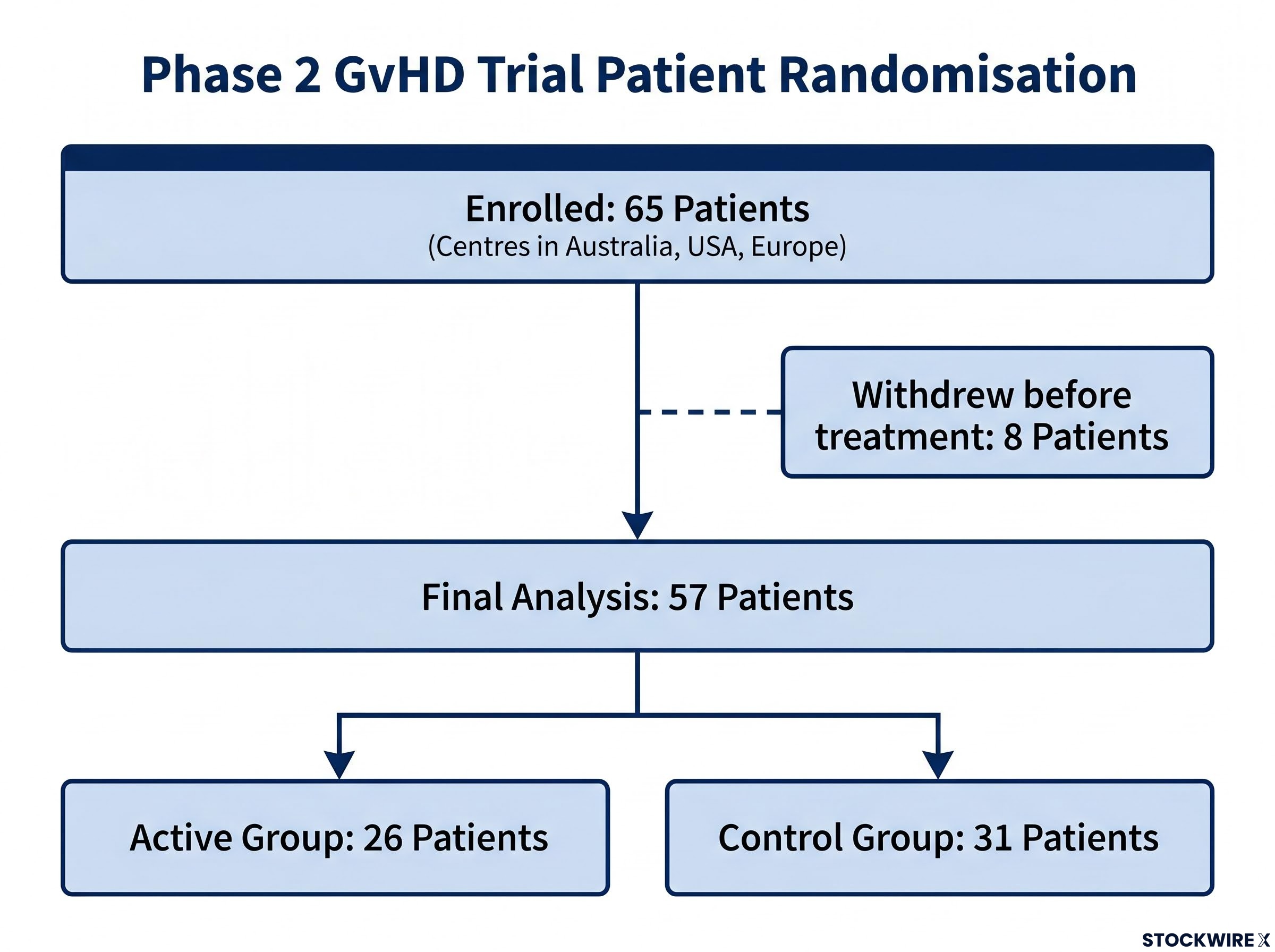
The trial enrolled 65 patients across clinical centres in Australia, the USA and Europe. Patients were randomised to receive either steroids plus CYP-001 or steroids plus placebo. 57 patients were included in the final analysis — 26 in the active group and 31 in the control group — while eight randomised patients withdrew before receiving any investigational product.
The Company identified no safety concerns, with adverse event profiles similar between groups. However, the trial failed to show separation between active and control arms across primary and secondary efficacy endpoints.
| Endpoint | Active Group | Control Group | P Value |
|---|---|---|---|
| Day 28 ORR | 57.7% | 54.8% | >0.9999 |
| Day 28 CRR | 38.5% | 35.5% | >0.9999 |
| Day 100 ORR | 23.1% | 32.3% | 0.5581 |
| Day 100 CRR | 19.2% | 29.0% | 0.5392 |
| Durable ORR | 19.2% | 32.3% | 0.3681 |
| Day 100 overall survival rate | 88.1% | 82.3% | 0.5137 |
Notably, the control group showed numerically higher response rates at Day 100 across multiple measures, though none reached statistical significance. The Durable ORR — which measures sustained response across Day 28, Day 60 and Day 100 — was 32.3% in the control group versus 19.2% in the active group.
Understanding clinical trial endpoints in GvHD
Overall Response Rate (ORR) measures the proportion of patients who show improvement in their graft versus host disease symptoms at a specific time point. Complete Response Rate (CRR) measures the proportion whose symptoms resolve entirely. These are standard measures in GvHD trials to assess whether a treatment provides clinical benefit.
The p values in the results table indicate the statistical likelihood that the observed differences between groups occurred by chance. A p value close to 1.0 (such as >0.9999 for the primary endpoint) shows virtually no difference between the active and control groups. In clinical trials, p values below 0.05 are typically required to claim statistical significance.
Durable ORR measures sustained response over time rather than a single snapshot. A patient must show improvement at Day 28, Day 60 and Day 100 to be counted. This endpoint matters because a treatment that produces only temporary improvement has limited clinical value in a chronic condition like GvHD.
When a trial shows no separation between active drug and placebo on primary endpoints, it typically means the therapy has failed to demonstrate clinical benefit in that indication. This is distinct from a safety failure, where the drug may cause unacceptable side effects.
Why Phase 1 success didn’t translate to Phase 2
Dr Kilian Kelly, Cynata’s CEO and Managing Director, acknowledged that the earlier Phase 1 results “were very positive” and “had given us strong grounds for optimism.” Phase 1 trials are primarily designed to assess safety and appropriate dosing, not efficacy, and typically involve far fewer patients than Phase 2.
Phase 1 GvHD data had set a high benchmark, with an 87% overall response rate and 60% two-year survival in steroid-resistant patients, against historical two-year survival rates below 20% for the same population.
Phase 2 represents the first true test of whether a drug shows measurable clinical benefit versus a control group. Many therapies that clear Phase 1 safety hurdles fail at this stage because biological activity in early testing does not translate to meaningful patient outcomes.
Dr Kilian Kelly, CEO & Managing Director, Cynata Therapeutics
“We are exceptionally disappointed with this outcome. The results of our Phase 1 clinical trial of CYP-001 in aGvHD were very positive, which had given us strong grounds for optimism, but sadly the Phase 2 results have fallen well short of what we were hoping for. I would like to acknowledge the huge amount of work that went into this trial, by Cynata employees, our service providers, clinical investigators and their teams. Above all, I would like to thank the patients who participated in the trial, and wish all aGvHD patients the very best.”
What happens next for Cynata
The trial’s follow-up period was originally expected to end in December 2027 (two years after the final patient was enrolled), but has been terminated early in light of the primary evaluation results. The Company remains under voluntary suspension pending Phase 3 SCUlpTOR trial results for CYP-004 in knee osteoarthritis, expected later this week. Osteoarthritis represents a separate indication using the same Cymerus platform technology.
- GvHD programme: Terminated following Phase 2 failure
- Osteoarthritis programme (CYP-004): Phase 3 results imminent
- Trading status: Voluntary suspension continues
The upcoming osteoarthritis results now carry significantly greater weight for Cynata’s investment case, as the GvHD programme has been discontinued. Investors will be watching to see whether the Cymerus platform can demonstrate efficacy in any clinical indication.
Cynata’s Cymerus platform explained
CYP-001 is derived from Cynata’s Cymerus iPSC-derived MSC technology. The platform uses induced pluripotent stem cells (iPSCs) to manufacture mesenchymal stem cells (MSCs) at commercial scale. Induced pluripotent stem cells are adult cells that have been reprogrammed to an embryonic-like state, allowing them to produce large quantities of other cell types. Mesenchymal stem cells are a type of adult stem cell with potential therapeutic applications in inflammatory and regenerative conditions.
The key claimed advantage of the Cymerus platform is avoiding the need for multiple tissue donors and reducing product inconsistency. Conventional MSC production requires ongoing tissue collection from donors, which can result in variability between batches.
A single clinical failure does not necessarily invalidate an underlying platform technology. However, investors will closely scrutinise the osteoarthritis results to assess whether Cymerus-derived products can demonstrate efficacy in any indication. The GvHD programme’s termination means the osteoarthritis trial is now the primary test of whether Cynata’s core technology can deliver commercial outcomes.
The Cymerus platform pipeline extends beyond GvHD and osteoarthritis to include candidates targeting diabetic foot ulcers and kidney transplantation, and the platform received a proposed WHO International Nonproprietary Name of ‘pixenstrocel’ in May 2026, a formal step in the global regulatory approval process.
Don’t Miss the Next Biotech Catalyst
Join 20,000+ investors getting FREE breaking ASX biotech news delivered to your inbox within minutes of release, complete with in-depth analysis. Click the “Free Alerts” button at StockWire X to stay ahead on clinical trial results and regulatory decisions the moment they break.