

Clarity’s SAR-bisPSMA data accepted for presentation at EANM 2026 Congress in Vienna
Clarity Pharmaceuticals (ASX: CU6) has had data on both its diagnostic agent 64Cu-SAR-bisPSMA and its therapy candidate 67Cu-SAR-bisPSMA accepted for presentation at the European Association of Nuclear Medicine (EANM) Annual Congress 2026, held 17–21 October in Vienna, Austria.
One acceptance is a Top Rated Oral Presentation of the Co-PSMA investigator-initiated trial, led by Prof Louise Emmett at St Vincent’s Hospital, Sydney.
The EANM Annual Congress is one of the world’s leading nuclear medicine conferences. The acceptances are testament to the strength of the data generated by Clarity’s products.
When big ASX news breaks, our subscribers know first
Three abstracts headed to Vienna
The accepted abstracts span both the diagnostic and therapeutic applications of Clarity’s SAR-bisPSMA platform in prostate cancer.
| Product | Abstract Type | Title (shortened) | Session / Date |
|---|---|---|---|
| 64Cu-SAR-bisPSMA | Top Rated Oral Presentation #1803 | Co-PSMA Trial head-to-head vs 68Ga-PSMA-11 in biochemical recurrence post-prostatectomy | Mon 19 Oct 2026, 8:00–9:30AM |
| 64Cu-SAR-bisPSMA | E-Poster #296 | Real-world detection following negative SOC PSMA PET (three-patient case report) | EANM 2026 |
| 67Cu-SAR-bisPSMA | E-Poster #1786 | Undetectable disease in mCRPC, two SECuRE case reports | EANM 2026 |

Co-PSMA trial: 64Cu-SAR-bisPSMA outperforms standard-of-care imaging
Prof Emmett’s Co-PSMA trial compared 64Cu-SAR-bisPSMA head-to-head with the current standard-of-care (SOC) 68Ga-PSMA-11 PET/CT in patients with biochemical recurrence (BCR) of prostate cancer with low PSA, following radical prostatectomy.
The study reported improved diagnostic performance of 64Cu-SAR-bisPSMA next-day imaging across all key parameters assessed:
-
Mean lesions per participant: 1.26 vs 0.48 (p<0.0001)
-
Total lesions detected: 63 vs 24
-
True positive rate: 71% vs 29%
-
Positive scan rate: 78% vs 36%
The Co-PSMA data has been published in the journal European Urology and presented at the European Association of Urology 2026 conference. According to Clarity, the findings corroborate previously reported improvements in diagnostic performance of 64Cu-SAR-bisPSMA over SOC PSMA imaging in BCR patients.
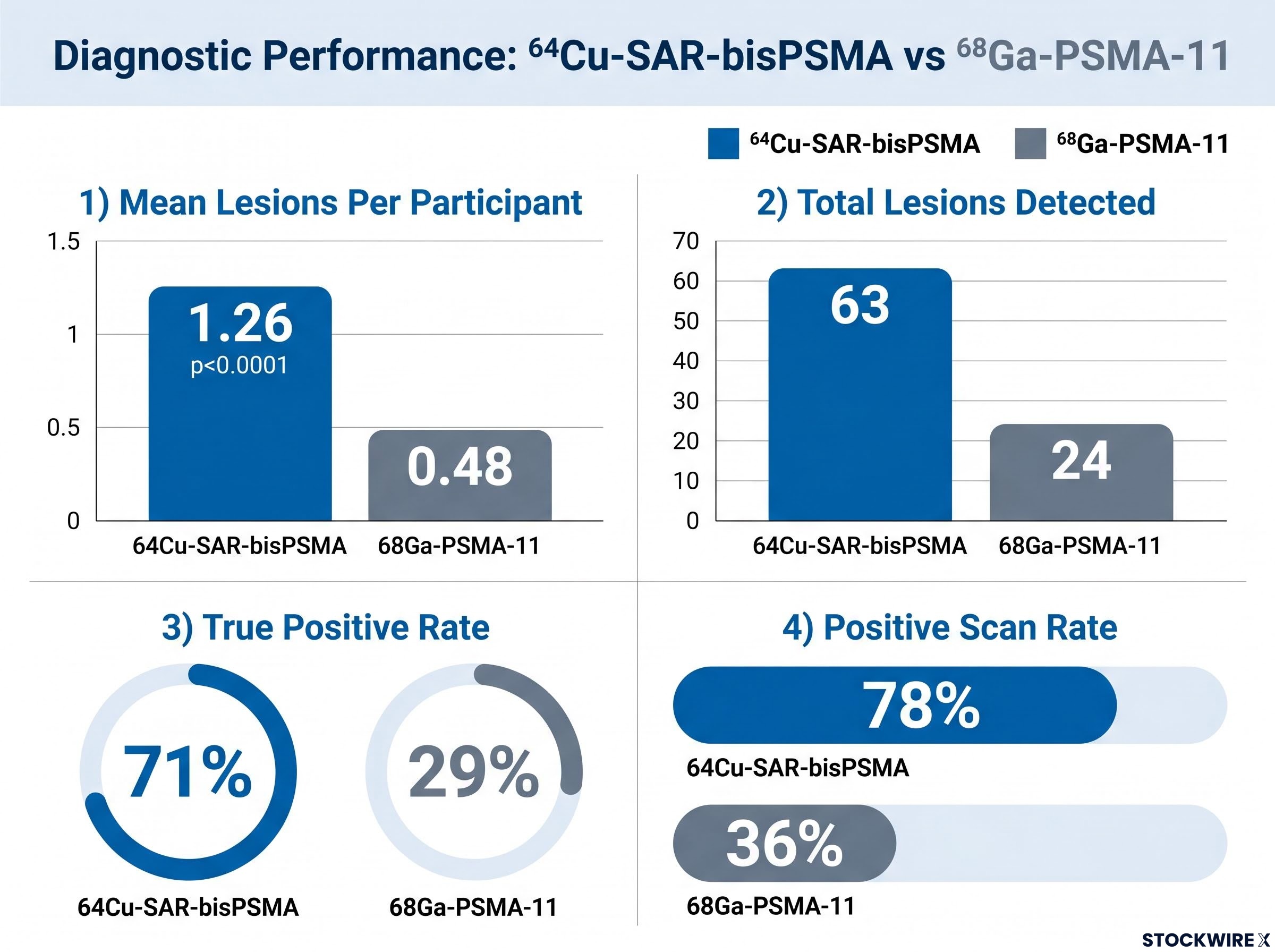
The SAR-bisPSMA publication in European Urology, which carries an impact factor of 25.2, formally documented the 63 versus 24 total lesion finding across 50 patients and showed that 44% of participants experienced a change in planned clinical management following 64Cu-SAR-bisPSMA imaging.
Real-world case report — detection after negative SOC scans
A separate three-patient case study examined men with biochemical recurrence who were negative on SOC PSMA PET/CT, yet positive with subsequent 64Cu-SAR-bisPSMA PET/CT in all three cases.
Baseline PSA across the three patients ranged from 1.4–21.0 ng/mL. Next-day imaging, taken 24 hours post-injection, detected a 2.25-fold increase in lesions (nine versus four) compared with same-day imaging at one hour post-injection, with additional lesions identified in the prostate bed and lymph nodes.
For lesions visible at both timepoints, mean maximum standardised uptake value (SUVmax) increased from 3.5 to 6.1, a 1.8-fold increase in tracer uptake. Notably, the imaging changed planned clinical management in all three patients.
A patient’s perspective: deferring ADT through earlier detection
One of the three patients, Steve Hunter, received 64Cu-SAR-bisPSMA under compassionate use. Diagnosed in 2016 and initially treated with prostatectomy and radiation therapy, his PSA began rising in 2023 while SOC PSMA imaging detected no lesions.
Patient experience: Steve Hunter
“My experiences led me to believe that what I really had were a small number of tumours that were undetectable by the current SOC PSMA PET/CT imaging even on a state-of-the-art PET/CT system. I contacted Dr Alan Taylor in 2023 and asked if there was any possibility of being tested using their next-day imaging, knowing that this would significantly enhance the chance of finding these tumours. The results were beyond my expectations. Three tumours were found and I underwent targeted external beam radiation. Since then, I have repeated this process with Clarity and Alan’s support a few times to scan, find and subsequently treat the ensuant small number of tumours that arise, with stereotactic radiation therapy. I am so grateful to Clarity in making these scans available. This approach has proven to be highly successful by allowing me to obtain clear information about my disease and defer requiring ADT therapy and all the associated side effects with this treatment. I am currently symptom-free and hope to remain like this for a long time. It certainly demonstrates the importance of this agent for patients like me.”
In this case, next-day 64Cu-SAR-bisPSMA imaging enabled targeted radiotherapy to detected lesions and allowed androgen deprivation therapy (ADT) to be deferred over a 3-year period while achieving PSA responses. Clarity describes ADT deferral as a patient-centric outcome given the treatment’s side-effect burden. This reflects a compassionate-use case rather than a registered indication.
67Cu-SAR-bisPSMA therapy: two mCRPC patients reach undetectable disease
The therapeutic potential of 67Cu-SAR-bisPSMA is being showcased through a case study of two participants from Clarity’s Phase I/IIa SECuRE trial, a theranostic study in metastatic castration-resistant prostate cancer (mCRPC) reported earlier this year. Both participants had Stage IV mCRPC at study entry.
| Participant | Age / Baseline PSA | Cycles | PSA Decline | Outcome |
|---|---|---|---|---|
| Participant A | 64 / 6.06 ng/mL (bone mets) | 4 cycles over 5 months | 95.7% decline to 0.26 ng/mL within 4 weeks | Undetectable after 3rd cycle, still undetectable at 33 weeks; no disease on follow-up imaging |
| Participant B | 76 / 3.25 ng/mL (nodal mets) | 2 cycles over 2 months | 94.2% decline to 0.19 ng/mL within 4 weeks | Undetectable at 8 weeks, RECIST complete response, undetectable at 16 weeks |
Both participants experienced mostly mild and transient adverse events. Participant A reported Grade 1 nausea, vomiting and flu-like symptoms, all of which resolved. Participant B reported Grade 1 altered taste, dry eyes, eye pain, fatigue and salivary gland soreness, all resolved, alongside Grade 2 anaemia that was ongoing at the last assessment.
Understanding SAR-bisPSMA and the theranostic approach
SAR-bisPSMA derives its name from “bis”, reflecting a novel approach of connecting two PSMA-targeting agents to Clarity’s proprietary sarcophagine (SAR) technology. This technology holds copper isotopes securely inside a cage-like structure called a chelator. Unlike other commercially available chelators, the SAR technology is designed to prevent copper leakage into the body.
PSMA, or prostate-specific membrane antigen, is a protein expressed by prostate cancer cells that the radiopharmaceuticals target.
SAR-bisPSMA is a Targeted Copper Theranostic (TCT), meaning it can be used with copper-64 (64Cu) for imaging and copper-67 (67Cu) for therapy. The same targeting molecule supports both diagnostic and therapeutic applications.
For investors, the significance lies in a single platform addressing both the diagnosis and treatment of prostate cancer. Prostate cancer is the second most common cancer diagnosed in men globally. The American Cancer Society estimates around 333,830 new US cases and approximately 36,320 deaths from the disease in 2026.
Why this matters for investors
The conference acceptances add external validation to a growing body of clinical evidence. According to Clarity, 64Cu-SAR-bisPSMA has consistently outperformed SOC imaging in head-to-head trials under multiple conditions.
These data support two ongoing registrational Phase III trials. Real-world evidence continues to build through the Special Access Scheme (SAS) in Australia and the Expanded Access Program (EAP) in the US, with the body of knowledge now in the range of 700–800 patients dosed across multiple cameras, geographies and clinical settings.
The AMPLIFY Phase III enrolment milestone, completed in just nine months despite four rival PSMA PET products already on the market, is one of the clearest signals of clinician confidence in the 64Cu-SAR-bisPSMA platform ahead of the anticipated FDA submission.
The company states it will continue releasing these data “in preparation for commercialisation.”
Management commentary
Dr Alan Taylor, Executive Chairperson of Clarity Pharmaceuticals
Dr Alan Taylor commented that the EANM Annual Congress is a conference focused specifically in Clarity’s area of nuclear medicine, and that the company is very pleased to see Professor Louise Emmett and her team receive yet another Top Rated Oral Presentation for her excellent work on the Co-PSMA trial. He noted that this additional recognition from EANM is testament to the high quality and clinical relevance of the head-to-head trial, and that data from trials with 64Cu-SAR-bisPSMA provide an early view of what is expected to be the largest single body of work ever undertaken on PSMA imaging agents. He added that Clarity will continue to release data in preparation for commercialisation, with its goal of taking a product from the Australian benchtop to blockbuster status — something achieved in the entire history of Australian life sciences by a number of pharmaceutical products you can count on one hand, the most widely recognised of which is Gardasil. He emphasised that beyond the data, what drives the team in the development of this product is the effect it can have on patients’ lives.
What comes next
Presentations will be available on Clarity’s official website after the EANM 2026 Congress. The company’s two registrational Phase III trials remain on track.
Clarity has indicated it will continue releasing real-world data from its SAS and EAP programs ahead of commercialisation. It should be noted that 64Cu-SAR-bisPSMA and 67Cu-SAR-bisPSMA are unregistered products, and their safety and efficacy have not been assessed by health authorities such as the US Food and Drug Administration (FDA) or the Therapeutic Goods Administration (TGA).
Don’t Miss the Next Healthcare Breakthrough on ASX
Big News Blast delivers FREE breaking ASX healthcare news directly to your inbox within minutes of release, complete with in-depth analysis. Join 20,000+ investors already ahead of the market and never miss a market-moving announcement. Click the “Free Alerts” button at Big News Blast to start receiving alerts the moment news breaks.