
BlinkLab delivers positive SHANK2 autism study results ahead of schedule
BlinkLab (ASX:BB1) has reported positive results from its exploratory SHANK2 autism study. Individuals with a SHANK2 mutation (n = 8) showed significant differences on BlinkLab smartphone tests versus matched community participants (n = 99), unaffected siblings (n = 10), or both.
The readout was identified as Q1 2027 in the 14 July 2026 Company Update on Clinical Development Programs. Completion of the analysis allows BlinkLab to report earlier than anticipated.
The study was run in collaboration with the SHANK2 Foundation, a partnership announced on 13 March 2026. The result is the first in a series of upcoming readouts from the company’s exploratory research programs.
The SHANK2 Foundation partnership also extended into preclinical work, with CEO Dr Henk-Jan Boele set to test mouse models carrying the same mutation through the SCANNER consortium at Erasmus MC.
The announcement of 11 November 2026 is intended to lift the Trading Halt granted on Monday 9 November 2026.
The assessment measured three domains:
- Sensorimotor gating
- Startle habituation
- Spontaneous sensorimotor behaviour
Dr Henk-Jan Boele, Co-Founder, Managing Director and CEO
“…It is important to understand that this study is not about the immediate market size of SHANK2-related autism (it’s a rare condition). It is about a much larger scientific and commercial opportunity: understanding how specific genetic mutations shape behaviour, including behaviours associated with autism, and ultimately translating these insights into new therapeutic approaches…”
When big ASX news breaks, our subscribers know first
Study results: a clear sensory gating signature
The study compared a rare genetic cohort against two reference groups. The design combined a family-based comparison with a larger community benchmark.
How the study was run
- Twenty participants were recruited through the SHANK2 Foundation: nine with a SHANK2 mutation and eleven unaffected siblings.
- Eight individuals with a SHANK2 mutation and ten siblings completed the 15-minute smartphone assessment. Two participants were unable to complete testing because of discomfort with the headphones or auditory stimuli.
- Smartphone-based assessments enabled recruitment across the US, Australia and Europe.
- A matched community comparison group of 99 participants completed the same protocol, matched on sex, race and age within two years where an eligible match was available.
- The completed groups did not differ significantly in age or sex.
- The study used the same core smartphone-based neurometric technology that underpins BlinkLab Dx1, deployed in a research setting.
The assessment measured acoustic startle response, prepulse inhibition, startle habituation and spontaneous sensorimotor behaviour, using computer vision analysis of the smartphone camera feed. Participant numbers are necessarily small because SHANK2-related disorder is very rare, though the company said the observed group differences reached statistical significance.
Headline findings
The clearest result was in sensory gating, which describes the filtering of sound.
- Matched community participants showed +27.2% and siblings +27.8%, while the SHANK2 group showed the reverse at -26.5%, a gap of about 54 percentage points.
- The group effect was p = 0.020, and p = 0.0001 after adjustment for age and sex.
- The size of the acoustic startle response did not differ between groups (p = 0.55; p = 0.61 after adjustment for age and sex).
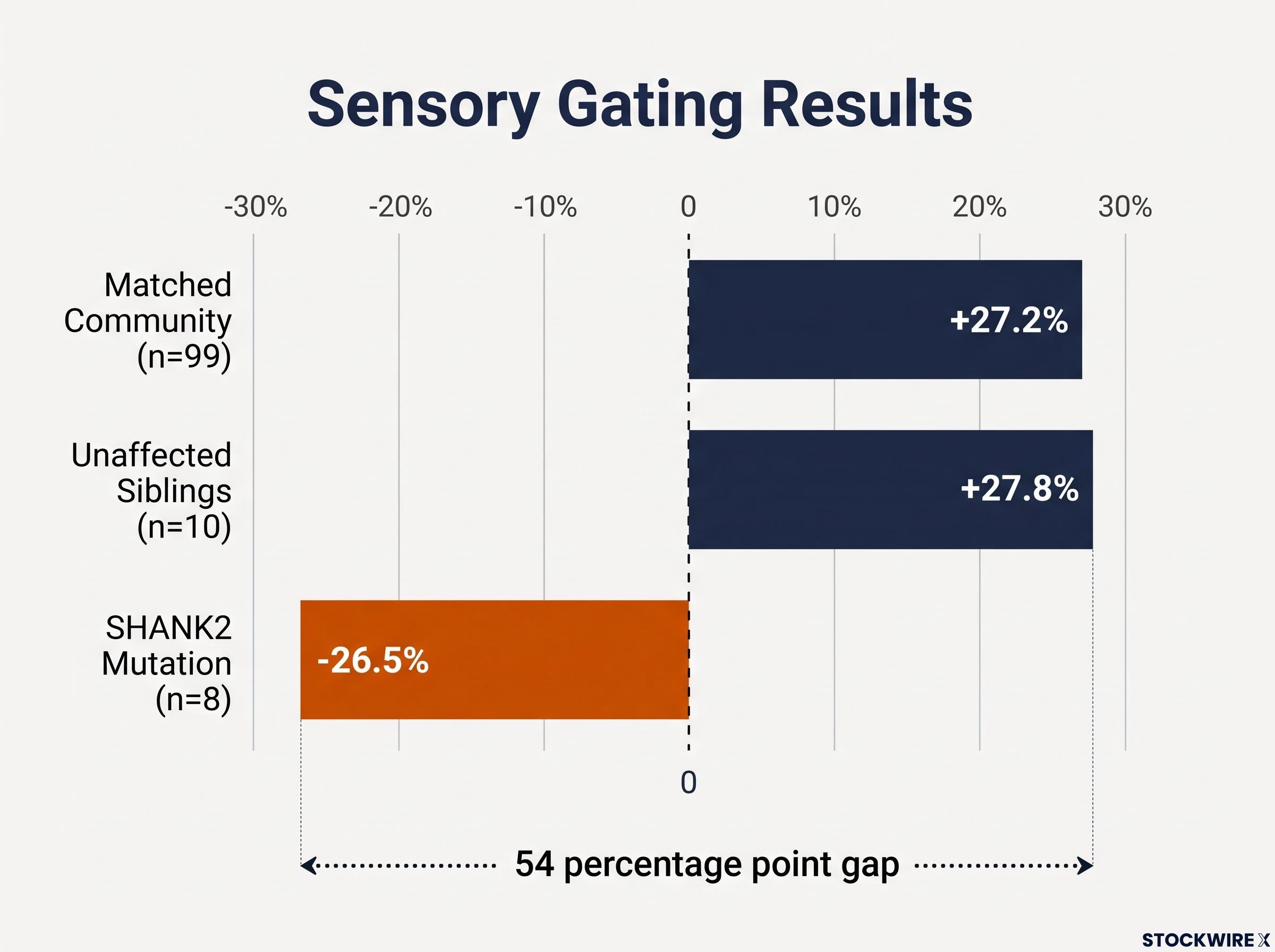
The company said the findings emphasise the need to evaluate how sensorimotor responses adapt over time and are gated, rather than overall responsiveness.
Startle habituation, the reduction in response to repeated sounds, also differed between groups. With sounds at random intervals, the SHANK2 group showed greater habituation than matched community participants but not siblings. With sounds at rhythmic intervals, it showed greater habituation than both.
For spontaneous sensorimotor behaviour, the SHANK2 group differed from siblings in postural stability, head rotations and mouth openings. It also showed more mouth openings than matched community participants.
| Measure | Versus matched community | Versus siblings | Result |
|---|---|---|---|
| Habituation, random-interval sounds | p < 0.001 | p = 0.208 | Greater habituation than community participants only |
| Habituation, rhythmic-interval sounds | p = 0.004 | p = 0.021 | Greater habituation than both groups |
| Postural stability | n/a | p-Holm = 0.009 | Differed from siblings |
| Head rotations | n/a | p-Holm = 0.010 | Differed from siblings |
| Mouth openings | p-Holm = 0.033 | p-Holm = 0.010 | More mouth openings than community participants; differed from siblings |
Why a genetic autism model matters
SHANK2 is a gene that encodes a scaffolding protein involved in excitatory synapses, the connections where nerve cells pass on signals. Rare pathogenic variants in SHANK2 are associated with neurodevelopmental conditions including autism, intellectual disability and ADHD.
Biological validation of the platform
BlinkLab said Dx1 measured differences across objective neurophysiological domains. This supports the view that the technology captures underlying brain biology rather than behavioural variation alone.
The sensorimotor measures echo the peer-reviewed 536-child study published with Princeton and Erasmus Medical Center collaborators, which first showed that a smartphone could objectively detect autism-related sensorimotor differences.
Most autism is biologically heterogeneous, reflecting the combined influence of many genetic and environmental factors. A SHANK2 mutation provides a more biologically defined model for studying the pathways that contribute to autism and related conditions.
The company also said the most informative biomarker may be a combination of signals rather than any single measurement. Its stated rationale is that in other areas of medicine, genetically defined populations have helped validate disease mechanisms, identify biomarkers and guide targeted therapies.
Prof. Raphael Bernier, Non-Executive Director
“…This approach has the power to identify treatment biomarkers essential to clinical trials, can inform the discovery of novel therapeutic targets, and holds the promise for the realization of precision medicine for autism.”
Drug development and stratification
Clinical development in autism and rare neurodevelopmental disorders is limited by the availability of objective, scalable endpoints. Trials often rely on caregiver- and clinician-rated measures that can vary between assessments and may be affected by placebo response.
Sensorimotor gating and startle habituation are translational measures that can be studied in both preclinical models and humans. That creates potential continuity from laboratory research to clinical trials.
The company said a platform measuring several signals at once could help researchers characterise biological subtypes, which may support future approaches to patient stratification.
Kayleigh Gultig, BlinkLab Clinical Research Lead on the SHANK2 autism project
“…The sensorimotor differences we observed in SHANK2 show that BlinkLab could provide such a measure. It was mentioned during the conference that outcome measures are particularly important during Phase 2 clinical trials where the choice of endpoint can determine whether or not a potentially promising treatment progresses to the next phase or is abandoned. By providing objective and reliable measures that families, all over the world, can collect at home, we can help ensure potential treatments are judged on their true effect.”
The study is exploratory. Additional prospective work is required before these measures could be used as validated clinical trial endpoints or treatment-response biomarkers, and the study does not itself establish the diagnostic performance of Dx1.
Dx1 FDA pathway unchanged, platform opportunity widens
The study does not change the company’s FDA 510(k) pivotal program for BlinkLab Dx1, which BlinkLab said remains on track. The company set out four points under its investment significance:
- Supports the Dx1 investment case: the findings provide additional evidence that the core technology measures biologically relevant neurophysiological features, while remaining separate from the regulatory evidence for Dx1.
- Opens a potential research and pharmacological intervention market: objective biomarker services may support research collaborations and, subject to further validation, future clinical and pharmacological trials for genetically defined neurodevelopmental disorders.
- Reinforces BlinkLab as a platform company: a common smartphone assessment and software platform can be applied across clinical diagnosis, research into biological subtypes and therapeutic development.
- Capital-efficient rare-disease research model: the study combined existing technology, recruitment through a patient advocacy organisation and academic collaborator, and a substantial matched community comparison group.
What happens next for BlinkLab
BlinkLab outlined two next steps:
- Further exploratory study readouts: the company remains on track to announce further study results before the end of the year.
- Expanded SHANK2 work: the CEO said the company looks forward to expanding this work together with the SHANK2 Foundation.
Want Alerts Like This on the Biotech and Healthcare Stocks You Follow?
StockWire X Market Intelligence scores every announcement in our coverage for how significant it’s likely to be for investors, and which way it points, then alerts you on the stocks you follow. The first 1,000 founding members lock in 50% off for life: A$247 a year instead of the standard A$495. Join the founding waitlist today.