
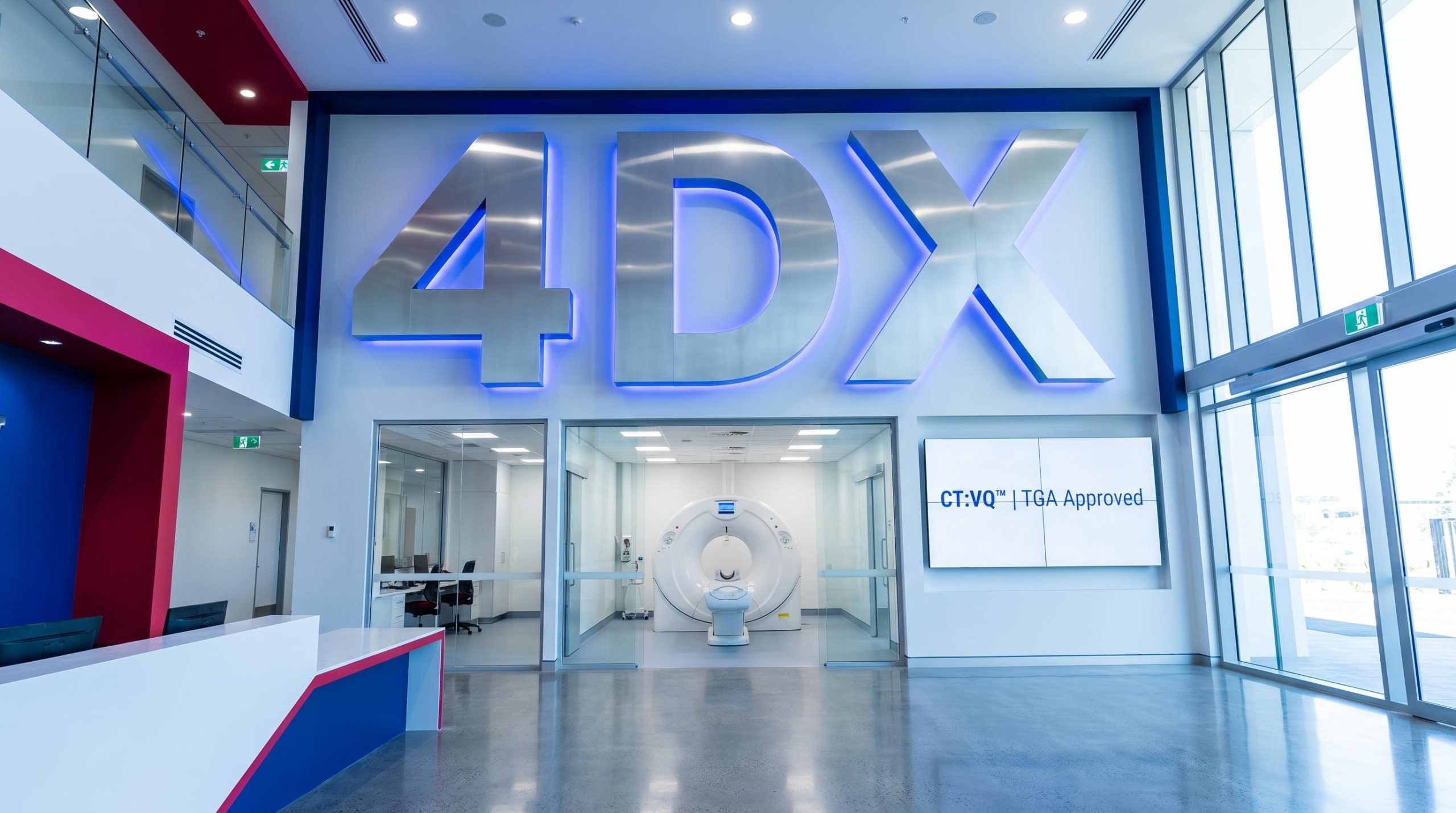
4DMedical secures TGA approval for CT:VQ™, unlocking nationwide Australian deployment
4DMedical (ASX:4DX) has received Therapeutic Goods Administration (TGA) approval for its CT:VQ™ imaging solution and inclusion in the Australian Register of Therapeutic Goods (ARTG), enabling commercial deployment across Australia.
CT:VQ™ is a software-only, non-contrast, ventilation-perfusion solution that enables functional lung imaging using existing CT infrastructure. The technology requires no injections, contrast agents, radiotracers or nuclear medicine equipment.
For the Melbourne-headquartered company, the clearance carries particular significance as it opens its home market. The approval moves CT:VQ™ from regulatory pending to commercial-ready in Australia, positioning the technology for routine clinical use across the nation’s healthcare system.
When big ASX news breaks, our subscribers know first
Australia joins a growing global regulatory footprint
The Australian clearance extends CT:VQ™’s international reach. The solution now holds regulatory approval across the United States, European Union, United Kingdom, Canada and New Zealand, with Australia the latest market to join.
According to 4DMedical, each additional approval delivers a compounding strategic effect. Collectively, the clearances strengthen the clinical evidence base, establish reimbursement precedent, increase physician familiarity, and deepen regulatory confidence, building the foundation for CT:VQ™ to become the new standard for functional lung assessment globally.
Momentum has been particularly strong in the United States following FDA clearance in September 2025. CT:VQ™ has since been deployed across leading academic medical centres including Stanford, Cleveland Clinic, UC San Diego Health, University of Chicago Medicine and University of Miami, with evaluation well-progressed at Mayo Clinic.
The company’s recently announced commercial agreement with SimonMed Imaging further demonstrates CT:VQ™’s applicability in high-volume community imaging settings. 4DMedical describes the agreement as providing a strong reference model for broader deployment in Australia.
| Jurisdiction | Regulator | CT:VQ™ Status |
|---|---|---|
| United States | FDA | Cleared |
| European Union | CE Mark | Cleared |
| United Kingdom | MHRA | Cleared |
| Canada | CMDR | Cleared |
| New Zealand | Medsafe | Cleared |
| Australia | TGA | Approved |
Why Australia’s CT infrastructure makes it a standout market
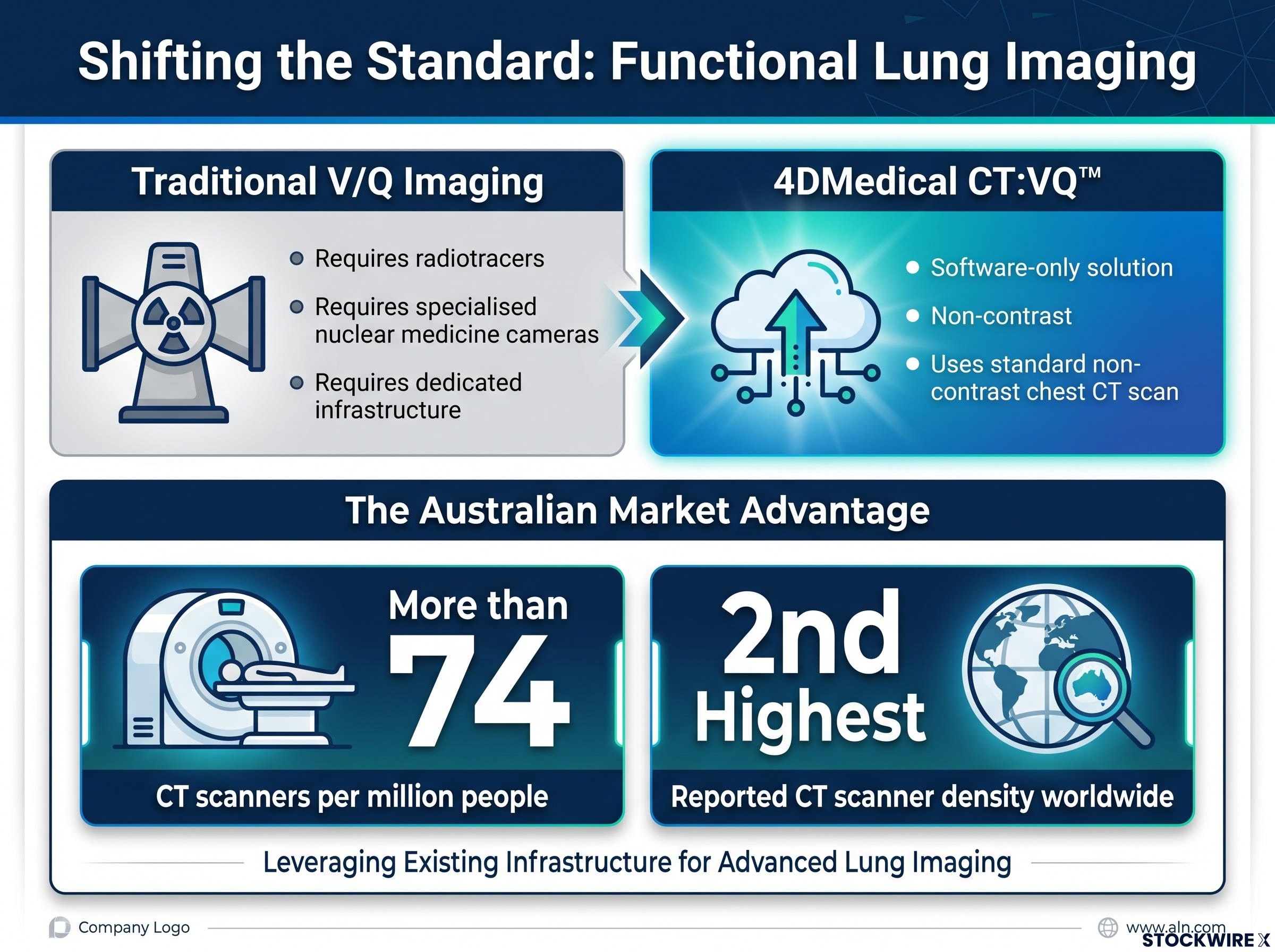
Ventilation-perfusion (V/Q) imaging assesses how air and blood flow through the lungs. Traditionally, this assessment requires radiotracers, specialised nuclear medicine cameras and dedicated infrastructure, limiting where the test can be performed.
CT:VQ™ delivers the same functional assessment directly from a standard non-contrast chest CT scan, removing dependence on nuclear medicine infrastructure. This is where Australia’s market profile becomes relevant.
The country has one of the highest CT scanner densities in the world. With more than 74 CT scanners per million people, Australia ranks among the highest CT-utilisation markets globally and holds the second-highest reported CT scanner density worldwide. This extensive footprint means deployment can proceed rapidly and at scale with minimal capital barriers.
According to 4DMedical, the technology is positioned to expand access across several segments:
-
Regional and rural communities, where nuclear medicine services may be limited or unavailable
-
Smaller hospitals and imaging centres that possess CT scanners but lack nuclear medicine equipment or specialist staffing
-
Health systems seeking to reduce patient exposure to inhaled and injected radioisotopes, while minimising associated logistical burden
-
Health systems seeking a scalable, software-based alternative to traditional ventilation-perfusion imaging, enabling more efficient use of nuclear imaging capacity for advanced procedures such as oncologic theranostics
Pathway to Medicare reimbursement
With TGA approval secured, 4DMedical will commence preparation of an application to the Medical Services Advisory Committee (MSAC) to pursue Medicare Benefits Schedule (MBS) reimbursement for CT:VQ™.
The submission is expected to incorporate clinical evidence, health-economic modelling, and real-world utilisation data generated through Australian deployment. The company believes the combination of international regulatory validation, growing clinical adoption, Australia’s extensive CT infrastructure and the health-system efficiencies enabled by a non-contrast solution will support its case for reimbursement consideration.
Peer-reviewed clinical validation published in the world’s leading respiratory medicine journal shows CT:VQ-guided patient selection achieving a 76% surgical response rate versus 46% under current methods, the kind of outcomes data that underpins both physician adoption and the health-economic modelling needed for a Medicare reimbursement submission.
Reimbursement remains a future objective rather than a completed event.
Andreas Fouras, MD/CEO and Founder, 4DMedical
“TGA approval clears the way for CT:VQ™ to be deployed across Australia and marks a landmark moment for respiratory diagnostics in our home market.
… As the first non-contrast, CT-based ventilation-perfusion solution, CT:VQ™ expands access to functional lung imaging while leveraging existing healthcare infrastructure. Australia’s exceptional CT scanner density makes it one of the most scalable markets we have entered.
… With TGA approval secured and a reimbursement pathway ahead, 2026 continues to be a defining year for 4DMedical as we expand access to next-generation respiratory imaging for patients, clinicians and health systems around the world.”
What it means for investors
The approval brings together several elements of the investment case: home-market commercial readiness, expanding global regulatory validation, low-barrier deployment via existing CT infrastructure, and a defined reimbursement pathway.
4DMedical delivers its solutions through a Software-as-a-Service (SaaS) model that integrates into existing hospital infrastructure, supporting scalable revenue potential. The company’s AI capabilities, expanded through its 2023 acquisition of Imbio and 2026 acquisition of contextflow, add further depth to its imaging portfolio.
Pharmaceutical imaging contracts with GSK and AstraZeneca have added a separate recurring revenue stream alongside the SaaS deployment model, broadening the commercial base that underpins the company’s 2026 growth narrative.
Per CEO commentary, management continues to frame 2026 as a defining year for the company. With Australian deployment now able to progress and a reimbursement application in preparation, the period ahead will test how quickly clinical engagement translates into commercial uptake across the company’s home and international markets.
Ready to Learn More About CT:VQ™ and 4DMedical’s Australian Opportunity?
With TGA approval now secured and Australia ranked among the highest CT-scanner-density markets in the world, 4DMedical is positioned to deploy CT:VQ™ rapidly and at scale across its home market. A defined Medicare reimbursement pathway and growing global regulatory footprint add further weight to the commercial opportunity ahead.
Investors seeking a deeper understanding of the technology, the SaaS revenue model, and the company’s broader 2026 growth strategy can explore the full 4DMedical investor and product centre for the latest information.