
Bipartisan US bill targets 4D lung imaging pilot for Veterans
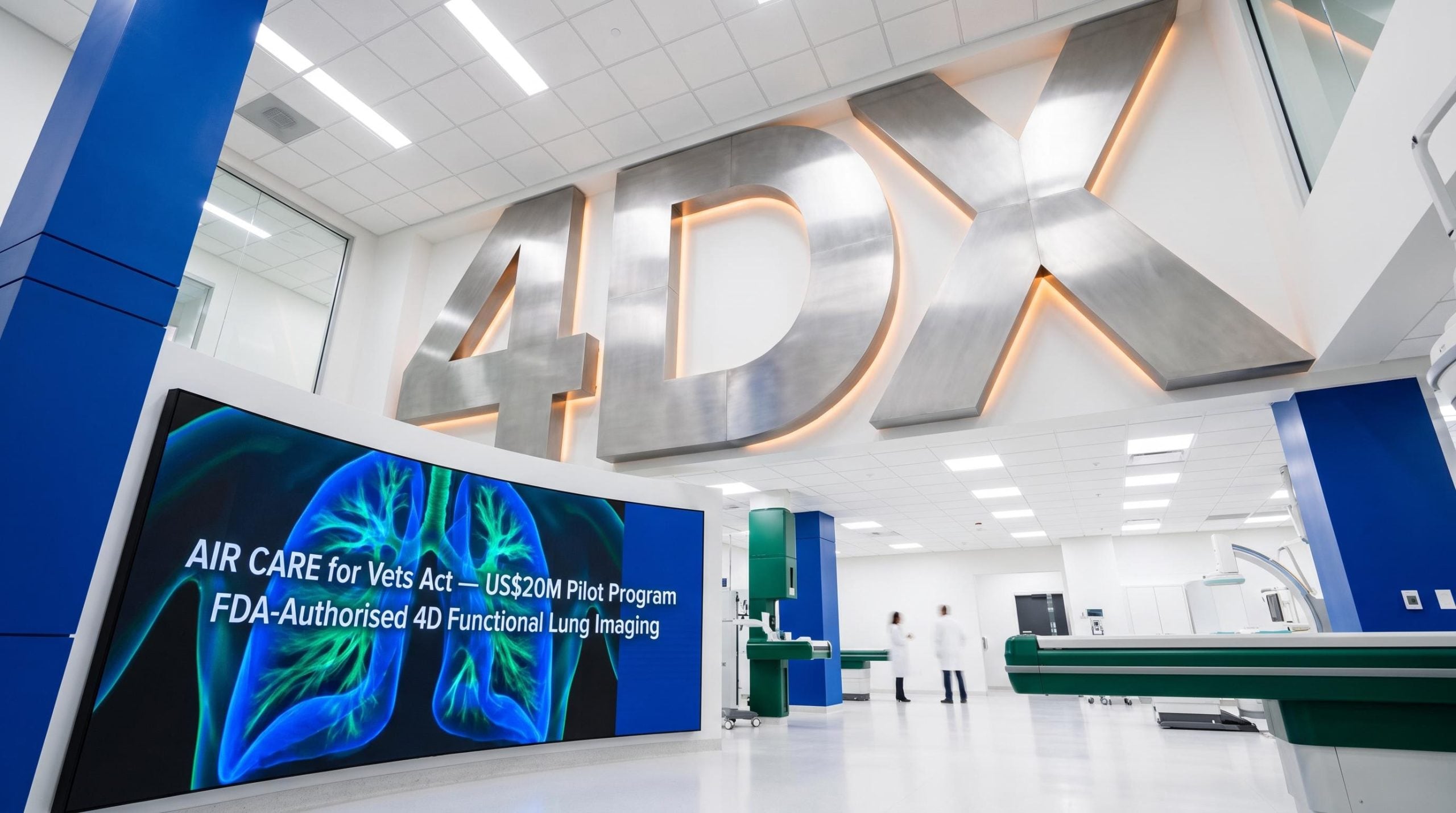
A bipartisan bill introduced in the US House of Representatives, the AIR CARE for Vets Act (H.R.9666), would direct the US Department of Veterans Affairs (VA) to establish a pilot program using 4D functional lung imaging software to identify respiratory disorders and lung disease in Veterans. According to 4DMedical Limited (ASX: 4DX), the bill authorises US$20 million for the pilot program.
The bill defines an eligible product as an FDA-authorised 4D functional lung imaging product that evaluates lung function, a category in which the Company’s XV Technology® is described as a global leader. Importantly, the bill does not name 4DMedical.
Upon introduction, the bill was referred to the House Committee on Veterans’ Affairs, which will determine whether it should progress through the House legislative process. It was jointly introduced by Representatives Juan Ciscomani (Republican, Arizona) and Chris Pappas (Democrat, New Hampshire), both members of that committee.
When big ASX news breaks, our subscribers know first
What the bill would provide for
If enacted, the bill would direct the Secretary of Veterans Affairs to establish a pilot program and to “seek an agreement to license an eligible 4D functional lung imaging software product” for use at VA facilities.
The bill defines an eligible product as “a 4D functional lung imaging software product with FDA authorisation to evaluate lung function.” 4DMedical’s XV LVAS®, an FDA-cleared 4D functional lung imaging product, “sits squarely within that definition,” per the announcement, though the legislation itself does not reference the Company.
The bill authorises appropriations of US$20 million to support the pilot, contingent on the legislation progressing and being enacted.
Key facts of the proposed legislation are summarised below:
-
Bill name / number: AIR CARE for Vets Act, H.R.9666
-
Funding authorised: US$20 million
-
Current status: referred to House Committee on Veterans’ Affairs
-
Sponsors: Representative Juan Ciscomani (R-AZ) and Representative Chris Pappas (D-NH)
Why Veterans’ respiratory health is a growing focus
4D functional lung imaging turns standard scans into rich, functional insights. This distinction matters for a patient population where much respiratory disease goes undetected.
Veterans experience elevated rates of respiratory disease, much of it associated with exposures sustained during service, such as burn pits. A meaningful proportion goes undetected by standard tests such as spirometry and conventional CT.
In peer-reviewed multicentre research, 4DMedical’s XV Technology® distinguished Veterans with biopsy-confirmed deployment-related constrictive bronchiolitis from healthy controls, even where standard spirometry was normal. According to the Company, imaging that can identify these conditions earlier and more precisely has the potential to materially improve how respiratory illness in Veterans is detected and managed.
For investors, this points to a differentiated clinical value proposition in a large, policy-backed patient population, should adoption follow.
Captain Le Roy Torres (US Army, Ret., Co-Founder of Burn Pits 360)
“I wore two uniforms, one for my state and one for my country, and when I came home sick, I was met with doubt and denial. I endured an invasive open lung biopsy searching for answers that revolutionary, 4D functional lung imaging can now provide, identifying respiratory disorders and lung disease with a precision we never had before. These are not minor ailments. They are devastating, progressive, and deadly. This legislation ensures that no Veteran will ever have to fight as long or as hard as we did just to be seen and believed.”
A sustained line of congressional interest
Congressional interest in functional lung imaging for Veterans is well established. In 2022, the Congressional appropriations committee report for Military Construction and Veterans Affairs referenced emerging technology using existing imaging equipment to derive 4D models of lung function, and urged the VA to evaluate it for population-wide surveillance of Veterans exposed to airborne hazards.
That same year, the PACT Act listed constrictive bronchiolitis as a presumptive condition and required the VA to provide toxic-exposure screening to the millions of Veterans in its care.
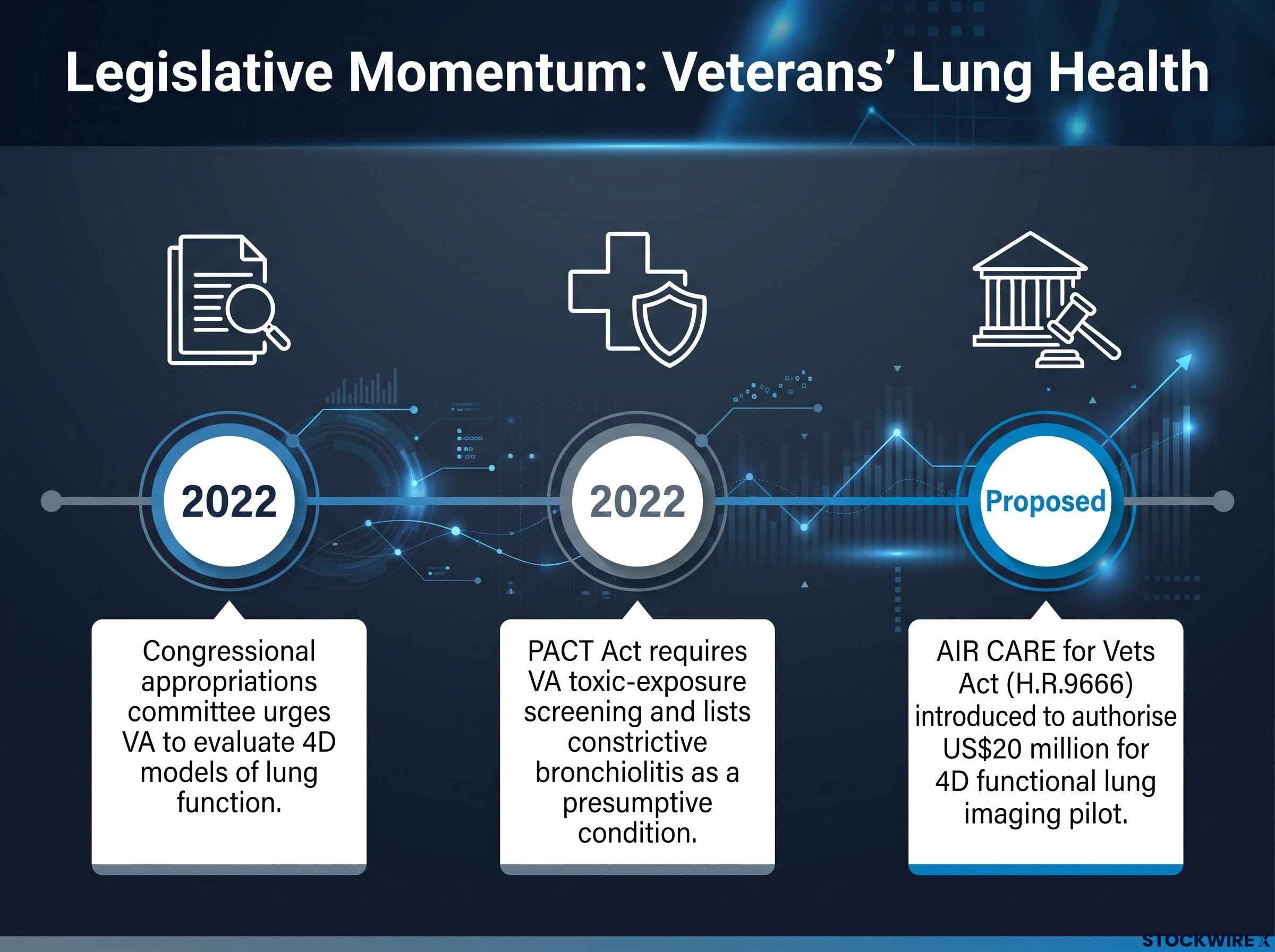
Viewed in this context, the Company frames the current bill as a continuing and broadening focus by US lawmakers on 4D functional lung imaging as a tool for Veterans’ respiratory health, dating back to 2022, rather than an isolated proposal.
What it means for 4DMedical
4DMedical already has an established commercial footprint in the United States, including a growing base of clinical sites, US reimbursement pathways for its functional and structural imaging products, and a portfolio of FDA-cleared software delivered through a Software-as-a-Service model.
The table below compares the eligibility parameters contemplated by the bill against the Company’s existing capabilities:
| Commercial Attribute | 4DMedical’s Existing Capability |
|---|---|
| Regulatory Status | XV LVAS® (FDA-cleared) |
| US clinical footprint | Growing base of clinical sites |
| Reimbursement | Established US reimbursement pathways for functional and structural products |
| Delivery model | Software-as-a-Service (SaaS), integrating into existing hospital infrastructure |
The Company states it is “well positioned to support a VA pilot program of the kind contemplated by the bill should it proceed.” This remains a potential opportunity rather than a guaranteed outcome, with the legislation still to progress through Congress.
Scaled US outpatient deployment has progressed in parallel with the VA legislative track, with 4DMedical securing a three-year commercial agreement covering more than 170 imaging centres across 10 US states on a per-scan SaaS basis, a deal structure that mirrors the licensing model the VA bill would contemplate.
Andreas Fouras, MD/CEO and Founder, 4DMedical
“This $20m pilot is a landmark step toward improving how respiratory disease is identified, assessed and managed across the U.S. Veterans healthcare system. I am proud to see bipartisan support in the US congress continue to focus on giving Veterans access to the kind of advanced 4D functional lung imaging that 4DMedical has pioneered.”
What happens next
The immediate next step rests with the House Committee on Veterans’ Affairs, which will consider whether the bill progresses through the House legislative process.
In his commentary, Fouras also flagged ongoing progress across the Company’s sales pipelines in ANZ, Europe and North America.
The proposed legislation reflects growing policy momentum around Veteran lung health, aligning with the 4D functional lung imaging technology that 4DMedical has pioneered. Whether this translates into a funded pilot program depends on the legislative process ahead.
For investors exploring how the VA pilot fits within 4DMedical’s wider US growth ambitions, our dedicated guide to 4DMedical’s broader US market strategy covers the CLEAR programme targeting the US$2.5 billion pulmonary embolism market and the company’s plan to expand its addressable scan volume sixfold, providing essential context for sizing the commercial opportunity beyond Veterans healthcare.
Ready to Learn More About 4DMedical’s XV Technology® and the VA Pilot Opportunity?
The bipartisan AIR CARE for Vets Act represents a potentially significant milestone for 4DMedical, with US$20 million authorised to establish a VA pilot programme using 4D functional lung imaging — a category in which the Company’s FDA-cleared XV LVAS® is squarely positioned to compete. With an established US clinical footprint, reimbursement pathways, and a SaaS delivery model already in place, 4DMedical states it is well positioned should the legislation progress.
To explore the Company’s full pipeline of products, clinical evidence, and US commercial strategy, visit the 4DMedical investor and corporate centre for the latest developments direct from the source.