Mexico’s economy just handed the peso a solid set of numbers. The Global Indicator of Economic Activity (IGAE), a monthly proxy for GDP, rose 0.6% in August. Yet the currency is still on course for a weekly loss of more than 1%.
Good domestic news is not protecting the peso. That raises a fair question about what is actually setting its price.
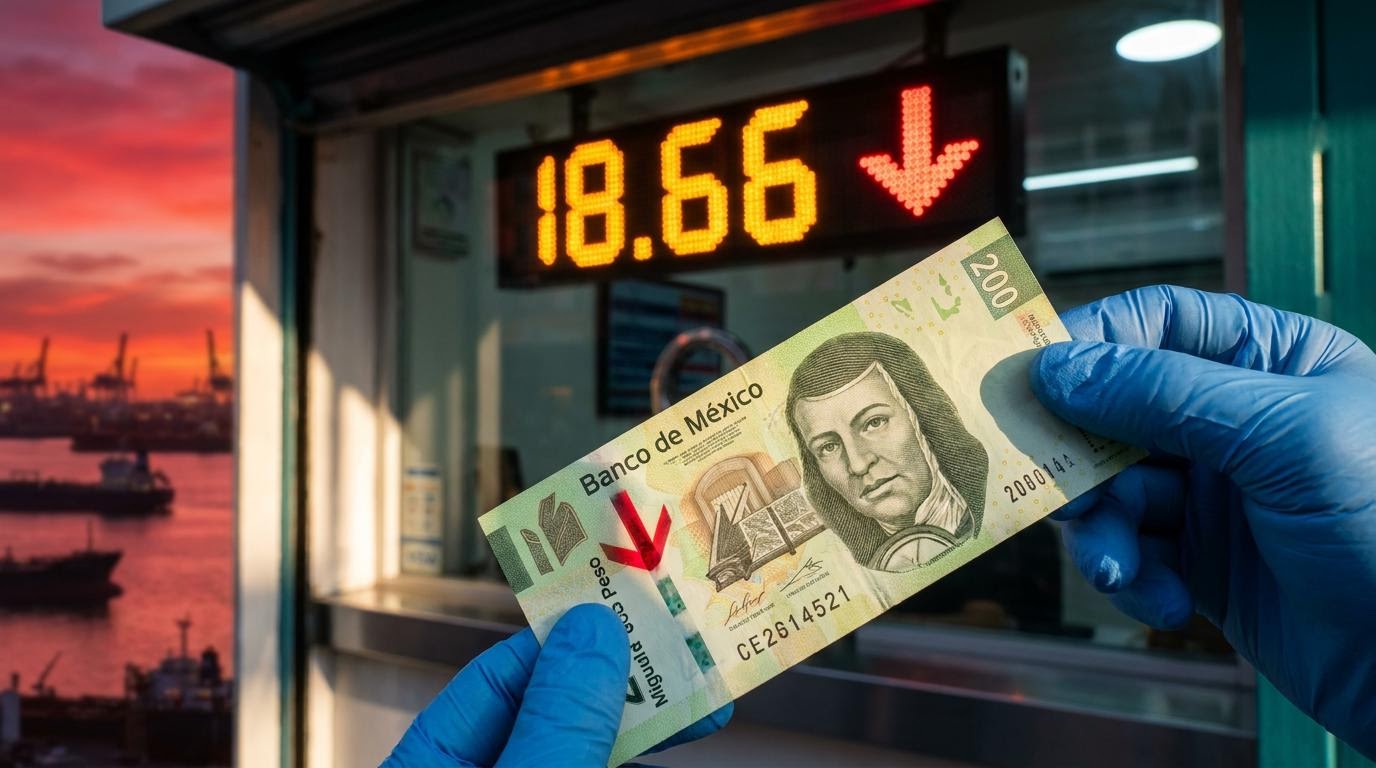
The answer sits outside Mexico. Three forces are landing at once: escalation between the US and Iran around the Strait of Hormuz, a hot US inflation print, and a market-implied 78% probability that the Federal Reserve hikes in December. The USD/MXN exchange rate traded near 18.66 on Friday, 23 October 2026, after touching 18.80 earlier in the session. The peso clawed back around 0.3% on the day, but that barely dented the week’s damage.
Any USD/MXN forecast built only on Mexican data will miss most of the move. Here is what the evidence says about which forces are in control, which price levels matter, and which three events next week could change your read on the pair.
Why is the peso falling when Mexican data is holding up?
Start with the contradiction. Mexican activity is expanding for a second straight month, and manufacturing has surprised to the upside. In a calm market, that combination would usually lift the peso.
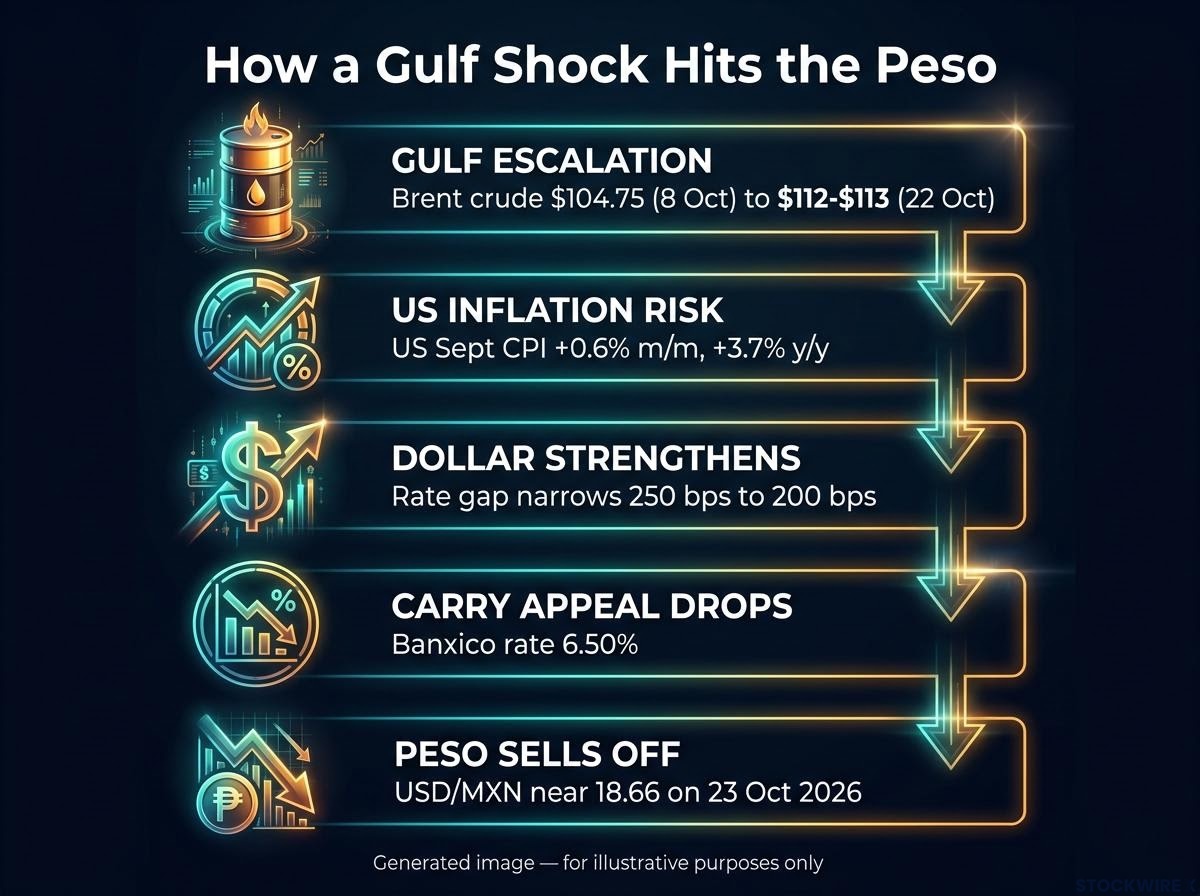
This is not a calm market. On 22-23 October, the Islamic Revolutionary Guard Corps (IRGC) said it attacked four vessels near Hormuz for using what it called an “illegal” route, while the Houthis and Saudi Arabia traded fire. Brent crude climbed to roughly $112-$113 a barrel on 22 October, up from $104.75 on 8 October.
Those headlines are the trigger, not the story. The story is how a Gulf shock travels to a currency thousands of kilometres away:
- Gulf escalation raises oil prices. Attacks on shipping threaten one of the world’s main energy corridors.
- Higher oil revives US inflation risk. An energy shock on top of hot September price data makes Fed tightening more plausible.
- Higher expected US rates strengthen the dollar. Mitrade expects the year-end gap between Fed and Banco de México (Banxico) rates to narrow from about 250 basis points to 200 basis points (one basis point is 0.01 percentage points).
- A narrower gap reduces the peso’s carry appeal. Investors earn less extra yield for holding pesos.
- Risk aversion hits high-beta currencies. In stress, investors sell currencies that swing hard with global sentiment, and the peso is one of them.
The pattern has already played out once this month.
The 8 October test Brent rose more than 4% and the peso fell 1.3% in a single day, according to Reuters.
Banxico has thinned the usual cushion too. A Reuters-distributed report said three of its five board members favour further cuts if the inflation outlook improves. For you, the point is that the peso is trading as a risk and rates instrument right now. Good Mexican data is a cushion, not a driver, and the first link to watch for a reversal is oil.
Banxico has also dropped its forward guidance, leaving the board free to move either way, so Mexican inflation and the rate path now matter more than any single growth print.
When big ASX news breaks, our subscribers know first
What the US and Mexican data are telling you
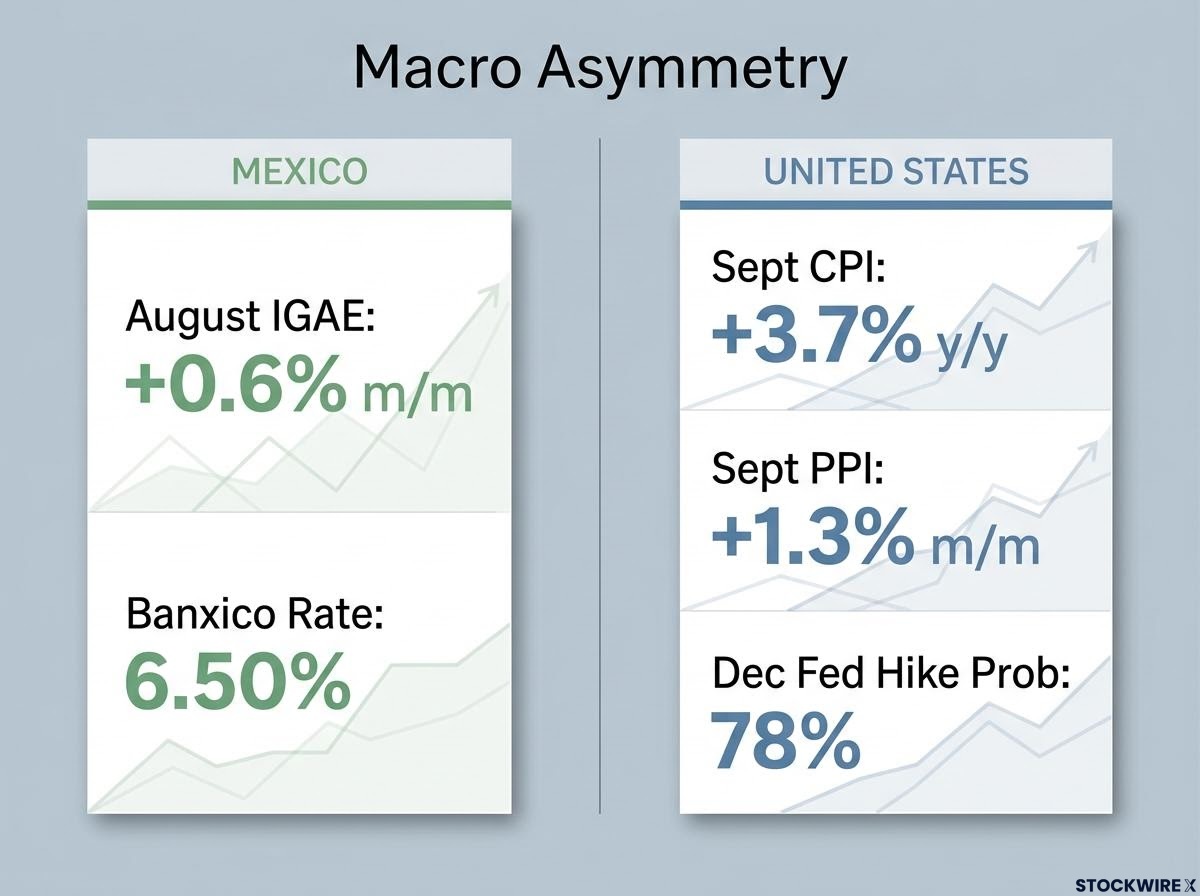
Put the two economies side by side and the asymmetry becomes clear. Mexico’s data helps the peso at the margin. US inflation data does the heavy lifting for the dollar.
Mexico
August IGAE rose 0.6% month-on-month, with secondary activity (industry) up 0.6% and tertiary activity (services) up 0.2%. Sources conflict on the annual figure, putting it at either 3.3% or 3.5%.
Third-quarter GDP expectations are even wider apart. One calendar consensus sits at 0.2% quarter-on-quarter and 1.7% year-on-year, while Banco Base’s Gabriela Siller expects 0.99% and 3.04%. INEGI’s timely indicator points to 3.4% year-on-year, and Citi Mexico’s Julio Ruiz said stronger manufacturing and investment could bring modest upward revisions to growth forecasts.
United States
The US numbers carry more force. September CPI rose 0.6% on the month and 3.7% on the year, while producer prices (PPI) jumped 1.3%, the largest monthly increase since March 2022. Sentiment and business surveys are mixed rather than decisive.
| Indicator | Latest reading | Region | Read-through for MXN |
|---|---|---|---|
| IGAE (August) | +0.6% m/m; +3.3% to +3.5% y/y | Mexico | Mildly supportive |
| Banxico policy rate | 6.50% | Mexico | Carry still positive, but easing bias |
| CPI (September) | +0.6% m/m; +3.7% y/y | US | Negative, supports Fed hike case |
| PPI (September) | +1.3% m/m | US | Negative |
| Core PCE (August) | 3.0% y/y | US | Negative if it accelerates |
| Michigan sentiment (October) | 48; 12-month inflation expectations 4.7% | US | Mixed |
| S&P Global PMIs | Manufacturing 56; services 57.9 | US | Neutral, in line with forecasts |
Fed pricing ties it together. Markets put roughly 91.5-93.5% odds on a hold next week, but 78% (within a 77-83% range) on a December hike. That gap between a likely Fed hike and a stable Banxico tells you a narrower rate advantage is already being priced, so Mexican beats need to be large to move the pair.
How the peso responds: the structural drivers behind the move
The falling peso on your screen sits on top of deeper machinery. The peso is the most traded Latin American currency, which makes it a liquid, convenient tool for global investors to express a view on risk. When fear rises, it is often the first emerging-market currency sold.
What is the carry trade?
A carry trade means borrowing in a low-interest currency and investing in a higher-yielding one to pocket the difference. Banxico’s rate of 6.50%, held on 24 September, gives the peso a sizeable yield advantage over the dollar.
That advantage attracts capital in quiet times. When the gap narrows, or when currency swings threaten to wipe out the extra yield, that capital can leave quickly, which is why higher Banxico rates generally support the peso and lower rates tend to weaken it.
The carry trade can reverse fast once the spread compresses, as the 2.50 percentage point gap, the tightest since 2015, is now showing.
Which drivers are cyclical and which are structural?
The peso responds to several distinct levers:
- Banxico policy (supportive or risk): Rates above inflation support the currency; cuts erode it. The bank targets 3% inflation within a 2%-4% band.
- Growth data (supportive): Strong activity, low unemployment and confidence favour the peso.
- Nearshoring (supportive): Manufacturing relocating closer to the US brings steady investment inflows.
- Oil exports (supportive): Higher crude adds export revenue, although the US inflation effect usually dominates.
- Remittances (risk): Money sent home by workers abroad is sensitive to US conditions.
- US trade policy (risk): Uncertainty can hit exports and sentiment.
- Global risk sentiment (risk): Turmoil sends capital to safe havens such as the dollar.
Rates, data and risk sentiment are cyclical and shift week to week. Nearshoring and trade integration are structural and move over years. This week’s selloff has been driven almost entirely by the cyclical levers, which tells you it reads more like a reaction to shocks than a confirmed trend change.
USD/MXN forecast: technical levels and competing views
That distinction between shock and trend is exactly where the chart and the analysts start to part ways.
Reading the chart
Monex puts short-term support near 18.62 and resistance near 18.77, after an overnight range of 18.62-18.80. FXStreet’s daily-chart analysis, which was written with an AI tool, holds a bullish near-term bias, with the pair well above its clustered moving averages.
The Relative Strength Index (RSI), a momentum gauge that runs from 0 to 100, sits at 70.48. Readings near 70 are considered overbought, which suggests consolidation or shallow pullbacks rather than a reversal. FXStreet’s deeper supports sit at 17.58, 16.89 and 14.84, far from spot.
An RSI near 70 means the pair is stretched. You should treat fresh dollar-buying chases with caution unless Hormuz headlines worsen further. Levels also show where orders may cluster, not how a geopolitical shock resolves; a confirmed Hormuz closure or a diplomatic breakthrough could invalidate them in a session.
Where analysts disagree
Monex’s 2026 year-end forecast sits at 18.75, with GDP growth of 1.29% and a policy rate of 6.50%. That implies a weaker peso than earlier in the year, not a disorderly slide.
| View | Main argument | Implication for USD/MXN |
|---|---|---|
| Bearish cyclical | Oil-driven inflation, a possible Fed hike and safe-haven demand | Higher while Hormuz stays threatened |
| Constructive domestic data | Firm IGAE, possible GDP upgrades | Peso recovers if geopolitical pressure fades |
| Carry support | 6.50% still offers a sizeable yield advantage | Peso declines may be limited |
| Structural positive | Nearshoring and US manufacturing integration | Selloff need not be permanent |
| Structural negative | Remittances, weak domestic demand, trade uncertainty | US shocks could outweigh local gains |
| Forecast-based | Monex year-end 18.75 | Weaker peso, not disorderly |
The real disagreement Is this a temporary risk-off shock, or evidence that the peso’s carry and external-flow advantages are eroding?
Next week’s calendar and what could break the pattern
That question gets tested quickly. Three scheduled releases next week will push the pair one way or the other.
| Event | Expected | Bullish MXN if | Bearish MXN if |
|---|---|---|---|
| Fed decision | Hold (91.5-93.5% odds) | Tone cools December hike talk | Signals a December hike |
| September Core PCE | +0.35% m/m; +3.1% y/y | Prints below expectations | Prints above 3.1% |
| Mexican Q3 GDP (Friday) | +0.2% to +0.99% q/q | Lands near the top of the range | Disappoints at the bottom |
The Fed itself is not the variable; a hold is almost fully priced. The signal on December is what matters. Core PCE, the Fed’s preferred inflation gauge, is expected at 0.35% month-on-month (likely rounding to 0.4%), up from 3.0% to 3.1% annually.
With the Fed’s forward guidance removed, inflation prints rather than official signals now drive rate expectations, which is why a single Core PCE reading can reprice the December hike odds.
A Core PCE print above 3.1% would harden the December hike case and tell you the dollar’s support is likely to persist. A soft print opens room for a peso rebound. Mexico’s GDP figure matters mostly if it confirms the stronger estimates.
The research found no earlier-cycle USD/MXN precedents for this mix of Gulf shock and Fed tightening, so any historical comparison should be treated with suspicion. Four risks could reverse the move:
- De-escalation: A ceasefire or restored Hormuz shipping could trigger a sharp peso rebound as safe-haven positions unwind.
- Banxico-Fed divergence: Banxico cuts alongside a Fed hike would shrink carry faster; sticky Mexican inflation would do the opposite.
- Crowded positioning: A one-way selloff can snap back on modest good news or lower oil.
- Inflation asymmetry: Higher oil helps Mexican revenues, but the US inflation effect usually weighs more.
Weighing the peso’s next move: what to hold onto
This week’s peso weakness came from external rates and risk forces, not from Mexico’s economy. The dollar’s strength is conditional on two things: Hormuz staying tense and the Fed leaning toward December.
The distinction that matters most is temporary shock versus structural carry erosion. Next week’s Core PCE and the Fed’s December signal will do more to settle it than Mexican GDP.
Rather than anchoring to one level, keep three variables in view:
- Hormuz and Gulf shipping headlines
- The Fed’s tone on a December hike
- The September Core PCE print
These statements are speculative and subject to change based on market developments, and currency levels can move sharply on geopolitical news. Past performance does not guarantee future results. This article is for informational purposes only and should not be considered financial advice. Investors should conduct their own research and consult with financial professionals before making investment decisions.