South Korea’s semiconductor exports jumped 259.4% year-on-year in the first 20 days of September 2026, and that single number is now reshaping how currency desks price the Korean won.
The scale is difficult to overstate. Chips alone brought in US$34.1 billion over just 20 days, accounting for 47.8% of everything the country shipped abroad. That surge is widening the national trade surplus and, combined with falling global crude oil prices, building a fundamental floor under the won.
For anyone tracking the USD/KRW forecast, the picture is a tug of war between overwhelming export strength and technical resistance capping the dollar’s decline. What follows here is a framework for reading both: the macroeconomic engine driving won demand, the exact price levels strategists are watching, and the risks that could stall the move before it runs.
How AI hardware demand is reshaping South Korea’s trade balance
The number that matters most right now is not the exchange rate. It is the export data underneath it.
Korea Customs Service flash figures for 1-20 September 2026 show semiconductor exports of US$34.1 billion, up 259.4% year-on-year. That is the highest reading ever recorded for the first 20 days of any month, surpassing even August’s strong print. Chips generated roughly four-fifths of the entire increase in total exports compared with a year earlier.
This is where the interpretation matters. A 259.4% jump is not a seasonal bump or a routine inventory restock. It reflects a structural pull from artificial intelligence hardware demand, and that distinction changes the won’s baseline valuation rather than nudging it for a quarter.
The memory chip supercycle driving these export figures is structurally unlike previous DRAM upcycles: AI data centre operators now account for an estimated 70% of total memory shipment volumes, and new manufacturing lines cannot reach mass production before 2027, meaning the demand pressure on Korean exporters is not a restocking event that will self-correct in a few quarters.
The AI-driven chip supercycle Seoul Economic Daily frames the current surge as an “AI-driven chip supercycle”, tying record semiconductor shipments to demand for AI servers, high-bandwidth memory, and advanced logic chips rather than the older PC and smartphone cycles.
That demand is flowing straight into the external balance. When a country runs a persistent trade surplus, foreign buyers must convert their currency to pay for goods, and that steady conversion supports the exporting nation’s currency over time.
The August surplus reached US$34.75 billion, according to the Ministry of Trade, Industry and Resources, corroborated by Citi research. Citi now projects the full-month September surplus could widen to US$42.7 billion, with full-month export growth forecast at +68.4% year-on-year.
| Time period | Semiconductor export growth (YoY) | Trade surplus (actual vs Citi forecast) |
|---|---|---|
| August 2026 | +209% (US$46.65B) | US$34.75B (actual) |
| September 2026 (1-20) | +259.4% (US$34.1B) | US$42.7B (Citi forecast) |
The read for a currency trader is straightforward. This export engine gives the fundamental case for a stronger won its hardest evidence, and it explains why appreciation pressure keeps resurfacing even when the charts pause.
When big ASX news breaks, our subscribers know first
Demystifying the link between chip exports and FX portfolio flows
Here is the trap that catches newer currency traders. They see record exports, assume the won can only strengthen, and ignore the mechanism that actually moves the exchange rate day to day.
A trade surplus provides a slow, steady floor. It works over months. But the sharp swings in USD/KRW over any given week are driven by something faster and more volatile: portfolio flows, meaning money moving in and out of Korean stocks and bonds.
Repatriation-driven appreciation is qualitatively different from speculative currency moves because it is anchored to corporate cash cycles tied to actual export invoices, making it harder to reverse on a single headline than positioning-led rallies.
Why equity flows move the exchange rate
The mechanism is worth understanding precisely. When a foreign investor wants to buy shares in a Korean semiconductor company, they cannot pay in dollars. They must first sell dollars and buy won, which pushes the won higher. When they sell those shares, they convert the proceeds back into dollars, which pushes the won lower.
This ties the KOSPI, Korea’s main equity index, directly to the currency. And because the KOSPI is heavily weighted toward the same chip makers driving the export boom, foreign appetite for Korean semiconductor equities becomes a live input into the exchange rate.
That connection cuts both ways. When chip stocks rally and foreign investors pile in, both the KOSPI and the won tend to strengthen together. When valuations look stretched or global risk sentiment sours, investors can reverse quickly, triggering equity outflows and a weaker won even while the export numbers stay excellent.
History backs this up. During the 2018 global risk-off phase and periods of pandemic-driven volatility, Korea maintained solid export performance while the won weakened, because foreign investors were cutting exposure to Asian and emerging market equities across the board.
So the practical lesson is this. When you track the won, you have to track foreign equity positioning in Korean chip stocks alongside the trade data. Those portfolio flows dictate immediate currency action more forcefully than the headline surplus does, and trading the won on export figures alone leaves you blind to the faster force in the market.
Mapping the bearish chart signals squeezing the dollar
With the macro engine established, the near-term battle is being fought on the chart, and the recent candlesticks lean against the dollar.
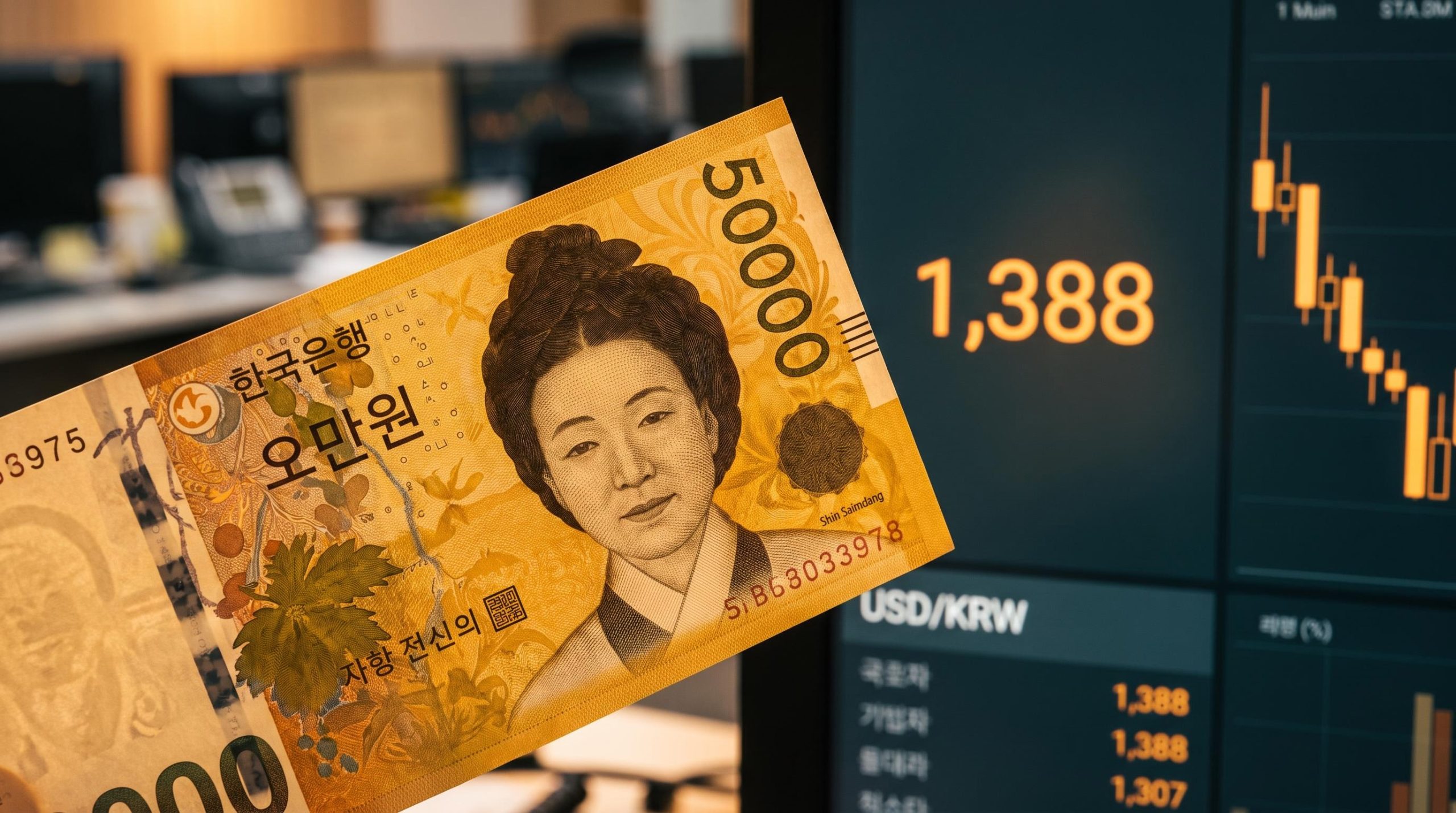
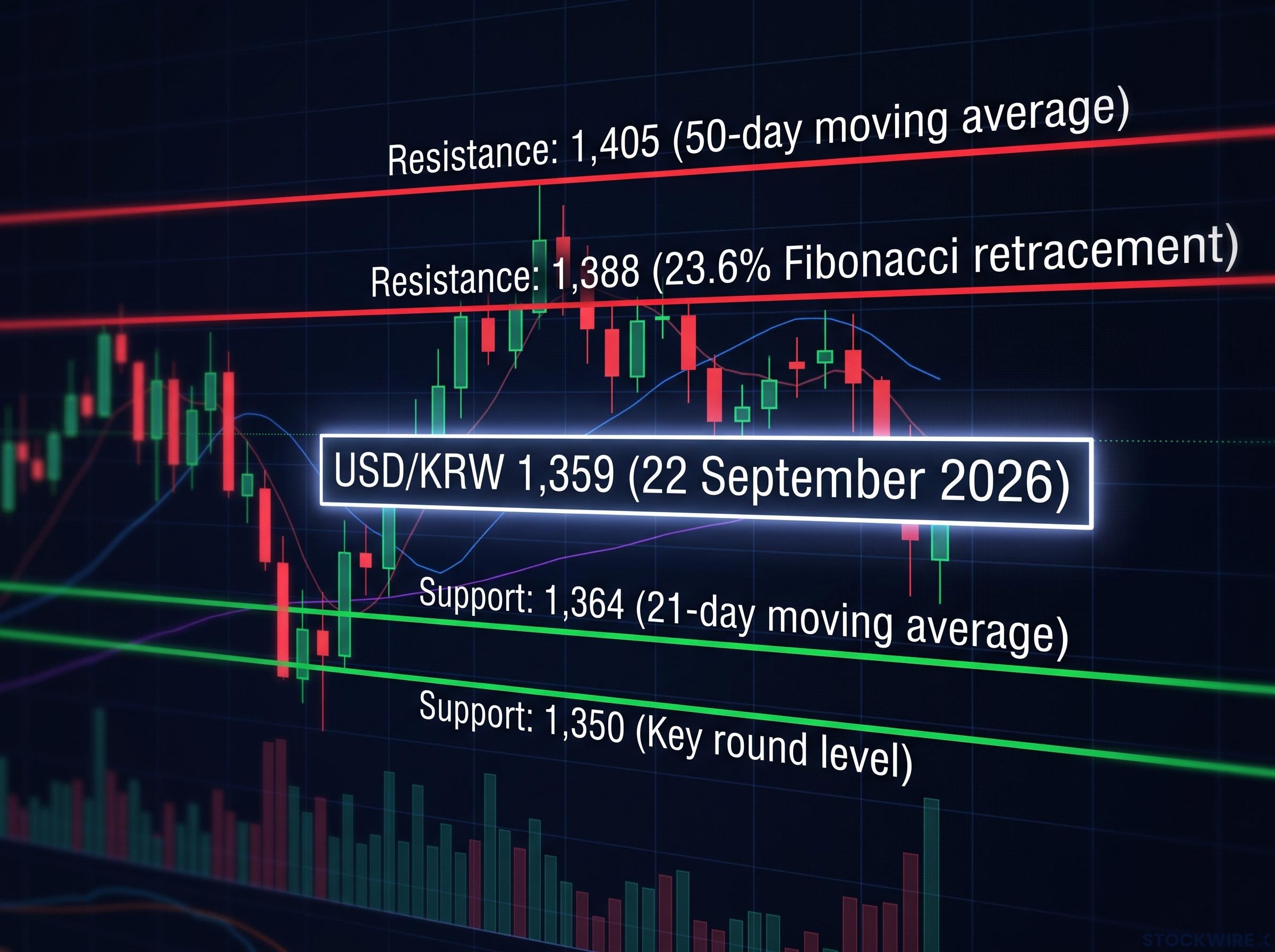
USD/KRW sits around 1,359 as of 22 September 2026. OCBC strategists Sim Moh Siong and Christopher Wong, reporting via FXStreet, flagged a bearish engulfing candlestick pattern near the 1,388 level. A bearish engulfing pattern forms when a down day completely swallows the prior up day’s range, and it often signals that selling pressure is taking over.
The strategists mapped out the levels that will define the near-term range. Resistance sits at 1,388, the 23.6% Fibonacci retracement measured from the July high to the September low, with a secondary ceiling at 1,405, aligned with the 50-day moving average. On the downside, support runs at 1,364, the 21-day moving average, and then 1,350.
| Price level | Type | Technical basis | Strategic importance |
|---|---|---|---|
| 1,405 | Resistance | 50-day moving average | Upper ceiling; a break signals dollar recovery |
| 1,388 | Resistance | 23.6% Fibonacci retracement | Key rejection zone; bearish pattern site |
| 1,364 | Support | 21-day moving average | First downside target on follow-through selling |
| 1,350 | Support | Key round level | Deeper won-strength target |
The 1,388 level is the one to watch. A clean rejection there tells you the bearish engulfing pattern is validating, and further downside toward the 1,364 support becomes highly probable.
One caution keeps the picture honest. Daily momentum indicators remain in broadly bullish territory overall, even though the RSI has eased back from overbought levels. That means the bearish setup is a near-term signal working against a still-supportive longer-term momentum backdrop, so the downside case needs confirmation before you lean on it hard.
Why inconsistent equity flows threaten sustained appreciation
The bullish won thesis is compelling on the fundamentals, but a straight-line appreciation is far from guaranteed. Several tripwires could halt the rally abruptly.
The most immediate risk is the very portfolio flow mechanism described earlier. OCBC noted that overseas investors flipped back to net sellers of Korean equities during a recent Asian trading session, even as the KOSPI advanced. That kind of erratic foreign buying denies the won a firm foundation for sustained gains.
Foreign equity outflows concentrated in Samsung Electronics and SK Hynix have repeatedly overwhelmed the structural trade surplus signal in prior sessions, with over 93% of a recent six-session selling wave hitting just those two names and demonstrating how narrowly the portfolio risk is distributed.
The distinct threats to the appreciation case break down as follows:
- Equity flows: Foreign investors have shown they can turn net sellers quickly, and inconsistent buying caps the won’s ability to build a durable uptrend.
- Policy caps: Commerzbank expects the pair to consolidate in a tighter 1,330-1,380 range, arguing that Korean authorities are likely to temper rapid appreciation. National Pension Service FX hedging and a central bank preference for gradual moves both point to intervention risk if the won climbs too fast.
- Yield environment: If US Treasury yields re-accelerate and the Federal Reserve holds a higher-for-longer stance, dollar demand can offset Korea’s trade story. OCBC identified a moderation in the pace of yield increases as a prerequisite for continued won support.
- Oil prices: Korea is a large net energy importer. Declining crude has been a tailwind, so any sharp reversal in oil would widen the import bill and compress the surplus that underpins the currency.
The takeaway is a matter of risk management. You should not treat won appreciation as a one-way trade, because unpredictable foreign equity selling and the threat of official intervention are actively positioned to cap your upside.
Positioning for the next phase of currency consolidation
The tension is clear. Historic semiconductor fundamentals are pulling the won stronger, while technical resistance and policy caution are holding the dollar’s decline in check.
For the pair to break below its current consolidation band, two things likely need to align: a consistent rebound in foreign equity buying to reinforce the trade surplus, and an easing in global dollar conditions to remove the competing pull of US yields. Absent both, the 1,330-1,380 range flagged by Commerzbank remains the most probable path.
The practical balance is to respect the fundamental floor while trading the range, watching foreign flows and the 1,388 resistance as your primary triggers.
For investors tracking the won through the lens of the underlying chip export cycle, our dedicated guide to semiconductor cycle investing lays out the five leading indicators that signal when the AI hardware demand wave is approaching its peak, including the supply expansion timeline that could shift Korea’s trade surplus in 2027-2028.
This article is for informational purposes only and should not be considered financial advice. Investors should conduct their own research and consult with financial professionals before making investment decisions. Past performance does not guarantee future results. Financial projections are subject to market conditions and various risk factors, and forward-looking statements are speculative and subject to change based on market developments.