The Morningstar US Technology Index climbed 32% between 30 March and 18 May 2026. Nine of the ten largest contributors to overall market returns over that stretch were AI-related stocks. The rally was fast enough to reshape the valuation map for US equities, and the strategist who told investors to buy the technology dip in March is now telling them to rebalance. David Sekera, Morningstar’s Chief US Market Strategist, has called time on his own growth and technology overweight, recommending a shift back toward a balanced barbell between growth and value. What follows is an examination of the data behind that call: what changed in valuations between late March and mid-May, what the new recommended portfolio structure looks like, and how to think about AI exposure going forward without abandoning the theme entirely.
How a 32% rally in eight weeks erased a market opportunity
On 30 March 2026, the Morningstar US Market Index was trading at a 12% discount to composite fair value. The technology sector sat at a 25% discount. Growth as a category was 20% below fair-value estimates. Those discounts were the foundation of Sekera’s March recommendation to overweight technology and AI equities.
By mid-May, the numbers told a different story. The US Market Index had risen 16% from the end of March. Technology surged 32%. Growth climbed 20%. The discount on technology compressed from approximately 25% to approximately 7%, according to Morningstar’s proprietary valuation data.
Nine of the ten largest contributors to overall US market returns between 30 March and 18 May 2026 were AI-related stocks, according to David Sekera of Morningstar.
The laggards made the divergence sharper. The Morningstar US Value Index gained just 4% over the same period. The Energy Index declined 3%.
| Index / Category | Return (30 March to 18 May 2026) | Discount to Fair Value (30 March) | Discount to Fair Value (15 May) |
|---|---|---|---|
| US Market | +16% | 12% | 5% |
| Growth | +20% | 20% | 5% |
| Technology | +32% | 25% | 7% |
| Communications | — | 17% | 12% |
| Value | +4% | 5% | 7% |
| Energy | -3% | 18% premium | 4% premium |
| Utilities | — | 7% premium | 1% premium |
The speed of that compression is the entire premise of the rotation call. Eight weeks erased most of the valuation gap that justified the original overweight.
Index concentration risk compounds the valuation compression story: Goldman Sachs’ May 2026 assessment found that the top five companies now control roughly 30% of total U.S. market capitalisation, meaning passive investors who believe they are broadly diversified have in practice been running a leveraged bet on the same narrow group of AI names that the March-to-May rally ran through.
When big ASX news breaks, our subscribers know first
What the valuation map looks like now across all major sectors
As of 15 May 2026, Morningstar’s composite fair-value estimates place the broader US equity market at a 5% discount, down from 12% at the end of March. The market-wide margin of safety has roughly halved.
The sector-level picture explains why a balanced approach now carries more weight than a growth tilt. Growth trades at a 5% discount to fair value. Value sits at a 7% discount. Technology is at 7%. Communications, which includes Alphabet (GOOGL) and Meta (META), holds a 12% discount, the widest remaining gap among major categories.
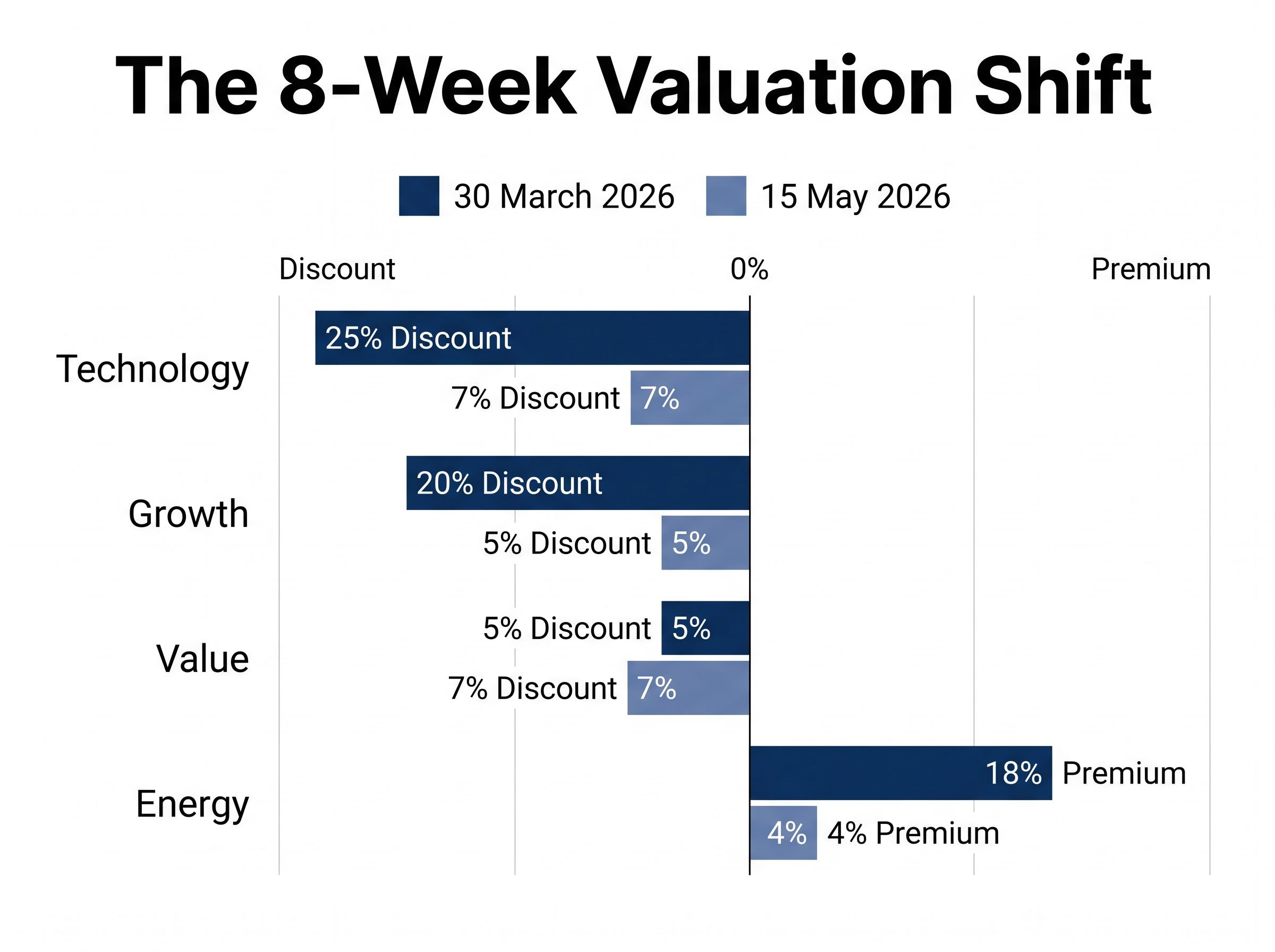
Energy, which Sekera advised trimming in March, now trades at a 4% premium to fair value, down from an 18% premium at end of March. Utilities carry a 1% premium.
| Sector / Category | Discount (Premium) to Fair Value, 15 May 2026 |
|---|---|
| Growth | 5% discount |
| Value | 7% discount |
| Technology | 7% discount |
| Communications | 12% discount |
| Energy | 4% premium |
| Utilities | 1% premium |
When growth loses its valuation edge over value
The case for overweighting growth relative to value in March rested on a wide discount differential: 20% for growth versus 5% for value. That 15-percentage-point gap gave growth a clear valuation advantage.
With growth now at a 5% discount and value at 7%, the differential has effectively closed and reversed by a narrow margin. The original rationale for a growth overweight no longer holds at the same scale. This is not a prediction that growth will underperform; it is a recognition that the valuation argument for concentration in growth has been consumed by the rally itself.
The barbell strategy that worked in March, and why it needs recalibration now
Sekera’s current call is the second chapter of a strategy that already delivered. In March, he recommended harvesting gains from energy and value stocks and rotating into technology and AI equities, a move premised on the wide discount in the technology sector.
The results validated the thesis:
- Phase 1 (March 2026): Rotate from energy into technology and AI. Growth returned +20%; the energy position that was trimmed declined 3%.
- Phase 2 (current): Rebalance back toward a growth-value barbell, capturing the gains from the growth overweight while repositioning for a narrower discount environment.
Morningstar describes this approach as valuation-driven rather than market-timing-oriented, according to Sekera. The barbell framework is designed to allow ongoing reallocation as relative valuations shift: during rallies, growth outperforms and profits are captured; during downturns, value absorbs rotation and enables the reverse trade.
The sequential logic matters. This is not a strategist reversing course under pressure. It is a pre-planned framework executing its second leg.
Alpine Macro’s concurrent case for barbell positioning against oil-driven inflation adds a complementary lens to Morningstar’s valuation rationale: where Sekera’s framework is driven by discount compression, Alpine Macro’s version is probability-weighted around a U.S.-Iran resolution that would pull WTI crude from $101 and reduce the energy-cost overhang currently embedded in growth-stock multiples.
CFA Institute research on the value premium finds the advantage of value over growth is most pronounced during tightening cycles and periods of elevated uncertainty, a pattern that gives the current barbell tilt toward value additional empirical grounding beyond pure valuation arithmetic.
Not all AI stocks are created equal: where Morningstar sees durable value versus narrative froth
The recalibration does not mean abandoning AI. Capital investment in AI infrastructure continues at a strong pace, and Morningstar recommends maintaining exposure to the theme. The distinction is between companies with durable competitive advantages and commodity hardware suppliers whose valuations are more closely tied to sentiment than to fundamentals.
The AI bubble frameworks most widely applied by institutional analysts, including Minsky’s financing stages, Kindleberger’s displacement-to-revulsion arc, and the Shiller CAPE at 40.11, each tell a partially different story: none has yet reached the threshold that would confirm a full speculative mania, but the Minsky analysis places hyperscalers firmly in the speculative financing stage as of early 2026.
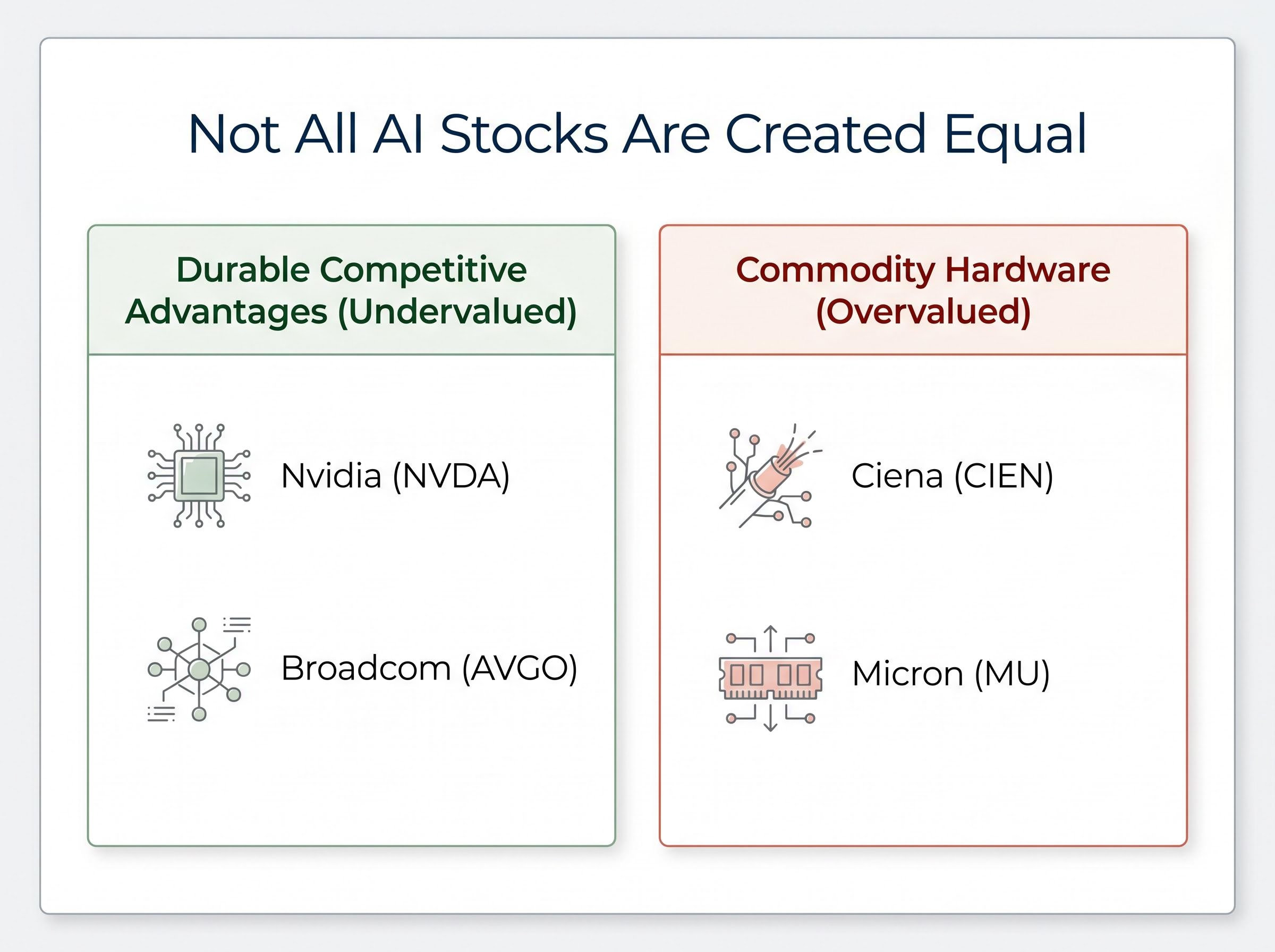
AI companies with durable competitive advantages
- Nvidia (NVDA): Cited by Sekera as undervalued relative to Morningstar’s fair-value estimate, with a long-term structural position within the AI infrastructure stack that extends beyond near-term revenue growth.
- Broadcom (AVGO): Similarly identified as undervalued, with competitive advantages in custom silicon and networking that position it as a durable beneficiary of the AI buildout.
Commodity hardware suppliers carrying sentiment-inflated valuations
- Ciena (CIEN): Described by Morningstar as overvalued, with a stock price driven more by AI narrative than by underlying fundamentals.
- Micron (MU): Characterised as similarly overvalued, with exposure to commoditisation pressure as the infrastructure build matures.
Historical technology cycles reinforce the framework. Companies with enduring competitive moats tend to retain value through cycle turns; commodity suppliers tend to face pricing pressure as the infrastructure phase gives way to optimisation and consolidation. For investors who built AI positions during the 2024-2025 run, the moat distinction provides a qualitative filter for auditing existing holdings rather than reducing exposure indiscriminately.
What could destabilise this outlook: the risk factors investors should track
The barbell recommendation sits within a risk environment that Morningstar’s 2026 Market Outlook characterised as likely to produce elevated volatility throughout the year. Several specific factors could shift the current valuation map materially.
Macro and rate risks
- Japanese government bond yields have reached their highest levels since 1997, according to Morningstar reporting, signalling that the global rate environment remains pressured.
- The Federal Reserve is not expected to reduce the federal-funds rate in the foreseeable future, given persistent inflationary conditions.
- Higher-for-longer rates compress multiples, and that compression weighs most heavily on high-multiple growth stocks, the same names that drove the March-to-May rally.
Trade, geopolitics, and political calendar
- No substantive trade deals were announced during President Trump’s recent visit to China, and trade and tariff issues are expected to resurface as a market focus during the summer of 2026.
- China’s economy is decelerating more sharply than previously anticipated, according to Sekera.
- Elevated oil prices tied to unresolved tensions with Iran add a persistent input-cost overhang.
- US midterm elections represent an additional source of political uncertainty later in the year.
Crowded positioning risk adds a structural amplifier to each of the macro factors listed above: Wolfe Research’s May 2026 analysis found U.S. equity positioning at its most extended levels since late 2021, with BofA, Goldman Sachs, and CFTC data all confirming concentrated long exposure in the same AI and technology names that drove the March-to-May rally, meaning any catalyst that forces de-risking could produce outsized unwinds rather than orderly rotation.
These risks are best understood as event-driven volatility catalysts rather than structural threats to the broader equity bull case. The barbell structure is designed precisely for this type of environment: holding both growth and value allows participation if AI momentum resumes while providing protection if macro headwinds force a defensive rotation.
Morningstar’s call reflects a broader Wall Street shift away from concentrated tech bets
Morningstar’s rotation call is more publicly detailed than equivalent communications from major houses, most of which sit behind client firewalls. The directional message, however, is consistent across several firms.
- Morningstar: Explicit recommendation to shift from a growth and technology overweight to a balanced growth-value barbell, with selective AI exposure focused on moat-protected names.
- Goldman Sachs: The US equity strategy team (note: David Kostin retired from the Chief US Equity Strategist role at year-end 2025 and transitioned to an Advisory Director position) recommends “quality growth at a reasonable price,” identifying industrials and health care as AI and capex beneficiaries and advising investors to broaden beyond narrow AI leaders.
- BlackRock: The BlackRock Investment Institute’s Q2 2026 Global Outlook, published 22 April 2026, emphasises the quality factor and selectivity within AI and technology rather than an across-the-board overweight, warning that parts of the AI trade have run “very far very fast.”
When three of the largest research and asset management platforms point in the same direction, the signal carries weight. The precise language differs, but the conclusion converges: concentrated mega-cap tech positioning has run its course as a valuation-driven trade, and broadening is warranted.
A strategist who bought the dip is now telling you to rebalance. That is the signal.
The credibility of Sekera’s current call rests on a specific track record. He recommended overweighting technology when the sector traded at a 25% discount to fair value. That call delivered a 32% return in eight weeks. The same framework that generated the buy signal is now generating the rebalance signal.
The recommended structure: A barbell portfolio split evenly between value and growth, allowing for ongoing reallocation as relative valuations shift, according to David Sekera of Morningstar.
The broader US equity market remains modestly discounted at 5% below Morningstar’s composite fair value as of 15 May 2026, down from 12% at the end of March. The market has not become expensive; the margin of safety has simply thinned.
The practical action that flows from this analysis is straightforward: review current portfolio weights in growth and technology against the valuation map presented above. Identify where concentration has built through the rally. Consider trimming into value where the discount differential now supports it. The article is not asking investors to call a top or abandon equities. It is asking them to check their weights against the evidence and make a disciplined adjustment.
This article is for informational purposes only and should not be considered financial advice. Investors should conduct their own research and consult with financial professionals before making investment decisions. Past performance does not guarantee future results. Financial projections are subject to market conditions and various risk factors.