For half a century, the fastest way to cross a continent by air has gotten slower, not faster. Concorde retired in 2003, and since then commercial aviation has competed on cost and comfort while speed sat frozen at roughly the same point it hit in the 1960s.
That freeze is now under active political assault. A rare bipartisan push in Washington is dismantling the 53-year-old prohibition on overland supersonic flight in the United States, forcing regulators to rewrite rules that have stood since 1973.
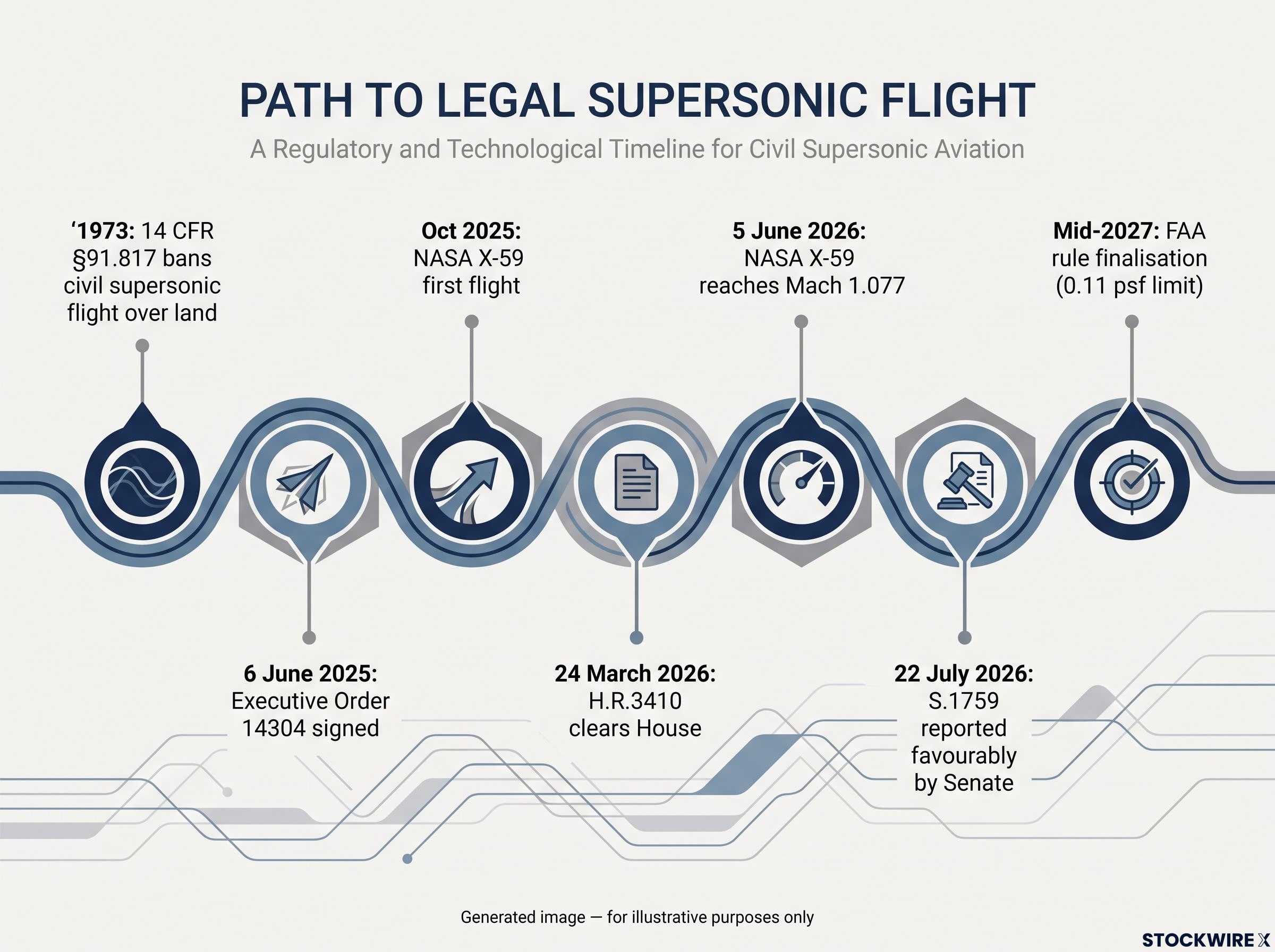
The catalysts are specific and recent. Executive Order 14304, signed on 6 June 2025, directed the Federal Aviation Administration (FAA) to scrap the ban and build noise-based standards in its place. Congress has been moving in parallel through the Supersonic Aviation Modernization Act.
For investors circling the private aerospace companies positioned to benefit, the political story and the commercial story are not the same thing. What follows separates the legislative wins from the hard timelines, the headline order books from the conditional fine print, and the marketing targets from the engineering reality that will actually dictate when, or whether, paying passengers board these aircraft.
Replacing a blanket speed limit with an acoustic standard
The legislative momentum is real, and it is fast by Washington standards. On the House side, H.R.3410 cleared the chamber on 24 March 2026. On the Senate side, the Commerce Committee ordered S.1759 reported favourably on 22 July 2026 by unanimous vote, and as of late September 2026 it awaits a full floor vote.
The executive branch moved first. Executive Order 14304 gave the FAA a 180-day deadline to repeal the overland ban and replace it with a performance standard based on noise rather than raw speed.
Here is the shift that matters. The 1973 rule (codified as 14 CFR §91.817) banned civil supersonic flight over land outright, using speed itself as the trigger. The FAA’s proposed replacement scraps that logic entirely and instead sets a hard ceiling on how much noise reaches the ground.
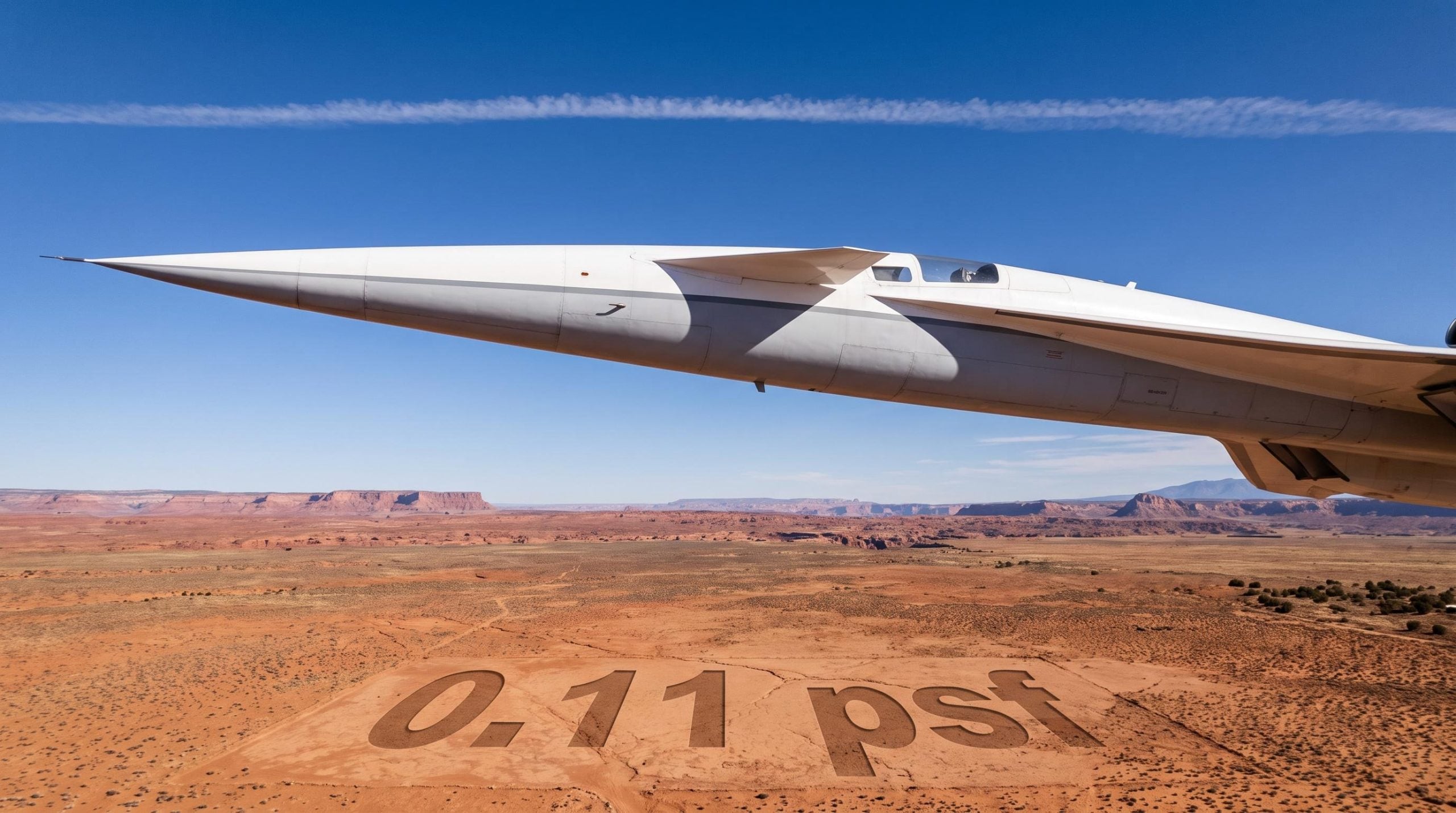
That ceiling is stringent. The FAA’s Notice of Proposed Rulemaking proposes a surface sonic-boom overpressure limit of 0.11 pounds per square foot (psf). An aircraft may fly supersonic over land only if it can prove it will not exceed that figure at ground level. The rulemaking is targeted for finalisation in mid-2027.
The FAA’s Notice of Proposed Rulemaking, published in the Federal Register on 2 July 2026, formally proposes repealing 14 CFR §91.817 and replacing it with the 0.11 psf overpressure ceiling, citing Executive Order 14304 as the statutory basis for the rulemaking.
The ban being lifted and an aircraft being allowed to fly are two very different milestones. Repealing the 1973 rule removes a legal impossibility. Meeting the 0.11 psf threshold is an engineering hurdle that no commercial transport has yet cleared in everyday operation.
That distinction is the entire investment case in miniature. The politics have moved, but the regulatory shift does not hand anyone the right to fly overland. It simply converts a flat legal “no” into an extraordinarily demanding technical “prove it.”
Providing the proof is where NASA comes in. The agency’s X-59 experimental aircraft, part of its Quesst mission, is designed to replace the traditional sonic boom with a quieter “thump” and to gather the public-reaction and acoustic data regulators need to justify the new standard. The X-59 completed its first flight in October 2025 and reached supersonic speed of Mach 1.077 on 5 June 2026.
For anyone weighing claims from supersonic startups, the 0.11 psf number is the boundary of the entire overland market. Without knowing that figure, you cannot assess whether a given aircraft is legally allowed near the US mainland at all.
When big ASX news breaks, our subscribers know first
Sizing up the 130-aircraft order book
The private company positioned most directly to benefit is Boom Supersonic, developer of the Overture airliner. And on the surface, its commercial traction looks formidable.
Overture is designed to carry 60-80 passengers at Mach 1.7 over water, where sonic booms fall harmlessly on open ocean, and at a “boomless cruise” of roughly Mach 1.3 over land to stay inside the proposed noise limit. Boom targets a break-even round-trip transatlantic fare of about $3,500, positioning the aircraft as premium travel rather than a Concorde-style luxury novelty.
The order book is the headline number. Boom reports 130 total orders and pre-orders, representing the first five years of planned production, from carriers including United Airlines, American Airlines and Japan Airlines.
Now read the fine print. Industry analysis indicates only around 35 of those commitments involve non-refundable deposits. The rest are conditional, contingent on Overture actually meeting its certification, noise and performance targets.
| Airline | Stated commitment | Known conditionality |
|---|---|---|
| United Airlines | 15 firm, plus 35 options | Conditional on certification, performance, and Sustainable Aviation Fuel operation |
| American Airlines | 20 aircraft | Largely conditional; subject to Overture meeting targets |
| Japan Airlines | 20 aircraft | Pre-order commitment, conditional on delivery milestones |
The distinction between a firm aerospace order and a conditional pre-order is where the real signal sits. A firm order carries financial penalty for cancellation. A conditional commitment lets an airline walk away at little or no cost if the aircraft misses its marks.
Airline conditional commitments have become a standard tool for managing capital exposure on long-duration aerospace programmes; the same carriers whose management teams publicly declined merger discussions in June 2026 have simultaneously structured their Overture pre-orders to carry minimal financial penalty for cancellation, reflecting a consistent preference for optionality over obligation.
That matters for how you read the coverage. When headlines tout a 130-aircraft backlog, the more accurate framing is that roughly two-thirds of those commitments carry minimal financial risk for the buyer. The airlines have signalled genuine interest, but they have structured their exposure so that Boom, not the carriers, absorbs the downside if certification slips or the noise target proves unreachable. For a pre-revenue company, that is a meaningful gap between apparent traction and contractual certainty.
Bridging a massive funding gap through AI infrastructure
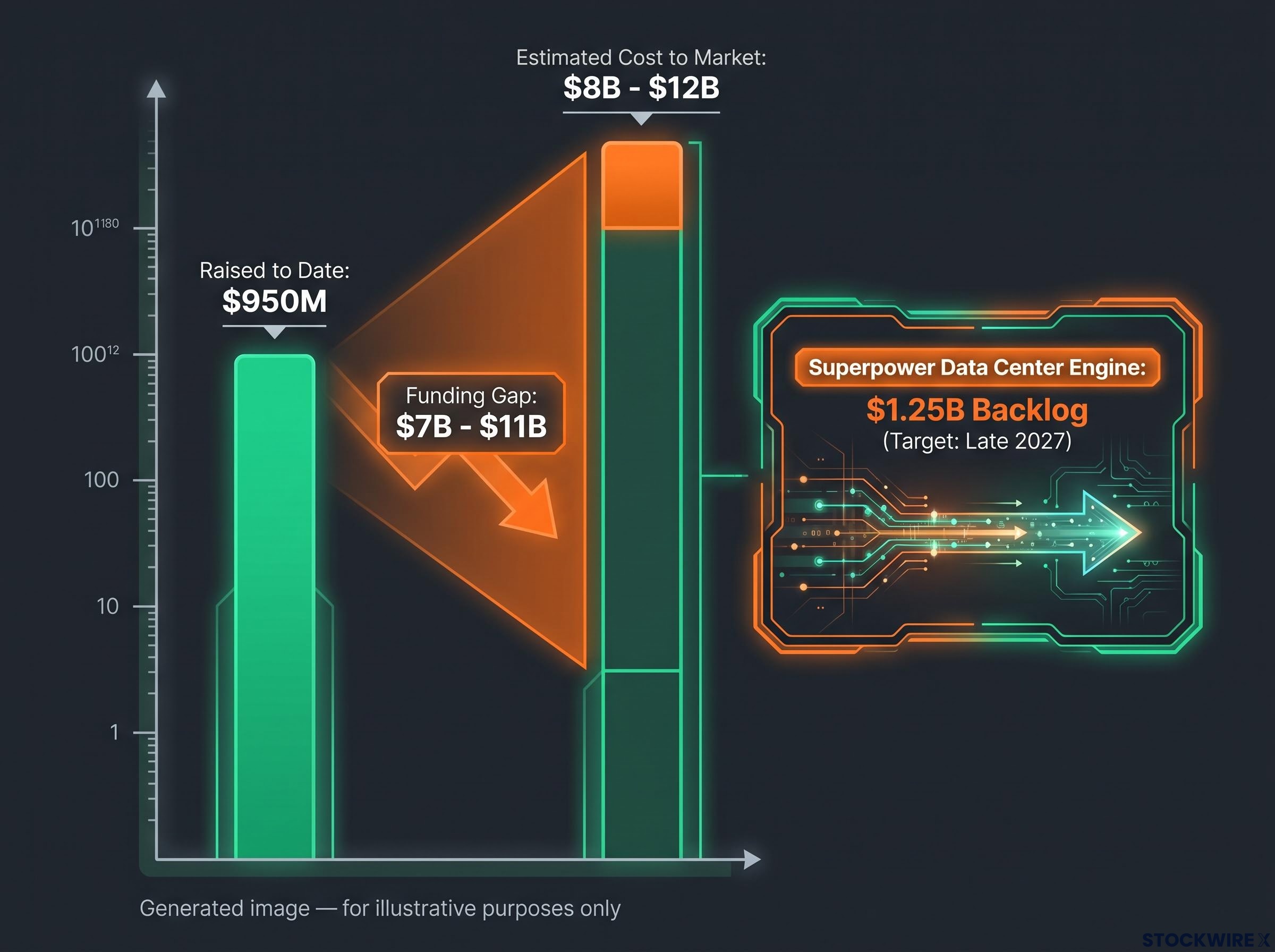
Here is the number that reframes everything. Bringing a clean-sheet commercial airliner (airframe, engine, certification and production ramp) to market is estimated to cost $8 billion to $12 billion.
Against that, Boom has raised roughly $950 million to date, frequently rounded to nearly $1 billion. That includes a $300 million round in December 2025, led by Darsana Capital Partners with participation from Altimeter Capital, ARK Invest, Bessemer Venture Partners, Robinhood Ventures and Y Combinator, which implied a post-money valuation between $1.5 billion and $1.6 billion.
Do the arithmetic and the picture is stark. Boom faces a funding gap of somewhere between $7 billion and $11 billion to reach commercial service. For a pre-revenue company, that is a chasm, and it is exactly the point at which most deep-tech aerospace ventures stall.
The data center revenue bridge
This is where Boom’s strategy takes an unexpected turn. Rather than relying solely on aircraft sales that remain years away, the company is repurposing its engine technology for an entirely different market: powering AI data centers.
The initiative, a gas-turbine version of Boom’s Symphony engine branded “Superpower,” adapts propulsion technology built for flight into stationary power generation for the compute-hungry AI sector. Boom reports a launch backlog exceeding $1.25 billion for this business, including agreements with firms such as Crusoe.
The urgency driving Boom’s pivot into stationary power generation is structural: AI data center power demand has grown faster than grid infrastructure can absorb, with the IEA projecting combined data centre and AI electricity consumption to exceed 1,000 TWh by 2026, creating a market where novel power sources, including gas-turbine adaptations from aerospace, can compete for long-term supply contracts.
The strategic logic is the interesting part. The Superpower line is targeted to begin generating revenue from late 2027, years before Overture could plausibly carry a paying passenger. That near-term cash flow is intended to help underwrite the aerospace research and development that would otherwise depend entirely on dilutive fundraising.
This is how sophisticated deep-tech startups cross what the industry calls the valley of death, the gap between a working prototype and a commercial product. A dual-use revenue stream that most surface-level aerospace coverage overlooks.
For an investor, the read is counterintuitive but important. Boom’s survival over the next several years may hinge less on its ability to fly people across the Atlantic and more on its ability to sell power plants to AI data centers. The data center order book is arguably a more immediate de-risking signal than the airline backlog, because it converts to revenue far sooner.
These statements are speculative and subject to change based on market developments and company performance.
The engineering hurdles dictating the true timeline
Strip away the politics and the financing, and one problem towers over the rest: the engine. Propulsion is the primary pacing item for the entire venture, and history is not kind to companies that underestimate it.
Boom must develop its bespoke Symphony engine into a certified, highly reliable commercial power plant in the 40,000-lb-thrust class. The company has achieved sustained combustion in a prototype burner, an early milestone, but a certified engine is a vastly harder and longer undertaking. Developing a clean-sheet engine has historically taken longer than building the airframe it powers.
The technical risks stack up across three distinct fronts:
- Symphony engine certification. Turning a prototype burner into a certified 40,000-lb-thrust-class commercial engine is a multi-year effort and the single largest schedule risk in the programme.
- Acoustic compliance at Mach 1.3. Overture must deliver genuine “boomless cruise” performance to stay under the 0.11 psf limit. No commercial transport has yet demonstrated this in routine service.
- Sustainable Aviation Fuel infrastructure. United Airlines’ commitment is strictly conditional on Overture operating with Sustainable Aviation Fuel (SAF), a low-carbon jet fuel whose supply remains limited and expensive at scale.
Each of these can slip independently, and each pushes the timeline further out.
That is why the calendar has quietly moved. Earlier company targets pointed to first commercial passengers by 2029, a date no longer prominently featured on Boom’s primary website. First flight of the full-scale Overture is now expected around 2027, with independent analysts widely expecting commercial entry to slip into the early 2030s.
The practical takeaway is to treat a multi-year delay as the base case, not the downside scenario. Any investment thesis in this sector that leans on pre-2030 commercial flight is pricing in an engineering timeline that the propulsion challenge alone makes difficult to defend.
Valuing the long runway to commercial viability
The core conclusion is straightforward. The US regulatory shift is a necessary condition for the return of overland commercial supersonic flight, but it is nowhere near a sufficient one.
Washington has modernised the rulebook, converting a flat ban into a demanding noise standard. But the laws of physics and the mathematics of capital markets have not softened. A $7 billion to $11 billion funding gap and an unproven clean-sheet engine remain firmly in the way.
The supersonic regulatory shift sits within a broader pattern of politically-driven acceleration across advanced aviation and space programmes, where aerospace and defence spending driven by geopolitical competition has created recurring government demand that can insulate hardware developers from purely commercial fundraising timelines.
For those tracking the sector, two milestones will serve as the next genuine de-risking events. The first is the FAA finalising its noise-based rules in mid-2027, which would convert regulatory intent into an operating framework. The second, and arguably more telling, is the arrival of data center engine revenue from late 2027, which would prove Boom can generate cash before Overture ever carries a passenger. Watch those two, not the airline order headlines.
This article is for informational purposes only and should not be considered financial advice. Investors should conduct their own research and consult with financial professionals before making investment decisions. Past performance does not guarantee future results, and financial projections are subject to market conditions and various risk factors.