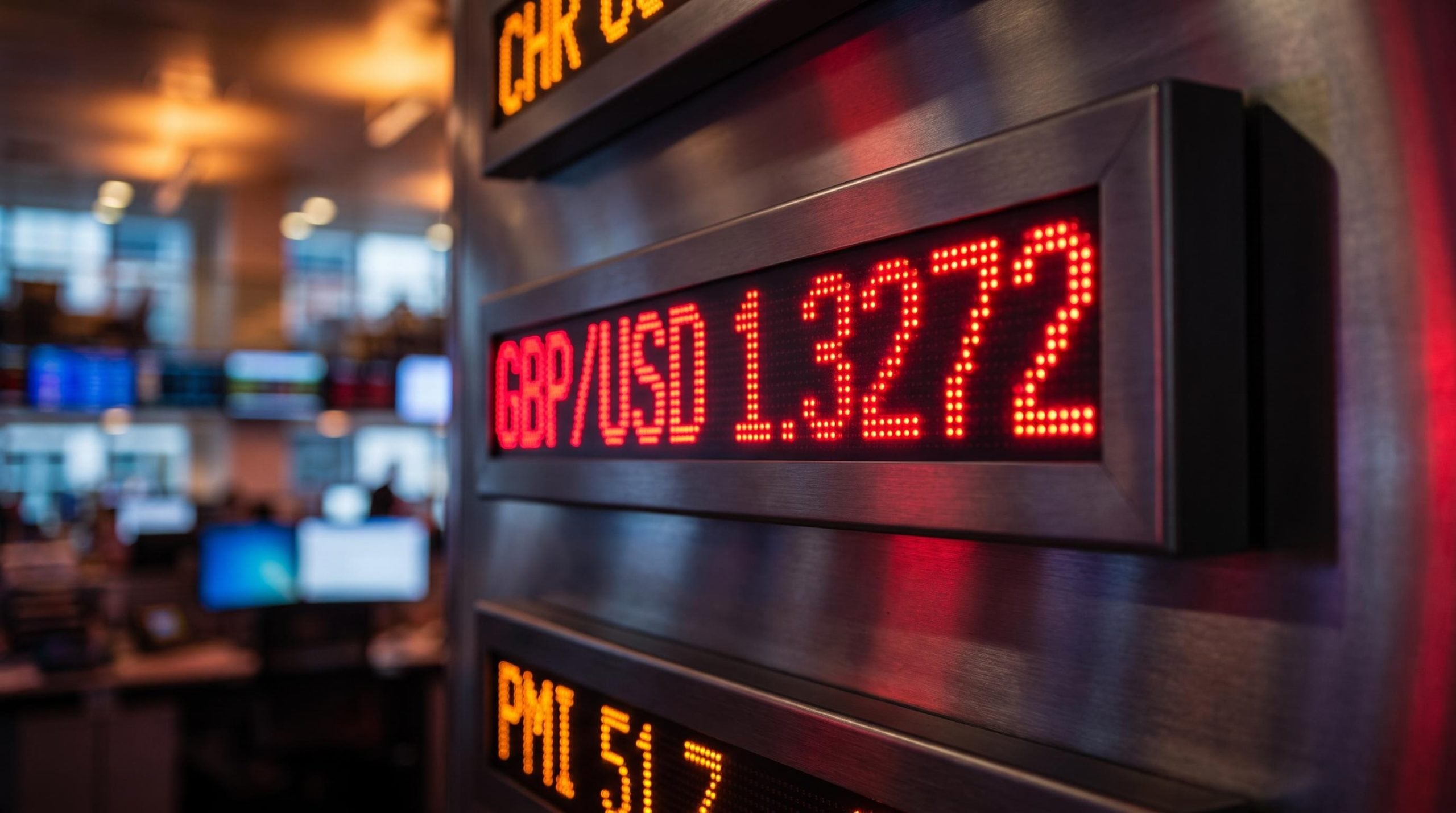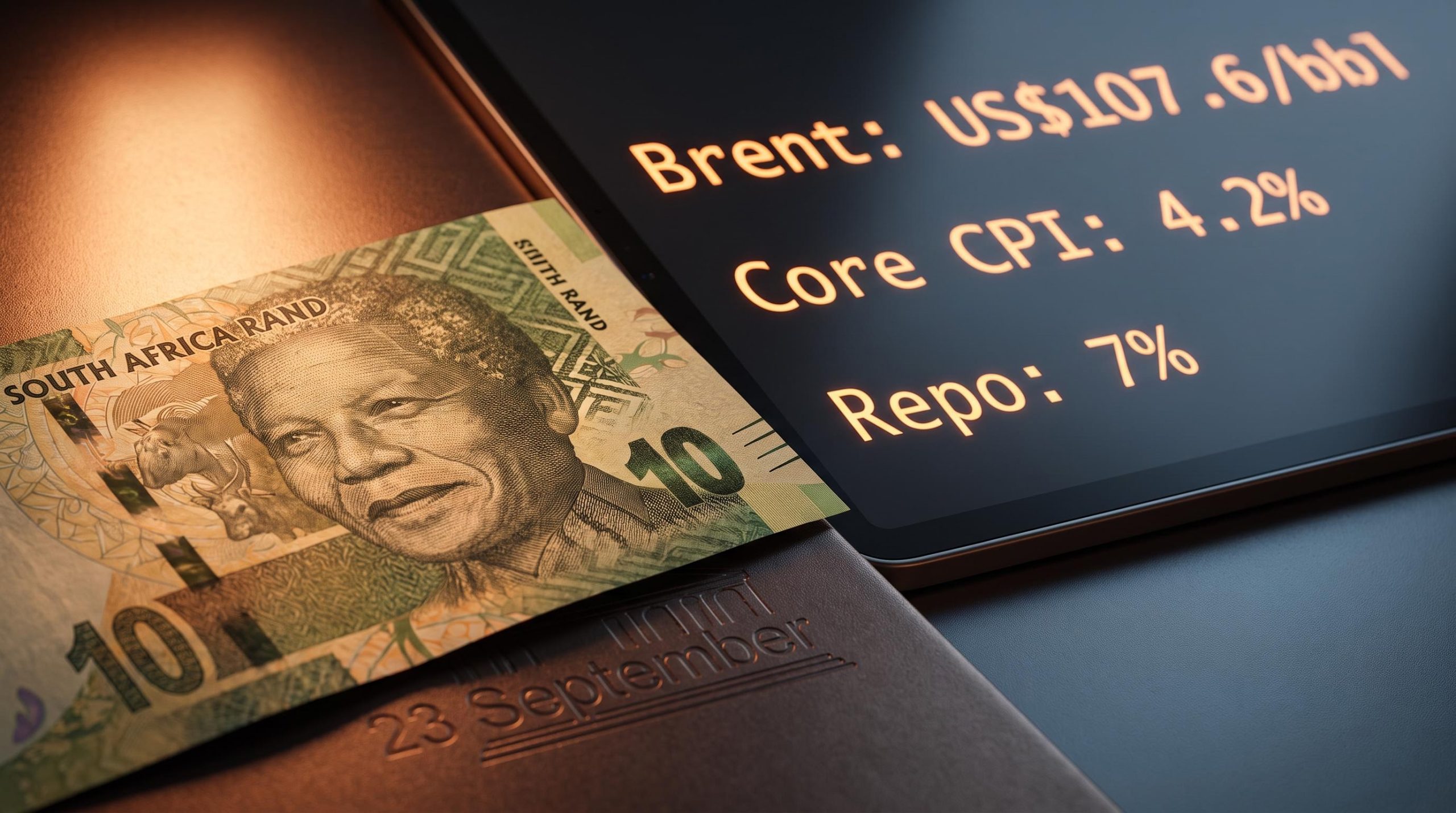
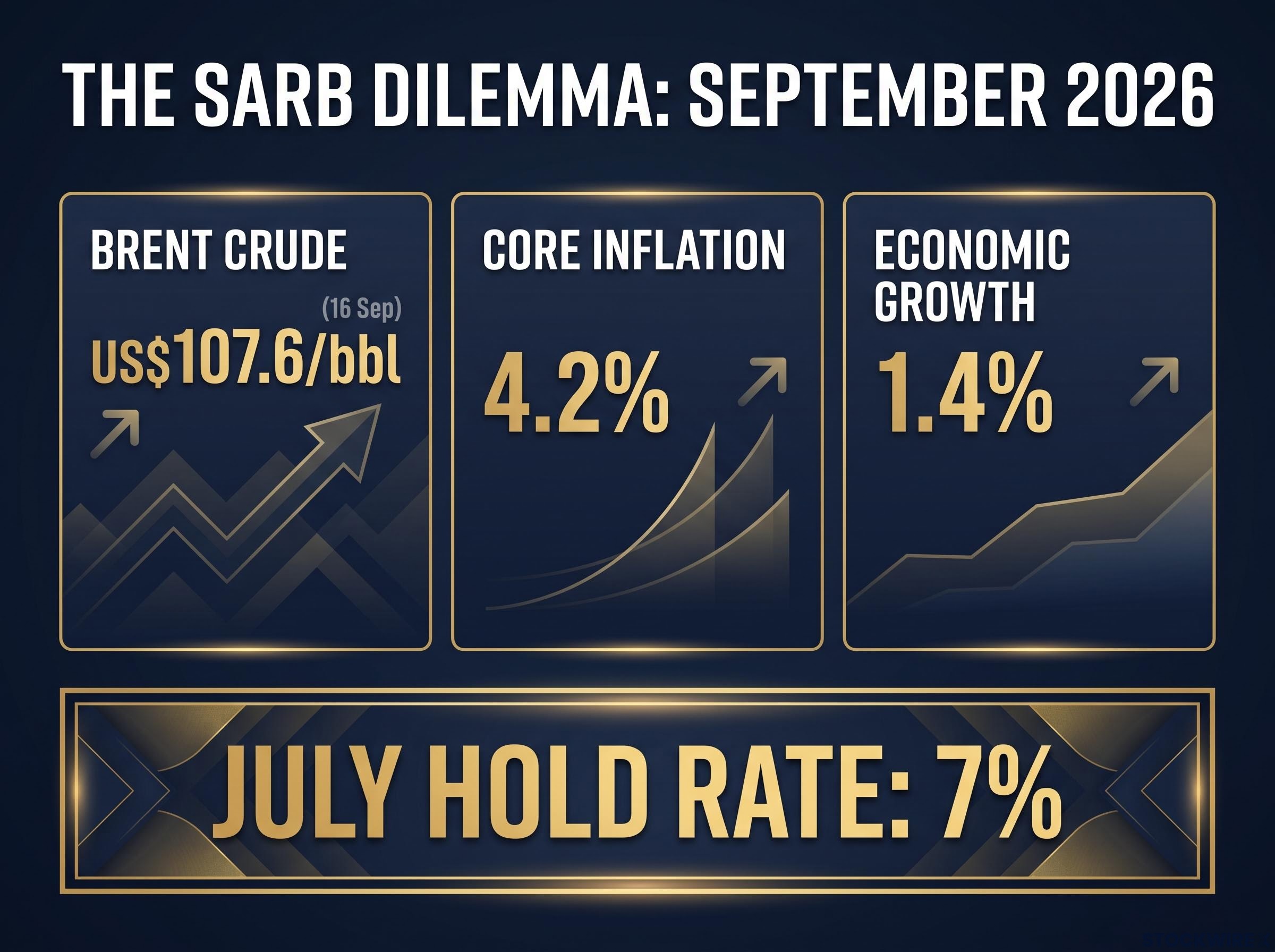
On the morning of 22 September 2026, the South African Reserve Bank sits in front of three numbers that pull in different directions. Brent crude is above US$100 per barrel. Core inflation is running at 4.2%. And the economy is growing at roughly 1.4%.
That is the shape of a stagflation dilemma: prices that will not settle, an economy too weak to shrug off a tightening cycle, and a central bank that cannot cut without risking one and cannot hike without threatening the other.
The July hold at 7% is what made the meeting on 23 September matter. Analysts had expected a hike in July, did not get one, and are now watching whether the SARB acts on the very conditions it flagged as too hot in its own statement. A 25 basis point move to 7.25% is already fully priced by markets.
What follows below maps the three forces shaping the SARB interest rate outlook, what each one argues for, and what the central bank’s tone on the day will signal about rand stability into the final quarter of the year. Treat this as a decision-point briefing, not a recap.
Holding at 7% was a signal, not a pause
The July hold was not the SARB doing nothing. It was the SARB choosing not to move, and the distinction matters more than the headline suggested.
Before the 23 July 2026 meeting, the market and most analysts expected a rate increase. When the MPC held at 7%, the surprise itself carried information. This was not a central bank drifting; it was one that had looked at the same inflation data everyone else had seen and judged that the case to act again had not yet closed.
The sequence up to that point tells the story:
- May 2026: the SARB raised the repo rate by 25 basis points to 7%.
- July 2026: the MPC held at 7%, against consensus expectations of a hike.
- September 2026: the next decision, with a further 25 basis point move fully priced by markets.
The bank had already tightened once in the recent cycle. Holding in July was about pace, not direction. The MPC statement put the balance plainly.
The SARB’s July MPC statement confirmed the hold at 7% while explicitly acknowledging that inflation remained above target and that oil-price risks from the Middle East conflict had not materially receded, framing the pause as conditional rather than directional.
“The inflation outlook has improved slightly since our last meeting, but inflation is still too high, while growth is weak.”
Read that as a conditional, not a pivot. The SARB was signalling that it would not fire on every piece of uncomfortable inflation data, but that the trigger conditions were still building.
What this tells you is that September, not July, was always the meeting where the case would either close or ease. That places outsized weight on what the MPC actually says on 23 September, because a hold in July was never a dovish turn. It was the bank buying one more data cycle before committing.
When big ASX news breaks, our subscribers know first
What fuel is doing that monetary policy cannot fully fix
The clearest signal in the current inflation picture is one the SARB has almost no power over. Fuel inflation has run above 18% year-on-year, according to Ecofin Agency, with Brent crude breaching US$100 per barrel repeatedly through September 2026.
That is the analytical trap. Fuel-driven inflation is external and supply-side, born from geopolitical conflict rather than an overheating domestic economy. Rate hikes cannot lower the price of imported crude. They can only influence inflation expectations and work through the exchange rate channel, which is a far blunter tool against a shock that originates offshore.
Oil-driven rate policy reversals are not a South African anomaly: with WTI above $103, markets were pricing a 90% probability of a Fed hike triggered by crude, not labour or services data, a structural inversion of the usual relationship that amplifies every energy shock into a monetary event for any central bank holding an inflation mandate.
According to a Commerzbank estimate cited by FXStreet, fuel is contributing roughly 0.8 percentage points to headline CPI. Brent sat at US$107.6 per barrel on 16 September 2026, and the SARB has itself flagged crude above US$100 as the level at which additional policy adjustment becomes necessary.
Here is where the numbers stand against the bank’s targets.
| Indicator | July 2026 | Prior period | SARB target | Direction of risk |
|---|---|---|---|---|
| Headline CPI (y/y) | 4.3% | 5.0% (June 2026) | 3% | Easing at surface |
| Core CPI (y/y) | 4.2% | 4.1% (prior month) | 3% | Rising |
| Fuel contribution to CPI | ~0.8 pp | n/a | n/a | Upward |
| Brent crude | US$107.6/bbl (16 Sep) | Repeated US$100 breaches | US$100 trigger | Elevated |
The SARB’s medium-term projection has headline inflation averaging 3.6-3.7% across 2026 and returning to the 3% target by end-2027. That glide path assumes the energy shock fades rather than embeds.
When the headline eases but the core rises
The single most important tension in the data is that these two numbers are moving in opposite directions. Headline CPI fell to 4.3% in July from 5.0% in June. Core CPI rose to 4.2% from 4.1%.
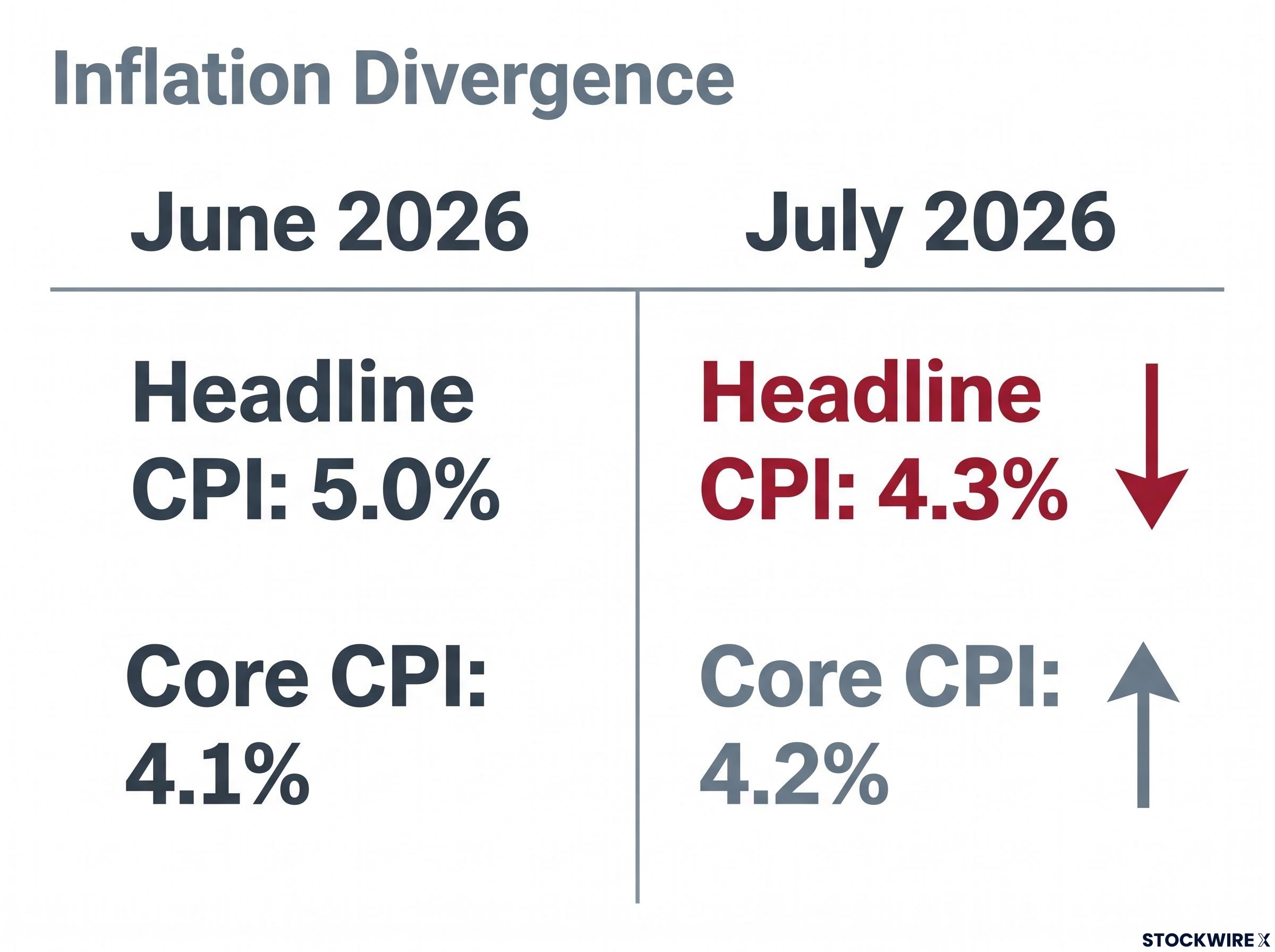
Disinflation is visible at the surface, but the underlying pressure is not retreating. Core inflation strips out volatile items like fuel and food, so a rising core suggests the fuel shock is beginning to leak into the broader price basket through second-round effects.
That divergence is exactly what justifies an “insurance” framing rather than a standard demand-tightening rationale. The SARB would not be raising rates to cool an overheating economy; it would be raising them to stop expectations from drifting. For a reader watching the data, a rising core alongside a fuel-driven headline is the specific condition that turns an insurance hike from a close call into a near-certainty.
Why what the SARB says matters as much as what it does
For an emerging-market central bank managing a volatile currency, the words in the statement can move the rand more than the rate itself. The September decision is a communication event first and a rate decision second.
Commerzbank’s Volkmar Baur made the point directly, recommending that any September rate increase be paired with hawkish forward guidance. His warning was that a more accommodative tone risked putting downward pressure on the rand regardless of whether a hike was delivered.
“Any rate increase should be accompanied by hawkish forward guidance, since a more accommodative tone risks direct downward pressure on the rand.”
The mechanism is about real yields. The rand is sensitive to real interest-rate differentials, the gap between South African returns and those elsewhere after inflation. Hawkish guidance anchors expectations for future real yields and dampens currency volatility. Dovish softening does the reverse, prompting investors to reprice inflation-adjusted returns.
Governor Lesetja Kganyago’s insistence on pulling inflation below a 4% ceiling before easing is the specific rhetorical anchor investors are watching. Any softening of that language would be read as reduced resolve.
Inflation expectations signalling is the mechanism the SARB is most directly trying to manage: once market-derived measures of future inflation drift above a credible anchor, the cost of pulling them back rises non-linearly, which is why a single softening in Kganyago’s forward guidance language can reprice bond yields before the next data release.
Morgan Stanley frames the likely September move as a 25 basis point “insurance hike” to 7.25%, motivated by oil-price risk to inflation expectations rather than demand overheating. Reuters has reported that the SARB’s inflation warnings alone have pushed markets to price for hikes, which demonstrates that verbal guidance moves bond yields and the rand ahead of any actual decision.
Three signals are worth tracking in the September statement:
- The forward guidance language on how much above-target inflation the bank will tolerate.
- Kganyago’s reference to the 4% ceiling, and whether it holds or softens.
- Whether the bank characterises the energy shock as transient or persistent.
Here is the read that matters. If the SARB delivers the expected 25 basis point hike but softens its forward guidance, treat that combination as net-dovish for the rand, because the guidance channel is the part markets have not yet priced. The headline rate is already in the price. The tone is not.
What Brazil and Turkey tell you about how this ends
To see the realistic range of outcomes for South Africa, it helps to look at two emerging-market central banks that already ran the experiment.
Brazil is the disciplined case. It sustained a tightening cycle from late 2024 through 2025 to defend its disinflation credibility, and it paid for that with slower growth. According to the French Treasury’s World Economic Outlook, Brazilian growth normalised to roughly 2.1% in 2025 from 3.4% in 2024, with household consumption and investment losing momentum under the weight of the tightening cycle.
Turkey is the high-inflation variant. The Central Bank of the Republic of Türkiye’s Inflation Report 2025 placed year-end inflation at 24% for 2025, with growth easing to 3.0% from 3.2% the prior year. That illustrates the cost of letting credibility slip: once expectations unanchor, the scale of restriction required to claw them back becomes far larger.
| Country | 2024 GDP growth | 2025 GDP growth | Inflation challenge | Policy response |
|---|---|---|---|---|
| Brazil | ~3.4% | ~2.1% | Above target, contained | Sustained tightening from late 2024 |
| Turkey | 3.2% | 3.0% | Year-end 24% | Highly restrictive stance |
| South Africa | n/a | ~1.4% (projected) | Fuel-driven, sticky core | Repo at 7%, insurance hike likely |
Both cases show the same thing from different angles: emerging-market central banks can sustain tightening long enough to matter for credibility, but the growth cost is always visible.
Emerging market central banks defending credibility against energy-driven inflation are not acting in isolation: Bank Indonesia’s shock 50-basis-point move in May 2026 triggered a regional tightening cycle across South Korea, India, and Taiwan, demonstrating that the same oil-shock transmission the SARB faces has forced larger and better-buffered economies into the same growth-versus-credibility trade-off.
South Africa’s thinner margin for error
The comparison exposes South Africa’s specific vulnerability. At a projected 1.4% GDP growth, the SARB is starting from a materially lower base than either Brazil’s 2.1% or Turkey’s 3.0% during their tightening eras.
The Stats SA GDP release for Q2 2026 reported that the South African economy contracted by 0.2% in the second quarter, ending a six-quarter growth streak and sharpening the stagflation framing the SARB must now navigate.
That means the growth-stability trade-off is steeper per basis point of restriction. Each additional hike buys less credibility relative to the demand it removes, because there is less demand to spare in the first place.
High unemployment and constrained fiscal space compound the problem. When the government has little room to support activity, monetary policy is left carrying more of the stabilisation burden, and it cannot do so without visible social and economic cost. The SARB has fewer cycles of restriction available than its larger peers before the domestic price of tightening becomes untenable.
Three variables that will define the SARB’s path through year-end
Rather than wait for the next meeting to surprise you, watch three conditions in sequence after 23 September.
- Brent crude relative to US$100 per barrel. This is the most actionable leading indicator, because the SARB has itself named the level as a trigger. Sustained trading above it keeps the pressure for further tightening live.
- Core CPI’s monthly direction. Core rose to 4.2% in July from 4.1% in June, so one month of upward movement is already on the board. A second consecutive rise would materially strengthen the case for another move; stabilisation or a decline would ease it. The August CPI release is the next data point that will inform the September statement tone.
- The tone of the 23 September MPC statement. Watch whether the bank calls the energy shock transient or persistent, whether it upgrades or downgrades confidence in returning to 3% by end-2027, and whether Kganyago holds the 4% ceiling language.
The clearest public signal the bank has already given is the one it set itself.
The SARB has flagged Brent crude above US$100 per barrel as a scenario that would necessitate further policy adjustment.
Monitor these three in order, and you will have a far better read on whether the SARB holds through year-end or moves again before December, rather than being caught out by the next decision.
What September 23 settles, and what it leaves open
The core tension is now clear. The SARB faces a supply-driven inflation shock that monetary policy can only partly address, in an economy with limited room to absorb the cost of tightening, where communication credibility works as a second instrument alongside the rate itself.
Whatever the bank decides, a hike confirms the insurance logic and supports the rand through signalling. It does not lower fuel costs, and it does not settle whether another move before year-end is warranted.
The active dynamic to watch is the interaction between the September statement tone and where Brent trades next, not the rate level in isolation. That combination will set the rand’s path into the fourth quarter.
For readers wanting to situate the rand’s vulnerability within the broader global FX stress of this period, our deep-dive into emerging market FX pressure in September 2026 maps how reserve buffers, capital outflow dynamics, and dollar-strength transmission are playing out across Asia, with direct comparisons to the mechanics driving rand volatility.
This article is for informational purposes only and should not be considered financial advice. Investors should conduct their own research and consult with financial professionals before making investment decisions. Past performance does not guarantee future results, and financial projections are subject to market conditions and various risk factors.
Treat 23 September as the opening move in a longer sequencing question, not the answer, and keep watching the SARB’s words and the data as closely as its rate.