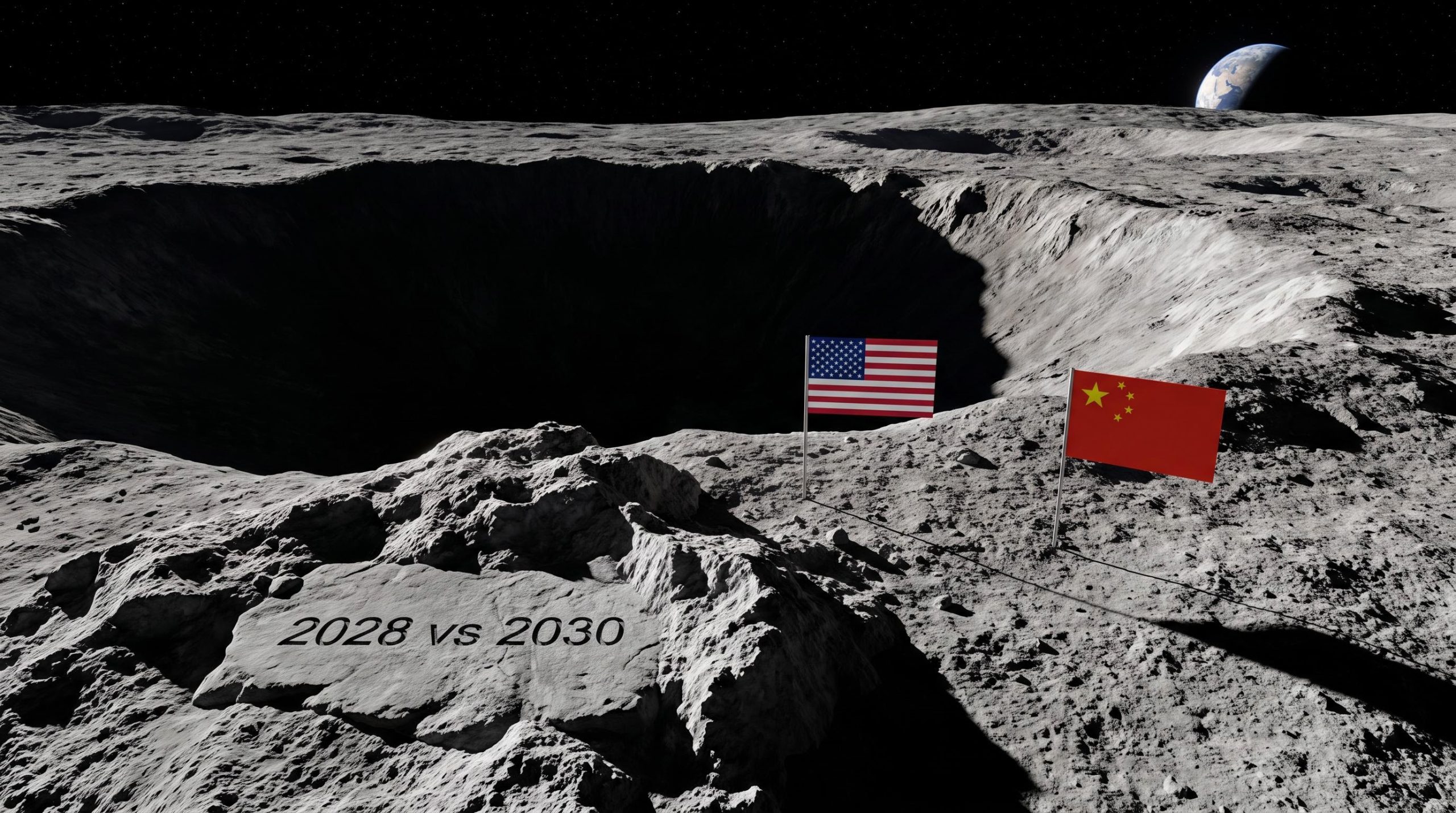
The lunar south pole’s total usable terrain is roughly the size of Washington D.C. Two spacefaring nations are now racing to claim the best of it before the other one arrives.
That is the geography that turns a prestige contest into a resource-control problem. The best ground is finite, and the first to plant permanent infrastructure on it gets to keep the advantage.
The timing is what makes this urgent right now. China’s target of landing astronauts on the moon by 2030 is no longer a slide in a strategy deck. It is a program supported by hardware that has already flown test articles in 2026, while NASA’s own first crewed surface landing has slipped to 2028 at the earliest.
The margin between those two dates is thinner than most investors appreciate. This analysis walks through what the contest actually turns on: why China’s timeline is credible, why the south pole specifically is the prize, what NASA’s internal restructuring reveals about the U.S. response, and how all of it converts into a structural driver for defence and aerospace spending that is already in motion.
China’s 2030 timeline is no longer a projection, it is a program
For years, China’s 2030 crewed lunar goal read like a political statement to be discounted from a distance. The hardware milestones logged in 2026 make that reading harder to sustain.
China’s crewed lunar effort rests on three named, flight-tested elements:
- Long March-10: the heavy-lift rocket that carries the crew capsule and, on a separate flight, the lander.
- Mengzhou: the crewed spacecraft that ferries astronauts to lunar orbit.
- Lanyue: the lunar lander that takes them from orbit down to the surface.
None of these is a paper design anymore. The clearest signal came on a single day.
On 11 February 2026, China conducted a low-altitude demonstration flight of the Long March-10 and a maximum dynamic pressure abort test for the Mengzhou capsule. Two integrated tests, same day, pointing to a coordinated campaign rather than isolated component work.
That coordination is the tell. An agency running scattered, one-off tests is still exploring feasibility. An agency running its rocket demonstration and its capsule abort test on the same date is running a schedule.
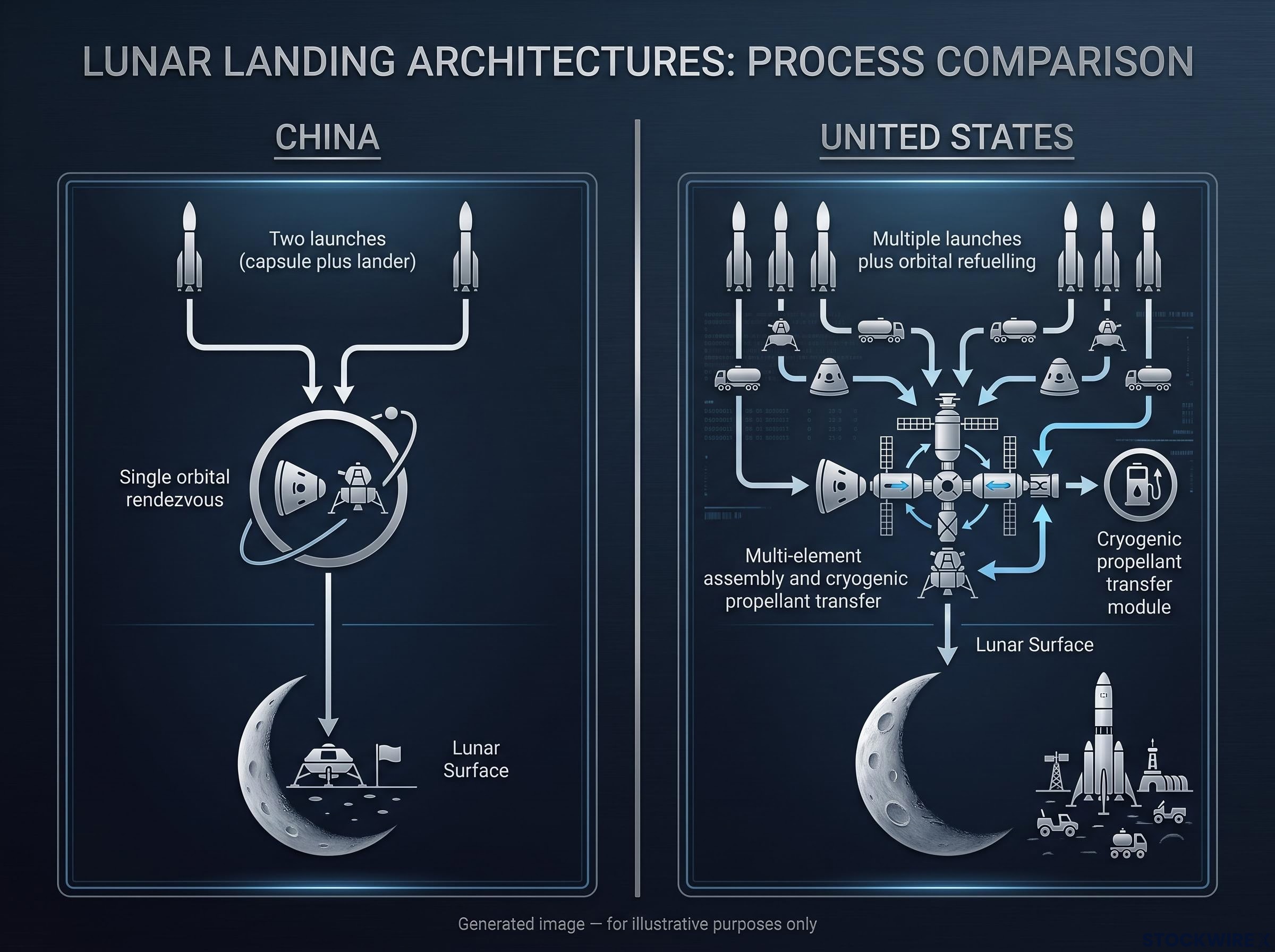
The architecture reinforces the point. China’s first landing needs only two launches: one for the capsule, one for the lander, joined by an orbital rendezvous. The U.S. approach is heavier and depends on multiple launches plus an unprecedented series of orbital refuelling flights. A simpler architecture is not an aesthetic preference; it is fewer things that have to go right on schedule, which is a structural advantage when the finish line is fixed.
| Factor | China | United States |
|---|---|---|
| Launch count for first landing | Two launches (capsule plus lander) | Multiple launches plus orbital refuelling |
| Rendezvous complexity | Single orbital rendezvous | Multi-element assembly and cryogenic propellant transfer |
| Funding model | Centralised, state-directed | Mixed commercial contractors plus Congressional appropriation |
The funding model belongs in that comparison as a competitive variable, not background colour. Centralised planning and state-directed money remove the political and budget-cycle friction that repeatedly stretches U.S. timelines. As a benchmark of the industrial base China has built since the SLS rocket was first designed, it now operates roughly 25,000 miles of high-speed rail, a proxy for the manufacturing depth that turns designs into flight hardware quickly.
The read you should take is straightforward. 2030 is a credible engineering deadline already in motion, and the gap to NASA’s 2028 first surface landing is thin enough that any U.S. slip closes it entirely.
When big ASX news breaks, our subscribers know first
Why the south pole, and why first mover wins permanently
Start with the constraint, because everything else follows from it.
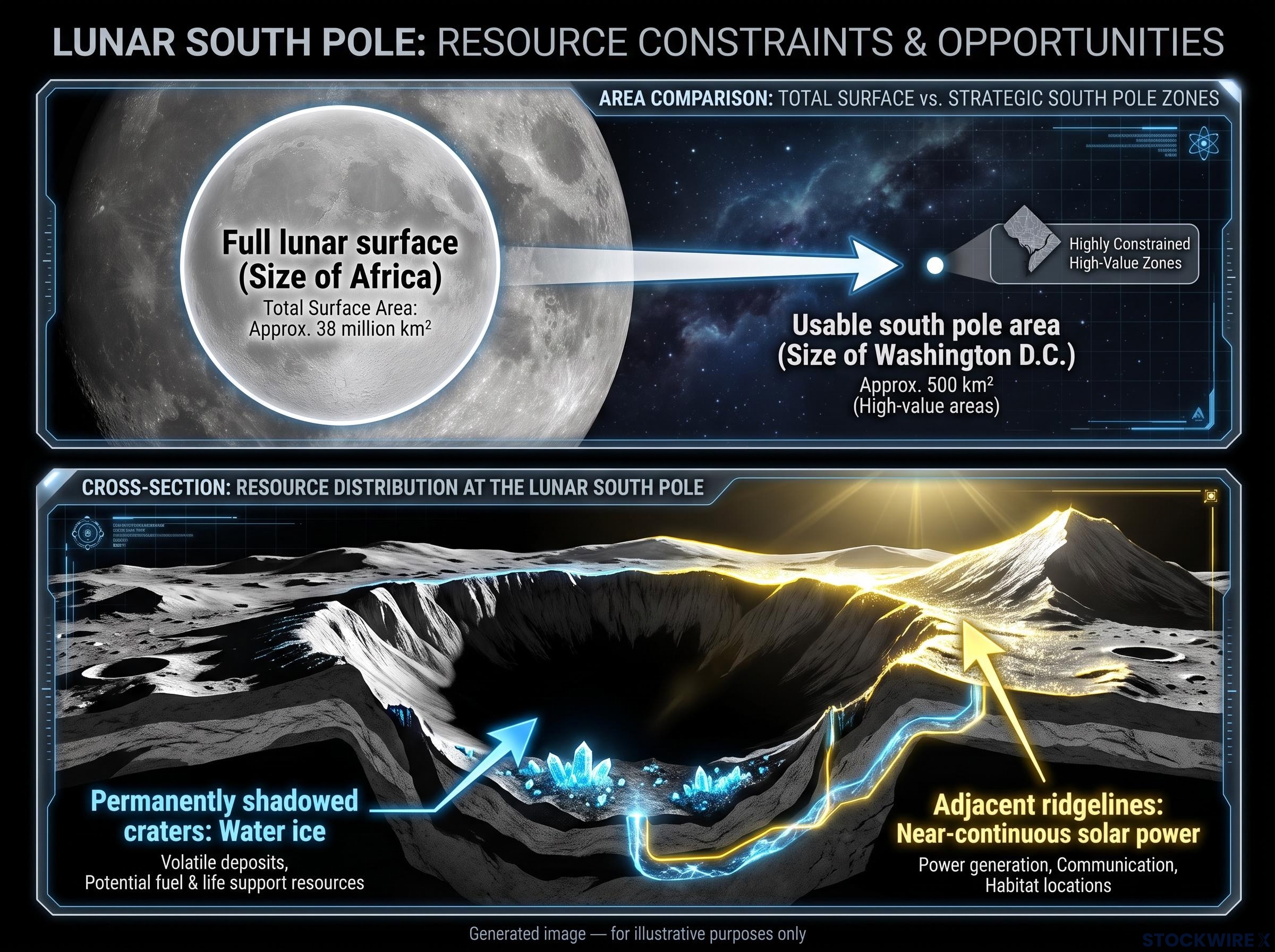
The lunar south pole’s total usable area is roughly comparable in size to Washington D.C. The full lunar surface is closer to the size of Africa. Almost all of that surface is irrelevant to the contest.
The reason the pole matters is a rare pairing of two features in one place. Permanently shadowed craters, regions that never see sunlight, hold water ice. Water ice can be split into hydrogen and oxygen for propellant, or used for life support. The ridgelines immediately next to those craters catch near-continuous sunlight, which means near-continuous solar power.
Ice plus power in adjacent terrain is what makes a permanent base possible. And that combination exists on only a handful of ridges.
Here is where the scarcity logic does its own work. The open lunar surface is effectively unlimited, so arriving second there costs little. The power-rich ridges beside the ice deposits are not unlimited. Whoever places infrastructure on the best of them first creates congestion that pushes later arrivals onto worse ground, further from ice or with less reliable power.
China’s robotic cadence is built around exactly this. Its Chang’e-7 mission targets the Shackleton crater region at the south pole, planned for late 2026 (Reuters reported a delay as of 23 August 2026), with Chang’e-8 following in 2028. That is a plan to establish presence before any crewed competitor arrives.
The U.S. is not absent from the surface fight. NASA is preparing a radioisotope-powered rover named Promise, built as a spare to the Mars rovers Curiosity and Perseverance, designed to prospect in the permanently shadowed regions that would strand solar-powered hardware. It signals genuine operational intent at the pole, not just a landing ambition.
The conclusion you reach on your own is the important one. The south pole may not merely be the most desirable site; it may be the only strategically relevant one. That changes the stakes from “who lands first” to “who controls the finite ground that matters.”
Standards, norms, and the second-order stakes
The terrain is the visible prize. The rules are the larger one.
Whoever establishes permanent infrastructure first shapes the standards around it: resource-use norms, technical specifications, communication network architecture, and dependency on propellant depots and life-support supply. China and Russia are jointly developing the International Lunar Research Station (ILRS), a nuclear-powered base with Russia contributing primarily nuclear power expertise, targeting a functional station by 2035.
If the ILRS becomes the default infrastructure, future lunar activity risks being structured around Chinese and Russian systems rather than U.S. or allied ones. That is a communications, supply-chain, and operational-standards question, not a flag-planting one.
The consequences extend past space. Analysts warn that a Chinese first landing would feed into how U.S. partners read the reliability of American security commitments more broadly. What starts as a bilateral race becomes a systemic test of whose systems the wider alliance ends up depending on.
What NASA’s internal restructuring actually signals
The reforms underway at NASA are easy to file as bureaucratic housekeeping. Read against the timeline, they look more like an institution that has internally concluded the competitive threat is real and is restructuring under pressure.
Administrator Jared Isaacman’s agenda is a deliberate narrowing. It consolidates the agency around mission-critical work, moves away from a contractor-heavy structure, standardises the SLS rocket on a near-Block 1 configuration, and cancels the more powerful Exploration Upper Stage to cut complexity and raise production cadence. Prior leadership, on this account, spread resources across congressional districts and outsourced core competencies until multi-month work stretched into multi-year efforts.
The most visible sequencing decision came in February 2026. Artemis III was formally redesignated from a lunar surface landing to a crewed demonstration in low Earth orbit, launching in 2027 to test the commercial landing system and rendezvous operations. That reads as a retreat only if you miss the logic: it shifts the first crewed surface landing to Artemis IV in 2028, matching hardware readiness to mission profile rather than forcing a landing before the lander is ready.
NASA’s Artemis program outlines the full mission sequence from Artemis II through Artemis IV, with the crewed surface landing formally assigned to 2028 as the date that has to hold against China’s 2030 target.
| Mission | Status / Target | Profile | Key milestone |
|---|---|---|---|
| Artemis II | Completed | Crewed lunar flyby | Four astronauts farther from Earth than any humans in history; 8.8 million pounds of thrust |
| Artemis III | 2027 | Crewed LEO demonstration | Redesignated Feb 2026; crew named 9 June 2026 |
| Artemis IV | 2028 | First crewed surface landing | The date that matters against China’s 2030 target |
The hardware is moving. NASA installed all four RS-25 engines on the Artemis III core stage on 10 September 2026, after lifting the stage vertical on 11 May 2026. On 9 June 2026, NASA named the Artemis III crew: Commander Randy Bresnik, Pilot Luca Parmitano of the European Space Agency, and Mission Specialists Andre Douglas and Frank Rubio.
The budget fight sits underneath all of it, and it reveals the tension. For FY2026, the President requested roughly $18.8 billion, about a 24% cut. Congress enacted approximately $24.4 billion via P.L. 119-74 and explicitly rejected proposed terminations of SLS and Orion after Artemis III. What this tells you is that the executive branch is trying to accelerate by consolidating, while Congress is protecting the industrial base that consolidation would rationalise away. More than $100 billion has gone into U.S. lunar return efforts across administrations, roughly $93 billion through FY2025, without a crewed landing delivered yet.
The risks the reforms have not resolved
Consolidation does not remove the technical risks that determine whether 2028 holds.
- Starship HLS schedule: SpaceX reportedly informed NASA in late 2025 that its Starship Human Landing System would not meet a June 2027 target.
- Orbital refuelling: the architecture requires on the order of ten or more refuelling launches to demonstrate long-duration cryogenic propellant management, a scale never attempted.
- Crew safety: NASA’s Office of Inspector General has flagged the 171-foot Starship lander height and tipping risk on rugged terrain, reliance on a single elevator for crew access, and the absence of a mandated crew rescue capability.
Starship schedule risk is not a hypothetical framing: a July 2026 engine abort halted a planned Texas test and sent SpaceX stock below its IPO price for the first time, illustrating that each Starship delay carries both mission-timeline and market-confidence consequences for the Artemis architecture that depends on it.
These are not reasons to assume the program fails. They are the variables that decide whether the 2028 landing holds or slips, which is the same as asking whether the two-year margin against China survives. For an investor, this is the line between contractors positioned for the streamlined, mission-critical reform agenda and those tied to the legacy cost-plus, sole-source model the current leadership is targeting.
What the space race means for defence and aerospace investment
The strategic logic points somewhere specific for capital: this is a structural spending driver, not a single catalyst.
Start with scale. Global government space budgets reached roughly $130 billion in 2024, with the U.S. at $73.2 billion and China rising to about 15% of the global share. The composition is the part that matters most: 54% of global space budgets go to defence.
China’s spending trajectory tells you the pressure is not easing. Between 2014 and 2024, China invested an estimated $85-95 billion in military and civil space, climbing toward nearly $20 billion annually, driven by a stated goal to usurp U.S. space leadership by 2045.
CSIS analysis of China’s space rise identifies the compounding risk to U.S. leadership as China’s annual investment approaches $20 billion, a trajectory that independent defence researchers argue warrants a structural rather than episodic response from allied governments.
Analysts project the rivalry could become a $1 trillion economic and military battleground by 2032.
Global government space budgets reaching $130 billion in 2024, with defence comprising 54% of that total, fits inside a broader structural story: space economy investing has shifted from speculative theme to a capital-allocation decision grounded in recurring government demand, long-duration contracts, and geopolitical competition that shows no sign of abating.
The spending is concentrating in specific capability categories:
- Satellite manufacturing
- Electronic warfare
- Low Earth orbit megaconstellations
- AI-enabled autonomous systems
- Space domain awareness
| Metric | United States | China |
|---|---|---|
| 2024 space budget | $73.2 billion | Approx. 15% of global share |
| Annual trajectory | Contested between requested and enacted levels | Climbing toward $20 billion per year |
| Primary focus | Mixed civil and defence | Mixed military and civil, defence-weighted |
Defence experts have recommended adding $250 million per year to U.S. Space Force budgets specifically for cislunar research and domain awareness. As space becomes contested capital stock, structural investment is expected to sustain defence primes such as Lockheed Martin, Northrop Grumman, and RTX.
Defence prime relationships in the space sector tend to function as floors rather than ceilings: once a contractor embeds in a programme like the SDA’s missile defence constellation, follow-on engineering change orders and sustainment work structurally expand the initial contract value, a dynamic directly relevant to how the defence-weighted cislunar spending build-out flows to second-tier contractors.
What this puts in front of you is a distinction. With more than half of global space budgets going to defence and China’s annual investment already near $20 billion, this is not speculative exposure to a future space economy. It is defence spending growth already underway, driven by a rival showing no sign of slowing, which means the relevant posture differs from how you would approach a single-event theme.
Past performance does not guarantee future results, and these budget figures and projections are subject to political, market, and programmatic risk.
The window is narrow, and the structural response is already in the competition
Four threads converge on one assessment. China’s 2030 target is credible engineering rather than aspiration. The south pole is a finite, strategically decisive prize. NASA’s reforms are a genuine, internally contested response to that threat. And the investment implications follow structurally from all three.
The number that frames everything is the gap: Artemis IV targets a first crewed surface landing in 2028, two years ahead of China’s 2030. That is not comfortable insulation. It is a schedule with zero slack, and NASA’s Promise rover signals the U.S. intends to be operating at the pole, not merely visiting.
Two variables will decide the outcome:
- Whether Starship HLS holds its schedule rather than slipping past 2027-2028.
- Whether Congress keeps funding at enacted rather than requested levels.
Here is the framework to carry forward. The competition sustains defence and aerospace spending regardless of which nation lands first, because a U.S. loss would accelerate the response and a U.S. win would entrench it. That structural tightness is what makes the theme resilient to short-term market noise, and it lets you read future Artemis schedule updates or Chinese milestones as signals within a thesis rather than isolated headlines.
This article is for informational purposes only and should not be considered financial advice. Investors should conduct their own research and consult with financial professionals before making investment decisions.