A 12.00% annual yield on an instrument that trades near its $100 par value and pays cash twice a month sounds like a money-market fund that somehow wandered into high-yield territory. Something has to give, because those two things do not usually live in the same product.
That contradiction is worth sitting with before resolving it. The $7 trillion money-market universe currently yields roughly 4.2%, Bitcoin has reclaimed a measure of institutional credibility, and corporate treasuries are actively hunting for yield with Bitcoin-adjacent exposure that avoids direct crypto custody.
STRC, the perpetual preferred stock of Strategy (formerly MicroStrategy), sits at the intersection of all three. It is structurally unlike almost anything else in the preferred-share universe, and understanding exactly how it differs is what determines whether it belongs in an income portfolio at all.
What follows breaks the instrument into the four things that actually decide the question for you: how the mechanics and yield work, whether the balance sheet covers the dividend, where the risk sits relative to the alternatives it replaces, and what the tax treatment does to the after-tax return. The goal is a framework for judging the yield-to-risk trade-off against your own conviction, not a blanket endorsement or dismissal.
How STRC actually works: mechanics, yield, and the $100 price target
Before comparing STRC to anything, it helps to understand what you would actually be holding, because it is easy to project familiar preferred-stock assumptions onto something that behaves differently.
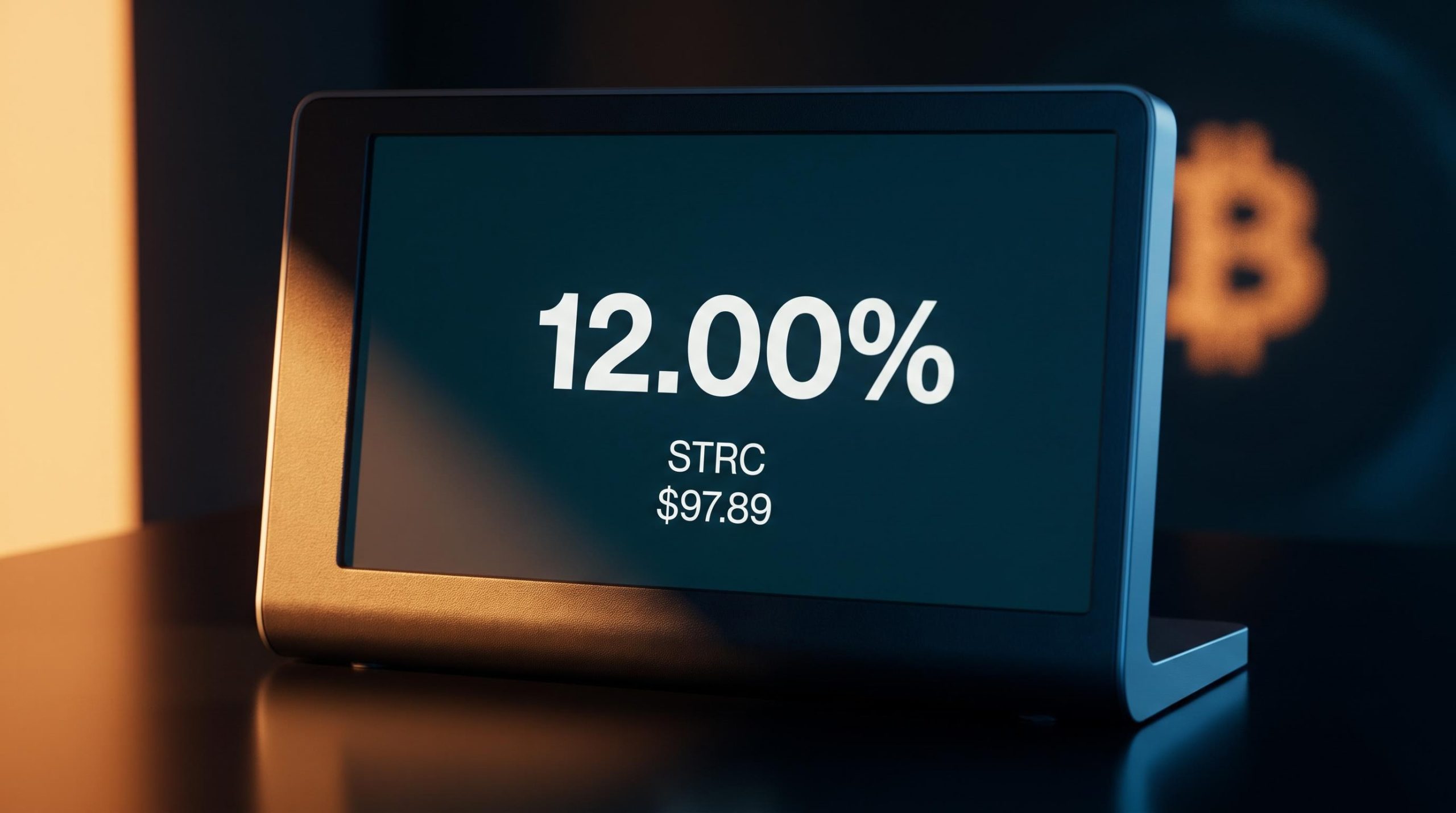
STRC is perpetual preferred equity. It has no maturity date, a $100 stated value, and an annualised dividend of $12.00 per $100 stated amount, payable semi-monthly in cash when declared. A company press release dated 15 September 2026 confirmed the 12.00% rate would hold for semi-monthly periods beginning on or after 16 September 2026.
The $100 figure is a target, not a floor. Strategy management has disclosed the use of active share buybacks to defend that price, which is a management decision rather than a contractual guarantee. STRC has traded as low as roughly $75-$80 before recovering to $88 and continuing back toward par.
As of mid-September 2026, it sits in the high-$90s: $98.51 on TradingView (18 September 2026), $98.13 on MarketBeat (17 September 2026), and $97.89 on MarketWatch (15 September 2026).
Because the shares trade at a discount to par, the effective yield moves with price:
- 12.28% effective yield at $97.75 (4 September 2026)
- 12.33% effective yield at $97.33 (30 August 2026)
- 12.63% effective yield at $95.01 (13 August 2026)
That gap between the target and the trading history tells you something the headline yield does not. Par is an objective backed by buybacks, not a floor backed by mechanics. Investors who bought near the $75-$80 low and held through the recovery captured a total return that yield alone cannot explain, which means your entry point matters as much as the coupon.
Total return, not yield alone, is the accurate measure of what STRC delivers: investors who bought near the $75-$80 low captured a price recovery component that the 12% coupon headline obscures, and conflating the two has historically led yield-focused investors to misprice similar instruments.
Where STRC sits in Strategy’s capital structure
STRC is one layer in a stack of Strategy preferreds. STRF sits senior, a non-cumulative perpetual preferred fixed at 10.00%. STRC is the junior cumulative layer at 12.00%. STRD (yielding roughly 14.16%) and SATA (roughly 13.04%) round out the higher-risk end.
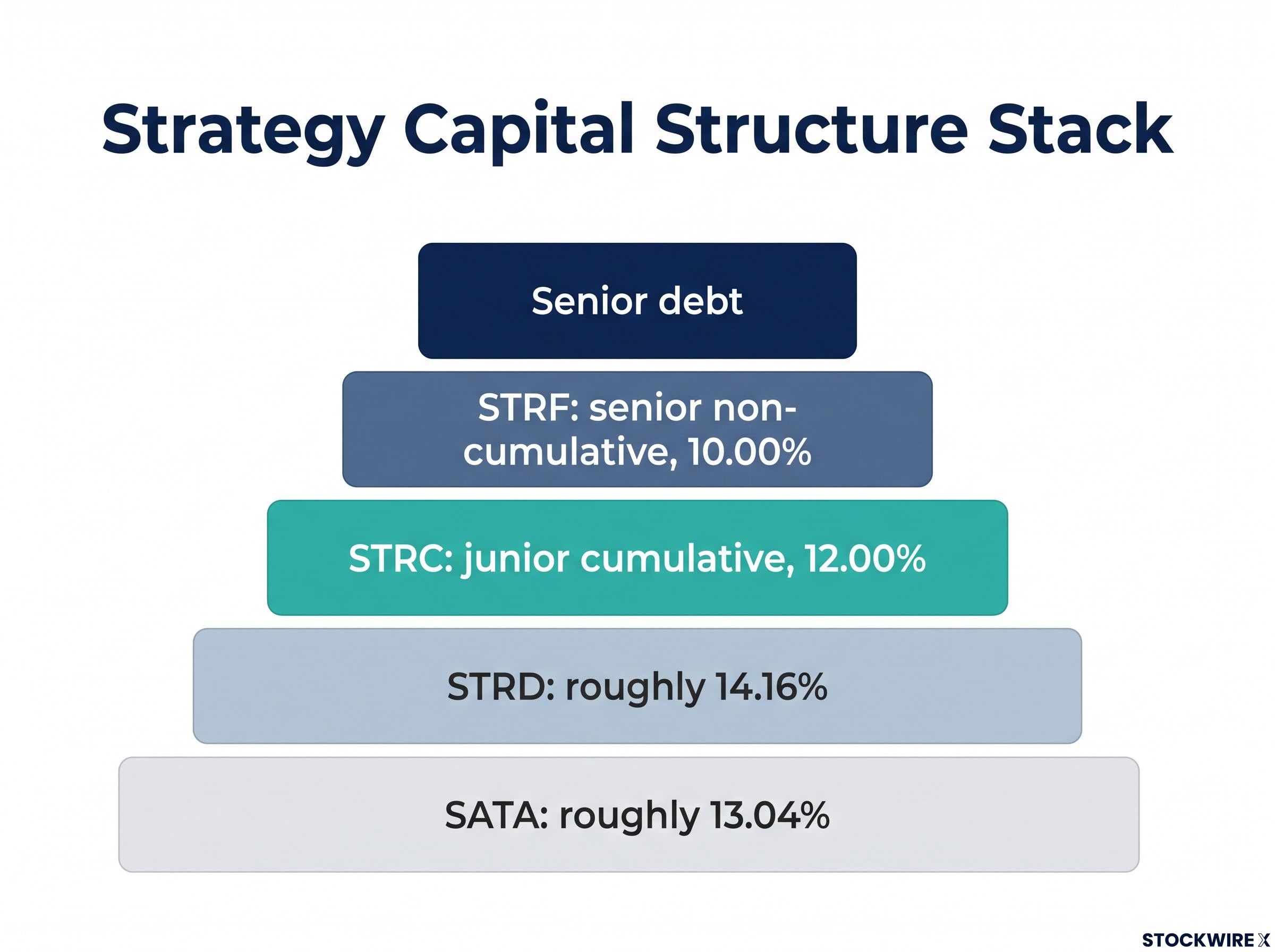
Junior positioning is the point. STRC dividends sit below senior debt and below STRF in stressed scenarios, and the extra yield over STRF is the market paying you for that subordination. You are not being handed a free two percentage points; you are being compensated for standing further back in the queue.
When big ASX news breaks, our subscribers know first
What Strategy’s Bitcoin treasury actually means for dividend coverage
The solvency case is the reason institutional buyers find STRC compelling, and it is best understood by building from the numbers outward before the counter-argument arrives.
Strategy held 845,050 BTC as of late August 2026, adding 4,603 BTC for roughly $370 million between 24-30 August 2026. That stack is valued at approximately $66 billion, against a cost basis of $63.73 billion to $64.27 billion (an average of $75,412 to $76,052 per Bitcoin), leaving around $1.73 billion in unrealised profit. Official Q2 2026 disclosures showed 843,775 BTC at a $63.69 billion cost and a $54.77 billion market value as of 26 July 2026.
The structural innovation separating resilient corporate bitcoin treasury firms from the miners that collapsed in 2022 is the combination of unsecured convertible senior notes and substantial fiat reserves, which removes the margin call trigger that made earlier crypto balance sheets so fragile.
At current prices, that treasury represents enough value to cover roughly 40 years of STRC dividend obligations. It is a striking figure, and it is the one that dominates the marketing.
The 40-year coverage figure At current Bitcoin prices, Strategy’s holdings could cover approximately 40 years of STRC dividends. This is a function of the current Bitcoin price, not a guaranteed buffer. The same holdings would cover far less if Bitcoin repeated its historical drawdowns.
The more honest number for an income investor is the cash-only figure. Strategy holds somewhere between $5.1 billion (management disclosure) and $6.71 billion in USD assets as of 30 August 2026, with the sources conflicting on the exact amount. On cash alone, without touching a single Bitcoin, that covers roughly four years of dividends.
| Coverage type | Asset base | Coverage duration | Key risk |
|---|---|---|---|
| Bitcoin-based coverage | 845,050 BTC (~$66B) | ~40 years at current prices | Bitcoin has historically fallen sharply in major drawdowns |
| Cash-based coverage | ~$5.1B-$6.71B USD reserves | ~4 years | Depends on treasury management, not asset sales |
Here is the tension worth holding onto. The 40-year figure is denominated in an asset that has repeatedly fallen dramatically from peak to trough, so it is a snapshot of today’s price rather than a stable promise. The four-year cash buffer is what actually protects your near-term income stream, and it is the number that deserves the most weight when you size a position. How much of STRC’s yield story you accept ultimately depends on how much of it rests on your Bitcoin conviction versus your confidence in the treasury desk.
How STRC’s risk profile compares to the alternatives it replaces
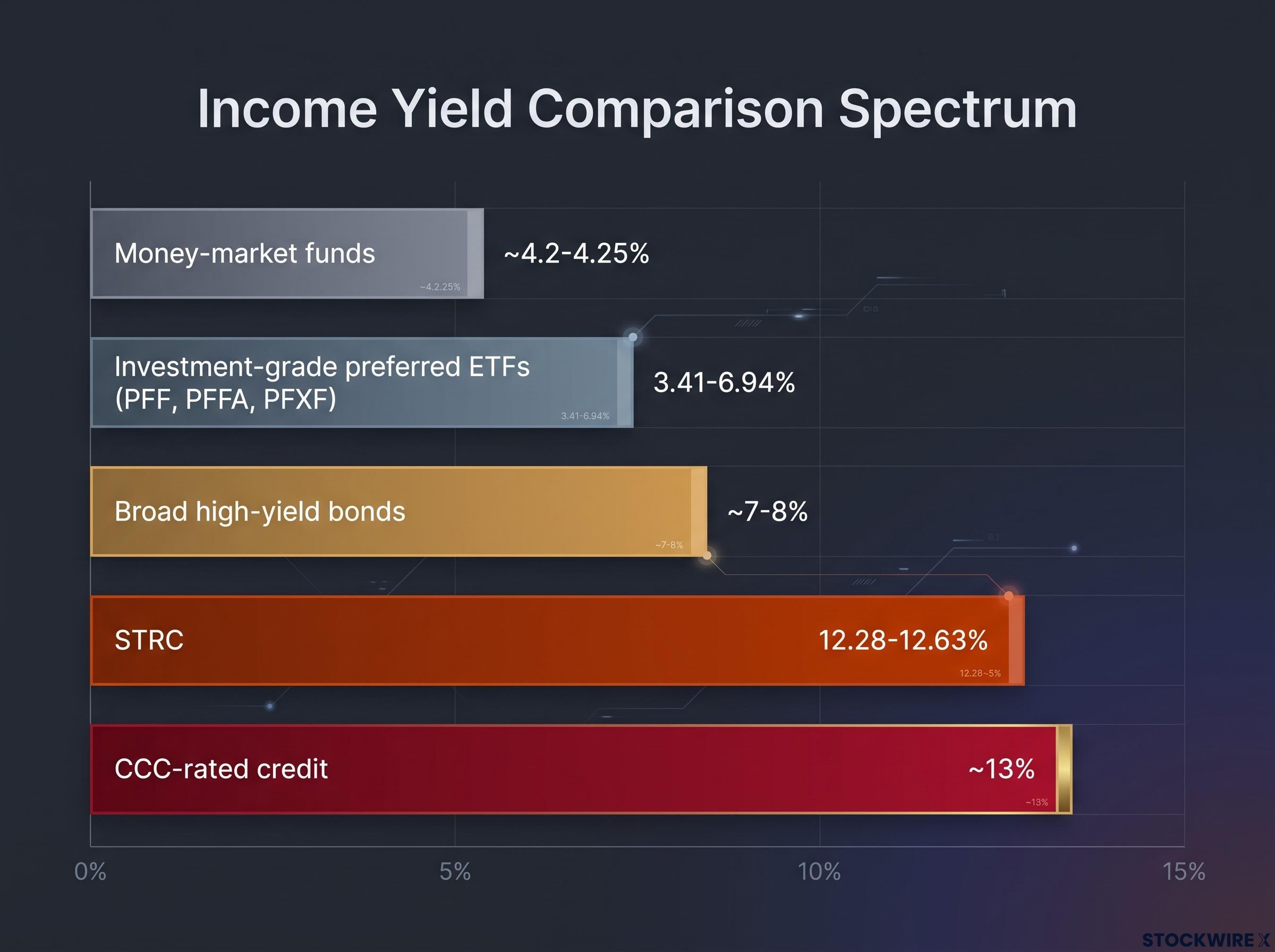
The abstract 12% yield only means something once it is placed on a concrete risk-adjusted spectrum, and that is where the comparison gets uncomfortable.
Money-market funds yield roughly 4.2-4.25%. Investment-grade preferred ETFs such as PFF, PFFA, and PFXF sit in the 3.41-6.94% range. Broad high-yield bonds yield around 7-8%. CCC-rated speculative credit, the lowest tier before default territory, yields around 13%. STRC’s 12.28-12.63% effective yield lands right alongside that CCC tier.
| Instrument | Approximate yield | Key risk | Suitable for |
|---|---|---|---|
| Money-market fund | ~4.2-4.25% | Inflation erosion of purchasing power | Capital preservation, short-horizon cash |
| Investment-grade preferred ETF (PFF) | 3.41-6.94% | Rate sensitivity, sector concentration | Diversified income |
| Broad high-yield bonds | ~7-8% | Default and credit-cycle risk | Yield with defined maturity |
| CCC-rated credit | ~13% | Elevated default probability | Speculative income |
| STRC | 12.28-12.63% | Bitcoin concentration, perpetual duration, subordination | Bitcoin-conviction income allocation |
Four structural features justify that CCC-equivalent spread, in rough order of how hard they hit an investor:
- Perpetual duration. No maturity date and no mechanism to compel principal repayment, so you rely entirely on the secondary market to exit.
- Single-issuer concentration. The dividend rests on one company’s undiversified, Bitcoin-correlated balance sheet, not diversified operating cash flow.
- Subordinated capital position. STRC sits below senior debt and STRF, so it absorbs stress first.
- Board dividend discretion. The charter allows management to adjust or, within limits, suspend the dividend to manage price stability.
The institutional adoption data is a genuine counter-signal, but it should not be overstated. Institutional ownership stood at approximately 57.88% of shares as of 30 June 2026 (Investing.com), and fund holdings surged 73,662.70% over the preceding three months to roughly 5.554 million shares across 41 reporting funds. STRC now appears in PFF (1.993 million shares), PFXF (844,000 shares), and PFFA (403,000 shares), alongside FWATX (735,000 shares) and FAGIX (663,000 shares). Strive Asset Management allocated $50 million, over a third of its corporate treasury, to STRC on 11 March 2026.
SEC Form 13F filings are the underlying source for the institutional ownership figures cited here, with quarterly disclosures from funds holding STRC shares providing the most direct window into how professional capital allocators are sizing and adjusting their positions over time.
That comfort reflects tradability and ETF mechanics, not a stamp on capital preservation quality. BitMEX Research puts it plainly, describing STRC’s risks as “substantially greater than those related to short-duration U.S. Treasuries.”
The read for you is this: the roughly 450-basis-point spread over broad high-yield bonds is not a windfall. It is the market’s price for single-issuer Bitcoin concentration, perpetual duration, and subordinated equity status. If you would not buy a CCC-rated bond, you owe yourself an honest answer on whether you are genuinely comfortable owning this.
The tax-adjusted return case and what it demands of the investor
Here is where STRC becomes genuinely differentiated for a specific type of investor, and where the numbers finally explain the institutional interest without overstating the safety.
Strategy classifies STRC distributions as return of capital (ROC), meaning the payment reduces your cost basis rather than creating current taxable income. The company announced that 100% of 2025 distributions on STRC and its other preferred instruments were treated as non-taxable ROC for U.S. federal income tax purposes. Its Q1 2026 guidance indicated this treatment should persist for ten years or more, because it does not expect to generate current or accumulated earnings and profits.
The deferral mechanism is the payoff. Tax is postponed until your basis reaches zero or you sell, at which point the gain is treated as capital gains rather than ordinary income. For a high-bracket investor, that distinction is not cosmetic.
The pre-tax equivalent Oak Research calculates that for a U.S. investor in the 37% marginal bracket, STRC’s roughly 11.5% ROC yield is equivalent to approximately an 18.3% pre-tax yield on a conventional bond taxed as ordinary income.
That 18.3% figure is the number that explains institutional appetite. It is also the most underdiscussed feature of the instrument for high-bracket U.S. investors, and it is what separates a considered allocation from a naive yield-chase.
There is a catch built into the benefit. As ROC grinds your basis down toward zero, exiting becomes harder to do tax-efficiently, which compounds the concentration risk rather than offsetting it. The tax advantage quietly raises the bar on how much long-duration conviction you need before entering.
Before leaning on the ROC benefit, an investor should be able to satisfy three conditions:
Tax-advantaged account placement decisions become more complicated for STRC because the ROC treatment already defers ordinary income tax in a taxable account, meaning placing STRC inside a Roth IRA or traditional IRA eliminates a benefit that was already doing tax-deferral work on the investor’s behalf.
- A genuine multi-year holding horizon, since the benefit rewards deferral and punishes early exit
- A real conviction in Bitcoin’s long-term value, because the underlying coverage depends on it
- The discipline to track tax basis carefully as it declines toward zero
For Canadian investors, the U.S.-listed shares are accessible but carry withholding tax implications. A Canadian-domiciled version is anticipated but not yet available.
STRC’s place in an income portfolio: a calibrated assessment, not a verdict
Pulling the threads together, STRC offers a genuinely differentiated yield and tax profile for the right holder. The risk premium, though, is real, and it maps to CCC-equivalent credit risk rather than preferred-stock risk. Treating the two as interchangeable is the single most common mistake this instrument invites.
The performance record is supportive but not decisive. Over an observation period of slightly more than a year, STRC has outperformed every alternative reviewed, including OVL (the S&P 500 with puts) and the money-market funds yielding 4.2-4.25% it is most often pitched against. Given Bitcoin’s history of deep drawdowns, that track record is data, not a forward guarantee.
Three variables will determine whether the thesis holds over a multi-year horizon:
Bitcoin conviction, the variable the STRC thesis ultimately depends on, rests on a theoretical anti-debasement case that the empirical record complicates: Bitcoin lost approximately 77% of its value during the highest U.S. inflation in four decades while gold held broadly stable, and recent cross-country research found no consistent correlation between Bitcoin returns and CPI.
- Bitcoin’s price relative to Strategy’s $63.73-$64.27 billion cost basis, which sets how far the asset can fall before balance sheet stress appears
- Strategy’s ability to sustain cash reserves independent of Bitcoin liquidation, the four-year buffer being the real near-term protection
- Secondary market liquidity for perpetual-duration preferred equity, particularly in a rate-shock environment where the only exit is a sale
The shift from retail to institutional ownership, quantified by that 73,662.70% surge in fund holdings to roughly 57.88% institutional ownership, improves the liquidity and price-discovery picture. It does not eliminate the risk. If you have worked through the preceding analysis with conviction intact, the two data points worth monitoring each quarter are the cash-only coverage buffer and the institutional ownership trend, because they are the leading indicators of whether this profile is improving or deteriorating. The ROC treatment, projected to persist for ten years or more, anchors the tax case over that same horizon.
This article is for informational purposes only and should not be considered financial advice. Investors should conduct their own research and consult with financial professionals before making investment decisions. Past performance does not guarantee future results. Financial projections are subject to market conditions and various risk factors.