
Twenty of the 39 most rigorously screened elite fund managers in America reduced their position in Microsoft this quarter. The interesting part: Morningstar still thinks the stock is roughly 19% below fair value.
The Morningstar US Market Index has gained more than 13% so far in 2026 through 21 August, yet that headline figure masks a more turbulent picture, with inflation worries, uncertainty around AI capital spending, and geopolitical friction prompting fund managers to quietly reduce exposure to well-known names. Morningstar screened 39 top-rated active fund portfolios, each with 50 or fewer holdings, and identified ten stocks seeing the most concentrated selling. What the screen reveals is not what most investors expect: the majority of names being cut are ones Morningstar considers undervalued.
This piece walks through all ten stocks, gives you the Morningstar valuation verdict on each, and flags the four names where the selling actually aligns with a cautious fundamental view. That distinction, between portfolio housekeeping and a genuine warning signal, is what matters before you decide whether to act.
Why elite managers sell stocks they still believe in
Fund managers trim positions for five reasons that have nothing to do with a bearish fundamental view:
- Position-size control: A stock that has grown large relative to a fund’s concentration limits must be trimmed regardless of conviction.
- Cash needs: Funds facing outflows or funding new positions raise cash from existing holdings. High-quality, liquid names are the first to go precisely because they are easy to sell.
- Mandate constraints: Style-box restrictions, sector limits, or benchmark-relative risk rules force selling of otherwise attractive positions.
- Benchmark risk: A large overweight in an underperforming name creates benchmark drag. Trimming reduces that risk independently of the fundamental view.
- Tax management: Realising losses or managing gain recognition affects timing in ways entirely unrelated to conviction.
The methodology behind the screen involved reviewing current fund holdings across 39 portfolios carrying a Gold, Silver, or Bronze Medalist rating, comparing each against the same portfolios from three months earlier, and applying a weighted sell score to capture both the scale and breadth of trimming activity. Susan Dziubinski published the results on 26 August 2026, with all data as of 21 August 2026.
Fund manager incentives are structurally built around AUM fees and benchmark-relative bonuses, meaning a manager trimming a wide-moat position to stay within tracking error limits is acting in their own professional interest, not necessarily signalling a change in their fundamental view.

“A manager trimming an undervalued wide-moat name to meet mandate constraints is not a sell signal. It is portfolio housekeeping.”
Before scanning the ten names below, internalise this: mirroring an institutional trim without sharing the fund’s mandate, flow, and benchmark constraints is often counterproductive for an individual investor.
When big ASX news breaks, our subscribers know first
The 10 stocks: a valuation snapshot before we dive in
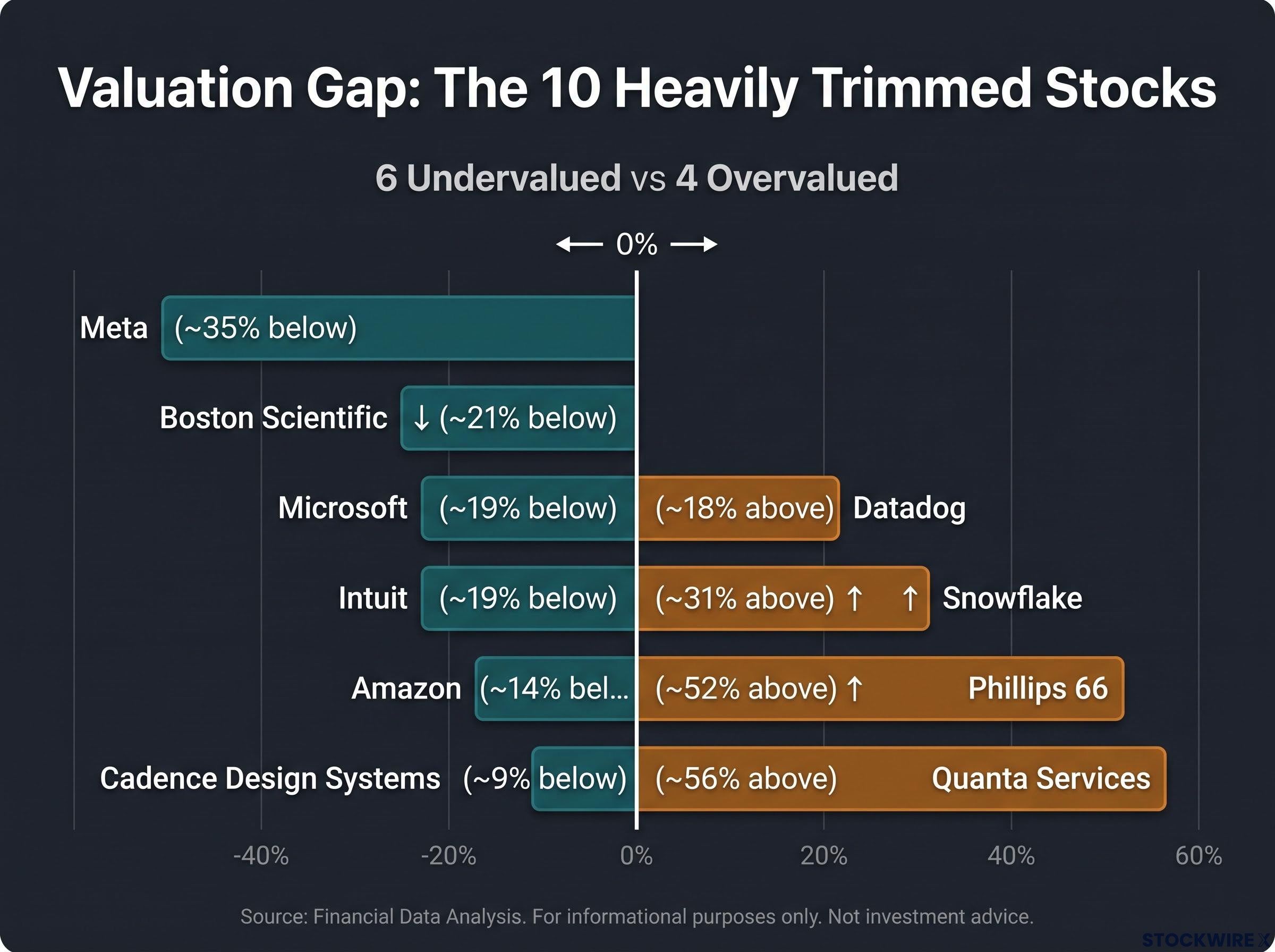
Six of the ten names on this list are considered undervalued by Morningstar. Four of those carry a 4-star rating. Only four stocks align with a cautious valuation view, and those are the ones where the selling makes fundamental sense.
The table below splits the picture open in one view. Pay particular attention to the tension between the YTD return column and the estimated discount or premium column: they frequently point in opposite directions, and that is precisely where investment opportunity, or risk, lives.
| Stock (Ticker) | Star Rating | Est. vs Fair Value | Managers Selling (of 39) | YTD Return |
|---|---|---|---|---|
| Meta Platforms (META) | 4-star | ~35% below | 16 | -16.53% |
| Boston Scientific (BSX) | 4-star | ~21% below | 6 | -47.17% |
| Microsoft (MSFT) | 4-star | ~19% below | 20 | +0.49% |
| Intuit (INTU) | 4-star | ~19% below | 10 | -44.05% |
| Amazon (AMZN) | 4-star | ~14% below | 20 | +12.05% |
| Cadence Design Systems (CDNS) | 3-star | ~9% below | 6 | +2.06% |
| Datadog (DDOG) | 2-star | ~18% above | 4 | +73.26% |
| Snowflake (SNOW) | 2-star | ~31% above | 6 | +51.70% |
| Phillips 66 (PSX) | 2-star | ~52% above | 2 | +91.17% |
| Quanta Services (PWR) | 2-star | ~56% above | 6 | +51.56% |
1. Meta Platforms (META): the deepest discount on the list
Meta sits at the widest valuation gap on the entire screen: 4-star, wide economic moat, roughly 35% below Morningstar’s fair value estimate, with a -16.53% YTD return making it the worst performer among the ten. 16 of 39 managers reduced this position. It is also the only large-value stock on the list.
Wide moat. 35% below fair value. That is the largest discount to Morningstar’s estimate on any stock being trimmed by elite managers this quarter.
The core platform remains as powerful as ever. Close to 4 billion people log in to Facebook, Instagram, WhatsApp, or Messenger each month, giving the company a reach that no rival can match. The business runs on a two-part logic: build deeper user engagement through product improvements, then layer advertising across those features to monetise at scale. AI investment has sharpened ad-targeting capabilities considerably, while Reality Labs hardware continues to absorb cash without delivering a profitable return. The Llama large language model is available to users across Meta’s app suite, though no concrete short-term revenue model around it has yet emerged.
AI capex spending is the source of investor unease. Morningstar does not view it as breaking the long-term thesis. A 35% discount to fair value on a wide-moat business with 4 billion users is not a small signal, and the question for you is whether near-term capex anxiety is creating a long-term entry point rather than validating the institutional trimming.
2. Boston Scientific (BSX): deepest drawdown, strongest valuation case in healthcare
Boston Scientific has fallen -47.17% year-to-date, the deepest drawdown on the entire list. Morningstar rates it 4-star with a narrow moat, approximately 21% below fair value. 6 of 39 managers trimmed.
Since Michael Mahoney took over as CEO, the company has deliberately moved away from slower-growth areas such as cardiac rhythm management and coronary stents, pivoting instead toward less penetrated categories including subcutaneous implantable defibrillators, left atrial appendage closure devices, and atrial fibrillation ablation. It has also broadened its reach through bolt-on deals that brought sacral neuromodulation and peripheral mechanical thrombectomy capabilities into the portfolio.
On the downside, product setbacks have been a feature of the journey: the company pulled both its Lotus transcatheter aortic valve and its Acurate Neo from the market, and the competitive environment is demanding, with Medtronic, Stryker, Johnson & Johnson, and Abbott all pushing aggressively to lock in consolidated hospital supply relationships. A nearly 50% YTD decline that has not moved Morningstar off a 4-star rating is a meaningful signal that price and fundamental value have diverged significantly. Whether the competitive risks justify that discount is the question you need to answer before acting.
3. Microsoft (MSFT): most trimmed, still undervalued
20 of 39 managers reduced their Microsoft position, making it the most widely trimmed stock on the list. Morningstar’s view: 4-star, wide moat, approximately 19% below fair value, with a near-flat YTD return of +0.49%.
Three durable strengths underpin the investment case. Azure enables organisations to run hybrid cloud environments seamlessly, giving it a meaningful advantage as enterprises continue migrating workloads off-premises. Office 365 holds an entrenched leadership position in workplace productivity software that no competitor looks close to threatening in the foreseeable future. And the OpenAI relationship places Microsoft well to serve as the coordination layer for the emerging era of agentic AI systems.
The SEC Form 13F disclosure rules require institutional investment managers overseeing more than $100 million in qualifying securities to report their holdings quarterly, which is the regulatory mechanism that makes this kind of fund-level portfolio analysis publicly available to retail investors.
The gap between selling intensity and valuation discount here tells you the trimming is almost certainly structural, position-size management and mandate constraints, rather than a fundamental call. That makes this a name worth examining more closely rather than following the crowd out.
4. Intuit (INTU): hardest-hit undervalued name
Intuit’s -44.05% YTD return through 21 August 2026 is the second-deepest drawdown on the list, and the most severe among the undervalued names. Morningstar rates it 4-star, narrow moat, approximately 19% below fair value. 10 of 39 managers trimmed.
Intuit’s core products command leading positions across their respective categories, covering small business accounting through QuickBooks and tax preparation through TurboTax. The Intuit Enterprise Suite is aimed squarely at mid-sized companies, carrying a monthly price point in the several-thousand-dollar range that sits between basic single-purpose tools such as standalone QuickBooks (several hundred dollars a month) and full enterprise resource planning systems like Oracle NetSuite (which typically run into the tens of thousands monthly). The company’s assisted service offerings, TurboTax Live, QB Live, and Mailchimp Live, pair customers with relevant professionals in real time and generate meaningfully higher revenue per user than self-service alternatives.
A 44% drawdown that leaves Morningstar’s fundamental assessment unchanged at 4-star tells you the market is pricing in a scenario Morningstar does not see in the underlying business. That gap deserves examination, not avoidance.
5. Amazon (AMZN): tied for most sold, trading at a discount
Amazon tied Microsoft with 20 of 39 managers trimming, and it is the only Consumer Cyclical name on the list. Morningstar rates it 4-star, wide moat, approximately 14% below fair value, with a YTD return of +12.05%, meaningfully stronger than Microsoft’s flat performance.
The long-term investment case rests on three distinct growth engines. AWS holds a commanding position in public cloud infrastructure, a market with years of structural expansion ahead. The Prime membership programme generates a reliable stream of high-margin recurring revenue while pulling customers and third-party sellers into a reinforcing loop that strengthens with scale. Meanwhile, the advertising business is growing rapidly, extending its reach into streaming content and drawing on Amazon’s uniquely rich pool of consumer purchase data to offer marketers capabilities that rivals struggle to replicate. Retail categories such as grocery and luxury goods remain far from fully penetrated and represent meaningful additional headroom.
Amazon’s positive YTD return alongside a 14% discount to fair value suggests the market has repriced the stock somewhat, but Morningstar still sees room to run. For a retail investor not subject to mandate constraints, Amazon’s combination of wide moat and below-fair-value pricing is a different proposition than what the selling activity alone implies.
Billionaire conviction on Amazon reached an unusual level of concentration in Q2 2026, with Druckenmiller rebuilding his position by more than 1,000%, Klarman allocating 16.5% of Baupost’s 13F portfolio, and Tepper making it his largest holding, a counterpoint worth considering alongside the 20 elite managers who trimmed in the same reporting period.
6. Cadence Design Systems (CDNS): the neutral case
Cadence is the most balanced entry on this list. 3-star, wide moat, approximately 9% below fair value, the smallest discount among undervalued names. 6 of 39 managers trimmed. YTD return: +2.06%.
Cadence sits at the heart of chip design, supplying the electronic design automation (EDA) software that engineers depend on to create semiconductor devices. The EDA market is concentrated among three dominant players, Synopsys, Siemens EDA, and Cadence itself, with Cadence particularly well regarded in analog design and having steadily grown its footprint in digital workflows as well. As chip architectures become more complex, incorporating multi-die and chiplet designs alongside AI-driven development processes, demand for sophisticated EDA tooling is expected to rise considerably through the next decade. The IP segment, which provides customers with ready-made chip building blocks, also carries an above-average growth outlook.
A 9% discount on a wide-moat business in a structurally growing industry is a reasonable entry. But it is not the same level of conviction opportunity as the 4-star names on this list. If you are deciding between Cadence and the deeper-discount names, weight accordingly.
7. Datadog (DDOG): wide moat, but valuation has outrun it
Datadog is the only 2-star name on this list with a wide economic moat. That distinction matters: Morningstar’s caution here is purely a valuation concern, not a business quality concern. 4 of 39 managers trimmed. The stock is approximately 18% above fair value with a +73.26% YTD return.
Datadog sells a cloud-based observability platform that aggregates telemetry signals from across an organisation’s technology environment and surfaces them through a unified dashboard, giving engineers a consolidated view of their entire infrastructure. The customer base exceeds 30,000 organisations, with the majority drawn from the small and mid-market segment. Dynatrace is the closest rival, though it has traditionally concentrated on the largest enterprise accounts. Looking at the broader market context, total cloud services spending, spanning both infrastructure and software-as-a-service, is forecast to approach $1.25 trillion by 2028, representing roughly 20% compound annual growth from the 2024 starting point.
The wide moat means the business will likely still be competitively strong when the valuation normalises. But buying at an 18% premium on a stock that has already returned 73% year-to-date compresses the upside available to a new buyer. For a believer in the long-term thesis, this is a prompt to wait for a better entry, not a reason to abandon the position entirely.
8. Snowflake (SNOW): strong growth, but priced for perfection
Here is where the register shifts. Snowflake is one of four names where Morningstar’s caution aligns with the institutional trimming: 2-star, no economic moat, approximately 31% above fair value, with a +51.70% YTD return. 6 of 39 managers trimmed.
Snowflake has built a genuine enterprise data business. The platform allows companies to consolidate data spread across multiple public cloud environments into a single, queryable source, and its decoupled compute-and-storage architecture delivers cost and scalability benefits over traditional on-premises data warehouses. Growing volumes of AI-driven data work are helping to keep net revenue retention anchored near 120%, and the decision to support the open-source Iceberg table format means users can now query data that lives outside Snowflake’s own environment, widening the platform’s addressable scope.
The competitive challenges are substantive, however. Databricks and Google BigQuery are credible alternatives built on distinct technical foundations, and the rivalry among these platforms is expected to persist, keeping a ceiling on the margin expansion that Snowflake can realistically achieve. With no economic moat and a 31% premium to fair value, the stock leaves almost no room for disappointment. If growth slows or competition bites harder than expected, the stock has meaningful room to reprice downward. This is one of only four names where you have genuine reason to consider following the institutional move.
9. Phillips 66 (PSX): the most overvalued name on the list
Phillips 66 carries the steepest overvaluation on the list: 2-star, narrow moat, approximately 52% above fair value. It is also the strongest performer, up +91.17% year-to-date. Only 2 of 39 managers trimmed, making it the least widely sold name, but that limited selling should not be confused with a positive signal when the valuation premium is this large.
The company spans a broader range of energy activities than most of its refining peers, with meaningful operations across refining, chemicals (through CPChem, a joint venture owned equally by Phillips 66 and Chevron), midstream pipelines, and marketing. Management’s strategic priority is growing the non-refining businesses, with a stated ambition for those segments to contribute $10 billion in EBITDA by 2027. New chemical capacity on the Gulf Coast and in Qatar is expected to come online during 2026. Elliott Management pushed for a more radical restructuring, winning two board seats but failing to force the breakup it argued for, which means the current integrated operating model remains in place.
When a stock has returned 91% year-to-date and Morningstar still sees it as 52% above fair value, the stock’s momentum is real but its margin of safety is not. The business transformation underway is genuine, but the price already reflects a great deal of that story. This is the clearest “wait for a better entry” case on the list.
10. Quanta Services (PWR): the highest premium, and no moat to justify it
Quanta Services carries the highest premium to fair value on the entire list: 2-star, no economic moat, approximately 56% above Morningstar’s estimate. YTD return: +51.56%. 6 of 39 managers trimmed.
Quanta holds a strong position as a specialist contractor serving the utility, renewable energy, and infrastructure sectors across two operating segments: electric power and underground utility and infrastructure. The electric business, which generated more than 80% of revenue in 2025, has benefited from a powerful combination of demand drivers including AI-related data centre construction, the broad shift toward electrification, and the reshoring of domestic manufacturing capacity. The 2021 acquisition of Blattner gave Quanta a substantial wind and solar EPC capability, adding renewable energy project delivery to its existing transmission and distribution work. More recent bolt-on deals, Cupertino Electric in 2024 and Dynamic Systems in 2025, have assembled what the company is positioning as a dedicated data centre infrastructure service platform.
The moat absence is the problem. Specialty contracting at scale is valuable, but without a structural competitive advantage preventing rivals from replicating the offering, the premium valuation depends on sustained perfect execution without a safety net. A 56% premium over fair value on a business with no durable competitive advantage means the current price requires everything to go right. The AI infrastructure tailwind is real, but the valuation has already captured it. You are better served waiting for a re-rating than paying today’s price for tomorrow’s growth story.
Valuation signals and timing operate on different horizons: metrics like CAPE and fair value estimates carry strong explanatory power over 8-18 year periods but near-zero predictive power over 1-3 years, which is why Snowflake and Quanta can remain 30-56% above fair value for longer than a disciplined seller expects.
What to do with this list before you buy or sell anything
The two-bucket verdict is straightforward. The four overvalued names, Phillips 66, Quanta Services, Snowflake, and Datadog, are ones where Morningstar’s view aligns with institutional trimming. The six undervalued names, Meta (approximately 35% below fair value), Boston Scientific (approximately 21% below), Microsoft (approximately 19% below), Intuit (approximately 19% below), Amazon (approximately 14% below), and Cadence (approximately 9% below), are ones where the selling appears to be structural housekeeping rather than a fundamental call.
Before acting on any of these names, run through this process:
- Examine the fundamentals and competitive positioning of any undervalued name you find interesting.
- Check how its valuation compares to your own return requirements and time horizon.
- Factor in tax implications and portfolio concentration.
- Determine whether the reasons behind the institutional selling, position-size management, mandate constraints, benchmark risk, actually apply to your own situation.
“Elite managers trimming an undervalued wide-moat stock is a signal to look closer, not a directive to sell.”
This screen is most useful as a research filter. It shows where price and fundamental value have diverged, and your job is to determine whether that divergence represents an opportunity or a risk in your specific portfolio context. The list is a starting point for your own analysis, not a trade idea.
For investors wanting to understand the broader market context behind these individual stock valuations, our full explainer on US equity valuation signals examines the Buffett Indicator at 223.6%, the equity earnings yield versus Treasury yield spread, and what Berkshire Hathaway’s $373 billion cash reserve implies about current index-level pricing.
This article is for informational purposes only and should not be considered financial advice. Investors should conduct their own research and consult with financial professionals before making investment decisions. Past performance does not guarantee future results.
—