
Most investors treat a government bond sell-off as a rates problem. Yields rise, future cash flows are worth less, and corporate bonds reprice through higher discount rates. The current episode suggests that view misses half of what is driving sovereign bond volatility into credit spreads, and the clearest evidence sits beneath the headline numbers.
Since the post-summer period began, the gap between high-yield (HY) and investment-grade (IG) corporate bond spreads has widened by about 60 basis points. A basis point is one hundredth of a percentage point. That move is meaningful, but the more telling shifts are happening inside the lower-rated end of the market.
France is the live case. Its government bonds have been unstable, the yield gap over Germany has widened, and the 2027 budget remains uncertain. Specialists at Federated Hermes, including Mitch Reznick, argue the shock is changing what you are paid to hold credit risk. They also argue it is changing how future cash flows are discounted, and their conclusion is that the damage is uneven across issuers instead of spread evenly across the whole market.
Here is how that second channel works, why weaker borrowers feel it first, why CCC spreads can mislead, and why European B credit is priced so differently from its US equivalent.
How does sovereign bond volatility reach corporate credit spreads?
The rates channel versus the risk-appetite channel
You probably already know the first channel. When government yields rise, the risk-free rate used to value a company’s future cash flows rises too, so corporate bond prices fall even if nothing about the company has changed.
Reading credit spreads alongside yields is the habit that separates a rates view from a credit view: you can see whether stress is confined to the weakest tier or spreading into BB and single-B names, which is the distinction that matters here.
The second channel is less visible. A credit spread is the extra yield you earn on a corporate bond over a comparable government bond, and part of it is a risk premium: the compensation investors demand for bearing the chance of default. When sovereign markets turn unstable, that premium can rise on its own.
Federated Hermes on the shift Mitch Reznick, head of cross-border credit at Federated Hermes, says sovereign volatility is “no longer just a rates story,” because it is changing risk appetite and causing real decompression in corporate spreads.
France shows both channels at work. A large fiscal deficit, doubts over passing the 2027 budget and political fragmentation have pushed investors out of French government bonds (OATs) and into German government bonds (Bunds).
| Metric | Reported figure | What it signals |
|---|---|---|
| French 10-year OAT yield | 5.06% intraday on 22 October 2026; 4.93% on 29 October 2026 | Borrowing costs for France remain elevated |
| French-German 10-year spread | About 164 bps on 22 October 2026 | Investors demand more to hold France over Germany |
| Moody’s rating and outlook | Aa3, negative outlook (affirmed 23 October 2026) | Rating depends on a deficit-reducing budget being adopted |
| Deficit target | 5.0% of GDP in 2027 vs 5.4% projected for 2026 | Consolidation is planned but not yet secured |
The yield and spread figures come from market data providers including Morningstar and Trading Economics. Reuters described the spread approaching about 180 bps during the 22 October sell-off.
Banks, liquidity and the feedback loop
Risk-premium repricing is one of six transmission paths:
- Risk-premium repricing: investors demand more for any corporate risk.
- Flight to quality: money leaves OATs for Bunds and pulls back from riskier European assets.
- Bank sovereign exposure: banks holding falling government bonds face weaker capital and higher funding costs.
- Domestic demand and government support: companies selling at home or relying on the state feel fiscal tightening.
- Ratings ceilings: a weaker sovereign can cap ratings of domestic banks and utilities.
- Liquidity and forced selling: simultaneous selling thins dealers’ capacity to make markets.

The 2011-12 eurozone crisis is the closest precedent, although JPMorgan Asset Management suggests today’s sovereign-bank linkage may hit balance sheets more mildly. For you, the widening HY-IG gap is the key signal: the market is charging more for credit risk itself, so a stable-looking government curve no longer proves corporate borrowing conditions are stable.
When big ASX news breaks, our subscribers know first
Why do lower-rated borrowers absorb the repricing first, and why have CCC spreads lagged?
Why weaker issuers are hit first
Reznick’s logic is straightforward. When growth cools, weaker businesses struggle to outgrow what they owe, and as money becomes more expensive, a bigger share of their cash flow goes to paying for and rolling over that debt.
Lower-rated issuers tend to share traits that magnify this pressure:
- Larger refinancing needs and shorter maturities
- Weaker interest coverage, meaning less profit relative to interest bills
- Smaller, less liquid bond issues
- Greater sensitivity to growth and bank lending
That is why the repricing lands on them first and hardest.
The CCC puzzle: lagging does not mean safe
CCC bonds sit near the bottom of the rating scale, where default risk is highest. Federated reports that CCC spreads in both the US and Europe have widened by nearly 300 bps, lagging the rest of global high yield.
Read the wording carefully “Lagged” and “underperformed” describe the same widening of nearly 300 bps. CCCs performed worse. They were not unaffected.
The confusion arises because CCC data behaves oddly. Federated’s US high-yield commentary reported the US HY spread over Treasuries moving from 294 bps to 305 bps, then tightening to 275 bps by quarter-end, with CCCs underperforming BB and B bonds. Several market-structure quirks can distort the picture:
- Thin trading delays price discovery
- Limited index capacity and few new issues
- Spreads lose meaning once bonds trade near expected recovery value
- Indices can end up dominated by relatively resilient bonds
Two readings compete. One says the lag is a measurement effect; the other says the worst risks were already priced at distressed levels. Either way, CCCs can trail at first and then gap wider when liquidity disappears or default odds climb.
For the weakest borrowers, distressed debt exchanges are a serious solvency warning rather than a clean fix, since roughly a quarter end in a hard default, which is why CCC stress deserves attention even when index spreads look calm.
History backs the caution. In 2011-12, in Italy in 2018 and during the UK gilt turmoil of 2022, broad indices masked large differences between issuers. Treat CCC index data as a lagging, noisy signal rather than a clean read on risk.
Why is European B credit pricing more risk aversion than US B credit?
The gap
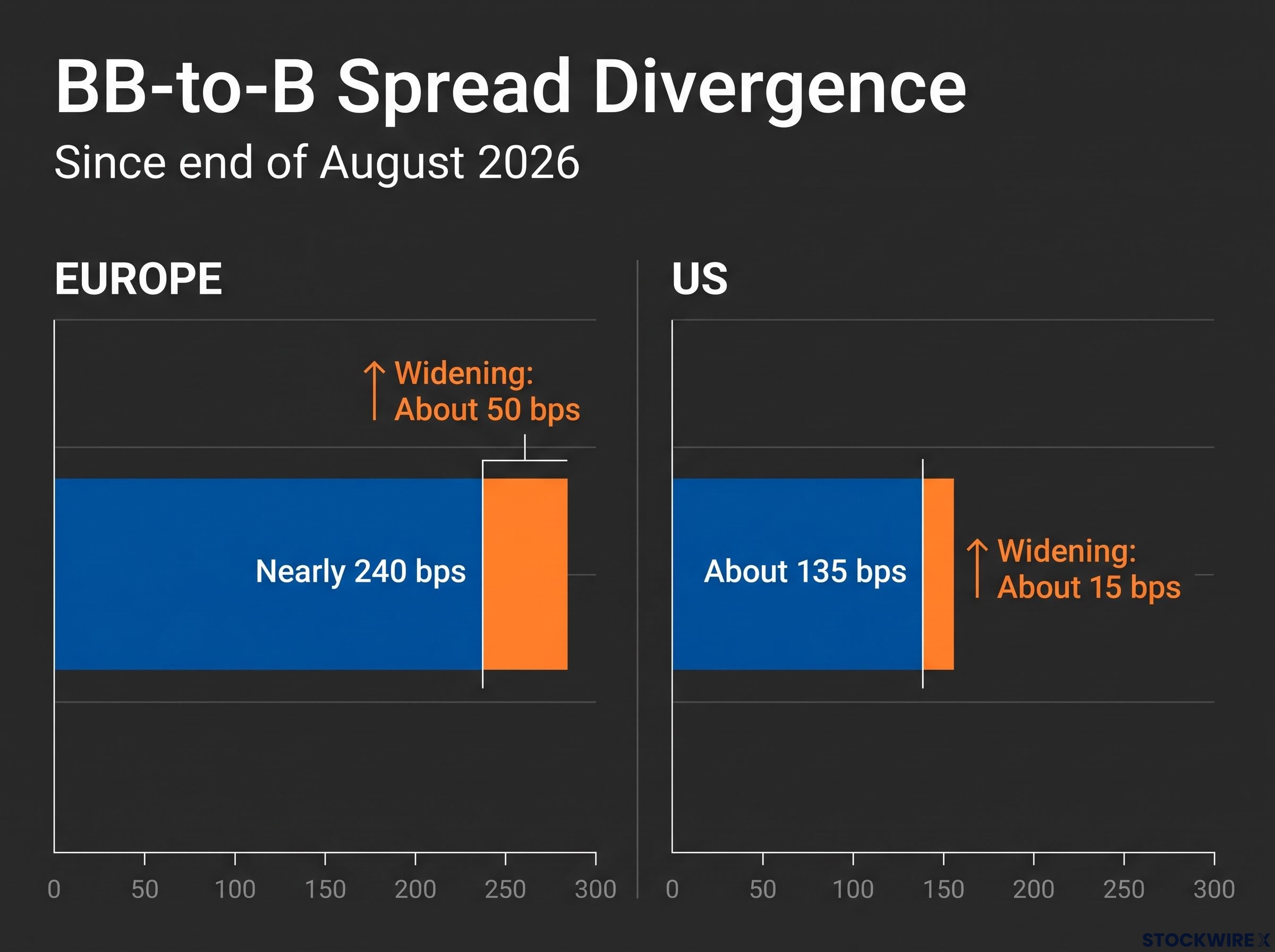
The BB-to-B differential measures how much more yield investors demand to step down from BB to single-B bonds. On that measure, Europe and the US have split sharply.
| Region | BB-to-B spread | Widening since end of August 2026 | Implied read |
|---|---|---|---|
| Europe | Nearly 240 bps | About 50 bps | Markedly more risk aversion |
| US | About 135 bps | About 15 bps | Modest repricing |
Five factors likely explain the divergence:
- Proximity to the French fiscal shock and contagion through banks
- A more fragmented investor base split by country, currency and regulation
- Weaker growth momentum and sensitivity to energy costs
- Heavier reliance on bank funding
- Euro-area policy uncertainty from the budget impasse
Opportunity or trap?
Federated sees selective European B credits becoming relatively attractive. The conclusion depends on judging each issuer individually instead of making a call on the region as a whole, and it favours companies with low refinancing needs, international revenues, strong liquidity and limited dependence on domestic banks.
The trap view deserves equal weight. Morningstar reported Italian BTP-Bund spreads also widened materially, so the shock is not confined to France. The extra spread may simply compensate fairly for worsening growth and liquidity, and a cheap bond can get cheaper if the shock deepens.
Other forces cut both ways. A credible 2027 budget could let volatility fade, while global term-premium and oil pressures could widen spreads regardless. Federated itself has described credit overall as “on the rich side of fair.”
The wide European gap tells you the market already demands payment for sovereign-linked risk. Whether that payment is generous or merely fair depends on the specific issuer you are examining.
What does the shift mean for issuer-level selection?
If dispersion is the story, broad exposure is the blind spot. An index or regional fund averages together exporters with strong cash balances and domestic borrowers with tight refinancing windows, which are exactly the differences now driving pricing.
The core framing Federated’s analysis points to dispersion within credit rather than broad dislocation, placing credit decisions at the issuer and balance-sheet level.
You can turn that into a screening sequence for any issuer you hold or follow:
- Refinancing runway: how much debt matures soon, and can it be rolled without strain?
- Revenue geography: does income come from abroad or from a fiscally stressed home market?
- Liquidity: does the company hold enough cash to ride out a funding freeze?
- Bank dependence: is it reliant on domestic banks exposed to their own sovereign?
- Government linkage: does it depend on state contracts, subsidies or regulated returns?
Past episodes show domestic-revenue, bank-dependent, short-runway or government-linked companies suffering most, while exporters, cash-rich firms and those with diversified funding held up better.
Federated names two conditions that would test its thesis:
- Whether sovereign volatility settles. The French 2027 budget outcome and the April-May 2027 presidential election are the near-term tests.
- The scale of any UK bank surcharge change. Reports suggest the surcharge on bank profits could rise temporarily from 3% to 6% (the pre-2023 rate was 8%), though proposals remain subject to change.
Keep the caveats in view. CCC data is noisy, defaults may stay contained, and the shock is not purely French. For you, the practical message is that balance-sheet detail now matters more than headline rating or region; the question is which issuers can fund themselves without leaning on stressed domestic channels.
Reading the shift: what stays uncertain and what to watch next
Sovereign stress is now reaching corporate credit through two channels at once: discount rates and the price of risk itself. Weaker borrowers are absorbing that repricing first, CCC figures understate the strain, and Europe’s lower-rated market is pricing far more caution than the US. The evidence still points to dispersion, not systemic breakdown.
The deciding question is whether France resolves its budget impasse before sovereign volatility spills into bank funding and corporate liquidity. Watch 2027 budget passage, OAT-Bund spread behaviour and the UK bank surcharge decision.
For any credit exposure you hold or track, run the five issuer-level questions rather than relying on rating or region alone.
This article is for informational purposes only and should not be considered financial advice. Investors should conduct their own research and consult with financial professionals before making investment decisions. Past performance does not guarantee future results, and forward-looking views cited here are speculative and subject to change based on market developments.