The rand looks like a currency waiting on one event. It is actually waiting on two, and the market is reading them at different speeds. On 3 November 2026, with a municipal count about to open and a US trade decision only a day old, the rand sat at about R16.62 per US dollar, barely moving.
That calm is deceptive. Municipal results are arriving today, 4 November 2026, and they will shape coalition talks across South Africa’s biggest cities. Separately, Washington has said South Africa loses its preferences under the African Growth and Opportunity Act (AGOA) from 1 January 2027.
Treat either story on its own and you risk misreading the South Africa rand outlook. The election is a fast-moving political signal. The trade decision is a slow-burning structural one, and they reach the currency through different channels.
Here is a way to separate noise from signal when both stories land on the same currency, and to know which headlines deserve your attention over the coming weeks.
Where the rand stands while the count is still open
On the surface, nothing much happened. Reuters reported the rand little changed in early trading yesterday, and Daily Investor put it at R16.62/$, close to the broader R16.65/$ level.
Look closer and the stillness reads as waiting, not indifference. Annabel Bishop of Investec attributed the subdued rand partly to uncertainty around the municipal elections. Investors, in other words, are holding back until political and trade clarity arrives.
The backdrop limits how much bad news the currency can absorb:
- Level: about R16.62/US$ on 3 November 2026, little changed
- Repo rate: 7.25%, with the South African Reserve Bank (SARB) meeting later this month; Trading Economics forecasts 7.5%
- Rating: South Africa remains below investment grade, often called “junk” status
- Analyst tone: cautious, with uncertainty cited as the main drag
The repo rate is the rate at which the central bank lends to commercial banks, and it sets the tone for borrowing costs across the economy. A sub-investment-grade rating means many large global funds treat South African debt as higher risk, which leaves the rand more exposed when sentiment sours.
Rand weakness is rarely a one-sided story, because rate differentials between the SARB and the US Federal Reserve decide how much carry investors earn for holding South African assets, and that gap can overwhelm local political headlines.
Commerzbank’s view Volkmar Baur said conditions for the ZAR remain challenging for now.
What this tells you is that the market has parked its view. A flat rand is not a safe rand. The next meaningful moves are more likely to come from coalition talks over the coming weeks than from election-night headlines.
When big ASX news breaks, our subscribers know first
Why a local election can still move a national currency
This is a vote for mayors and councils, not Parliament. Yet it is being treated as a test of the relationship between the African National Congress (ANC) and the Democratic Alliance (DA), the two parties at the centre of the national Government of National Unity (GNU).
Early figures reported by eNCA from the Independent Electoral Commission (IEC) show a split picture.
| Municipality | ANC | DA | EFF |
|---|---|---|---|
| Johannesburg | 33.6% | 26.1% | 10.6% |
| Cape Town | 18.6% | 58.3% | 4.1% |
| eThekwini | 42.1% | 25.9% | 10.5% |
| Ekurhuleni | 38.2% | 28.7% | 13.6% |
| Tshwane | 34.6% | 32.0% | 10.7% |
Provisional results as of 4 November 2026; not final. MK party figures were not shown.
Outside Cape Town, no party is near a majority. Pre-election polling was fragmented, and the News24/SABI headline ANC-DA gap sat within its margin of error. An eThekwini poll on 28 October showed MK at 48% and the ANC at 14.5%, but polling and early counts are different measures and cannot be compared directly.
Louw Nel of Oxford Economics Africa suggested ANC support could fall to roughly 31%-34%, making coalition bargaining harder. Mari Harris of Ipsos expects new coalitions in many metros, though not necessarily an immediate shift in national policy. Turnout is still unknown among 29.2 million registered voters, against 45.86% in 2021.
Two ways markets could read a strong DA result
- Reform-positive: a strong DA showing signals voter demand for better governance, which markets would generally welcome.
- Strain: if the ANC feels threatened, the national coalition could come under pressure, especially if left-leaning ANC factions push toward the Economic Freedom Fighters (EFF) or MK.
What the rand needs Baur stressed that, once the vote is over, the national coalition must get back to working together constructively and keep pushing structural reforms forward.
Survey evidence suggests about 70% of South Africans want the ANC and DA governing together, and no formal GNU collapse has been reported. Even so, a good DA night is not automatically good rand news for you. What matters is whether the ANC answers with cooperation or a lurch toward its left flank.
What losing AGOA preferences changes for exporters and the currency
The headline sounds severe. On 2 November 2026, US Trade Representative Jamieson Greer announced that South Africa and Rwanda would lose AGOA preferences from 1 January 2027, citing practices “inconsistent with AGOA’s eligibility criteria”. The numbers tell a smaller, sharper story.
Size of the exposure
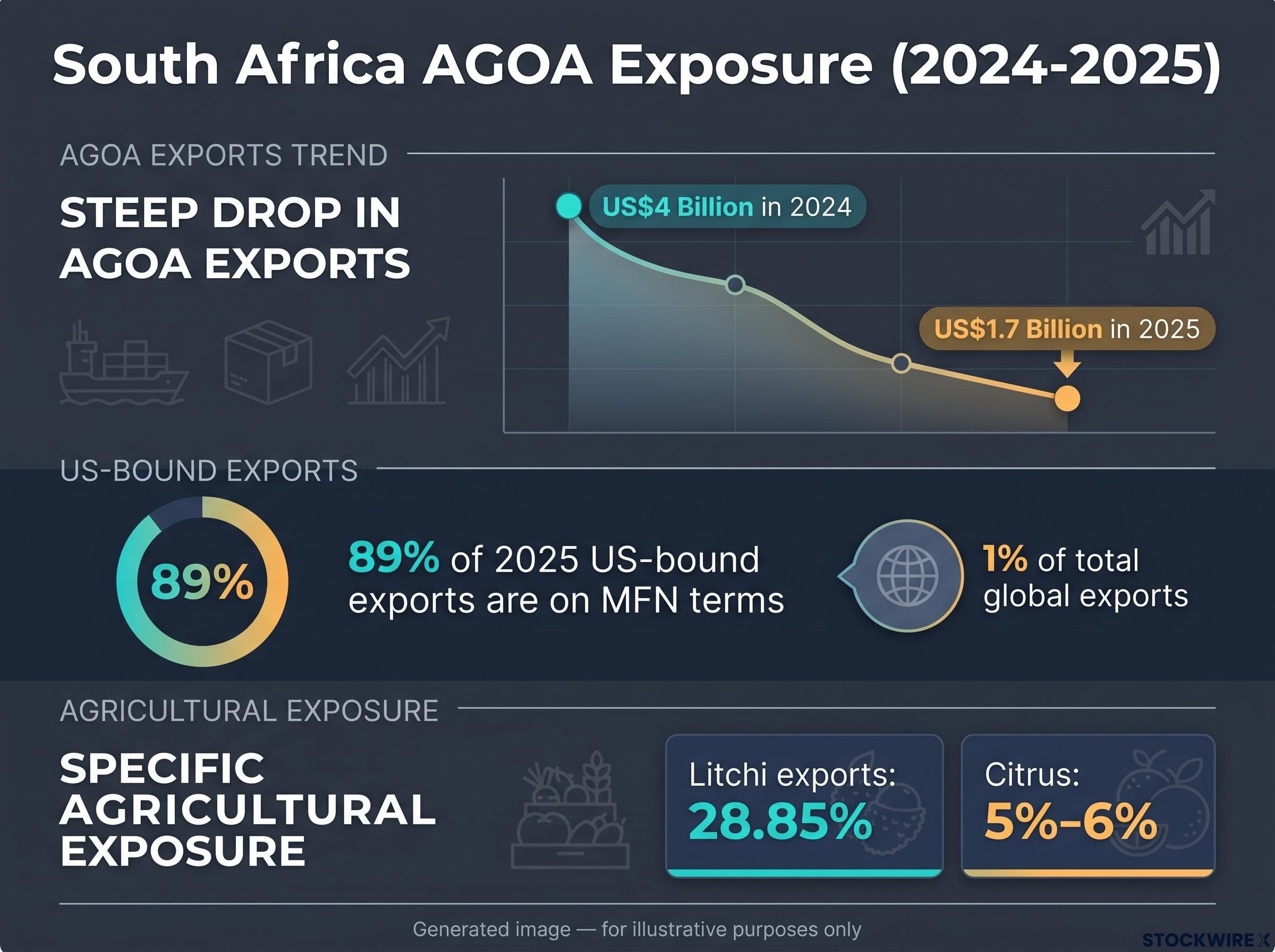
Exports entering under AGOA fell to about US$1.7 billion in 2025, from roughly US$4 billion in 2024. That was around 10% of exports to the US and about 1% of total global exports, according to the government.
About 89% of 2025 US-bound exports already entered on ordinary most-favoured-nation (MFN) terms, the standard tariff rates the US applies to World Trade Organization members. Some vehicles, steel and aluminium already faced US tariffs of 25%-50%, so the extra hit there is smaller than it looks.
| Metric | Figure | Year | What it measures |
|---|---|---|---|
| AGOA exports | US$1.7B | 2025 | All goods entering under AGOA |
| Agricultural exports to US | US$504M | 2025 | All farm exports to the US; not AGOA-only |
| US share of citrus volume | 5%-6% | Recent (AgriSA) | Citrus volume shipped to the US |
| US share of litchi exports | 28.85% | 2025/26 | Litchi exports absorbed by the US |
The first two figures measure different things and should not be compared. Sector asymmetry is the real story: litchi growers are far more exposed than citrus growers as a whole.
How it reaches the rand
Ranked by likely importance for the currency:
- Risk premium: investors may read the move as worsening US relations, demanding extra return to hold South African assets.
- Export earnings: lower volumes or margins for affected firms.
- Current account: fewer foreign-currency receipts from goods exports, a gradual rather than sudden effect. The current account tracks money flowing in and out of a country from trade and income.
- Jobs and investment: a Business Insider report put up to 10,000 jobs at risk.
Experts quoted by Daily Maverick said the outcome does not “spell doom”, and the government says it has secured alternative markets for citrus, avocados, grapes and apples. The direct trade hit is unlikely to move the rand much by itself. The channel you should watch is the risk premium.
What past episodes teach about political risk and trade shocks
Political events rarely hurt an emerging-market currency through their direct budget cost. They work through two channels: institutional credibility, meaning whether investors trust policy to stay sensible, and external financing, meaning how much a country relies on foreign money. Precedents show when damage lingers and when it fades.
| Precedent | Driver | Outcome pattern | Lesson for South Africa |
|---|---|---|---|
| South Africa, 2016 | Cabinet instability, fears for fiscal institutions | Sharp rand sensitivity | Institutional threats hit hardest |
| South Africa, 2024 | ANC lost majority, GNU formed | Coalition read positively when credible | Paralysis can flip the reading |
| Turkey | Institutional doubt plus large external financing needs | Outsized currency moves | Financing structure differs |
| India | Election surprises | Short-lived volatility | Continuity limits persistence |
| Brazil | Coalition and fiscal uncertainty | Repeated pressure on the real | Reform credibility matters more than partner count |
| Ethiopia, Mali, Guinea | Past AGOA exclusions | Higher tariffs, lower competitiveness | Effects stay sector-concentrated |
The pattern is consistent. Damage persisted where institutions looked threatened or foreign funding was fragile, and faded where continuity held. South Africa’s floating rand can react quickly through the risk premium, but its financing position is not Turkey’s.
These cases tell you that persistence depends on institutions and financing. The question to ask of South Africa is whether the coalition framework holds, not whether the vote was noisy.
A framework for reading the rand through coalition and trade signals
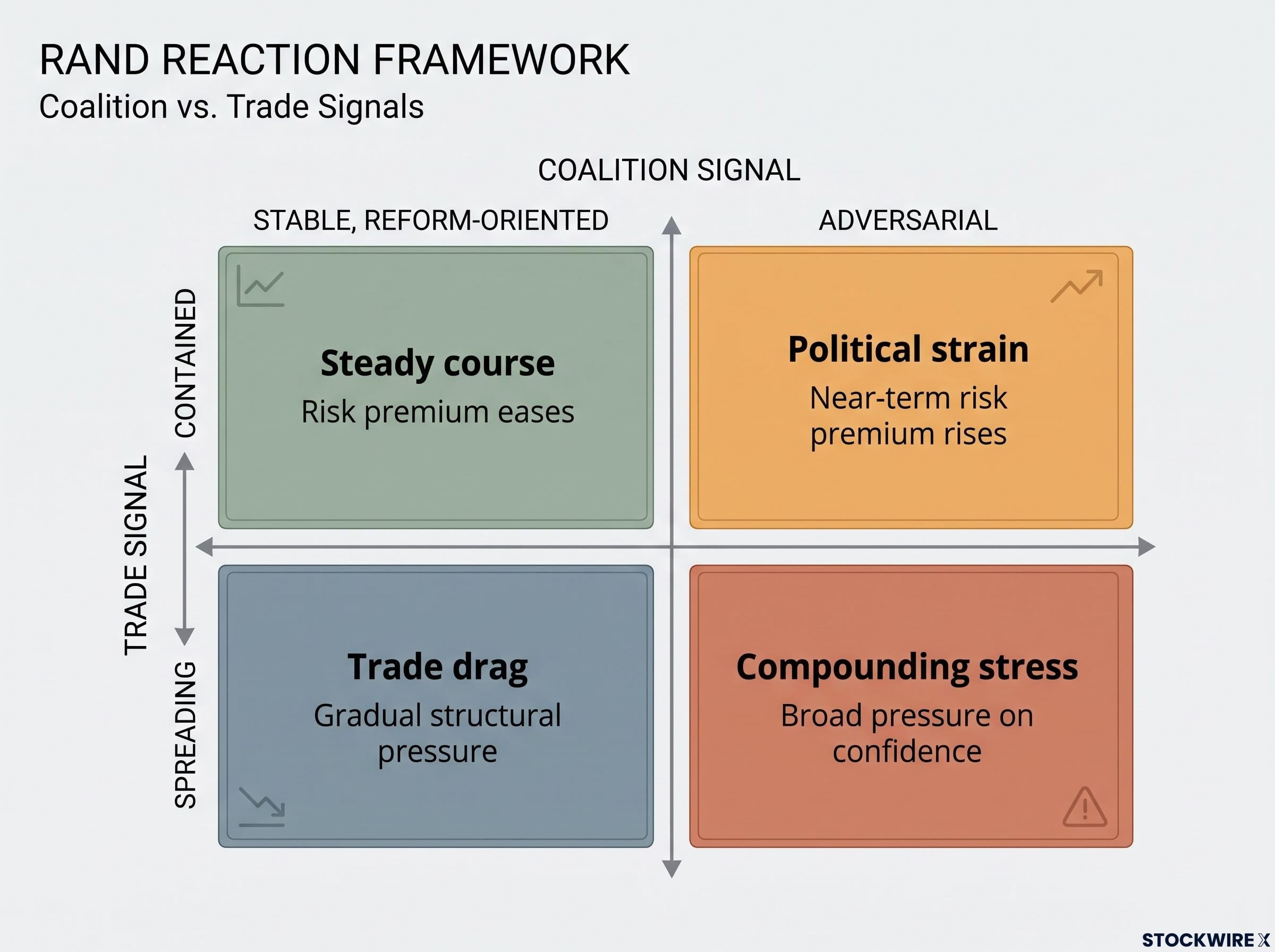
Bring the two threads together and you get two axes: coalition stability (reform-oriented versus adversarial) and trade shock severity (contained versus spreading). Analysts broadly agree that a stable, reform-oriented coalition supports the rand, while adversarial coalitions weaken confidence.
| Scenario | Coalition signal | Trade signal | Likely rand reading |
|---|---|---|---|
| Steady course | Stable, reform-oriented | Contained | Risk premium eases |
| Trade drag | Stable, reform-oriented | Spreading | Gradual structural pressure |
| Political strain | Adversarial | Contained | Near-term risk premium rises |
| Compounding stress | Adversarial | Spreading | Broad pressure on confidence |
Any honest framework includes the arguments against alarm:
- Possibly pre-priced: the rand was already trading defensively.
- Local versus national: the budget, SARB policy and trade diplomacy remain national matters.
- Trade redirected: alternative markets could cushion some exporters.
- Instability not inevitable: a strong DA result could encourage national cooperation.
Timing matters too. In the near term, the rand responds to announcements, coalition talks, the global dollar and risk appetite. Over the medium term, export competitiveness, investment, logistics, electricity reliability and reform credibility take over.
Because the dollar sits on one side of almost nine in ten global currency trades, the global dollar often explains a rand move before any South African news does, which is why the first check on any headline is whether the dollar did the work.
Coalition talks may run several weeks, and post-election arrangements are not yet verified. The research points to a near-term risk premium rather than a trade-driven collapse, with ANC-DA cooperation nationally as the deciding variable. Ask which axis each new headline moves; a rand move without a shift on either is more likely dollar or risk-appetite noise.
What to watch as coalition talks and the 1 January deadline approach
Four markers will tell you which quadrant the rand is heading toward. Watch how the ANC picks local partners in Johannesburg, Tshwane, Ekurhuleni and eThekwini. Track the tone of national ANC-DA cooperation, the SARB’s November decision, and any US exemption or replacement arrangement before 1 January 2027.
The near-term risk premium is a political story. The slower pressure is about trade and reform credibility, and it will outlast the count.
When fresh news arrives, weigh it by whether it changes coalition behaviour or trade access. If it does neither, give it less weight than the move it triggers.
This article is for informational purposes only and should not be considered financial advice. Investors should conduct their own research and consult with financial professionals before making investment decisions.