
ServiceNow just posted another beat-and-raise quarter. Revenue growth above 22%. Renewal rates near the ceiling. A full-year outlook lifted on the back of AI-driven demand. And the market’s response was, in effect, a shrug.
That gap between performance and conviction tells you something important. Enterprise software is a multi-trillion-dollar asset class built on the assumption that deeply integrated platforms create durable competitive moats. AI-native companies, from Anthropic to OpenAI, are now testing that assumption at the architecture level, not just the product level. The question investors are actually wrestling with is not whether ServiceNow is executing well right now. It is whether “executing well right now” constitutes sufficient evidence for long-term positioning.
Here is a framework for separating the signals that genuinely address the AI disruption question from the ones that merely confirm the status quo, along with the specific metrics worth tracking from this point forward.
A strong quarter, a persistent question
Start with what strong actually looks like at ServiceNow’s scale:
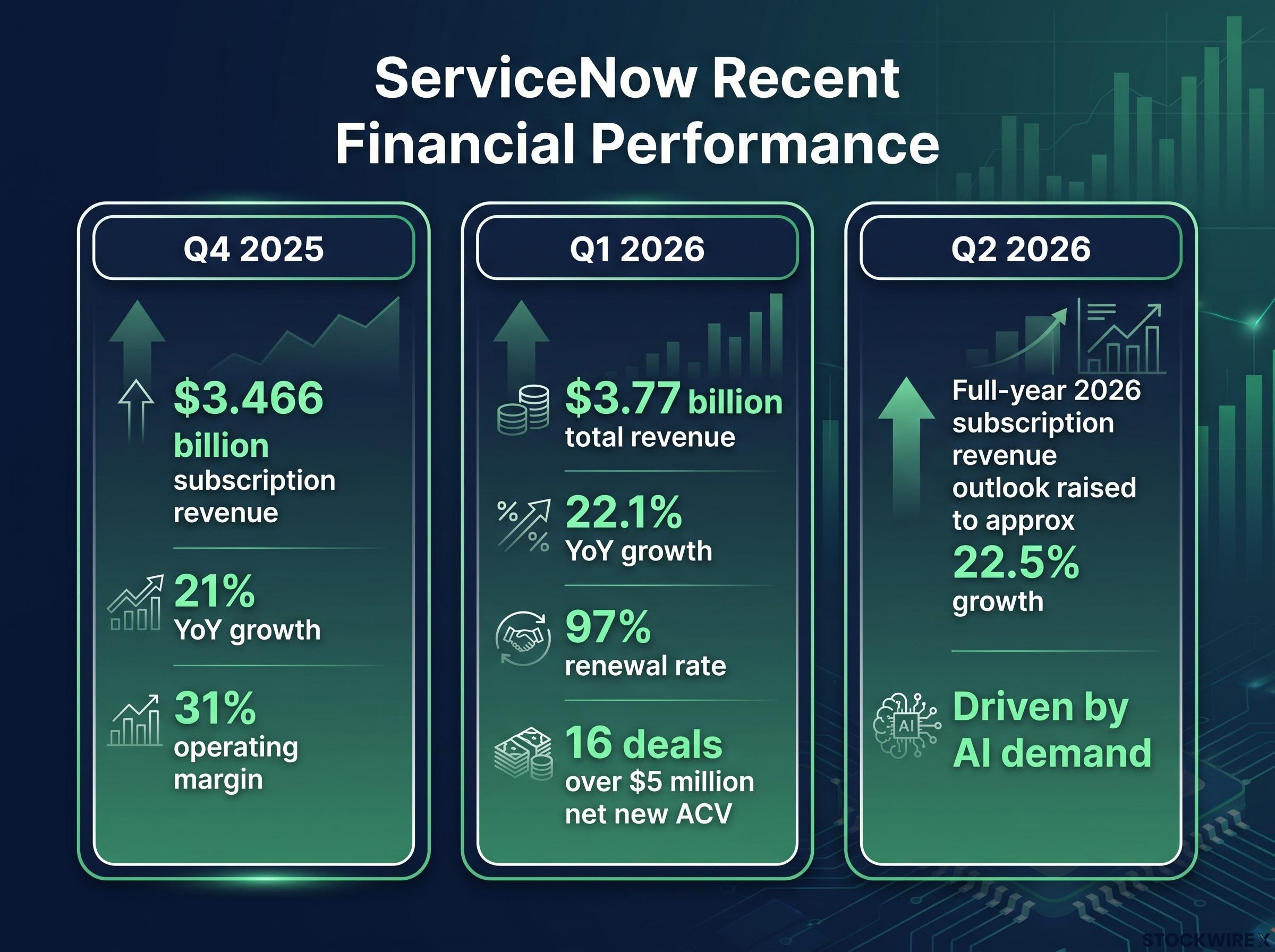
- Q4 2025: Subscription revenue of $3.466 billion, up 21% year over year, with a 31% operating margin
- Q1 2026: Total revenue of $3.77 billion, up 22.1% year over year, with a 97% renewal rate and 16 deals above $5 million in net new annual contract value (ACV, the annualised value of new contracts signed)
- Q2 2026: A beat-and-raise result that lifted the full-year 2026 subscription revenue outlook to approximately 22.5% growth, explicitly attributed to AI-driven demand
These are not adequate quarters. They are excellent quarters, delivered consecutively, at a scale where sustaining 22% growth requires billions in incremental revenue each year.
The problem is that excellence in current execution does not resolve the question the market is actually pricing. Vital Knowledge analysts, writing after the Q2 2026 result in July 2026, put it plainly.
The beat-and-raise result, while positive, falls short of dispelling the broader concerns weighing on traditional enterprise software companies facing competitive pressure from emerging AI models.
That observation captures the analytical tension precisely. Investors should take these numbers as confirmation that incumbents are not in distress today. But a repeat of this data point across the next several quarters still would not answer whether the platform model survives AI at full maturity.
Enterprise software valuations have become acutely sensitive to AI displacement narratives in 2026, with IBM, Salesforce, and ServiceNow each shedding 3-4% in premarket trading on a single unsubstantiated report, illustrating how quickly sentiment can reprice positions that fundamental earnings data had appeared to support.
When big ASX news breaks, our subscribers know first
Why enterprise moats are harder to breach than they look
Before writing off the incumbent position, it is worth understanding why enterprise software moats exist in the first place. They are not marketing abstractions. They are structural:
- Deep integration: Enterprise platforms like ServiceNow sit inside thousands of workflows, connected to identity systems, databases, compliance engines, and ticketing architectures that took years to configure
- Switching costs: Ripping out a platform that runs IT service management (ITSM), HR service delivery, and customer workflows simultaneously is not a quarterly decision; it is a multi-year programme with direct operational risk
- Governance and compliance: Regulated industries require audit trails, access controls, and accountability structures that incumbents have spent years hardening
- Trust from mission-critical deployment: When a system handles incident management for a bank or a hospital, the vendor relationship carries weight that no demo can replicate
AI-native startups face a genuinely high bar even with superior model capabilities. Enterprise procurement cycles, security requirements, and change management friction are real barriers, not excuses.
Where the moat becomes porous
The complication is timing. A 97% renewal rate in Q1 2026 tells you that ServiceNow’s existing base is loyal. It does not tell you how competitive the company is in greenfield opportunities where AI-native alternatives are already in the room.
Current renewals largely reflect contracts signed before AI-native competitors reached enterprise grade. They measure satisfaction with the incumbent, not the intensity of head-to-head competition. Disruption does not need to be imminent to be real, and a three-to-five-year horizon risk simply is not captured in today’s renewal economics.
The build-versus-buy decision has already flipped for some enterprises: Publicis Sapient cut SaaS licences by approximately 50% in a single year by substituting internal AI tools, a data point that illustrates how greenfield competitive dynamics can shift well before renewal statistics begin to reflect the change.
What disruption actually looks like in the numbers (and what it does not)
If you are relying on quarterly earnings alone to assess whether AI is eroding enterprise software’s competitive position, you are using the wrong instrument. Disruption in the technology sector follows a pattern, and that pattern is designed to be invisible in headline financial data until it is well advanced.
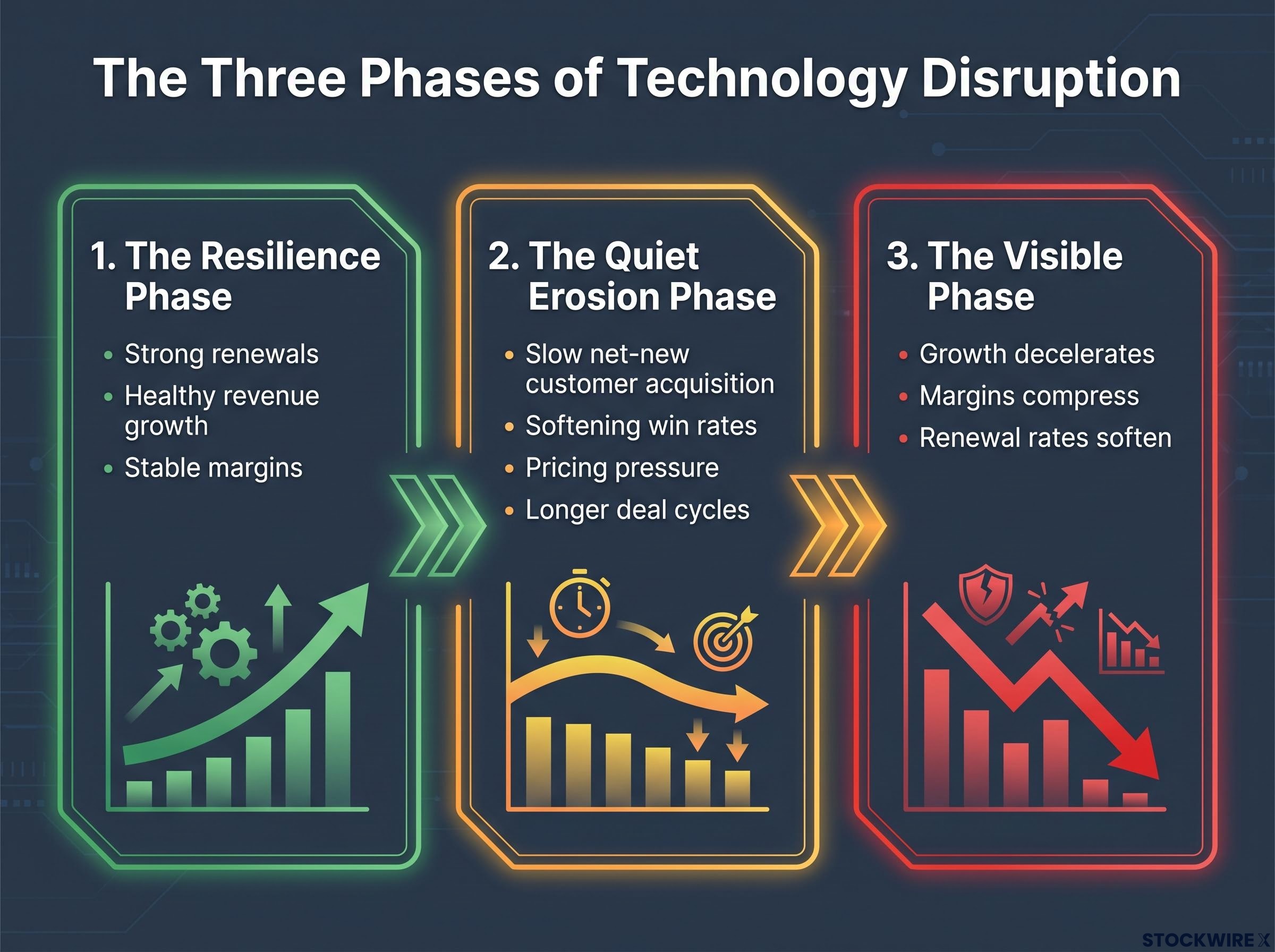
The typical sequence runs like this:
- The resilience phase: Incumbents report strong renewals, healthy revenue growth, and stable margins. Existing customers are slow to switch, and the installed base generates reliable cash flow. Everything looks fine.
- The quiet erosion phase: Net-new customer acquisition slows in contested segments. Win rates in greenfield deals soften. Pricing pressure appears in competitive RFPs. Deal cycles lengthen as buyers evaluate alternatives. None of this shows up cleanly in a quarterly earnings release.
- The visible phase: Growth decelerates, margins compress, and renewal rates begin to soften. By this point, the competitive shift is well established.
The most revealing data, win/loss rates against AI-native products, price concessions in renewals, deal cycle changes in contested segments, simply does not appear in standard quarterly disclosures.
Standard quarterly metrics are lagging indicators of competitive health. The numbers that would actually answer the disruption question are not publicly reported.
That information gap is precisely why analyst caution persists even after strong prints. Investors relying solely on quarterly earnings to assess the AI disruption risk are measuring decisions made 12 to 24 months earlier. The question is whether the instruments you are watching can even detect the change you are trying to track.
How ServiceNow is repositioning, and whether it is enough
ServiceNow is not standing still. The company’s strategic response is the most credible version of the incumbent playbook: rather than competing on foundational AI model capabilities, it is positioning itself as the layer where AI meets enterprise workflow, policy, and accountability.
ServiceNow now describes itself as an “AI control tower for business reinvention,” signalling a role as the orchestration, governance, and integration layer around AI rather than a standalone alternative to it.
The business model adaptation is equally concrete. Analysis of the company’s bookings mix suggests that more than 50% of net new ACV is now driven by non-seat, consumption-based pricing (this figure has not been independently verified and should be treated with appropriate caution). That shift matters more than any single quarter’s revenue beat, because it shows management is re-architecting the monetisation model before agentic AI forces them to. A company actively redesigning its revenue structure during a period of growth occupies a materially different risk category than one still entirely dependent on per-seat economics.
The shift to consumption-based pricing matters because AI-native entrants are benchmarking their enterprise offers at 80-90% below incumbent per-seat costs, meaning a company that completes the pricing pivot before competitors arrive in renewal conversations occupies a structurally different risk position than one that begins the transition under pressure.
In Q2 2026, ServiceNow deepened its alliances with Nvidia, Microsoft, Amazon Web Services, Accenture, Experian, FedEx, and Lenovo, extending both the technical scope and the commercial footprint of its AI platform across enterprise markets.
| Strategic Dimension | ServiceNow’s Move | What to Watch |
|---|---|---|
| AI positioning | Control tower framing: orchestration, governance, and workflow layer around AI models | Whether the orchestration role holds as AI-native alternatives mature and offer their own integration capabilities |
| Monetisation model | Shift to consumption-based pricing, moving away from pure per-seat economics | Whether the mix shift supports or erodes margins over time as usage patterns evolve |
| Partnership ecosystem | Expanded alliances with Nvidia, AWS, Microsoft, Accenture, FedEx, and others | Whether partners integrate deeper into ServiceNow’s platform or build competing offerings |
The honest assessment: this is a well-executed strategic pivot. Whether it is enough depends on a question no one can yet answer, which is how much of the orchestration and governance value layer remains defensible once AI-native platforms mature to enterprise grade.
The five signals that will actually answer the question
Analysis and context are useful. But what converts analytical understanding into an actionable surveillance routine are specific, forward-looking signals you can actually monitor. Here are the five that matter most:
- Net-new customer acquisition in AI-contested segments. Watch whether growth is driven mainly by expanding existing relationships or by new logos in ITSM, HR service delivery, and customer workflows, the segments where AI-native alternatives are most credible. A slowdown in new-logo wins in these verticals would be the earliest visible warning.
- Pricing and margin dynamics in competitive deals. If AI-native players begin to appear in renewal or new-build RFPs, the question becomes whether ServiceNow can hold premium positioning or is forced into material discounts. Margin compression in specific deal cohorts would signal a shift well before it hits aggregate financials.
- Mix shift from seat-based to consumption-based pricing. Track not just the direction of the shift but its effect on profitability. A successful pivot preserves or improves unit economics. A forced pivot erodes them.
- Partnership ecosystem evolution. The direction of alliances with hyperscalers, AI infrastructure providers, and global integrators will signal whether incumbents are entrenching as the preferred orchestration layer or being bypassed in favour of more native cloud and AI offerings.
The information gap: inferring AI-native traction indirectly
- Enterprise traction of AI-native startups. Because firms like OpenAI and Anthropic lack public quarterly financials, investors must infer traction from indirect signals: partnership announcements, published case studies, and hiring patterns in ServiceNow’s core verticals. If AI-native vendors begin appearing consistently in enterprise ITSM and workflow RFPs alongside ServiceNow, the competitive dynamic has shifted in a way that no amount of strong quarterly printing will fully offset.
BCA Research’s structural critique of AI model economics argues that foundation model providers face airline-like conditions: massive capital intensity combined with commoditised output and near-zero switching costs, a framework that clarifies why the competitive threat to enterprise software incumbents may be weaker than it first appears if the challengers themselves face structurally thin margins.
What today’s evidence actually supports, and what remains unresolved
The totality of ServiceNow’s recent results and strategic repositioning establishes a clear near-term picture. It does not establish a long-term conclusion.
| What the Evidence Establishes | What Remains Genuinely Open |
|---|---|
| Sustained high growth across Q4 2025, Q1 2026, and Q2 2026, with 97-98% renewal rates and strong margins | Whether AI-native competitors will capture a large share of new workflow and automation budgets over 5-10 years |
| Active pricing model adaptation toward consumption-based economics, with AI-driven demand explicitly credited in guidance raises | Whether hyperscalers will absorb more of the platform role themselves, compressing the incumbent value layer |
| Strategic repositioning as the AI orchestration, governance, and integration layer, supported by a broadening partnership ecosystem | Whether incumbents will successfully entrench as the indispensable orchestration and governance layer once AI-native ecosystems reach full maturity |
Strong quarters confirm that incumbents are adapting with intent. They do not resolve the architecture question: whether the platform model itself retains its value proposition once AI-native alternatives reach enterprise grade.
Investors who treat ServiceNow’s current outperformance as a resolution of the AI disruption question are making a timing error. The evidence supports near-term confidence in the company’s execution and adaptation. The five-to-ten-year question of how much value ultimately remains in traditional enterprise platforms once AI-native ecosystems mature cannot yet be answered from available data.
The practical read: position on what the evidence supports, monitor the five signals that will tell you when the answer is changing, and resist the temptation to treat a strong quarter as a structural verdict.
This article is for informational purposes only and should not be considered financial advice. Investors should conduct their own research and consult with financial professionals before making investment decisions. These statements are speculative and subject to change based on market developments and company performance.