The VanEck Semiconductor ETF (SMH) rose 3.02% on 27 October to close near $557.98. That was its second strong session in a row, and the AI trade looked alive again. The chart says something less comfortable: the fund is still down about 8.2% over the past 28 days, and it is now pressing against the underside of a rising channel it broke during the selloff.
That raises the question behind this semiconductor stocks rally. Is it the start of a fresh advance, or a bounce running into resistance?
Anthropic filed its public S-1 on 26 October, and the filing revived enthusiasm for anything tied to AI chips. Semiconductors now carry far more weight in the major indexes than they did a few years ago. This bounce is also arriving just before the Federal Reserve decision on 28 October and the midterm election on 3 November.
Here are the specific SMH, XLK and QQQ levels that separate a durable breakout from a failed bounce, and how the coming events could change that read.
Where SMH, XLK and QQQ sit against resistance now
The three ETFs (exchange-traded funds) all closed higher on 27 October. The size of each move differed, and so did the distance each one has left before it meets resistance.
| ETF | Oct 27 close | Daily move | Nearest resistance | Key support |
|---|---|---|---|---|
| SMH | $557.98 | +3.02% | About $563 | $536, then $520 |
| XLK | $189.49 | +1.70% | Distant broken trend line | Recently closed gap |
| QQQ | $721.25 | +1.27% | Trend line broken about two weeks ago | Prior Wednesday’s gap |
SMH: channel, $563 and $520
SMH had climbed inside a rising channel since 7 April 2025, about a year and a half of orderly gains. The recent selloff broke that channel. For two sessions, $536 switched from a floor to a ceiling, and then buyers took it back.
That makes $536 near-term support. The next level up is about $563, close to the area of the October rebound. If SMH turns lower there, the bears gain the upper hand.
A semiconductor ETF comparison shows why SMH behaves differently from rivals such as SOXX or XSD: heavy Nvidia and TSMC weightings mean the fund can hit resistance faster than more evenly capped alternatives.
The more important line sits lower. Chris Vermeulen of The Technical Traders treats $520 as the threshold that matters most. A break below it, he argues, opens a path toward roughly $371.
What would confirm the breakout Vermeulen reads the setup as a bullish flag, a short pause in an uptrend that often comes before the move continues. He wants gains held for about 1-1.5 weeks, with rising volume and fresh capital flowing into technology and AI shares.
XLK and QQQ: more room, same trend-line test
XLK has closed its gap, and its next major resistance is a broken trend line some distance above the current price. QQQ has moved back above the prior Wednesday’s gap. It next faces a trend line it broke a couple of weeks ago.
The PHLX Semiconductor Index (SOX) offers a useful cross-check. It fell roughly 24% from its June peak. According to Reuters technical analysis, it faces resistance at the 50-day moving average (the average closing price over the past 50 sessions) near 12,064, then near 13,350. Support sits at 11,110-11,056, with the 200-day average near 10,601.
The bounce now meets the oversold-countertrend view head on. Bulls need SMH to reclaim resistance on strong volume, while bears expect a rejection to set up another leg down. SMH sits closest to its ceiling, so semis face the first test, and how SMH behaves at $563 may set the tone for XLK and QQQ.
When big ASX news breaks, our subscribers know first
Why semiconductors move the whole market
You might assume a chip bounce matters only to people who own chip stocks. One figure from Scott Rubner of Citadel Securities shows why that assumption no longer holds.
Sector weight, then and now Semiconductors make up about 19.7% of the S&P 500 in 2026, compared with roughly 5% in June 2020.
Most major indexes are cap-weighted, which means each company’s share of the index depends on its total market value. When chip stocks rise, their weight in the index grows. Passive funds that track the index then have to buy more of them, and that buying pushes prices higher again.
Rubner points to this loop. It amplifies gains on the way up, and it can amplify selling on the way down. Four channels carry semiconductor moves into the broader market:
That loop feeds S&P 500 concentration risk, where a small group of chip stocks drives most of the index’s gains and a reversal in them can drag the headline index even while many other constituents hold up.
- Cap-weighting concentration: the ten largest S&P 500 companies account for about 40% of the index’s market capitalisation.
- Sector weight: semiconductors account for nearly a fifth of the S&P 500.
- Nasdaq sensitivity: in one 2026 analysis, the Nasdaq’s top ten holdings made up about 53.3% of its weight, and technology made up about 65.22%.
- AI capex transmission: capex, or capital expenditure, is money spent on long-term assets. A change in expected AI spending flows through chip designers, memory, storage, networking, cloud providers and power suppliers.

The Anthropic filing shows that fourth channel at work. The S-1 says Anthropic could buy more than $20 billion of AMD chips. It also lists commitments of about $110 billion through 2036 for Amazon Trainium chips and about $114.5 billion through 2033 for Google TPUs. Reuters reported that Broadcom agreed to lend Anthropic up to $42 billion.
The market responded on 26 October:
- PHLX Semiconductor Index: +2.8%
- Nvidia: +2.4%
- Micron: +3.0%
- Broadcom: +2.3%
- AMD: +2.8%
Investors hold two views of this sector at the same time. The structural case sees a multiyear AI infrastructure build. The cyclical case says demand, inventory, pricing and financing still swing between boom and bust.
If you own a broad index fund, you already hold significant semiconductor exposure. A failed semis rally is therefore a portfolio problem for you, and not only a sector problem.
Seagate, NXP and Corning: what the single-stock reactions reveal
Strong results should lift a stock. On 27 October, two companies with solid numbers fell sharply in after-hours trading.
Seagate beat on fiscal Q1 earnings and revenue, and it raised guidance above expectations. Before the release, Morgan Stanley kept its Overweight rating and lifted its 12-month target to $1,200 from $1,187, citing demand for data storage. The shares still fell about 6% after hours.
NXP Semiconductors had risen nearly $50 in the weeks before it reported. Its Q4 revenue outlook of $3.85 billion (plus or minus $100 million) was roughly in line with the LSEG consensus of $3.86 billion. Investors had wanted more, and the stock dropped about 9% after hours.
Corning is the quieter case. It slipped about 0.75% on the day, and its price gap stayed intact. No October earnings or analyst action has been verified to explain the move.
| Stock | Catalyst | After-hours move | Expectation gap |
|---|---|---|---|
| Seagate | Fiscal Q1 beat, stronger guidance | About -6% | Beat not enough after target upgrade |
| NXP | Q4 outlook $3.85B | About -9% | In line after a run-up of nearly $50 |
| Corning | No verified catalyst | Not reported (down about 0.75% on the day) | Gap intact |
The trader quoted in the source commentary disclosed the following positions. These show one person’s positioning and are not a recommendation:
- Holds SMH and Corning
- Holds a new, smaller Seagate position after being stopped out earlier
- Keeps a tight stop just above 716 on Seagate
When good results cannot lift a stock, the good news was already priced in. That makes the broader rally more fragile than the index gains suggest.
Fed, earnings and election: how to size risk into resistance
The event calendar and the VIX question
The source commentary described volatility as extremely low, close to “near zero”, with little fear in the market. Later data tells a different story. The VIX (a measure of expected S&P 500 volatility) was most recently near 20.24, up from 16.68 on 21 October. Complacency appears to be unwinding just as the calendar fills up:
- 28 October: the FOMC decision, expected to hold rates at 3.75%-4.00%, followed by Chair Warsh’s press conference.
- 28-30 October: Alphabet, Microsoft and Amazon report, with about 230 companies reporting on 28 October and 47 on 30 October.
- 3 November: the midterm election.
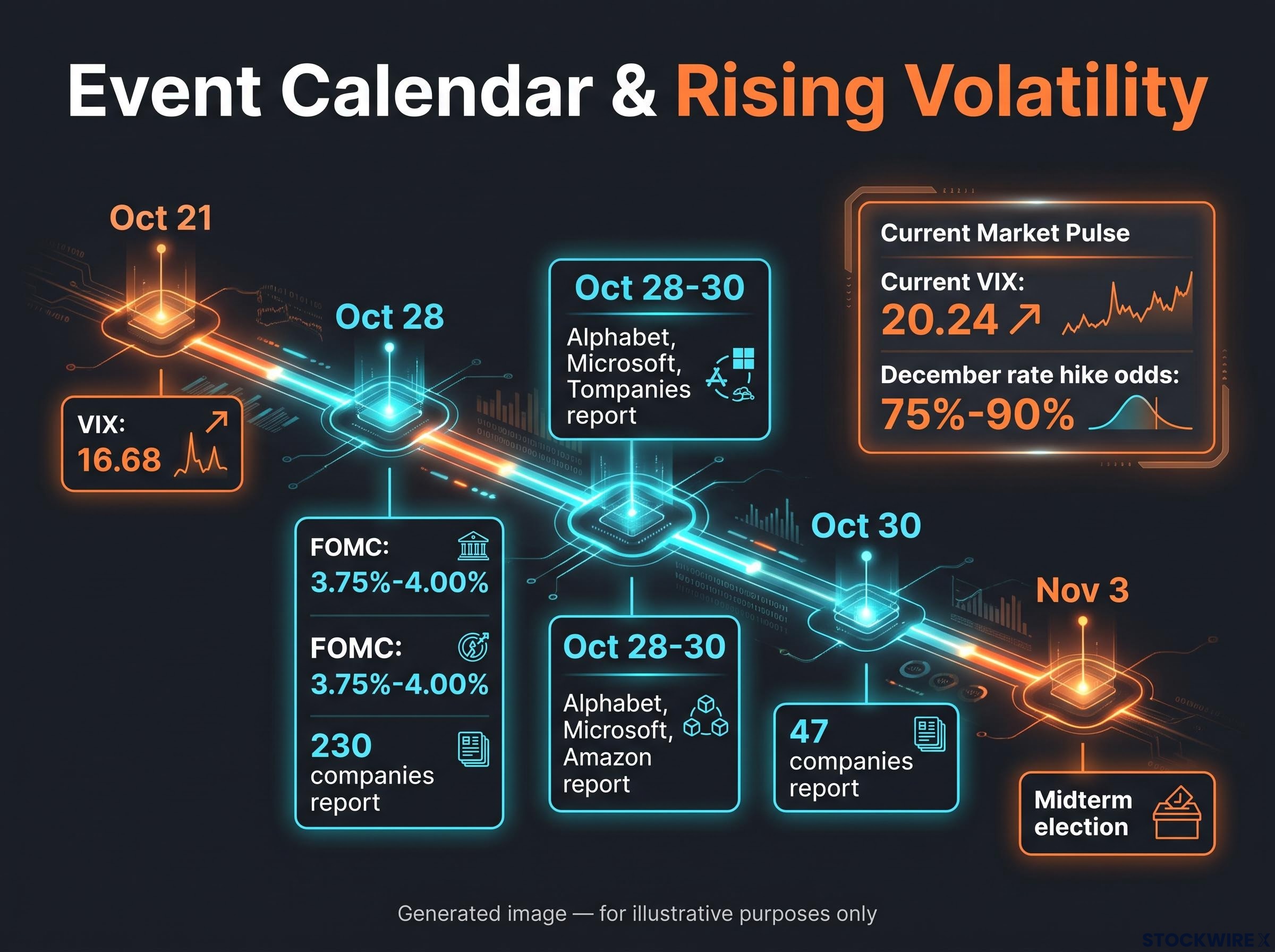
Futures markets price roughly 75%-90% odds of a December rate hike. A hold that comes with language supporting a December hike could hit semis even if earnings are strong. Treat the next few sessions as a test of resilience, not as confirmation of a trend.
Positioning: what the strategists say
| Commentator | Stance | Key level or claim |
|---|---|---|
| KC Rajkumar, Lynx Equity Strategies | Constructive | Expects AI semis to run into year-end |
| JPMorgan Private Bank | Rotational | A rotation, not a collapse of the AI thesis |
| Mike Wilson, Morgan Stanley | Cautious | Another 10%-15% downside possible; SOX near 9,500 |
| Jonathan Krinsky, BTIG | Cautious | Use rebounds to cut exposure; SOXX support about $490, then $468 |
The published commentary points to a few risk controls:
- Reduce into strength instead of adding on rebounds.
- Avoid overlap, because SMH, QQQ, XLK, Nvidia, Broadcom, AMD and Micron can all fall together.
- De-gross before binary events, which means reducing total exposure and leverage before outcomes that could swing either way.
- Watch rates, since December-hike pricing can outweigh strong earnings.
The source trader offers one example. He cut his exposure from about 135% to about 110%, using almost no margin, and plans to stay cautious until after election week.
For investors wanting to size chip exposure sensibly, our dedicated guide to core-satellite semiconductor investing explains how capping the satellite at 3-10% of a portfolio limits the damage from a 40-60% sector drawdown.
What the next week will settle, and what it will not
The bounce is real. It still has to prove itself at $563 on SMH and hold for the 1-1.5 weeks of volume-backed confirmation that Vermeulen wants. Fed and election outcomes could override the technical picture in either direction.
The Seagate and NXP reactions show that expectations are running high. Because semiconductors are so heavily weighted in the major indexes, that pressure reaches most portfolios.
Three things to watch:
- SMH at $563, against support at $536 and $520
- Warsh’s tone on a December hike
- The market’s reaction after 3 November
This article is for informational purposes only and should not be considered financial advice. Investors should conduct their own research and consult with financial professionals before making investment decisions. Past performance does not guarantee future results, and the forward-looking views cited are speculative and subject to change.